
With the upgrading of outdoor operations, farm operation and maintenance, mountain hunting and off-road leisure scenes, electric UTV (multifunctional side-by-side off-road vehicle) has gradually replaced traditional fuel UTV with the advantages of zero fuel consumption, low noise, low operation and maintenance cost and high torque output, and has become the core equipment for agricultural machinery operation, outdoor exploration and commercial site operation and maintenance. But the vast majority of electric UTV owners will face the same core problem: how to charge electric UTV? How long does it take to be full? household socket can be used? Is it safe to charge overnight? How to charge more cost-effective and protect batteries in different scenarios?
Different from ordinary household new energy vehicles, the charging system of electric UTV is specially optimized for outdoor, rural and non-fixed power supply scenarios. It only supports primary/secondary AC charging (Level 1/Level 2 AC) and is not suitable for tertiary DC fast charging.
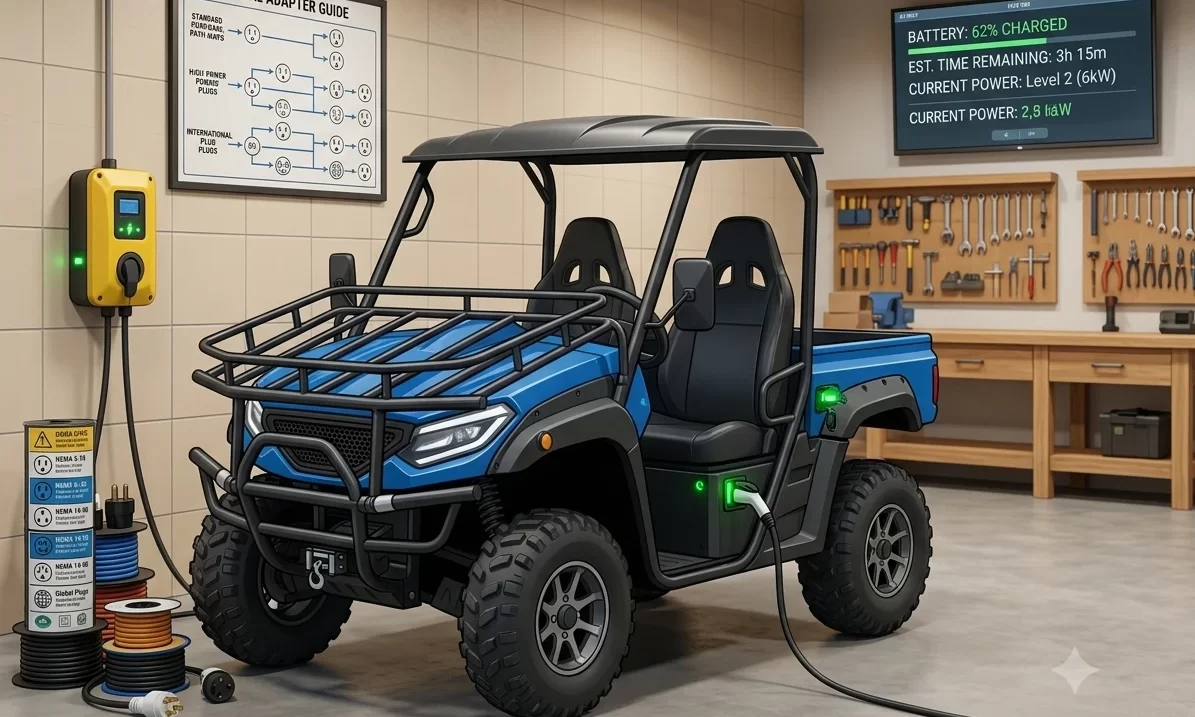
The charging logic of electric UTV is similar to that of household electric vehicles, but the hardware system is more suitable for outdoor complex working conditions. The core is to convert external AC power into DC power. Under the whole-process monitoring of the battery management system, the high-voltage lithium battery pack can be safely and stably supplemented, with intelligent protection and adaptive adjustment capability in the whole process.
The entire charging system performs its own duties to jointly ensure charging efficiency and safety, and is also the basis for understanding the charging logic of electric UTV:
Electric UTV charging is a standardized and intelligent closed-loop process without manual intervention:
First, complete the device connection and system handshake: park the vehicle on a flat ground, put the parking gear, pull out the key, connect the EVSE charging gun to the grounding compliance socket, and then insert the vehicle charging interface, and the device automatically completes the circuit, voltage, temperature, Grounding safety detection. Then enter the power conversion phase, the on-board charger converts the mains AC power into the battery-adapted DC power, first replenish the energy in the constant current fast charging mode, and then switch to the constant voltage trickle mode after the power is close to saturation. The whole process is controlled by BMS. When the battery temperature is in the best range of 50-104 °F(10-40°C), it will be charged at full speed, and the power will be automatically adjusted under over-temperature or low temperature conditions. After the charging is completed, the vehicle will be automatically powered off and standby. After confirming that it is full, the gun can be pulled out and the interface cover can be tightly covered to complete the charging.
In addition, the energy recovery braking during the driving of the vehicle can realize passive energy supplement. When decelerating, going downhill, and coasting, the motor is converted into a generator, and the kinetic energy is converted into electric energy to recharge the battery, which effectively extends the battery life, but it can only make up a small amount. Electricity cannot replace active charging.
Electric UTV is suitable for a variety of charging scenarios, from convenient household charging, dedicated fast charging to outdoor off-grid charging. The speed, cost and adaptation scenarios of different methods vary greatly. Car owners can flexibly choose according to the frequency of use and site conditions.
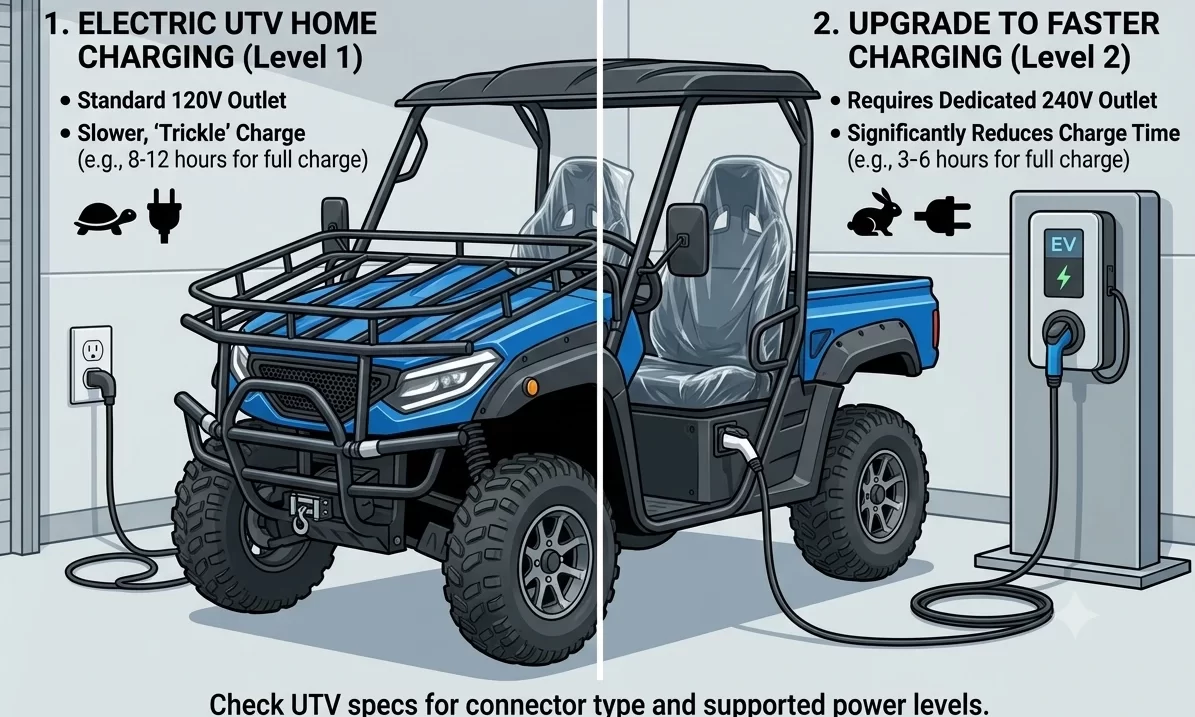
The whole series of electric UTV comes standard with charging mode. No additional equipment is required. The portable EVSE charging line of the original car is used and directly connected to the household 120V grounding socket. The advantage is zero installation cost, anytime and anywhere available, suitable for home, camp, temporary site replenishment, the disadvantage is the slowest charging speed, 15kWh battery pack full of about 10 hours, 30kWh double battery pack takes more than 20 hours. The most suitable for low-frequency use, night static charging owners.
Relying on the same 240V socket as the dryer and oven, and using it with the original car’s dual-voltage charging line, it is the most cost-effective fast charging scheme. Under standard working conditions, most electric UTV only need about 5 hours to be fully charged, and the charging efficiency is more than 1 times higher than that of 120V socket. There is no need to modify the vehicle, only 240V circuit with compliance grounding is required, which is suitable for daily high-frequency use and farm and site operation and maintenance users who need quick energy replenishment.
It is an advanced upgrade charging scheme. It requires electrician wiring to install a special 240V/40A circuit hard pile, which represents the Wallbox Pulsar Plus charging pile adapted to Polaris. The charging speed is the same as or slightly higher than that of portable 240V charging. At the same time, it supports regular charging, remote monitoring of mobile phone APP, intelligent start-stop, regular line, higher safety and no wire clutter. Suitable for high-frequency commercial, household long-term fixed charging scene, is the best choice for heavy users.
Relying on outdoor public J1772 standard AC charging pile charging, it is suitable for out-of-home operation, long-distance cross-country and off-site camping scenes. The charging principle is completely consistent with household secondary charging. The disadvantage is that the coverage of outdoor scenes such as rural and mountainous areas is low, and most of them are charged by the degree, and the cost of use is higher than that of household charging, which is only used as an emergency energy supplement scheme.
The non-plug-in charging method belongs to the driving auxiliary energy supplement system. When the vehicle decelerates, goes downhill, and coasts, it automatically recovers excess kinetic energy and converts it into electrical energy, and slightly supplements the battery power, effectively reducing the charging frequency. However, this method cannot achieve full charge, and the system will automatically shut down when the battery is close to saturation, which can only be used as an auxiliary means of endurance.
It is specially designed for field, deep mountain and remote camps without commercial power supply, and includes two mainstream methods: 1 is portable generator charging, which can provide 120V/240V power and adapt to emergency energy supplement, but it has high noise, high oil consumption and low efficiency; The 2 is solar charging. Small solar panels can maintain 12V auxiliary battery power and prevent static power loss. High-power customized solar system can realize main battery charging, is the best DIY solution for long-term outdoor off-grid use.
The vast majority of electric UTV owners will encounter the problem of unstable charging speed: the same vehicle, sometimes 5 hours to fill, sometimes 6-7 hours, even double the charging time in extremely cold weather. Many people mistakenly think that the charging time is only determined by the battery capacity. In fact, the seven core factors of battery capacity, on-board charger (OBC) power, power supply voltage and circuit specifications, battery temperature, initial power, power supply quality, and load conditions directly determine The final charging time. Only by mastering these variables can we accurately predict the charging time and reasonably plan the rhythm of the car. Based on the full set of official data of Polaris RANGER XP Kinetic, a mainstream benchmark model in the market, and combined with the working conditions of universal electric UTV, this paper sorts out the most accurate reference standard for charging duration.
For mainstream single-battery and dual-battery electric UTV, the standard full-charge duration of different charging configurations is as follows, which is also the core basis for car owners’ daily reference:
15kWh standard battery + 3kW standard on-board charger: 120V Level 1 charges slowly for about 10 hours and 240V Level 2 charges quickly for about 5 hours;
30kWh top with dual battery + 6kW upgrade on-board charger: 120V Level 1 slow charging for up to 20 hours, 240V Level 2 fast charging for only 5 hours;
Core rule: 240V high-voltage circuit can completely release the performance of high-power car charger, even if the battery capacity doubles, it can maintain a stable and fast charging speed; while 120V low-voltage power supply will severely limit the output of high-power chargers, and the charging efficiency of large battery models will be greatly reduced.
(2, seven core factors on the charging speed of the detailed impact
(1) On-board charger power (core hardware factor): The mainstream electric UTV is equipped with 3kW and 6kW on-board chargers (OBC), and the 6kW charging efficiency theory doubles. 240V full power supply under the speed increase effect is remarkable, and 120V ordinary socket will limit the power output, the charging speed gap between the two greatly narrowed.
(2) Battery capacity :15kWh single battery is suitable for daily light use, with low charging load and stable speed; The 30kWh dual battery mainly focuses on long endurance and heavy load, and the battery cell capacity doubles. Under the 120V low voltage slow charging scenario, the charging time will directly double, which is the core reason for the slow charging of large battery models.
(3) Environment and battery temperature (high impact hidden factors): the best charging temperature of the battery is 10-40 ℃, which can be charged at full speed. Low temperature of 0-10 ℃ will trigger the system current limit, and the charging time will increase by 30%-50%; Charging is directly suspended below -25 ℃, and the battery can be restored only after preheating; High temperature above 40 ℃ will start the cooling and speed reduction mechanism to prolong the charging time.
(4) Quality and specification of power supply circuit: Level 1 slow charging is adapted to 15A basic grounding circuit, and Level 2 fast charging requires 30-40A independent dedicated circuit. Old lines, shared circuits, and long-line losses can cause voltage and current instability, causing charging to slow down and start and stop repeatedly; dedicated independent grounding circuits can stabilize charging power and ensure optimal charging efficiency.
(5) Initial charging quantity: lithium battery charging is divided into two stages, 0-80% is constant current fast charging and high-speed energy supplement, and 80%-100 is constant voltage trickle slow power protection. Daily replenishment from 50% of the electricity only requires 40% of the time when the empty electricity is fully charged, and there is no need to deeply empty the battery to recharge.
(6) Equipment aging and interface status. Long-term outdoor use can easily lead to dust accumulation, oxidation and moisture of the charging interface. Matching aging charging wires will cause poor contact, power loss and directly slow down the overall charging speed.
(7) On-board power load: Turn on the lights, on-board fans and various external equipment during charging, which will shunt the power supply, reduce the battery charging input power, and slightly extend the charging time.
Household low-frequency users: priority 120V overnight slow charging, no need to deliberately pursue fast charging, adapt to idle time, protect the battery;
Farm/high-frequency operation users: upgrade 240V special circuit and realize daytime cycle operation with 5-hour fast charging;
Users in extremely cold areas: preheat the battery with electricity before charging, avoid the problem of low temperature current limit, and shorten the charging time;
All scenarios are recommended to use with charge, shallow charge and shallow discharge to prevent deep power loss charging, which not only improves vehicle efficiency, but also prolongs battery life.
The charging efficiency, battery life and electricity safety of electric UTV depend entirely on the matching degree of charger and power supply equipment. Unlike ordinary electric vehicles, electric UTV focuses on outdoor, heavy-duty, long-term static use scenarios, and requires higher stability, compatibility, and protection of the charger. Selecting the wrong charger will not only cause problems such as slow charging, unsatisfactory charging, and frequent errors, but also cause irreversible damage to the lithium battery, and even cause safety hazards such as short circuit and fire. This section will give a full set of selection schemes that can be directly landed from the 5 dimensions of general standards, graded selection, crowd adaptation, upgrade schemes, and hard core pit avoidance.
At present, all new mass-produced electric UTV (mainstream brands such as Polaris and Bombardier) on the market are equipped with SAE J1772 American AC charging interface, that is, the industry’s common J-plug, with no brand-specific private interface and strong compatibility. All compliant J1772 AC charging equipment can be used universally without the need for customized special chargers, which greatly reduces the user’s equipment adaptation cost.
The new car comes standard with a dual-voltage portable EVSE charging gun. It is originally compatible with 120V Level 1 and 240V Level 100.00g voltages. It has its own circuit self-checking, leakage protection and temperature monitoring functions. The protection level is suitable for simple outdoor scenes, fully meets the daily basic use of ordinary car owners, and is the basic charging equipment with the highest cost performance.
(1) Basic standard scheme: original portable EVSE charging gun (suitable for low-frequency household, leisure and entertainment users)
Adaptation crowd: car owners who use 1-3 times a week, short-distance off-road, long idle time, and no fixed dedicated charging site;
Core advantages: no need to install, plug and use, dual voltage compatibility, self-contained safety protection, zero additional cost;
Adaptation scenario: slow charging of household 120V socket overnight, temporary energy replenishment in camp, emergency charging for short trips;
Limitations: no intelligent control function, wire exposed easy to wear, 240V fast charging stability is slightly lower than the hard pile equipment.
(2) Advanced upgrade scheme: 240V wall-mounted WallBox hard pile charger (suitable for high-frequency operation, farm and commercial users)
Adapted people: users who need fast energy replenishment and long-term fixed-site charging for daily operation and maintenance of farms, mountain operations, high-frequency heavy loads, and long-term fixed-site charging;
Mainstream model: Wallbox Pulsar Plus (Polaris original adaptation model);
Core advantages: support 30-40A high current output, stable charging speed, no wire loss; With APP remote monitoring, timing charging, electricity statistics, fault self-checking function; Line regulation, waterproof and dustproof, suitable for garage, barn, outdoor shed and other complex sites; Support low price regular charging, long-term electricity saving;
Adaptation scenario: daily high-frequency operation, fleet batch charging, fixed site normalization of energy.
(3) Top matching performance scheme: 6kW high-power on-board charger upgrade (suitable for users with large batteries and high-intensity operations)
Adapted people: 30kWh dual-battery top-fitting models, daily heavy-duty traction, high-frequency and high-intensity operations, and users with extremely high charging speed requirements;
Upgrade income: compared with the original 3kW OBC, the charging power is doubled, the charging time can be compressed to the maximum under 240V circuit, and the large battery model can also be fully charged for 5 hours, thus completely solving the pain point of slow charging of the large battery.
Whether the charger performance can be fully exerted depends on the specifications of the power supply circuit. Failure to meet the parameters will lead to fast charging failure, frequent error reporting and equipment damage:
Level 1 120V slow charging: minimum 15A grounding special circuit, must be equipped with GFCI leakage protection device, it is forbidden to share high-power household appliance circuit;
Level 2 240V fast charging: standard 30-40A independent special circuit, full grounding compliance, no shunt, no long line loss, is the basis of stable fast charging;
All circuit installations and upgrades must be operated by a certified electrician in accordance with local electrical codes to avoid electrical safety hazards.
① Prohibition of DC fast charging: All electric UTVs do not support CCS, NACS, CHAdeMO and other three-level DC fast charging. Forced access to fast charging equipment will directly break down the on-board charging system and damage the BMS motherboard, resulting in extremely high maintenance costs;
② Prohibit switching equipment: It is strictly prohibited to use extension cords, plug-in, multi-function adapters, intelligent timing sockets and voltage stabilizing adapters. Such equipment cannot carry charging current and is extremely easy to generate heat, short circuit and fire. At the same time, it will trigger the system safety lock, resulting in charging failure;
③ Prohibit non-standard equipment: refuse to 3 non-modified chargers, non-J1772 interface compatible equipment, damaged and aging charging lines, non-standard equipment without BMS adaptation protocol, unable to balance the battery core, long-term use will lead to battery bulge, attenuation acceleration;
④ Prohibit non-grounded charging: ungrounded socket will trigger leakage protection, unable to charge normally, and there is a serious risk of electric shock.
Ordinary leisure users: the original portable EVSE is fully sufficient without additional upgrades;
High-frequency operation/commercial users: give priority to the installation of 240V WallBox hard piles, taking into account speed, safety and intelligence;
Large battery top model: upgrade 6kW car charger, completely unlock the fast charging performance;
Stick to the whole process: only employ compliant J1772 AC equipment and special grounding circuit, and eliminate all non-standard transfer schemes.
The life of the high-voltage lithium battery pack equipped with the electric UTV depends entirely on the daily charging habits. Following standardized operation and maintenance techniques, it can effectively extend the battery cycle life and reduce the probability of failure.
The first step is to park the vehicle on the flat ground, engage the parking gear and pull out the vehicle key to ensure that the vehicle is completely stationary. The second step is to connect the EVSE charging cable directly to a special socket that complies with grounding to prevent switching equipment. The third step is to open the body charging interface cover plate and insert the charging gun until the buckle is locked. The fourth step is to observe the indicator light of the vehicle dashboard and the charging gun. Blue flashing is normal charging, after being fully charged, the system will automatically cut off the power, unplug the charging gun, and tightly cover the interface cover and dust cover to prevent muddy water and sundries from entering.
First of all, adhere to the “charge as you use it” principle, and do not need to recharge when the power is exhausted. The manufacturer clearly recommends to keep the battery fully charged in daily use. Frequent shallow charging and shallow discharging can effectively protect the battery core. Secondly, strictly control the charging temperature. In low temperature environment, the battery can be preheated by electricity first, and exposure and charging can be avoided in high temperature weather. Finally, when idle for a long time, there is no need, it is 50%-70%, place in a dry and constant temperature environment and replenish electricity regularly.
Electric UTV is equipped with a high-voltage lithium-ion system. Standardized charging is the core to ensure personal and equipment safety. All safety guidelines are based on original factory specifications and EV industry general standards.
It is strictly forbidden for the owner to disassemble and repair the high-voltage battery, charging circuit and charging interface by himself. High-voltage current can cause serious electric shock and burn accidents. After the vehicle collides or soak in water, it is forbidden to charge directly and shall be inspected and repaired by professional technicians. Lithium battery fire is a special fire, you need to use Class D dry powder fire extinguisher to put out the fire, and then use water to cool down, to avoid re-ignition.
Before each charging, check whether the charging line and interface are damaged, wet or oxidized, and stop using the equipment immediately if it is abnormal; It is forbidden to use extension cord, plug-in, timing socket and intelligent switching equipment in the whole process. All charging must be directly connected to the wall socket.
Keep the charging area away from inflammable and explosive materials and keep ventilated; avoid open charging in extreme high temperature and cold weather as far as possible; keep away from children and pets during charging to prevent safety accidents.
Most of the daily charging faults are circuit, temperature and connection problems. No professional maintenance is required, and the owner can solve them by himself:
The high probability is that the socket has no power, the open trip, the grounding is poor, or the high-voltage maintenance switch is not locked, and the charging interface is blocked by sundries. Solution: reset the leakage protector, replace the compliant socket, clean the dust and water vapor on the interface, and check whether the high-voltage switch under the seat is locked.
The core causes are abnormal battery temperature, use of transfer lines, and high circuit load. Move to a cool place at high temperature to cool down, warm up the battery at low temperature, and replace the dedicated independent circuit to restore the normal charging speed.
No light: the socket is powered off, check the circuit; Normally bright blue: the equipment is on standby, plug and unplug the charging gun again; Amber light: ordinary fault, restart the connection; Red flashing: serious fault, immediately power off, contact the dealer for maintenance.
The answer is entirely possible, and the official recommendation of high-frequency users overnight charging. The BMS intelligent system of electric UTV has perfect overcharge protection and voltage stabilizing control functions. After the electric quantity is full, it will automatically stop charging and enter the standby voltage stabilizing state without overcharge damaging the battery.
For 120V slow charging models, overnight charging is the most suitable way, and the battery can be fully charged after 1 the whole night. The 240V fast charging model can be fully charged in a few hours, and the system will intelligently stabilize the voltage and protect the electricity during the rest of the night. As long as the original compliance equipment and grounding circuit are used, overnight charging is safe and risk-free, and it is also one of the best ways to maintain batteries.
The charging cost of electric UTV is much lower than that of fuel UTV, and long-term use can save a lot of operation and maintenance costs. Combined with the average electricity price of residents in the United States in 2026 (0.185-0.19 USD/degree), the cost details after comprehensive charging loss are as follows:
For the 15kWh single-battery model, the full charge cost is about 2.8-3.5 US dollars; for the 30kWh dual-battery high-end model, the full charge cost is about 5.5-7 US dollars. The cost of different electricity price regions is slightly different. The low electricity price region only needs 2-4 US dollars for a full charge, and the high electricity price region only needs 5-13 US dollars.
At the same time, the use of night trough electricity price charging can further reduce costs, daily on-demand electricity to supplement the average daily cost of only $1-3. Compared with the fuel cost of 10-25 US dollars per day of fuel UTV, the economic advantages of electric UTV are extremely significant, and there is no need to replace the oil, filter element, spark plug, and the operation and maintenance cost is lower.
Priority is given to the installation of 240V wall-mounted charging piles, which can be charged as required between operations, the low electricity price at night can be supplemented, and the battery can be preheated in advance in low temperature weather to ensure the full power output of daytime operations.
Charge with full power the night before the trip, carry portable charging wires when there is no commercial power in the field, rely on the camp socket to charge slowly, turn on energy recovery during driving, avoid deep power loss, and put an end to field endurance anxiety.
The power consumption under heavy-duty conditions is greatly increased, so it is necessary to start at full power every day, shorten the energy supplement interval, give priority to secondary fast charging, avoid low battery power and high load work, and reduce battery core loss.
Special charging piles are installed in batches in the fleet for peak-shifting charging. Long-term idle to maintain medium power, store in a constant temperature and dry environment, and regularly replenish power to prevent battery loss and scrapping.
With the iteration of new energy outdoor equipment technology, the electric UTV charging system will be upgraded in the direction of faster, smarter and more suitable for field scenes: future models will be equipped with higher power on-board chargers, greatly reducing the fast charging time; Battery material optimization to improve low temperature performance and cycle life; Some high-end commercial models may be adapted to DC fast charging function. At the same time, new technologies such as intelligent APP remote control charging, solar off-grid charging, V2L external discharge, wireless induction charging, etc. will be gradually popularized to completely solve the problem of outdoor charging and make the use of electric UTV more comprehensive and convenient for operation and maintenance.
Electric UTV charging is not complicated, the core is to master the four principles of “adaptation equipment, compliance operation, temperature control and maintenance, and on-demand charging. All models are suitable for household primary/secondary AC charging, without special fast charging equipment; daily overnight charging is safe and efficient, and scientific charging habits can greatly extend battery life; compared with fuel models, electric UTV charging costs are lower, Operation and maintenance are simpler. Car owners only need to combine their own usage scenarios, select the corresponding charging method, and follow the safety and maintenance specifications, so that the vehicle can maintain the best performance for a long time and adapt to the whole scene of operation, exploration and leisure.



-150x150.png)