Spring UTV Maintenance Checklist for Farmers

Sep 16, 2026

Spring spring farming is concentrated, time-sensitive, electric UTV by adapting to the complex terrain of the field, low consumption and easy-to-use advantages, become the core operation of farmers agricultural machinery. However, after the equipment is stored at low temperature and humidity in winter, it is easy to accumulate hidden faults such as battery power loss, oil deterioration, aging of accessories, line corrosion, rat bite damage, etc. Most farmers will directly overload in spring, which will lead to concentrated outbreak of faults, causing problems such as equipment shutdown, insufficient power, brake failure, etc., which will not only delay farming time, cause agricultural production reduction losses, but also increase high maintenance costs.

In this paper, combined with the special working conditions of agricultural UTV such as heavy load, dusty and muddy, fertilizer corrosion and high frequency operation, and different from the simple maintenance scheme of ordinary leisure UTV, a set of complete maintenance list for spring that can be directly landed is compiled, covering the principle of equipment damage, high frequency failure, maintenance misunderstanding and scientific maintenance cycle, helping farmers to complete the maintenance of the whole machine at one time, avoiding the failure of spring ploughing shutdown, prolonging, prolonging the service life of equipment and improving the efficiency, ensure stable agricultural production and income throughout the year.

Why Spring Is the Right Time to Service Your UTV

Most farmers believe that the appearance of electric UTV idle in winter is intact and does not need maintenance, but low temperature, humidity and long-term standing will cause a large number of hidden equipment damage, and high-intensity spring ploughing operations in spring will quickly amplify the risk of failure. Therefore, comprehensive maintenance before spring ploughing is the key to check hidden dangers, restore the best working condition of equipment and ensure the stable operation of agricultural machinery.

Hidden Winter Damage Is Dragging Down Your Farm UTV

The winter environment will lose agricultural electric UTV from many aspects, 5 large and high frequency hidden damage directly affects the stability of spring ploughing operations:

  1. Condensate water corrosion system: Condensate water generated by temperature difference between day and night will be mixed with various oil products, resulting in emulsification failure of oil products, aggravating metal wear, blockage of oil circuit and poor circuit contact, causing power jam and equipment alarm.
  2. Rubber accessories aging: Low temperature causes rubber parts such as tires, rubber sleeves, dust sleeves, etc. to harden and crack, and protection failure. Mud water in the field easily invades the inside of the equipment in spring, causing wear and damage to core components such as bearings and suspension.
  3. Battery performance attenuation: Low temperature accelerates the self-discharge of the battery, and long-term idle is prone to power loss and terminal corrosion, resulting in weak start-up of the equipment, poor power and shrinking endurance. In severe cases, the battery is directly scrapped.
  4. Hazards of sundries accumulation and rat damage: Accumulated soil and fertilizer residue stored in winter will corrode the fuselage and block the heat dissipation system; Rodents in the warehouse are easy to bite the lines, damage the insulating layer, and bury potential safety hazards of short circuit and power failure.
  5. Mechanical parts rust Caton: Long-term standing makes the grease of steering, brake, suspension and other components dry up, and the metal contact surface rusts and becomes stuck, which reduces the control accuracy of the equipment and greatly affects the safety of field operations.

The Core Value Of Spring Maintenance Of Farmers: Reducing Costs, Improving Efficiency And Ensuring Safety

Spring preventive maintenance is a cost-effective agricultural machinery operation and maintenance method, can effectively help farmers reduce costs and efficiency, to ensure the safety of spring farming operations, the core values are as follows:

  1. Hold the farming season and avoid delays in production.: The spring ploughing window period is extremely short, and early maintenance can thoroughly check hidden faults, prevent downtime during operation, and avoid economic losses such as agricultural time delay and crop reduction.
  2. Reduce costs and protect core equipment: Timely treatment of aging, corrosion, oil deterioration and other small problems, can avoid damage to high-priced components such as motors, batteries, gearbox, etc., to avoid high maintenance costs at low cost.
  3. Optimize working conditions to improve operation safety: After maintenance, the UTV has better braking, steering, and shock absorption performance, and more stable grip. It can easily cope with muddy potholes in spring and effectively avoid safety accidents such as sideslip and brake failure.
  4. Staggering peak maintenance, saving spring ploughing time: Autonomous maintenance in advance can avoid the peak of agricultural machinery maintenance in spring, do not need to wait in line, reserve sufficient fault repair time, and do not delay the progress of spring ploughing.
  5. Extend life and stabilize operating capacity: Repair winter losses through rust removal, oil change, lubrication, and parts renewal, restore the original working conditions of the equipment, reduce component wear, effectively extend the service life of the equipment, and stabilize the efficiency of agricultural operations throughout the year.

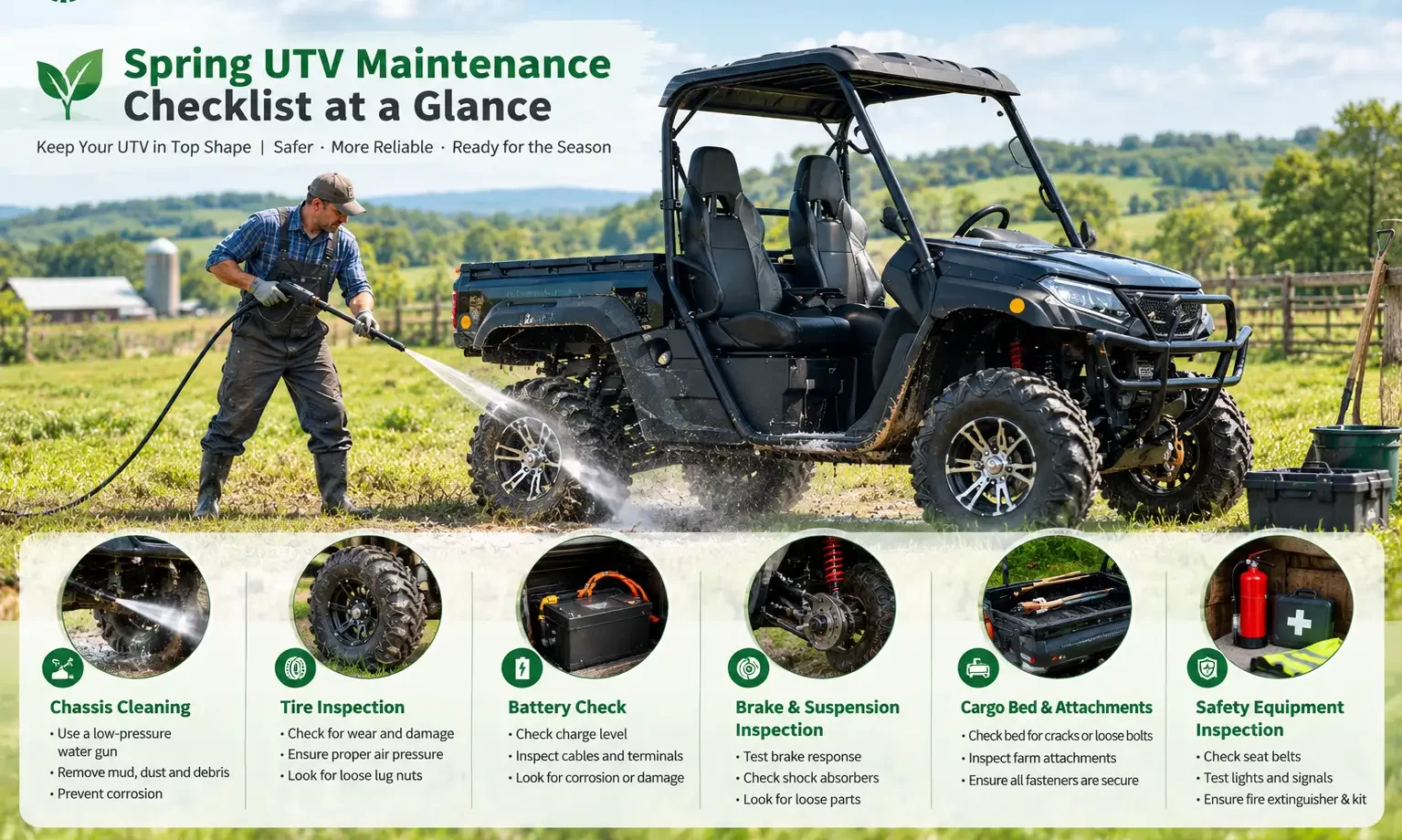
Spring UTV Maintenance Checklist at a Glance

This chapter is an exclusive spring practical operation and maintenance tutorial for agricultural electric UTV. It fits the working conditions of heavy load, muddy and high corrosion in the field. The steps are clear and the landing ability is strong. Farmers can operate in sequence independently and complete the professional maintenance of the whole machine without the need for a professional master to come to the door.

Step 1: Inspect and Clean Your UTV After Winter

Cleaning is the basic core step of spring maintenance. Residual soil, fertilizer residue and dust in winter not only corrode the fuselage, but also block hidden troubles. Only by thoroughly cleaning can hidden problems such as cracks, leakage, corrosion and rat bite be exposed to ensure accurate follow-up maintenance.

  1. Standardized cleaning process: Park the cooled UTV on a flat ground, and manually clean the frame, heat dissipation net, weeds, caked soil and other large debris in the chassis gap; Then use a low-pressure water gun with agricultural machinery cleaning fluid to wash the chassis, wheel hub, heat sink, line interface and other dirty areas. It is strictly prohibited to directly rush high-pressure circuits, bearings, rubber sleeves and other precision parts. After cleaning, dry the fuselage and blow dry the accumulated water in the line gaps with compressed air, finally, plastic, rubber, bare metal spray curing agent, to achieve anti-rust, anti-aging protection.
  2. All-round hidden danger investigation: After cleaning, the whole machine will be inspected item by item, focusing on the core problems such as cracking and deformation of the guard plate, loosening and missing screws, damage and oil leakage of CV rubber sleeve, suspension deformation, rodent bite of the circuit, leakage of oil circuit and water circuit, and corrosion of brake steering parts.
  3. Verification of high incidence in winter: Focus on checking common hidden dangers such as condensation corrosion, rubber aging, circuit damage and component 4, and mark suspicious points to facilitate subsequent targeted repair and avoid missing minor faults.

Step 2: Check the Electric UTV Battery

Battery is the core power component of electric UTV, and it is also the high incidence of winter loss and spring failure. Low temperature standing in winter is easy to cause battery power loss, capacity attenuation, terminal corrosion, and directly cause common problems such as equipment failure to start, insufficient power, and shrinking endurance. It is the top priority of spring maintenance.

  1. 12V auxiliary battery maintenance: Disconnect the positive and negative poles of the battery, check the shell for bulging, leakage and cracking, clean the terminal oxidation rust and dry thoroughly for fastening; Use a multimeter to detect the voltage. The healthy voltage should be above 12.6V, and the power should be replenished in time below 12.4V. If the voltage is seriously deficient below 12.2V and the power cannot be maintained, the power should be replaced directly. After curing, apply insulating grease to the terminals to prevent oxidation corrosion.
  2. High-voltage power battery detection: Check the battery power, health and system fault code through the instrument or matching APP, and check the problems of uneven battery cells, abnormal temperature, system error reporting, etc. Check the integrity and tightness of the battery pack shell, and check the coolant state and liquid level for the liquid cooling version. Long-term storage equipment shall maintain the electricity in the healthy range of 40%-60% to avoid overcharging and overdischarging.
  3. Criteria for battery replacement: After the battery is powered up, the voltage stabilization is insufficient, the load voltage drops suddenly, the shell bulges and leaks, and the performance is greatly attenuated after 3-5 years of use. If any condition is met, it shall be replaced immediately to prevent power failure in the middle of the operation.

Step 3: Inspect Tires and Wheels

Tyres directly determine the grip and safety of UTV field operations. Low temperature standing in winter is easy to cause insufficient tire pressure, tire deformation and aging, unable to adapt to muddy and soft terrain in spring, and prone to problems such as slippage, jitter, tire burst, etc. Calibration and testing are required.

  1. Precise tire pressure calibration: Low temperature will continue to reduce tire pressure, and vehicles generally have insufficient tire pressure after standing still in winter. When the tire is cooling, use a special low-pressure tire pressure gauge to inflate according to the original factory standard. The conventional tire pressure of agricultural UTV is 5-12PSI, which is suitable for field terrain, balances the grip and shock absorption effect, and avoids slippage and deformation caused by abnormal tire pressure problem.
  2. Tire wear and aging detection: Comprehensively check the tire tread and sidewall, and check the problems of dry cracking, bulging, cracks, eccentric wear, stone embedding, etc. Flat spots on the tread caused by standing in winter are easy to cause driving jitter, and tires with serious wear and aging need to be replaced in time to prevent the risk of tire burst in the field.
  3. Maintenance of hub and bearing: Check whether the wheel hub and valve are aging, deformed, leaking and rusting; tighten the wheel hub screws diagonally according to the standard torque; rotate the tire in the air, check the bearing wear problems such as stuck, abnormal noise, excessive clearance, etc., and repair and replace in time for abnormal conditions.

Step 4: Inspect the Braking System

The brake system is the core safety guarantee for field operations. In winter, humid environment is easy to cause brake oil to absorb water and deteriorate, caliper Caton, brake pad aging, heavy load in spring, downhill, muddy operation, easy to brake soft, lag or even failure, must be fully overhauled.

  1. Brake fluid detection and replacement: Clean up the dust in the brake oil tank, check the oil level and oil condition, and replace the turbid, emulsified and blackened brake oil immediately; it is recommended to replace it once every 1-2 years, strictly match the original DOT specifications, and avoid braking caused by the decrease of the boiling point of the oil failure.
  2. Brake pad and brake disc inspection: The brake pad should be replaced in time when it is worn to the minimum limit of 1-2mm; check whether the brake disc has deep grooves, deformation, high temperature discoloration, and large area of rust. Slight rust can be removed by brake polishing, and serious wear needs to be repaired and replaced.
  3. Caliper and brake performance test: Clean up the silt of the caliper, check whether the piston returns smoothly, and apply special grease to the sliding pin; repeatedly test the brake feel, it needs to be tight, no empty position, no sponge feeling, and the brake is soft, it needs to check the pipeline air intake, leakage and Timely exhaust; at the same time test the parking brake to prevent hidden dangers of slipping.

Step 5: Check Steering and Suspension

The bumpy and muddy road conditions in the field have great loss on steering and suspension. Long-term standing of the equipment in winter is prone to grease drying up, parts rusting, screw loosening, and spring operation is prone to problems such as steering jam, body shaking, abnormal chassis noise, etc., affecting control stability.

  1. Shock absorption and suspension component inspection: Check whether the shock absorber has oil leakage, deformation, poor rebound, whether the dust cover is intact, and the failed shock absorber should be replaced in time; check the cracking and wear of the swing arm, connecting rod, rubber sleeve, and bushing to prevent the suspension gap Too large causes the body to shake.
  2. Accurate inspection of steering system: Whether the full-width steering test is smooth, no jam, no abnormal noise, no excessive empty position; check whether the steering rod and ball joint dust cover are damaged, and the clearance exceeds the standard, check whether the steering gear is leaking, the screws are loose, and adjust and tighten in time.
  3. Lubrication and fastening of hinge point of whole vehicle: Clean the grease nipple of the whole vehicle and add the original grease to replace the old grease to solve the problem of dry parts; Tighten the chassis according to the standard torque and hang all fixing screws to avoid vibration and loosening.

Step 6: Inspect the Electric Drivetrain

The electric UTV transmission system is composed of motor, controller, high voltage line and gear box, with precise structure and high maintenance requirements. The wet environment in winter is easy to cause circuit corrosion and power failure, so special detection and maintenance are needed in spring.

  1. High voltage line detection: Focus on the inspection of the insulation layer of the high-voltage line, and check the aging, damage, rat bite and extrusion damage; confirm that the high-voltage connector is locked without looseness, oxidation and moisture, and the line clip is in good condition and firm to ensure the safety of the high-voltage system.
  2. Maintenance of motor and controller: Check the tightness and integrity of the equipment shell and whether the oil seal leaks; Clean up the sediment and sundries of the heat sink to ensure smooth heat dissipation; Power-on test the start-stop and power output status of the equipment to ensure no abnormal noise, jam and abnormal high temperature.
  3. Gearbox maintenance: Check the oil level and state of the gear box. The oil is emulsified, blackened, and contains impurities and needs to be completely replaced; check the oil seal and joints for leakage, and tighten the fixing screws to avoid gear wear caused by lack of oil and oil leakage.
  4. Troubleshooting and firmware upgrade: Read and clear the false fault code generated by winter standing, upgrade the latest official firmware of the vehicle, optimize the power output and battery management logic, and improve the stability of equipment operation.

Step 7: Inspect the Electrical System

The electrical system controls the functions of the whole vehicle. In winter, moisture, low temperature and rodent damage are easy to cause circuit aging, short circuit and accessory failure. Comprehensive verification is required before spring operation to ensure the normal operation of lights, switches and agricultural appliances.

  1. Line and insurance investigation: Comb the wiring harness of the whole vehicle, check the insulation layer damage, rat bite, extrusion and wear problems; clean up the moisture and oxide debris of the fuse box, replace the blown and aged fuse; tighten the terminal and ground wire, and apply insulating grease after rust removal. Moisture-proof and anti-corrosion.
  2. Light and switch test: Test the lights and instrument displays of the whole vehicle one by one, and replace the damaged parts; detect the ignition, four-wheel drive, differential lock, throttle, handbrake and other control switches to ensure that the functions are sensitive and there is no jam failure.
  3. Agricultural accessories testing: Power-on test winch, external power supply, spraying equipment and other auxiliary accessories, check the circuit, motor, transmission structure status, check the caton, leakage, failure problems, to ensure that can be put into agricultural operations at any time.

Step 8: Check Fluids and Lubrication

During the static period of the equipment in winter, the condensed water generated by the temperature difference will cause emulsification failure of all kinds of oil products and attenuation of lubrication effect. Even if the appearance of the oil products is clean, it needs to be replaced in spring and the whole vehicle should be lubricated to reduce mechanical wear from the root.

  1. Special oil replacement: Completely replace gear oil, brake oil, and coolant, and check for oil emulsification and excessive impurities; replace the filter element as needed, fill the oil in strict accordance with the original factory specifications and capacity, and re-check the oil level and liquid level at idle speed after filling. Hidden dangers of leakage.
  2. Lubrication and rust prevention of all vehicle parts: Fully add grease to the door, tailgate, pull wire, steering pin shaft and chassis hinge point to eliminate dry and abnormal noise; do anti-rust treatment to the exposed metal parts to adapt to the wet working environment in spring.

Step 9: Inspect the Cargo Bed and Farm Attachments

Cargo boxes, hydraulic dump systems and agricultural accessories are the core carriers of UTV field operations, which directly affect agricultural efficiency and are indispensable key modules for spring maintenance.

  1. Cargo box and tailgate maintenance: Clean up the container fertilizer and soil sundries, dredge drainage holes to prevent corrosion; Check the integrity of the box body and welding points, lubricate the tailgate hinge and lock catch, replace damaged accessories, and ensure stable bearing and smooth opening and closing.
  2. Maintenance of hydraulic dump system: Check whether the hydraulic oil cylinder, pipeline and joint have aging and leakage, check the hydraulic oil state and replace the deteriorated oil in time; Lift the container for many times without load, test the stability of lifting, lubricate the hinge point, and prevent the problems of Caton and pressure relief falling.
  3. Maintenance of agricultural tools: Clean the residual impurities such as sowing, spreading fertilizer and spraying, check the state of frame, transmission and bearing parts, lubricate movable points and replace worn parts; Test the linkage function of the accessories to ensure that they meet the requirements of field operations.

Step 10: Check Safety Equipment

Field operation conditions are complex, and safety equipment is the key to avoid accidents. Long-term storage in winter is easy to cause aging and failure of safety accessories. Comprehensive verification is required before spring operation to build a strong safety line.

  1. Inspection of protective structure: Check the roll cage and body protection frame for deformation and cracking, solder joints falling off, and tighten all fixing screws; check the locking function of the side guard net and door protection structure to ensure effective protection.
  2. Inspection of safety belt fittings: Comprehensively check the webbing, buckle and retraction function of the safety belt. If there is wear, crack and jam, replace it immediately to ensure the safety of driving and riding protection.
  3. Verification of emergency equipmentcheck the pressure and validity of the fire extinguisher, first aid kit consumables, tow rope, self-rescue equipment, etc., replace expired accessories, organize emergency equipment, and meet the needs of field rescue.
  4. Inspection of warning equipmentconfirm that the reflective strips and warning signs of the vehicle body are in good condition and clear, so as to ensure the visibility of field operation and road transportation and avoid collision accidents.

Step 11: Perform a Controlled Spring Test Drive

Static maintenance cannot check all dynamic hidden dangers. After all maintenance procedures are completed, the performance of the whole machine must be verified by no-load low-speed test run, simulating field working conditions, and completely eliminating hidden faults.
  1. Idle start detection: Start the equipment and run at idle speed for 1 minute. Observe that the instrument has no fault report, stable voltage, no abnormal noise, peculiar smell, and no leakage. The motor and controller run smoothly.
  2. Low speed dynamic test: Drive at low speed in an open field, test acceleration and deceleration, steering, and braking performance; check abnormal chassis noise, body shaking, and power jam problems through turning and bumpy road sections, and simultaneously test four-wheel drive, differential lock and linkage functions.
  3. Stop and recheck and finishafter the test run, stop the machine and let it stand. For the second inspection, the whole vehicle shall be free of oil leakage, the parts shall be free of high temperature abnormality, the screws shall be free of looseness, and the circuit shall be in good condition. It shall be confirmed that the whole machine is in standard condition and can be put into high-intensity farming operations in spring.

Spring UTV Maintenance Checklist at a Glance

Common Spring UTV Problems Farmers Should Watch

Based on the feedback from thousands of farmers, the 10 types of faults with the highest incidence after UTV spring are sorted out, and the symptoms, root causes and solutions are accurately matched to help farmers quickly investigate and repair them:

Serial Number Fault Type Symptoms and manifestations root cause Solution
1 Battery power loss, unable to start Start weak, instrument black screen, dim light Low temperature self-discharge and terminal corrosion in winter Clean the terminal, charge activation, aging battery directly replace
2 Insufficient power, sudden drop in endurance Weak heavy load, speed-up, greatly shortened endurance Battery attenuation, heat dissipation blockage, system fault code not cleared Battery detection, cleaning the cooling system, upgrading the firmware code
3 Brake soft, brake lag The brake stroke becomes longer, the brake is not sensitive, and the pedal feels sponge. The brake fluid absorbs water and deteriorates, the caliper is stuck, and the pipeline air intake Replace the brake fluid, lubricate the caliper, and drain the air from the pipeline.
4 Tire slip and driving jitter Slipping on muddy road, shaking when driving straight, unstable body Abnormal tire pressure, flat tread spots, uneven wear Calibrate tire pressure and replace aged and worn tires
5 Chassis abnormal noise, bump loose Absant noise over the pit, loose body shaking Insufficient lubrication of suspension, aging of bushing and loosening of screws Lubricate the whole vehicle, replace aging bushing and fastening screw
6 Line failure and parts failure Lights not bright, switch failure, intermittent power failure Moisture corrosion, rodent bite circuit, blown fuse Repair the circuit, replace the fuse, and prevent moisture and corrosion.
7 Hydraulic dump jam, pressure relief Slow lifting, falling and abnormal noise of the container Deterioration of hydraulic oil, oil cylinder stuck and pipeline leakage Replace hydraulic oil, service lines and lubricate hinge points
8 High temperature of equipment and limited power High temperature alarm and power drop after a period of operation Blockage of heat dissipation net, failure of heat dissipation fan, accumulation of sundries Deeply clean the heat dissipation system and overhaul the fan
9 Steering Caton, excessive dummy position Inaccurate steering, heavy Catton, driving deviation The steering ball head is dry, the gap is too large, and the screw is loose. Lubrication adjustment and replacement of worn ball joint
10 Abnormal operation of the equipment Malfunction of spreading fertilizer, spraying and traction Rusting, poor line contact and transmission jam Clean maintenance tools, check lines and lubricate transmission parts

Spring Maintenance Mistakes Farmers Should Avoid

Many farmers’ UTV failure is not the natural loss of equipment, but the secondary damage caused by the wrong maintenance method. The following 10 high-frequency misunderstandings must be strictly avoided:

Myth 1: Skip deep cleaning, direct maintenance: Soil, fertilizer residue and corrosion will block the fault point, and residual impurities will enter the precision parts, causing secondary wear. All maintenance must be cleaned before overhaul.

Myth 2: If the oil looks clean, you don’t need to change it.: Condensed water mixed with oil is difficult to identify with naked eyes. Long-term standing will inevitably lead to emulsification and deterioration of oil. It must be replaced in spring and cannot be judged by appearance.

Myth 3: The battery can start without detection: The hidden power loss and capacity attenuation of the battery will not affect the short-distance start, but the heavy-duty operation will suddenly cut off and stop, and voltage detection and regular maintenance are required.

Myth 4: Estimate tire pressure with naked eyes: Agricultural UTV is suitable for low-pressure tire pressure, which cannot be accurately detected by ordinary naked eyes and ordinary tire pressure gauges. Abnormal tire pressure directly affects operation safety and tire life.

Myth 5: Ignore the small rubber sleeve and oil seal damage: The tiny CV rubber sleeve and oil seal are cracked, which will not affect the use in the short term, but the sand will quickly wear the transmission shaft and bearings after the invasion, which will eventually lead to high maintenance.

Myth 6: long-term static after direct heavy load operation: The brake, suspension, and transmission systems are stuck for a long time, and they are directly overloaded without maintenance, which can easily cause brake failure and component breakage.

Myth 7: only maintain the main engine, ignoring the agricultural tools failure of cargo box, hydraulic system and fertilizer spraying equipment will also directly delay farming. Maintenance of equipment is as important as maintenance of main engine.

Myth 8: random mix of non-standard oil, grease: Non-standard oil viscosity and parameter mismatch will cause blockage and wear of gear box, motor and oil circuit, and the original specified consumables must be strictly used.

Myth 9: Do not test run directly after maintenance: Static maintenance cannot check dynamic hidden dangers, and it is easy to cause sudden failure in the field without direct heavy load.

Myth 10: repair after the outbreak of failure: Agricultural machinery maintenance and prevention is greater than maintenance. Passive maintenance is not only more costly, but also causes irreversible production losses during the critical period of busy farming.

How Often Should Farmers Maintain a UTV?

Agricultural UTV has been operating in the harsh environment of heavy load, dust and fertilizer corrosion for a long time, and the equipment loss is much higher than that of ordinary leisure UTV. It is necessary to strictly follow the exclusive maintenance cycle and adjust the maintenance frequency as needed to avoid lack of maintenance or excessive maintenance. The specific standardized maintenance cycle and working condition adaptation rules are shown in the following table:

Maintenance cycle gear Core Maintenance Projects
Before Daily Homework (Required) Check tire pressure, brakes, electricity and lights, clean up sundries in the heat dissipation network, visually check equipment leakage, loose screws, damaged accessories and other problems, and quickly avoid the operation failure of the day.
Every 25-50 hours (high frequency operation) Replace all kinds of oil filter elements, lubricate and maintain the hinge points of the whole vehicle, check the working state of the battery, tighten the wheel hub screws, check the wear of the rubber sleeve, and clean up the dust on the surface of the circuit.
Every 100 hours/every half year Replace the gear oil and hydraulic oil, overhaul the brake system, detect the clearance of bearings and ball heads, deeply clean the whole machine, and scan and clear the fault code of the vehicle system.
Seasonal special maintenance Before spring ploughing in spring: complete a full set of in-depth maintenance of the whole machine to make up for stable operations throughout the year; Before shutdown and warehousing in autumn: replace oil, supplement battery power, clean and rust-proof the whole machine, standardize storage and storage, and reduce static loss in winter.
Annual Professional Maintenance Check the safety protection structure of the whole vehicle, replace the brake oil and coolant, deeply inspect the motor and controller, upgrade the firmware of the vehicle system, comprehensively screen and replace the aging parts.

Condition cycle adaptation rules: Light use (within 100 hours of annual working hours) to implement standard maintenance cycle; Moderate use (annual working hours of 100-300 hours) curing cycle shortened by 15%; Severe use (annual working hours of more than 300 hours, dusty and corrosive conditions) curing cycle shortened by 30%-50%.

How Proper Maintenance Improves Farm UTV Productivity

Many farmers think that equipment maintenance is a “waste of time and money”. In fact, professional spring maintenance is the most cost-effective way to increase income. It directly improves farm income from the four dimensions of reducing losses, improving efficiency, protecting farmers and protecting assets:

  1. Put an end to busy farm downtime and hold on to core earnings: Spring farming timeliness is extremely strong, sowing, fertilization, insect control the best window period is only a few days. Perfect spring maintenance completely put an end to sudden downtime failure, to avoid equipment damage caused by agricultural delays, crop production, artificial idle losses, firmly hold the core income of spring production.
  2. Improve the working condition of the equipment and increase the daily operation volume.: The maintained UTV has sufficient power, sensitive steering, stable braking and endurance up to standard. It is suitable for all complex terrain in the field. It is more efficient in transportation, spraying, inspection and traction operations. It can complete more agricultural tasks in one day and greatly improve the overall operation capacity.
  3. Significantly reduce long-term operation and maintenance coststhe cost of consumables for preventive maintenance is much lower than the cost of fault maintenance. Regular oil change, lubrication and parts replacement can effectively protect core high-priced components such as motors, batteries and gearbox, avoid large maintenance expenses and reduce the annual agricultural machinery operation and maintenance costs.
  4. Extend the life of the equipment and preserve and increase the value of the equipment.Scientific seasonal maintenance can prolong the service life of electric UTV for several years and reduce the frequency of equipment replacement. Complete maintenance records and good equipment condition can greatly improve the second-hand residual value of equipment and reduce the long-term equipment input cost.
  5. Improve operational safety and avoid accident losses: A sound braking, steering, and safety protection system can effectively avoid safety accidents such as sideslip, rollover, and brake failure in the field, reduce additional losses from personal injuries, equipment damage, and crop damage, and ensure safe production on the farm.
  6. Improve the utilization rate of equipment and revitalize the value of agricultural machinery.: UTV in stable state can be adapted to all-scene farming work such as transportation, inspection, fertilization, spraying, traction, etc. The utilization rate of equipment is greatly improved, replacing manual and large agricultural machinery to complete fine and high-frequency work and optimizing the overall production mode of the farm.

Summary

Electric UTV is an important auxiliary agricultural machinery for modern agricultural spring farming production, and the stability of equipment operation directly affects the efficiency of agricultural operations and the income of planting and breeding. All kinds of hidden losses caused by long-term low-temperature standing of equipment in winter are the main reasons for frequent failures in spring operation, delayed farming time and increased operation and maintenance costs. Compared with ordinary leisure UTV, agricultural UTV has a worse working environment and needs to be adapted to special working conditions of heavy load, dusty and muddy, fertilizer corrosion and high frequency operation to carry out spring maintenance.

Spring preventive maintenance is a cost-effective agricultural machinery input, not redundant processes. Farmers only need to complete fine maintenance from 11 core dimensions such as equipment cleaning, batteries, tires, brakes and circuits. At the same time, they can repair equipment loss in winter, keep UTV in the best operating condition, effectively prevent sudden shutdown of spring ploughing, improve quality and efficiency, reduce operation and maintenance costs, and build a solid equipment guarantee for stable agricultural production and income throughout the year.

FAQ

Q1: What is the difference between spring maintenance of electric UTV and fuel UTV?

The core mechanical maintenance (tires, brakes, suspension, appliances) is basically the same; the biggest difference is that electric UTV does not need to maintain the engine and CVT belt, and focuses on the maintenance of exclusive electrical systems such as high-voltage batteries, motors, controllers, and high-voltage lines to avoid moisture leakage and battery Attenuation and circuit failure.

Q2: Spring farming is too busy, can you skip maintenance and direct homework?

Skipping is not recommended. Spring is a period of high incidence of failures, hidden failures will be concentrated in heavy-duty operations, once the shutdown, delayed farming hours, resulting in maintenance costs, resulting in agricultural losses, much higher than the time and cost of maintenance, short-term laziness will cause long-term losses.

Q3: The equipment didn’t open 1 winter. It looks in good condition. Do you need to change the oil?

Must be replaced. Condensed water generated by temperature difference in winter will be mixed into gear oil and brake oil, causing emulsification and deterioration of oil products, which cannot be accurately judged by naked eyes. Deteriorated oil products will accelerate the wear of core components. Forced oil change in spring is a necessary process.

Q4: How many times a year does agricultural UTV need to do deep maintenance?

It is suggested to maintain the core depth twice a year: once before spring ploughing (the most important in the whole year) and once before shutdown and warehousing in autumn; The best working condition of the equipment can be maintained for a long time with the routine maintenance of the working period.

Q5: How to effectively prevent UTV winter corrosion and rodent damage?

Before storage in winter, thoroughly clean the equipment, remove the residue of fertilizer and soil, and do anti-rust maintenance for the whole vehicle; Disconnect the negative electrode of the battery and connect the battery maintenance instrument; Close the air inlet and line gap of the equipment, and place the anti-rat device; Store in a dry and ventilated warehouse to avoid outdoor wet storage.

| (Note: Some content may be generated by AI)

TAGES:
Learn More About Our Products
If You Have Any Questions About UTV, You Can Fill Out The Form Online And We Will Respond To You Within One Business Day And Provide You With The Latest News On Our Products. We Respect Your Privacy And Will Never Disturb You.


    0086-371-63299927
    VIP.kingwoo@ekingwoo.com
    0086 13838317652
    Get in touch with us