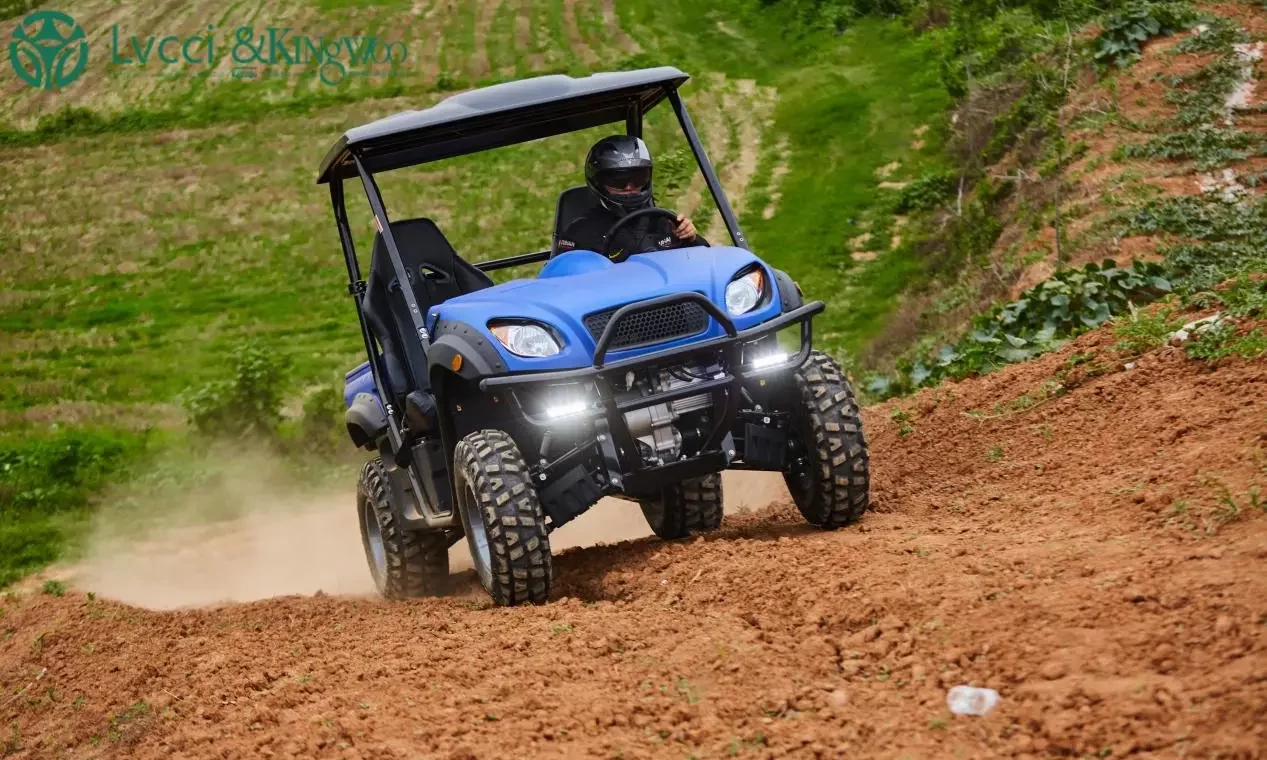
Electric UTV is called Electric Utility Task Vehicle, and is often called Electric Side-by-Side in the industry.
Simply put, it is an off-road off-road vehicle powered by a high-capacity lithium-ion battery pack and electric motor. It completely abandons the internal combustion engine and oil circuit system of the traditional fuel car, and drives the whole car to run by relying on the electronic control system.
Power system: motor output instantaneous torque, driving noise is extremely low, no exhaust emissions, environmental protection properties
Tool properties: standard cargo cargo box, support winch, snowboard and other expansion accessories, traction load generally reaches 1000-3000 pounds
| CompareDimensions | ElectricUTV | GasUTV |
| running noise | Very low, suitable for wildlife reserves, residential areas | he engine noise, easy to cause noise nuisance |
| exhaust gas emission | Zero exhaust emission, no harmful waste gas | Exhaust emissions, fuel smell |
| current maintenance | Minimal maintenance items, no need to change oil spark plugs | Maintenance tedious, regular replacement of filter, oil, transmission accessories |
| Energy consumption | Extremely low electricity costs, 70%-90% less energy than fuel | Long-term use cost of gasoline and diesel is high |
| starting torque | Zero speed and full torque, stronger starting and climbing power | Torque delay, low speed, heavy load and weak power |
| Energy supplement/endurance | Moderate battery life, hours to fully charge | Longer battery life, refueling in minutes |
| car purchase threshold | Higher upfront purchase price | Lower vehicle price and low entry barrier |
With unique product features, electric UTV has irreplaceable advantages over fuel vehicles in many types of restricted scenarios:
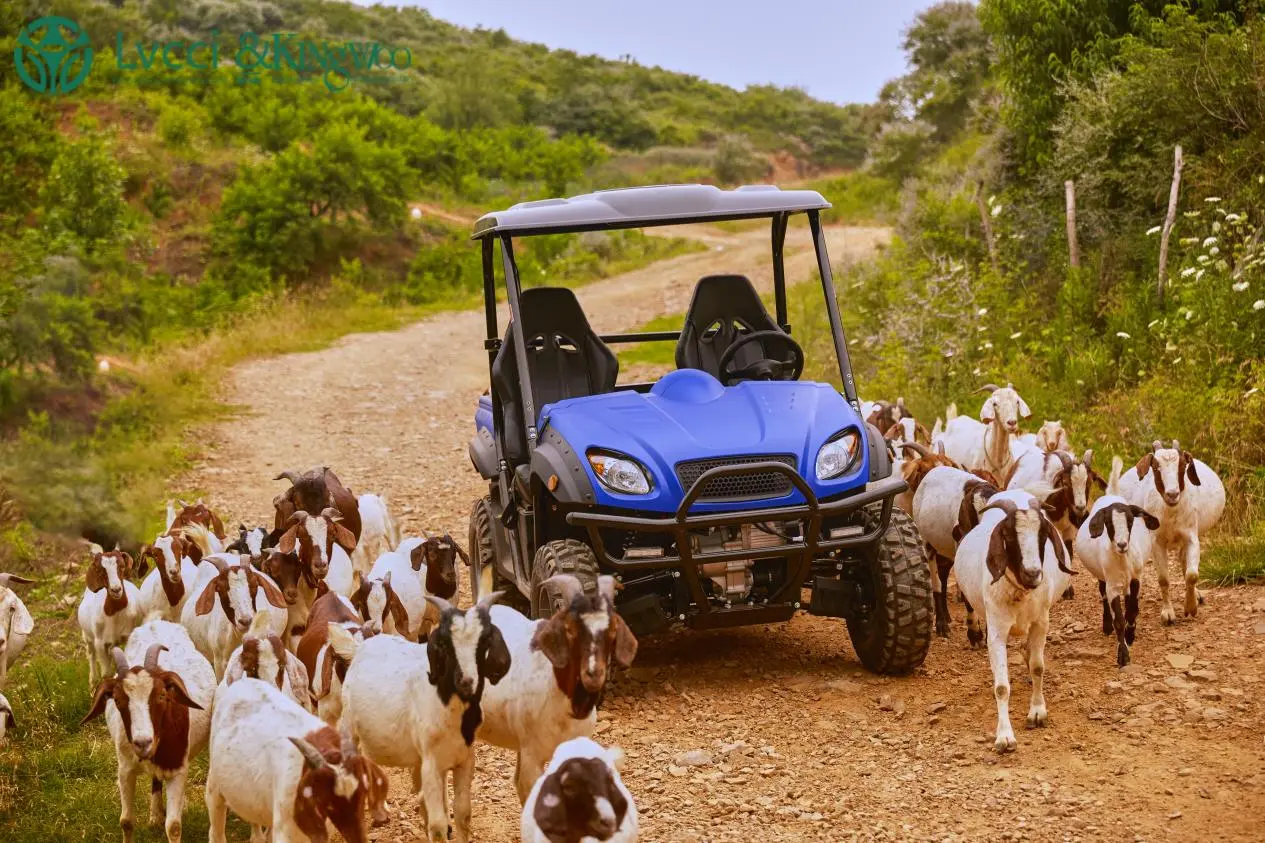
Farm operation: low noise, no disturbance to livestock and poultry, no peculiar smell of fuel oil, special for short-distance material transfer on site
Outdoor hunting cross-country: silent driving, strong concealment, will not disturb wild prey
Operation and maintenance of scenic spots/resorts: compliance with environmental protection control standards, noise compliance, commuting inspection within the park
Industrial and commercial sites: indoor and outdoor transportation in factory area, campus and airport, and safe use of confined space
Leisure cross-country: daily mountain and forest road leisure riding, with lower vehicle cost
Many buyers struggle with electric UTV, essentially not knowing its unique value. Compared with fuel models, electric UTV has 8 irreplaceable core advantages, covering all dimensions of vehicle use, vehicle maintenance and scene.
This is the most intuitive advantage of the old car owner feedback. ,The unit price of electric energy is far lower than that of gasoline and diesel oil, and the energy consumption cost is directly saved by 70 -90% under the conventional working condition.
At the same time, the electric structure has no engine wearing parts, and the high-frequency expenses such as engine oil replacement, spark plug, fuel filter element, exhaust system maintenance and the like are completely saved. Farm users with high frequency of use can recover the vehicle price difference within 2-4 years.
The motor runs almost without mechanical noise and exhaust noise, and the whole vehicle runs nearly silently.
Whether it’s hunting in the woods without disturbing wildlife, or suburban farms and high-end resort operations, there’s no noise pollution. This is also the core reason why most scenic spots give priority to purchasing electric UTV.
There is no exhaust emission and volatile fuel waste gas for the whole vehicle, which meets the environmental protection control regulations of nature reserves, ecological scenic spots and closed workshops all over the country.
Many fuel-fueled all-terrain vehicles are prohibited from entering the ecological control area, electric UTV can normally comply with the traffic operation.
The motor can output peak torque at 0 rpm, a feature that fuel engines cannot achieve. The ability to climb steep slopes, start with heavy load and get out of trouble on muddy roads is superior to that of the same level fuel UTV.
The power output of the whole vehicle is linear and smooth, without gear shifting, and the novice can easily control the heavy-duty vehicle. With energy recovery braking, downhill driving safety is higher.
the numb of parts of that electric UTV is reduce by more than 60 percent compared with that of a fuel model, and the electric UTV does not have a complex internal combustion engine transmission structure.
In addition, energy recovery braking reduces the wear of brake pads, greatly reduces the failure probability of the whole vehicle, and is not easy to fail when parked idle. It is suitable for ordinary users who do not understand vehicle maintenance.
No high-frequency vibration of the engine, the whole vehicle driving bumpy feeling is weaker, long-term operation is not easy to fatigue.
has no waste gas emission, can be directly operate in closed indoor environment such as warehouses, greenhouses and that like, and does not cause waste gas poison of personnel.
In 2026,17 provincial-level new energy pilot areas in China will open special purchase subsidies and tax relief policies for commercial and agricultural electric UTV.
With the rising demand for new energy off-road equipment, the second-hand hedging rate of compliance big brand electric UTV has increased year by year, and the resale discount is lower than that of fuel models.
It can operate normally in the silent control period at night and the high-risk control area of forest fire prevention, and is not restricted by the traffic ban of fuel vehicles.
Support the supporting use of solar charging piles, and the remote sites without power grid can also supplement energy at low cost.
Battery life is the core issue that buyers are most concerned about, and it is also the first consideration when choosing an electric UTV. Mainstream models in mass production in 2026 have a true range of 30-80 miles under standard operating conditions.
The manufacturer advertises that the battery life is the ideal no-load flat road data, and the real outdoor operation battery life is generally 10%-30% lower than the official parameter.
Many users report that the battery life is not up to standard, mostly due to external operating conditions rather than vehicle failure:
Load and towing weight (the biggest impact): When fully loaded with goods and towing a trailer, the endurance will be directly reduced by 30%-50%, and the power consumption for heavy load climbing will be doubled.
Terrain and road conditions: the power consumption of muddy, sandstone and steep slope off-road pavement is much higher than that of flat and hardened pavement
Driving speed: When the motor runs at a high load at more than 35 miles per hour, the endurance decreases rapidly; the economy mode can effectively save electricity
Ambient temperature: battery life in low temperature decreases by 20%-40%; high temperature environment has little impact on battery life
Car peripherals: spotlights, car winch, heater and other external equipment will continue to consume battery power
For 90% of farm, park, and hunting users, 30-80 miles of battery life is sufficient. The vast majority of sites do not travel more than 40 miles per day for routine operations.
After work at night and after work, plug in the electricity and replenish energy overnight, which can completely meet the day-to-day normal operation. Only in remote areas without power grids, continuous high-intensity off-road all day long, there will be battery life anxiety.
The charging duration of the electric UTV is determined by the battery capacity, the charging device specification and the remaining battery capacity. It takes 4-12 hours to fully charge the mainstream models in 2026.
| chargingmode | adaptingdevice | FullChargeDuration | applicablescenarios |
| First level slow charge (120V household outlet) | Household ordinary three-hole socket, no additional equipment | 8-12 hours | Overnight charging, everyday light car |
| Two-stage fast charging (240V special charging pile) ) | Site specific EV charging pile, farm/warehouse installation | 2.5-6 hour | Commercial high-frequency vehicle,daytime energy supplement |
| DC Overcharge | Public DC fast charging pile (supported by some high-configuration models) | Complete 20%-80% energy supplement in 50 minutes | Emergency quick energy supplement, less vehicle adaptation |
It is not necessary to charge the battery to 100% each time. Daily car charge to 80% can meet most working conditions, but also can prolong battery life.
Low temperature environment charging speed will slow down, conditional as far as possible in the indoor, garage charging. With solar power supply system, it can realize zero electricity charge and independent energy supplement in remote sites.
When the vehicle is driving downhill, the energy recovery system can automatically replenish the power, which slightly improves the daily driving endurance.
The battery is the core component with the highest cost and the greatest impact on the life of the electric UTV. There are only two types of battery configurations available: LiFePO4/Li3 + batteries and traditional lead-acid batteries.
Conclusion of hard shopping in 2026: The vast majority of users prefer lithium battery version; lead-acid battery is only selected for occasional vehicles with very low budget.
| Compare Dimensions | Lithium iron battery (standard) mainstream | lead-acid battery |
| Purchase price difference | 2000-5000 USD more | Lower vehicle price |
| cycle life | 2000-5000 Charge and discharge, use 5-10 years | 300-800 Secondary charge and discharge, 2-4 years of use |
| Dead weight and body handling | 50%-70% lighter and more stable | Heavy battery and high center of gravity |
| current maintenance | Maintenance-free, no manual care | Regularly replenish water, clean up the electrode corrosion |
| high and low temperature performance | Stable power output in cold and hot environments | Load voltage attenuation easily, low temperature performance is poor |
| Long-term vehicle cost | Lower overall cost, less frequent replacement | Frequent battery replacement, higher total cost |
Lithium battery selection: high-frequency operation, farm commercial, off-road enthusiasts, long-term vehicle users; first-line brand original models are all equipped with lithium battery.
Lead-acid batteries: extremely limited budget, a year of use less, short-term transition use of entry-level users.
Clear reply: The new electric UTV in 2026 can easily climb the hill, pass muddy, gravel, rock complex terrain, and the off-road performance is not inferior to the fuel models of the same level.
The zero-speed and full-torque characteristic of the motor is the biggest advantage in off-road scenarios. It can output the maximum traction force at the moment of starting, and it is easier to start on steep slopes and get out of mire than fuel vehicles.
Mainstream high-profile models support 30%-45% slope climbing, with four-wheel drive system, differential lock, long-stroke off-road suspension, through the full pull.
The battery is arranged under the chassis, so the center of gravity of the whole vehicle is lower, it is not easy to turn over when driving on mountain road and complex road surface, and the driving stability is superior to that of fuel UTV.
Downhill energy recovery braking, do not need to frequently step on the brake, long downhill road driving safety is higher.
Climbing steep slopes with heavy loads for a long time and continuous high-intensity off-road will consume electricity quickly, and the endurance attenuation is obvious.
The extremely deep ponding section shall strictly comply with the manufacturer’s wading standards to avoid water inflow failure of high-voltage electrical components.
Many purchasers worry that electric vehicles cannot do heavy work due to insufficient power. In fact, modern electric UTV can completely meet the needs of most heavy load operations in agriculture, animal husbandry and construction sites.
The equivalent horsepower of the first-line mainstream high-profile models can reach 80-110HP, the peak torque is 140lb-ft, the standard towing load is 1500-2500 pounds, and the cargo box carries 1000-1500 pounds.
Enough to complete the drag and drop of agricultural machinery, transport timber, feed transport, construction site construction materials such as short-distance handling of conventional heavy physical work.
advantage and disadvantages of heavy duty operation
the invention has that advantage of stronger low-speed heavy-load pow, stable operation without frustration, low noise without disturbing residents, stable vehicle body and difficult rollover.
Disadvantages: long-term full-load battery power consumption speed; away from the charging pile all-day field heavy work, not as convenient as fuel vehicles.
Low maintenance cost is the core selling point of electric UTV. Its maintenance process is far simpler than that of fuel-fired all-terrain vehicles, and zero-base owners can maintain them themselves.
| maintenance items | implementation cycle | OI (operating instructions) |
| Battery appearance inspection | Monthly/Before Long Trip | Clean up the dust on the wiring terminal and check the damage of the shell |
| Tire pressure and wear inspection | by the month | Tire pressure directly affects endurance and off-road safety |
| Brake System Inspection | 3-6 months | Energy recovery reduces brake pad wear, routine inspection is sufficient |
| Chassis suspension maintenance | 6 months or 500 miles | Fill the chassis with grease, and check the shock absorption connecting pieces |
| Vehicle system upgrade | On-demand upgrades after vendor push | Most big brands support remote OTA free upgrade |
| Professional overhaul of the whole vehicle | or 1000 miles per year | Store detection of high voltage circuit, motor control system |
Engine oil, oil filter element, spark plug, air filter element and fuel filter element do not need to be replaced; cooling system maintenance and exhaust system maintenance are not required.
Lithium battery version almost zero maintenance, only the old lead-acid models need regular water corrosion.
The average annual maintenance cost of electric UTV is 50%-80% lower than that of fuel model, and there is almost no large maintenance expense, so it saves money and worry for long-term use.
In 2026, the electric UTV will be produced in compliance with the regulations. The safety standard, outdoor weather resistance standard and fuel UTV are completely consistent, and the outdoor complex weather will be used normally.
The whole series is equipped with ROPS, safety belt and anti-collision body structure as standard; the high-equipped models are equipped with body stability control system, steep slope descent, electronic speed limit and geofence functions.
The high-voltage circuit is equipped with multi-layer insulation protection and battery management system BMS, which can automatically cut off power in case of failure, and there is no risk of electric shock in daily contact with the vehicle body.
Quiet driving can clearly hear the sound of the surrounding environment, hunting and field operations, safer than noisy fuel car driving.
Rainy/muddy road conditions: the motor, battery and controller are all sealed and waterproof, which can drive in rainy days and wading in shoals.
Cold weather in winter: normal driving uphill, only battery life slightly reduced; high-equipped models with battery preheating function
High temperature and scorching heat environment: With its own cooling system, lithium battery has better high temperature stability than lead-acid battery.
Dust outdoor site: dust-proof sealing design of electric control components, normal use of farm desert site
Note: It is prohibited to wading in deep water beyond the depth specified by the manufacturer; it is not recommended to charge in the open air in heavy rain weather to avoid circuit failure.
The electric UTV supports all kinds of original modified accessories, and gives priority to lightweight accessories to avoid the loss of vehicle life due to heavy accessories. The following are the most cost-effective and adaptable retrofits:
Class II 240V special charging pile (preferred and required): greatly shorten the charging time, and the warehouse and farm are configured as standard.
Hydraulic container self-unloading kit: no manual handling is required for loading and unloading gravel and feed in the farm.
4500-6000 lb synthetic rope winch: special for vehicles to get out of trouble and drag materials in the field, light weight and no electricity consumption
Windshield of the whole vehicle + closed cab: outdoor operation in rain and snow, autumn and winter improves driving comfort
LED low power spotlights: night lighting, power consumption is much lower than the traditional halogen headlights
Snowboard kit: snow removal in winter in northern China, one machine for multiple purposes
High wear-resistant and low rolling resistance tires: reduce driving power consumption and directly improve the cruising range of the whole vehicle
Battery insulation thermal management kit: special for northern low temperature areas to save winter battery life loss
Many buyers struggle with high prices in the early stage and ignore the total cost of long-term vehicles. We collate the real transaction and vehicle data of the market in 2026, and clearly compare the cost of graded car purchase and vehicle use.
Car purchase guide price for three-level models·entry-level models: 10,000 – 18,000 US dollars (Domestic Green Chi, Auders and other lightweight models)·Mid-range commercial models: 20,000 – 28,000 US dollars (Polaris standard version, John Deere basic electric version)·High-end heavy-duty models: 28,000 – 38,000 + US dollars (Polaris top configuration, Bombardier professional off-road version) Annual fixed vehicle cost Regular medium-intensity use, excluding vehicle depreciation, annual comprehensive vehicle cost is only 1000-3000 US dollars. Including electricity, maintenance, tires, insurance, annual inspection all costs.
Compared with the total cost of electric UTV and fuel UTV of the same level in five years, the overall cost of electric models will save 4000-8000 US dollars in five years.
Most users can fill the higher purchase price difference of electric vehicles in 2-4 years, and then save money every year. Superimposed local subsidies for new energy, the return cycle is further shortened.
Combine all the previous questions, sort out the simplest five-step purchase method, novice can copy directly without stepping on the pit.
Farm heavy load operation: priority to heavy load Polaris Ranger, John Deere Gator electric version
Silent hunting: priority to low power consumption, lightweight Bombardier electric vehicle model
Park light operation and maintenance: high cost performance domestic entry lithium battery model
Step 2: Lock core hardware parameters Priority lithium battery configuration; Daily operation life guarantee more than 40 miles; Select traction parameters according to maximum load; Complex terrain values ground clearance and four-wheel configuration.
Step 3: combine budget accounting full cycle cost do not just look at naked car price! High-frequency vehicles give priority to high-end models that are more expensive for a long time; low-frequency occasional vehicles choose entry-level versions. Inquire about the local new energy agricultural equipment subsidy policy to further save money.
Step 4: It is very important to verify the local after-sales channel for off-road equipment after-sales. Priority should be given to Polaris, John Deere and Bombardier brands in local cable stores, so that maintenance parts can be supplied faster.
Comprehensive analysis of all parameters and measured performance in the full text: For commuter users of farm operation and maintenance, outdoor hunting, scenic spots and parks, and factories, 2026 is very suitable for starting electric UTV.
It makes up for the early electric all-terrain vehicle endurance, power short board, low noise, low maintenance, low energy consumption three core advantages. As long as the site has basic charging conditions, priority will be given to replacing fuel UTV.
The only group not recommended: long-term no grid coverage, all-day uninterrupted long-distance high-intensity off-road users.
Want accurate model matching, latest activity quotation, supporting charging pile scheme? Ask our expert electric UTV sales consultants today for a one-to-one custom procurement solution.


-150x150.png)