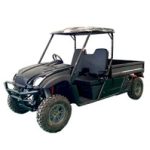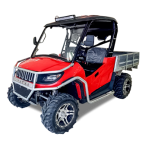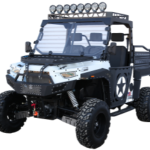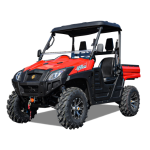
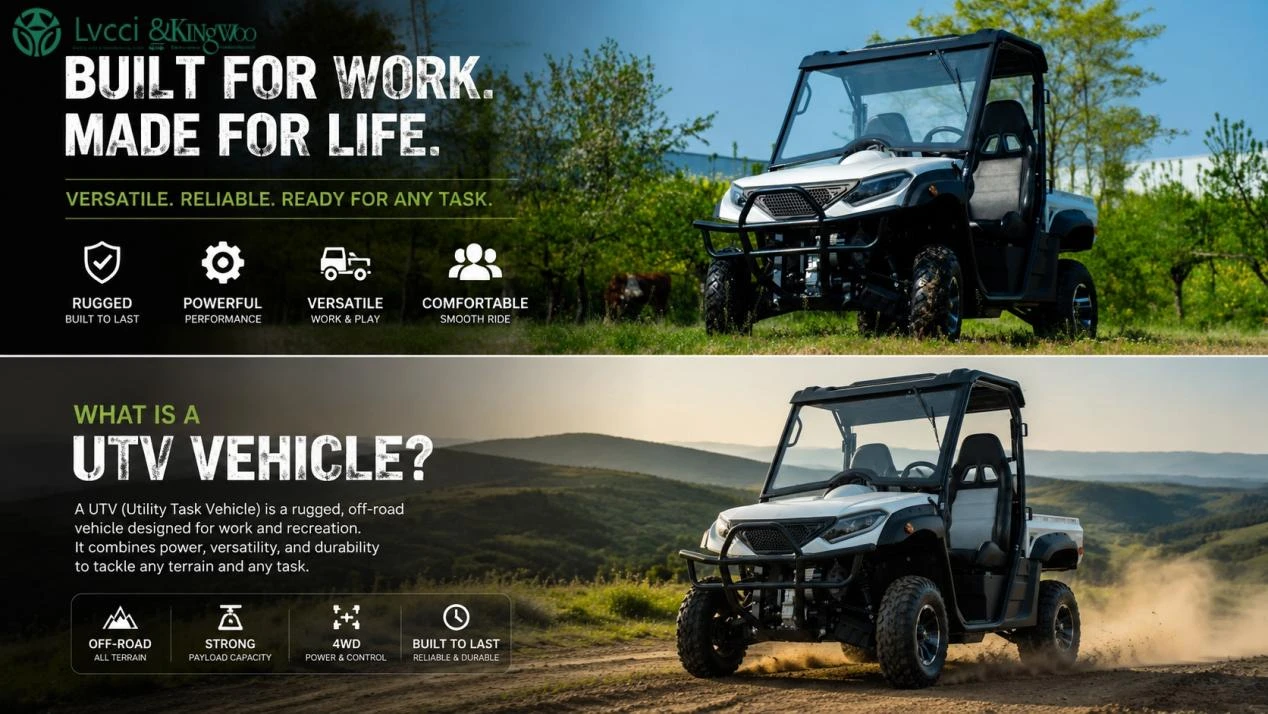
In outdoor off-road, agricultural operations, site operation and maintenance and other scenes, we can often see multi-functional all-terrain vehicles with strong shape and strong passability. Many novices often can’t tell the difference between UTV, ATV and golf carts, and it is easy to confuse all kinds of off-road vehicles.
UTV, as a mainstream all-terrain vehicle that takes into account both practicality and entertainment, has become the first choice for farm operations, outdoor adventures and site patrols with its balanced performance advantages. Whether it is daily work or leisure cross-country, it can adapt to multiple scenes.
The full name of UTV is Utility Terrain Vehicle, which can also be interpreted as Utility Task Vehicle. Chinese is translated into multifunctional all-terrain vehicle and practical task vehicle. In the industry, it also has a popular name-SxS(Side-by-Side, side-by-side vehicle).
This other name comes from the core design feature of UTV. The people in the car use a side-by-side riding mode, which is consistent with the sitting posture of cars and trucks. It is different from the ATV straddle riding style. This is also the core logo that distinguishes UTV from other off-road vehicles. one.
UTV is a four-wheel and above cross-country vehicle specially designed for complex non-paved roads. The core design intention is to give consideration to both practical operation and outdoor leisure. It fills the market gap between ATV light off-road and small pickup truck heavy-duty transportation, and is the 1 versatile and versatile vehicle.
The most mainstream UTV is called the Utility Terrain Vehicle (multi-function terrain vehicle) and is also interpreted as the Utility Task Vehicle (multi-function operation vehicle). The two interpretations complement each other and accurately summarize the core positioning of this model.
Because of this, UTV is uniformly called side-by-side all-terrain vehicles and multi-function off-road vehicles in the domestic industry. Different from off-road models with single entertainment attributes, UTV has taken into account both terrain passing ability and practical operation ability since its birth.
In addition, UTV has a common common name in the industry: SxS(Side-by-Side), that is, side-by-side vehicles. The name comes from its most iconic design. Drivers and passengers adopt a car-like sitting posture side by side, which is essentially different from ATV straddle and motorcycle-like riding structures.
From the perspective of vehicle positioning, UTV accurately fills the gap in the market. It is safer than the traditional ATV ATV, more capable of carrying people and goods, stronger off-road performance than golf carts, wider application scenes, more flexible than small pickup trucks, more suitable for complex non-paved roads, and is the 1 real “work + entertainment” dual-fit all-round model.
It is worth distinguishing that the UTV interpretation applies only to the field of off-road vehicles. In other niche scenes, UTV has irrelevant definitions, such as Ulster Television, a Northern Ireland TV station, and tugboats without inspection in the maritime field. These have nothing to do with what we call off-road UTV vehicles, and there is no need to confuse them when purchasing and understanding models.
The mainstream UTV in the market is divided into two versions: fuel power and pure electric power. The power structure is different, and the working mode is also obviously different. The traditional fuel UTV is equipped with a 400cc-1000cc large-displacement internal combustion engine. The engine mostly adopts a mid-rear layout to effectively protect the core components of the fuselage and optimize the weight ratio of the body.
The fuel engine drives the piston and crankshaft to run through fuel combustion to continuously output power and torque, focusing on strengthening low-speed torque performance, and is specially adapted to high-intensity operation scenarios such as climbing, heavy loading, and dragging.
The new electric UTV is equipped with a large-capacity battery pack and a permanent magnet synchronous motor, which does not require fuel combustion and relies on the conversion of electrical energy into kinetic energy. The advantage lies in the instantaneous release of torque, no power delay, starting, climbing, dragging heavy objects more smoothly, while achieving zero emissions, low noise operation.
Most UTVs come standard with the industry-wide CVT continuously variable transmission system, which is different from the traditional manual gearbox structure. It relies on the combination of double pulleys and transmission belts to automatically adjust the transmission ratio.
This system can automatically adapt the power output according to the depth of the throttle and the body load, amplify the torque at low speeds and heavy loads, and optimize the speed at high speeds. There is no shifting and frustration in the whole process. The operation is simpler, the driving is more stable, and the novice can easily control it.
After the power is transmitted through the gearbox, it enters the four-wheel drive system. Mainstream UTV supports 2WD two-wheel drive and 4WD four-wheel drive free switching, and some high-end models are equipped with front and rear differential locks. When the tires are slipping or the road is muddy and slippery, the differential lock will lock the wheel power and allow the wheels on both sides to run synchronously to avoid getting stuck and losing control.
This is the core design that distinguishes UTV from ATV, and it is also the key to the extremely low difficulty of getting started. UTV completely adopts car-style control logic, equipped with mechanical or electric power steering wheel, independent throttle pedal, and brake pedal.
The driver controls the steering of the front wheels through the steering wheel, and the pedal controls the increase and decrease of the vehicle speed. With the gear control handle, the driver can freely switch between high-speed, low-speed, and reverse gear modes. The vehicle instrument panel displays the vehicle speed, speed, power/fuel quantity and four-wheel drive status in real time, and monitors the vehicle running status in real time.
The whole set of control system abandons the complex riding control mode, does not need to rely on body balance to control the body, driving in a sitting position is more stable and safer, and it is not easy to fatigue after long-term operation and off-road.
UTV is equipped with a four-wheel independent suspension system, which is composed of core components such as A- arm, shock absorber, and spring. The four wheels can float up and down independently. The professionally adjusted suspension system can fully absorb the bumpy vibration of gravel roads, potholes and steep slopes.
With large-size low-pressure off-road pattern tires, the tires contact the ground area is larger, and the grip and adhesion are greatly improved, which can not only prevent cars from sinking in sand and mud, but also ensure the driving stability of rocky roads and steep slopes.
At the same time, the ultra-high ground clearance design allows UTV to easily cross stone, soil slope and weed obstacles, avoid chassis collision damage, and greatly improve the cross-country passability of the whole vehicle.
All UTV series are equipped with a four-wheel hydraulic disc brake system as standard. The brake response is sensitive and the braking effect is stable. Whether it is no-load driving or heavy-duty operation, it can achieve fast and stable braking.
At the same time, it is equipped with a dedicated parking brake, which can firmly lock the wheels after parking to avoid slipping on the slope. The fuel version of UTV also comes with an engine braking function, which can assist in deceleration when going downhill, reduce the load on the braking system, and improve driving safety in complex road conditions.
With the standard ROPS roll cage and seat belt protection system, a complete safety protection system is formed, which can not only ensure the driving stability of the vehicle, but also protect the personal safety of the drivers and passengers to the greatest extent.
The UTV tail is equipped with an integrated heavy-duty cargo hopper, and some models support hydraulic self-unloading, which can carry heavy objects, materials, tools, outdoor equipment, etc. The body is reserved with professional modification interface, which can be equipped with winch, snow pusher, spray equipment, trailer hook and other accessories.
Through this expansion system, UTV is no longer a simple walking and off-road vehicle, but can realize diversified operation functions such as towing, shovel, spraying, material transfer, etc., and truly realize multi-use of 1 vehicles.
On the whole, the working principle of UTV is to take into account the four core capabilities of stable driving, strong off-road, heavy-duty operation, and safety protection through the coordination of major systems. This is also the reason why it can adapt to multiple scenes and far exceed ordinary off-road vehicles. The core reason.
The core reason why UTV can be adapted to multi-scene use lies in its exclusive body design, safety configuration and off-road performance. Each feature accurately meets the dual needs of practicality and entertainment. The specific core features are as follows:
UTV adopts a car-style side-by-side seat layout, which supports 2-6 people to ride at the same time. The mainstream is divided into three configurations: 2 seats, 4 seats, and 6 seats. The seats are mostly wear-resistant bucket chairs or long seats, with ergonomic design, long-term ride is not easy to fatigue.
This kind of ride is different from ATV’s single-person straddle design, which can meet the needs of multi-person travel and team work. Family outdoor play and site team patrol can be easily adapted, and practicability and comfort are greatly improved.
UTV abandons the off-road motorcycle-style handle control and is equipped with the same steering wheel, accelerator, brake pedal combination of passenger cars. The control logic is exactly the same as that of family cars. Novices do not need to adapt for a long time, the threshold for getting started is extremely low, and they can drive a car to quickly control UTV.
Some high-end models are also equipped with an electric power steering system, which greatly reduces the steering force. In heavy-duty, low-speed off-road scenarios, the control is lighter and more precise, and driving fatigue is reduced.
Safety is one of the core advantages of UTV. The ROPS roll cage tubular protective structure is standard for all systems, which can effectively protect the safety of drivers and passengers when the vehicle rolls over or overturns, and avoid squeezing injuries.
At the same time, models come standard with three-point and four-point seat belts, and most models can be equipped with accessories such as doors, protective nets, and windshields. Compared with the poorly protected ATV,UTV’s active and passive safety configuration is more complete, and travel safety is higher.
UTV comes standard with a high ground clearance chassis and a heavy-duty independent suspension system, which can effectively filter the bumps of gravel and potholes. The vehicle supports 2WD/4WD switching mode, and some high-end models are equipped with differential locks, which can pass stably on muddy, sandy, steep slopes, and gravel roads.
With large-pattern low-voltage off-road tires, it has strong grip, is not easy to slip and sink, and is perfectly suitable for various complex non-paved terrains such as farmland, mountain forests, Gobi, and snow.
Different from ordinary entertainment off-road vehicles, UTV comes with its own rear cargo bucket. Most cargo buckets support self-unloading function and can load tools, materials, crops, outdoor equipment and other materials on a daily basis.
The load capacity of mainstream UTV can reach 500-1500 pounds, and the drag capacity of heavy-duty models can reach 1000-4000 pounds. It can drag small trailers and agricultural machinery equipment. At the same time, it supports the modification of various accessories such as winches, snow pushing boards, spray equipment, etc., with extremely strong expansibility.
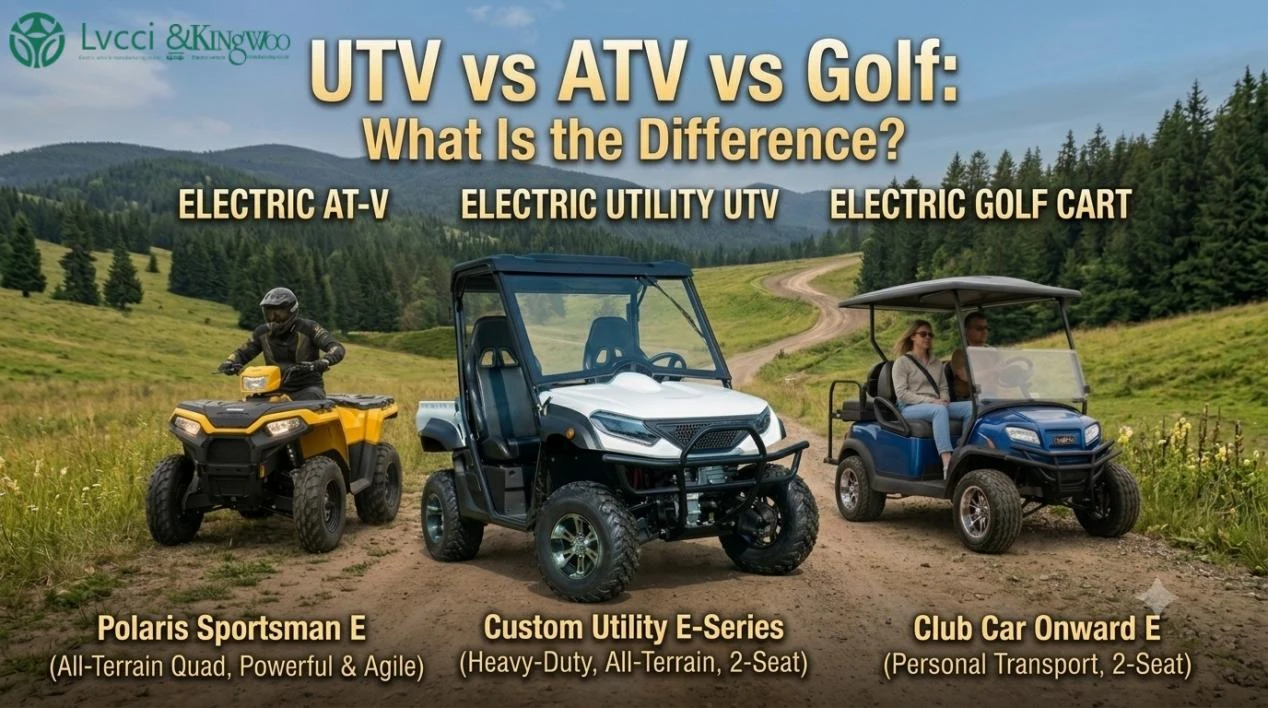
Many users tend to confuse these 3 models when purchasing. Although all three are small off-highway vehicles, they are very different in positioning, performance, and use. The following is a clear comparison to help you distinguish accurately and choose on demand.
ATV, commonly known as four-wheel ATV, uses straddle-type seats and handle control. It is light and flexible, and is only suitable for single or double short-distance leisure off-road.
The UTV uses side-by-side seats, steering wheel control, with roll cage and cargo hopper, and its safety, passenger capacity, and cargo capacity are better than ATV. ATV wins over narrow trails for mobility and UTV wins over integrated practicality and safety.
| Contrast dimension | UTV (Side by Side ATV) | ATV (ATV) |
| Ride mode | Side-by-side, 2-6 passengers | Cross-ride type, mostly single ride |
| Control mode | Steering wheel, foot pedal, car-style control | Handle + manual accelerator brake |
| Security configuration | Roll cage + safety belt with perfect protection | No professional protective structure, rely on protective gear |
| Cargo towing | Self-contained cargo bucket, strong dragging ability | Simple shelf only, limited load |
| Applicable Scenarios | Operation, manned, long-distance cross-country | Single Casual, Narrow Trail Off-Road |
Golf carts are mainly used for short-distance walking, low chassis, weak power, and no off-road performance. They are only suitable for golf courses and flat roads in residential areas.
UTV is specially designed for complex off-road terrain. The chassis is higher, the power is stronger, the body is stronger, and it has the ability to resist bumps and wear. It can cope with various harsh road conditions, and the scene adaptability far exceeds that of golf carts.
According to the use, performance and design positioning, UTV can be divided into four mainstream categories, covering leisure and entertainment, engineering operations, extreme cross-country and other full-scene needs, different models of the adaptation of the crowd is obvious.
This type of model focuses on lightweight design, smooth power adjustment, high suspension comfort, and simple and stylish appearance. It is mainly suitable for outdoor camping, forest crossing, desert shallow adventure, family leisure cross-country and other scenes.
The model takes into account both appearance and stability, simple operation and high safety, suitable for novice players and home users, does not pursue extreme speed, and focuses on comfortable and casual outdoor experience.
This is the market penetration rate of the highest demand models, the core focus on all kinds of job scenarios. The body structure is strong, the chassis is strong, and the emphasis is on optimizing load, drag and durability.
It is widely used in farm breeding, pasture inspection, landscaping, site material transportation, scenic spot operation and maintenance and other scenes. It can be matched with various modified accessories and is a veritable “universal tool vehicle for site operation”.
Designed for extreme cross-country and professional events, it is equipped with a large-displacement high-performance engine with strong power and rapid speed. Equipped with extended travel professional suspension, it can easily cope with extreme road conditions such as leaps, steep slopes, and rocky roads.
The body is lightweight and optimized, the control sensitivity is extremely high, and the top speed can reach more than 75 miles per hour, which is suitable for the racing and deep exploration needs of off-road enthusiasts and professional players.
It belongs to a new generation of upgraded UTV, using pure electric power system, completely replacing the traditional fuel engine. With the advantages of zero emission, low noise and low cost, it has become a popular upgrade model and the mainstream direction of the industry’s future development.
Adapt to scenic spots, ecological forest areas, breeding pastures, residential areas and other noise, emission-restricted scenes, taking into account the practicality of the operation and environmental compliance.
With the comprehensive advantages of “being able to carry people, cargo, off-road, and easy to operate”, UTV breaks through the scene limitations of a single model and is widely used in civil, commercial, and public welfare services.
In the outdoor field, UTV is a great partner for camping, cross-country crossing, mountain fishing and wild hunting. The multi-seat layout can meet the needs of many people, and the rear cargo bucket can accommodate tents, fishing gear, hunting equipment and other materials.
The characteristics of electric UTV silent operation, will not disturb wild animals, especially suitable for hunting, ecological adventure and other quiet scenes, greatly enhance the outdoor travel experience.
Farms and pastures are the core application scenarios of UTV. Farmers can drive UTV to inspect farmland, inspect fences, transport feed, carry farm tools and crops.
For large-area plantations and farms, UTV can quickly complete global inspection and material transfer, which is more flexible and efficient than walking and tractors, greatly saving labor and time costs.
In construction sites, garden landscapes, large manors, resorts and other venues, UTV is mainly used for short-distance transportation of materials, site inspection, garbage cleaning, equipment dragging and so on.
The body is small and flexible, and can shuttle in narrow areas that large vehicles cannot reach. At the same time, it has a certain load capacity, which perfectly adapts to the daily operation and maintenance needs of small and medium-sized venues.
UTV is also a common equipment for emergency rescue and public security. Forest fire, mountain rescue, park security, scenic spot patrols and other scenes, will use off-road performance strong UTV models.
Under the complicated road conditions such as rainstorm, mud and mountain forest, UTV can quickly reach the rescue point, transfer personnel and deliver rescue materials, making up for the short board of traditional rescue vehicles.
With the tightening of environmental protection policies and rising car costs, electric UTV has gradually replaced traditional fuel UTV, becoming the preferred model for home, commercial and site operation and maintenance, with multiple core advantages over fuel models.
Electric UTV relies on battery power supply, no exhaust emissions during operation, and fully meets the environmental protection requirements of ecological scenic spots, natural forest areas, and breeding bases.
At the same time, the motor operating noise is extremely low, and it will not produce the roaring noise of fuel vehicles, which can avoid disturbing livestock and wild animals, and will not cause noise pollution to surrounding residential areas.
Long-term use of fuel UTV requires continuous consumption of gasoline and oil, and regular replacement of filter elements, spark plugs and other accessories, resulting in high maintenance costs. Electric UTV does not need fuel, only needs daily charging, and the cost of electricity is much lower than that of fuel.
At the same time, the electric structure is simple, no complex engine, transmission accessories, low failure probability, simple daily maintenance process, long-term use can save a lot of maintenance expenses, and the comprehensive cost performance is far more than fuel models.
The electric UTV is equipped with a motor power system, which can achieve instantaneous torque output. The power response is faster when starting, climbing, and dragging heavy objects, without the frustration of a fuel vehicle.
The whole vehicle runs more smoothly, has less vibration, and is not easy to fatigue after long-term operation and riding. Both novice and veteran can get a comfortable control experience.
At present, environmental protection control in all walks of life is becoming more and more strict, and the use of fuel non-road vehicles is more and more restricted. Electric UTV is a green new energy equipment, no emissions, no pollution, stronger compliance, no need to worry about policy restrictions.
It is also a preferred model for all kinds of scenic spots, farms and parks to upgrade equipment and build a green operation and maintenance system.
Scene is the first standard for purchasing UTV. Different uses correspond to completely different vehicle models. Accurate matching can maximize the value of vehicles.
If it is mainly used for farms, pastures, site operation and maintenance, and material transportation, engineering practical UTV is preferred. Focus on load, drag capacity, body durability, no need to pursue high speed, stability and durability, strong bearing capacity is the core demand.
If the main family outdoor, leisure camping, light cross-country, hunting adventure, leisure balance or electric UTV can be selected. This type of vehicle has mild control, low noise, high safety, and comfortable riding for many people, which fully meets the daily leisure needs.
If you are a cross-country enthusiast or professional player, for deep crossing, desert racing, extreme cross-country, give priority to sports competitive UTV, and pay attention to engine horsepower, suspension stroke, speed-up performance and extreme passability.
The type of power directly determines the cost of the car, the suitability of the scene and the difficulty of post-maintenance, and is also the core tangle of the current user’s purchase.
Electric UTV is suitable for short-distance and fixed scenes, such as scenic area operation and maintenance, farm daily inspection, operations around residential areas, and hunting in ecological forest areas. Zero emission, low noise, simple maintenance, extremely low vehicle cost, and stronger compliance are the first choice for daily lightweight operations.
Fuel UTV is suitable for long-distance off-road, no charging conditions, high-intensity continuous operation scenarios. Convenient refueling, no short board in endurance, sufficient power reserve, more stable in the face of extreme road conditions and long-term towing operations, suitable for professional off-road and severe working conditions.
UTV is divided into 2, 4, 6 three mainstream versions, the number of seats directly affect the practicality and body size.
For single-person operation and double-person short-distance travel, you can choose a 2-seat model. The body is smaller and the shuttle between narrow forests and field paths is more flexible.
Family travel, team work, multi-person patrol operation and maintenance, giving priority to 4 mainstream versions, taking into account space and flexibility, and adapting to most scenes.
Large parks, farm team work, collective outdoor travel, can choose 6 extended version, to meet the needs of many people at the same time.
Different terrains have completely different requirements for UTV’s chassis, suspension, and four-wheel drive performance. If the parameters are not matched properly, problems such as car trapping, bumps, and unstable driving may occur.
Farmland, flat woodland and other mild complex terrain, conventional ground clearance, basic four-wheel drive version can be used, more cost-effective.
For muddy, sandy, and snow scenes, you need to choose models with differential locks, four-wheel drive switching, and large-pattern off-road tires to improve grip and escape ability.
Extreme terrain such as gravel, steep slopes, and rocks, focusing on long-stroke independent suspension, high ground clearance, and strong power torque to ensure off-road stability and passability.
The purchase of UTV can not only look at the price of bare cars, but also comprehensive post-maintenance, energy consumption, accessories modification and other long-term costs.
The entry-level practical model is cost-effective, suitable for ordinary farmers and small venues for daily use, budget-friendly, sufficient and non-wasteful.
The mid-range balanced model takes into account work and entertainment, complete configuration, high comfort, suitable for most families and small and medium-sized enterprise users.
High-end competitive, electric high-end models, stronger performance, richer configuration, suitable for professional players, high-end venues and long-term commercial operation and maintenance.
Long-term high-frequency use scenario, priority electric UTV, although the purchase price is slightly higher, but ultra-low maintenance and electricity costs, long-term use is more economical.
Whether leisure or work, safety is just needed. When purchasing, priority is given to models with ROPS roll cage, multi-point seat belts, and hydraulic disc brakes as standard to ensure driving safety to the greatest extent.
At the same time, it is suggested to choose a vehicle with strong expansibility and reserve a modification interface, which can be equipped with snow pusher, winch, spray equipment, windshield, ceiling and other accessories in the later period, so as to 1 the vehicle with multiple uses and adapt to more scenes.
Priority should be given to large brand models, with more stable quality control, perfect after-sales system, better matching of accessories, and no channel for later maintenance.
If conditions permit, you can test drive on the spot, feel the control feel, dynamic response and ride comfort, and judge whether it is suitable for your own needs in combination with real experience.
Understand the local site and road control rules in advance, confirm the compliance of vehicle use, and avoid normal use after purchase.
Combined with users’ high-frequency search questions, the most practical UTV frequently asked questions are sorted out to quickly solve everyone’s confusion about purchasing and using cars.
All in all, UTV is the 1 all-round all-terrain vehicle that takes into account practicality, safety, off-road, and entertainment. Through the unique body structure, mature power transmission system and perfect safety configuration, it has both strong terrain passing ability and efficient operation ability, which perfectly fills the market gap between ordinary scooters, off-road vehicles and engineering equipment.
UTV can be efficient and competent in daily operations of farms and pastures, site operation and maintenance, outdoor leisure cross-country and emergency patrols. Among them, electric UTV, as a new generation of upgraded models, with the advantages of environmental protection, low cost and high adaptation, has become the mainstream choice of the present and future.
If you are looking for an all-terrain vehicle that takes into account work and entertainment and adapts to multiple scenes, high-performance electric UTV is definitely the preferred solution with extremely high cost performance.


-150x150.png)