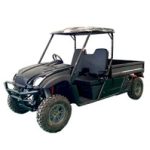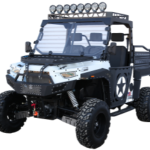

For farmers, ranchers, outdoor hunting enthusiasts, large-area property owners, and commercial users, UTVs (Side-by-Side Utility Vehicles/SxS) have long been more than mere recreational equipment; they are the core tools for daily operations, outdoor commuting, and site operation and maintenance. With the iterative upgrading of new energy technologies, electric UTVs are rapidly emerging as a mainstream alternative to traditional fuel UTVs.
Many users will be in a dilemma when shopping: electric UTVs are quiet and worry-free, but the purchase price is higher; fuel UTVs are cost-effective and have no anxiety about range, but the cost of use and maintenance remains high. There is no absolute advantage or disadvantage between the two models, but only the difference in the adapted scenarios.
In this article, we will compare the differences between electric UTVs and fuel UTVs from the dimensions of model definition, core performance, usage scenarios, long-term costs, industry trends, etc., to help you combine your own usage scenarios, budgets, and usage environments to accurately select the model that suits your needs, and avoid purchasing misunderstandings.
Electric UTV (Utility Task Vehicle, also known as side-by-side off-road electric vehicle) is a multi-functional off-road vehicle driven by batteries and electric motors, which completely abandons the traditional internal combustion engine structure, and is a new energy equipment suitable for outdoor work and recreational off-road in the new era.
In terms of appearance and basic functions, the electric UTV is highly consistent with traditional fuel models, and is equipped with 2-6 person side-by-side seats, steering wheel control, four-wheel drive, professional off-road suspension and rear-mounted cargo hopper as standard, which fully meets the basic needs of driving on complex terrain, hauling and towing of materials, and site operation and maintenance.
Its core differentiation advantages are focused on power and experience: equipped with lithium iron phosphate (LFP) or lithium battery pack with professional motor controller, it can output instantaneous peak torque, and has extremely fast power response for starting, climbing, and towing; the whole vehicle has simple mechanical structure, near-silent operation, and realizes zero tailpipe emission, and there is virtually no noise and no exhaust pollution in daily use, and the threshold of maintenance has been reduced significantly.
Fuel UTV is the mainstream traditional multi-functional off-road vehicle in the market, with gasoline and diesel internal combustion engine as the core power source, and has long dominated the outdoor operation and cross-country market by virtue of its mature technology, stable performance and flexible supply mode.
The basic configuration is interoperable with electric UTV, supporting 2-6 passengers, high ground clearance, 2WD/4WD switching, independent off-road suspension and rear cargo design, which is suitable for mountain, wilderness, farmland and other types of complex unpaved roads, and can meet the demand for heavy-duty towing, long-distance traversing and other high-intensity operations.
The power system is equipped with 400cc-1000cc+ single-cylinder/double-cylinder internal combustion engine, matched with CVT system, the power output is stable and long-lasting. However, the shortcomings are also very obvious: traveling noise, continuous tailpipe emissions, mechanical parts and components, the need for regular replacement of oil, filters, spark plugs, drive belts and other accessories, daily maintenance process is cumbersome and more costly.
The two models have similar appearance, load bearing and cross-country capability, and the core gap is centered on key dimensions such as power output, cost of use, range supply, and maintenance difficulty, etc. Below are the details of the precise benchmarking:
| Comparison Dimension | electric UTV | fuel UTV |
| Power Source Lithium | lithium iron phosphate battery + motor drive gasoline | diesel combustion engine drive |
| Running Noise | near-silent, no harsh noise | exhaust noise, high degree of recognition |
| Exhaust Emissions | Zero tailpipe emissions, zero pollution | generation of exhaust gases, the presence of carbon emissions |
| Torque And Acceleration | instantaneous full torque output, starting, climbing, dragging strong explosive | torque gradually climbing, sustained power stability, low-speed explosive power is weak |
| Horsepower Performance | mainstream models 110+HP, power parameters bright | mainstream models 60-100+HP, mature and stable tuning |
| Endurance | Range 20-80 miles on a single charge, greatly affected by terrain and load | Single tank of fuel range of 100 miles or more, can carry spare fuel to expand range |
| Replenishment Mode | slow charging takes 4-8 hours, fast charging can speed up, need to be fixed charging | scene refueling only a few minutes, replenishment flexibility without thresholds |
| Purchase Cost | high, the battery pushes up the pricing of the whole vehicle | the same configuration model price is lower, the threshold of entry friendly |
| Usage Cost | Extremely low cost of use, electricity costs about $0.09/mile | on the high side, fuel costs about $0.15/mile |
| Maintenance Cost | Very low maintenance costs, no oil, filters, spark plugs and other wear parts | maintenance process is high, you need to regularly change the oil, belts, filters and other accessories, regular maintenance engine |
| Ten Years Of Holding Cost | overall savings, compared to fuel models can save $ 7000-11000 | long-term oil + maintenance costs are high, the total cost of ownership is higher |
| Low-Temperature Performance | low-temperature battery degradation, a small decline in range | the low-temperature effect is minimal, stable working conditions |
| Scenarios | silent operation, short-distance daily operation and maintenance, ecologically sensitive areas | remote traversing of sites with charging conditions, remote sites without infrastructure, and long-time heavy-duty operation |
The core performance advantage of electric UTV lies in the low-speed instantaneous torque, which can output full power when the power is turned on, and the experience of hauling heavy loads, getting out of the mud and driving on steep slopes is far better than that of the same class of fuel models, which is very suitable for short-distance heavy-duty and fixed-point operation scenarios.
Fuel UTVs have no battery life concerns, gradual power output, higher stability at high speeds, and more stable working conditions for long hours of continuous operation, long-distance cross-country traversing, and high-load continuous towing scenarios, without power decay, making it the preferred choice for high-intensity, long-duration operations.
Silence and zero emission are the core differentiation highlights of electric UTV. Nearly silent operation will not disturb wild animals or neighboring residents, which is perfect for hunting, ecological parks, residential neighborhoods, indoor venues and other noise-sensitive scenarios. Zero exhaust emissions can be used in confined spaces, orchards, ecological protection zones and other venues with high environmental requirements, with no exhaust gas pollution risks.
Fuel UTV running noise, exhaust emissions, not only can not adapt to the quiet, environmentally friendly restricted scenes, long-term closed operation there will be security risks, only suitable for outdoor open, no noise control site use.
Range and replenishment are the core advantages of fuel UTVs. Fuel UTVs have a range of more than 100 miles on a single tank of fuel, and can carry spare fuel with them for quick replenishment anytime, anywhere, and can resume work in a few minutes, which is fully suitable for remote wilderness, no power infrastructure, and multi-day continuous operation scenarios.
The range of electric UTV can reach up to 80 miles, but the complex terrain, load, low temperature environment will further compress the range, and charging time consuming longer, need to plan in advance power, more suitable for short distances, fixed sites, stable charging conditions of the daily operation scenarios.
Electric UTVs are quiet, environmentally friendly, low-cost, low maintenance, and suitable for short-distance, high-frequency, and refined operation scenarios:
– Outdoor hunting and wildlife monitoring: silent operation will not disturb the prey, close observation and tracking of wildlife, suitable for early morning, late-night hunting and ecological monitoring work, is the hunting enthusiasts just need equipment.
– Daily operation and maintenance of farms and orchards: zero exhaust will not pollute crops and soil, suitable for feeding livestock, carrying agricultural materials, orchard inspection, light towing and other daily work, long-term use of very low cost.
– Large manor and residential area management: no noise operation, can work in the morning and evening without disturbing the people, suitable for yard finishing, firewood handling, snow cleaning, green plant maintenance and other fine operation and maintenance work.
– Commercial and ecological sites: resorts, golf courses, ecological parks, indoor construction sites, campuses, factories and other sites that require noise and environmental protection, suitable for patrol, material transfer, site maintenance and other work.
– Light outdoor leisure: short-distance camping, light cross-country, parent-child travel, smooth power, simple operation, better experience.
Fuel UTVs focus on long range, fast supply, high load, no dependence, and are suitable for long-distance, heavy-duty, and remote high-intensity operation scenarios:
– Remote ranch, large farm operation and maintenance: no power infrastructure in the vast field, continuous operation throughout the day, unlimited range with spare fuel, suitable for grazing, fence maintenance, bulk material transfer and other high-intensity work.
– Engineering construction and heavy-duty site management: support long-time heavy-duty towing, building materials handling, site leveling, stable power output in extreme terrain and high-altitude environments, suitable for construction sites, mines, forests and other complex operational scenarios.
– Long-distance cross-country traversing, multi-day outdoor adventure: no range anxiety, can be replenished at any time along the way, suitable for multi-day wilderness traversing, long-distance cross-country, remote area exploration and other scenarios.
– Municipal, engineering fleet commercial: high attendance rate, high fault tolerance rate, convenient replenishment, suitable for emergency rescue, site inspection, engineering operation and maintenance and other uninterrupted operation needs.
Many users only focus on the purchase price when shopping, but ignored the long-term cost of ownership. From 5-10 years of full life cycle, electric UTV comprehensive cost-effective far more than fuel UTV, only short-term low-frequency use of fuel models more cost-effective scenarios.
Fuel UTVs have a lower entry threshold, with mainstream basic models priced at $10,000-15,000 and high-specialized models priced at about $21,500 (e.g. Polaris Ranger XP 1000).
Electric UTVs are priced high due to battery costs, with mainstream high-spec models priced at US$30,000-37,000, and the initial purchase premium is obvious, but some regions can enjoy new energy subsidies of up to US$13,500, which significantly reduces the cost of purchasing a vehicle.
According to the industry’s ten-year actual measurement data, the long-term cost gap between the two models is significant:
– Energy cost: Fuel UTVs cost about US$6,000-7,000 for ten years; electric UTVs cost only US$1,000-2,000, with outstanding energy-saving advantages.
– Maintenance Costs: Fuel UTVs require regular replacement of oil, filters, belts, spark plugs and other accessories, with a ten-year maintenance cost of about 8,000-9,000 U.S. dollars; electric UTVs do not have a complex mechanical structure, which reduces maintenance costs by 70%, and costs only 4,000-5,000 U.S. dollars in ten years.
– Battery Replacement Cost: The battery life of electric UTV can reach 8-10 years, and the replacement cost of 4,000-15,000 U.S. dollars is the only uncertain cost item.
– Comprehensive total cost: Excluding the battery replacement cost, electric UTV can save $7,000-11,000 in ten years; even including the battery replacement cost, it still saves more money than fuel models in most scenarios.
Electric UTVs are more cost-effective: high-frequency daily operations, high average annual mileage, stable charging conditions, long-term holders (more than 5 years), and users who can enjoy new energy subsidies.
Fuel UTVs are more cost-effective: low-frequency weekend use, short holding period (within 3-4 years), remote charging conditions, and long-term high-intensity continuous heavy-duty operation.
2026 data show that electric UTV is the fastest growing segment of the off-road equipment industry, with an annual growth rate of up to 8%-19%, the North American market penetration rate has exceeded 18%, the head of the brand Polaris, John Deere, Can-Am have continued to increase the size of the electric model layout, the market substitution trend is obvious, the core reason for the 4 points:
– Driven by environmental protection policy: global non-road mobile machinery emission standards continue to tighten, fuel UTV emission control is getting stricter and stricter, zero-emission electric UTVs are more compliant and more adaptable in the future.
– Policy subsidies: California and other regions in the U.S. have introduced special subsidies for agricultural and commercial electric UTVs up to $13,500 purchase subsidies, which significantly erases the purchase price premium.
– Battery technology iteration: the new generation of LFP lithium iron phosphate battery range, stability, life significantly improved, the top model of the real range of up to 80 miles, to fully meet the needs of most daily operations, the battery cost continues to decline, the model cost-effective and constantly improve.
– Expansion of rigid demand scenarios: silent, zero-emission features unlocked hunting, ecological scenic spots, residential areas, indoor work and other fuel models can not cover the scene, commercial and civilian demand continues to explode.
– Long-term value highlights: enterprises, farms, commercial fleets pay more attention to the whole life cycle cost, electric UTV low energy consumption, low failure, low maintenance advantages, perfectly suited to the needs of large-scale operation.
At present, fuel UTVs still monopolize remote, long-distance and heavy-duty extreme scenarios, but for 80% of civilian, commercial and agricultural regular scenarios, electric UTVs have become more preferable.
The core principle of selection: do not look at the strength of the parameters, only look at the scene fit, to your 80% of the core needs for decision-making basis.
– Core demand for short-distance daily operation and maintenance, farm management, hunting, field patrol, average daily mileage of less than 50 miles;
– The use of the site has noise control, environmental protection requirements, near residential areas, ecological protection zones;
– Have stable charging conditions, can be charged at night valley power, to further reduce the cost of use;
– Plan to hold it for a long time (more than 5 years), pursuing low maintenance, low long-term cost and high cost-effectiveness;
– Prefer quiet and smooth operation experience, and loathe frequent overhaul and maintenance.
– High-frequency long-distance traversing, multi-day outdoor adventure, remote operation without power infrastructure;
– Requires all-day uninterrupted high-intensity heavy-duty operation, and has extremely high requirements for range and speed of replenishment;
– Limited budget, the pursuit of low upfront purchase cost, short-term holding, low-frequency use;
– Long-term operation in low temperature, high altitude and other extreme environments requires stable power output.
Many professional users and large venues will match the dual-vehicle configuration: electric UTVs are responsible for daily short-distance refinement operations, while fuel UTVs undertake long-distance, heavy-duty and adventure tasks, which comprehensively covers all kinds of use scenarios and takes into account the experience and efficiency.
Electric UTVs and fuel UTVs are not absolutely good or bad, but just adapt to different needs. Fuel UTV wins in low down payment, long range, fast supply and high stability, which is just needed for remote heavy load and long-distance cross-country; electric UTV wins in quietness and environmental protection, instantaneous power, ultra-low energy consumption, minimal maintenance, and long-term money-saving, which is suitable for most of the daily agricultural, commercial, and civil scenarios.
With the maturity of battery technology and subsidy policy in 2026, the comprehensive advantages of electric UTVs will be further magnified, and they will become a more cost-effective and better choice for users with charging conditions and long-term use. Combined with their own operating scenarios, budget and use of the environment to buy, in order to avoid the premium stepping on the pit, to buy the most suitable UTV models.

It is worthwhile. Although the initial purchase price is higher, the premium can be recovered in 3-5 years through the difference in electricity and maintenance fees, and the 10-year usage cycle can save thousands to tens of thousands of dollars, which is far more cost-effective than fuel models in the long run. Only short-term low-frequency use of the user is not recommended to start.
The service life of mainstream LFP lithium iron phosphate batteries can be up to 8-10 years, so there is no need to replace the batteries in the middle of normal daily use, and they can be replaced on demand after the expiration date, so most users don’t need to bear the cost of replacing the batteries during the holding period.
It can be used normally, but the low temperature will lead to a decline in battery activity and a small decline in range, which is a normal phenomenon; fuel UTVs are more stable in low-temperature conditions, and high-frequency use in extremely cold areas can be prioritized over fuel models.
The mechanical structure of electric UTV is extremely simple, no engine, transmission, spark plugs, belts and other wear parts, maintenance workload is reduced by more than 70%, the failure rate is lower, almost no need for overhaul.
Very suitable. Nearly silent running state will not disturb the prey, zero exhaust pollution, is the optimal choice for silent hunting, wildlife monitoring, but also hunting enthusiasts mainstream upgraded models.
Mainstream basic model range of 20-45 miles, high matching upgraded version of the range up to 80 miles, level road surface, light load conditions under the range of more solid, fully meet the daily field operations, short distance outdoor needs.



-150x150.png)