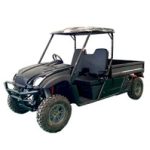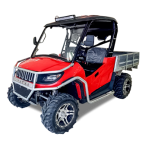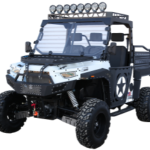
With the iteration of new energy technology, electric UTVs (side-by-side all-terrain vehicles) are gradually replacing traditional fuel UTVs by virtue of the advantages of quietness, environmental protection, excellent performance, and low operation and maintenance costs, and are widely used in agricultural and animal husbandry operations, park operation and maintenance, outdoor hunting, and factory transport scenarios. Traditional fuel UTVs are noisy, have exhaust fumes, cumbersome maintenance and high long-term costs, and many places have introduced fuel vehicle restrictions and noise restriction policies, further promoting the popularity of electric UTVs.
At present, the market electric UTV brand is complicated, the parameters are not the same, many buyers are prone to step on the pit and choose the wrong model. This article is a 2026 professional electric UTV shopping guide, from the definition of the model, the core advantages, scene matching, shopping parameters, avoiding the pit skills, model comparison, cost analysis and other dimensions, comprehensively dismantle the logic of the purchase, to help all types of users accurately match the high adaptability, cost-effective electric UTVs.
Electric UTV (Utility Task Vehicle, multifunctional work all-terrain vehicle), also known as electric side-by-side vehicle (Electric Side-by-Side), is relying on lithium batteries, lithium iron phosphate batteries powered by electric motors to drive a special vehicle for unpaved roads. Unlike traditional fuel UTVs with internal combustion engine power structure, electric UTVs rely on pure electric power output, retaining the body structure and off-road attributes of fuel UTVs, while realising the operational advantages of zero emission, low noise and high torque, making it a new generation of outdoor operational and recreational off-road equipment that takes into account both practicability and environmental friendliness.
Electric UTV is not a simple ‘fuel to electricity’, its core structure is suitable for outdoor complex working conditions, the core highlights of the configuration are as follows:
– Power system: the mainstream carries lithium-ion batteries or LFP lithium iron phosphate batteries, matched with multiple drive motors, abandoning the traditional internal combustion engine structure, which can achieve instantaneous full torque output at the start and zero delay in power response. The cycle life of the LFP battery is up to 2000-5000 times, which is far better than ordinary lithium batteries, and more suitable for high-frequency operation scenarios.
– Body design: side-by-side seating layout, supporting 2-6 passengers, equipped with a standard steering wheel, exclusive hopper, open/closed cockpit options, taking into account the dual needs of people and cargo.
– Off-road Configuration: 4WD/AWD four-wheel drive system is optional for the whole series, with independent suspension structure, it can easily deal with mud, steep slopes, gravel, grass and other complex unpaved roads, and the off-road passability is on a par with that of the fuel UTV.
– Hardcore performance: the towing capacity of mainstream models can reach up to 2500 lbs, and the cargo carrying capacity is 1000-1250 lbs. The comprehensive power, load, and cross-country performance are fully comparable to and even surpass the fuel UTVs of the same level.
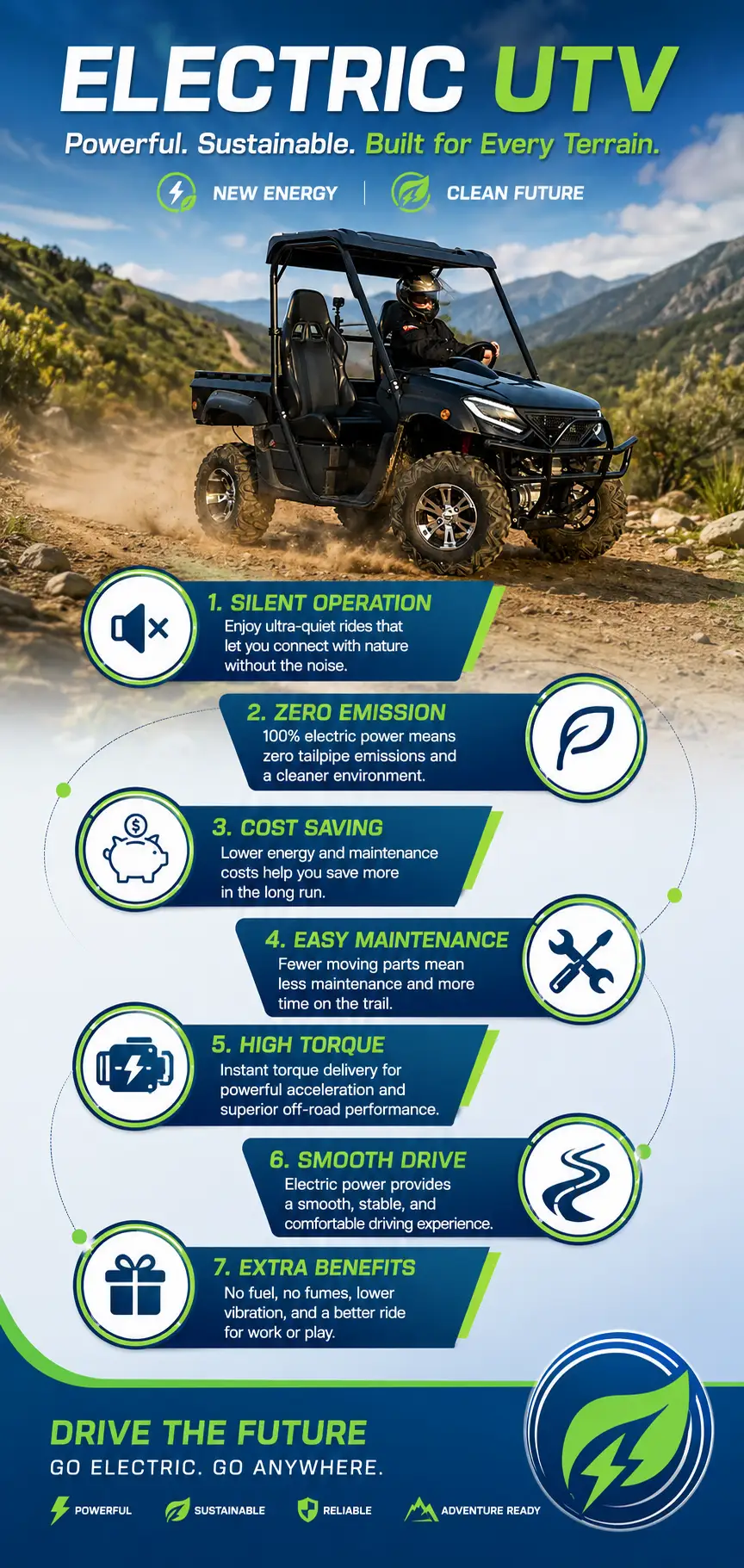
Compared with traditional fuel UTVs, the advantages of electric UTVs cover a variety of dimensions, such as experience, operation and maintenance costs, applicable scenarios, environmental compliance, etc., which is also the core reason for its rapid popularity.
There is almost no mechanical noise during the operation of electric UTVs, and there is no internal combustion engine roar and vibration, which completely solves the problems of noise nuisance and wildlife disturbance caused by fuel models. Whether it is the operation of farms near residential areas, scenic spot traffic operation and maintenance, outdoor hunting observation, or the passage of nature reserves, there will be no noise interference, and it is the only all-terrain operating vehicle that is suitable for the quiet control area at present.
The purely electric power structure operates without exhaust gas, pollutant emissions and petrol odour, which not only effectively reduces the carbon footprint and practices green operation, but also meets the requirements for use in strict environmental control areas. Meanwhile, it supports indoor confined space operation such as warehouses, factories and animal sheds, which is a core advantage that cannot be achieved by fuel UTVs at all.
The cost of electricity is much lower than that of fuel, and the daily charging cost is only about 60% of the cost of fuel, and if it is paired with solar charging at the site, it can achieve nearly zero energy consumption cost. In long-term high-frequency use scenarios, the savings on electricity costs are significant and can quickly offset the upfront premium of the vehicle.
Electric UTVs have no oil, spark plugs, air filters, fuel filters, exhaust systems and other wear and tear parts, completely eliminating the need for oil replacement, oil cleaning, exhaust maintenance and other cumbersome maintenance projects. Daily maintenance only requires checking tyre pressure, brake status and battery health, reducing maintenance workload by more than 70% and significantly reducing maintenance costs and equipment downtime.
The electric motor can release 100% peak torque at 0 rpm, which makes the starting, climbing and heavy-duty towing performance far better than that of the same-class fuel models. The power output is more stable under full-load travelling, climbing steep slopes and muddy scenes, without the problems of power lag and insufficient speed of fuel vehicles, which is suitable for all kinds of heavy-duty working conditions. The equivalent horsepower of high-end models can reach 110 hp, which is a very strong power performance.
There is no transmission stutter, no continuous engine vibration, precise throttle control, balanced body weight, and higher driving stability. When working outdoors for a long time or driving off-road for a long distance, the driving comfort is greatly improved, effectively reducing driver fatigue, and at the same time, the dialogue inside the vehicle does not need to be communicated in a loud voice, which makes the experience feel better.
It supports one-button start in low-temperature environments, eliminating the need for repeated ignition of fuel vehicles; it is equipped with an energy recovery braking system, which recovers electricity during downhill and deceleration, effectively extending the range; it meets the standards for green new energy equipment, and it can apply for new energy subsidies in many places, and special subsidies for agricultural emission reduction, which further reduces the cost of purchasing the vehicle.
The first core principle of choosing an electric UTV is that there is no best model, but only the one that is most suitable for the scenario. Blindly pursuing high configuration, high power, or low price and low configuration will lead to low equipment utilisation, insufficient performance and wasteful cost. Different use scenarios, the model configuration, load, range, cross-country ability of the demand is very different.
Core use: transporting crops, feed, fertiliser, fencing tools, agricultural equipment, suitable for muddy roads, bumpy dirt roads and steep slopes in the field.
Necessary configuration: Prefer four-wheel drive version, thickened and durable suspension, large-size hopper, and high load parameter models, to ensure the passability and heavy-duty capacity of complex field road conditions, and to meet the needs of daily high-frequency and large-load transport operations.
Core use: transfer of forage, animal husbandry materials, water supply equipment, maintenance tools, daily inspection and operation and maintenance of large pastures.
Core requirements: silent operation is the first and foremost need to avoid noise disturbance to livestock and horses; at the same time, flexible handling, stable low-speed torque, comfortable suspension system, suitable for long-distance gentle driving and fine road conditions in large pastures.
Core use: visitor transfer, luggage transport, park facilities inspection, environmental health operation and maintenance.
Core requirements: Priority is given to ride comfort, quietness, and neatness of appearance, with lower requirements for extreme cross-country capability. The models with multi-seat layout, stable body and low noise are suitable for green operation and high quality service in scenic spots.
Core use: factory, warehouse, campus, industrial park internal material transfer, equipment inspection, daily commuting.
Core requirements: strong battery stability, high charging efficiency, excellent continuous operation capability, as well as durable equipment, low failure rate, complete after-sales parts, to meet the needs of all-weather high-frequency continuous operation.
Core use: mountain cross-country, outdoor adventure, wild hunting, forest road exploration.
Core requirements: focus on ground clearance, suspension travel, 4WD off-road performance, range and quietness. Large-size tyres, high-passage chassis and powerful motors can easily cope with complex off-road conditions such as mud, woodland and gravel, and the quiet feature can avoid disturbing wild animals during hunting.
Before purchasing a vehicle, be sure to confirm: type of road conditions, average daily driving distance, maximum load/towing weight, number of passengers, frequency of use, local weather conditions, on-site charging conditions, as the core basis for screening models, to eliminate the configuration of excess or inadequate performance.
Explore our high-performance electric utility vehicles designed for tough terrains, off-road adventures, and sustainable utility tasks. Direct factory pricing.
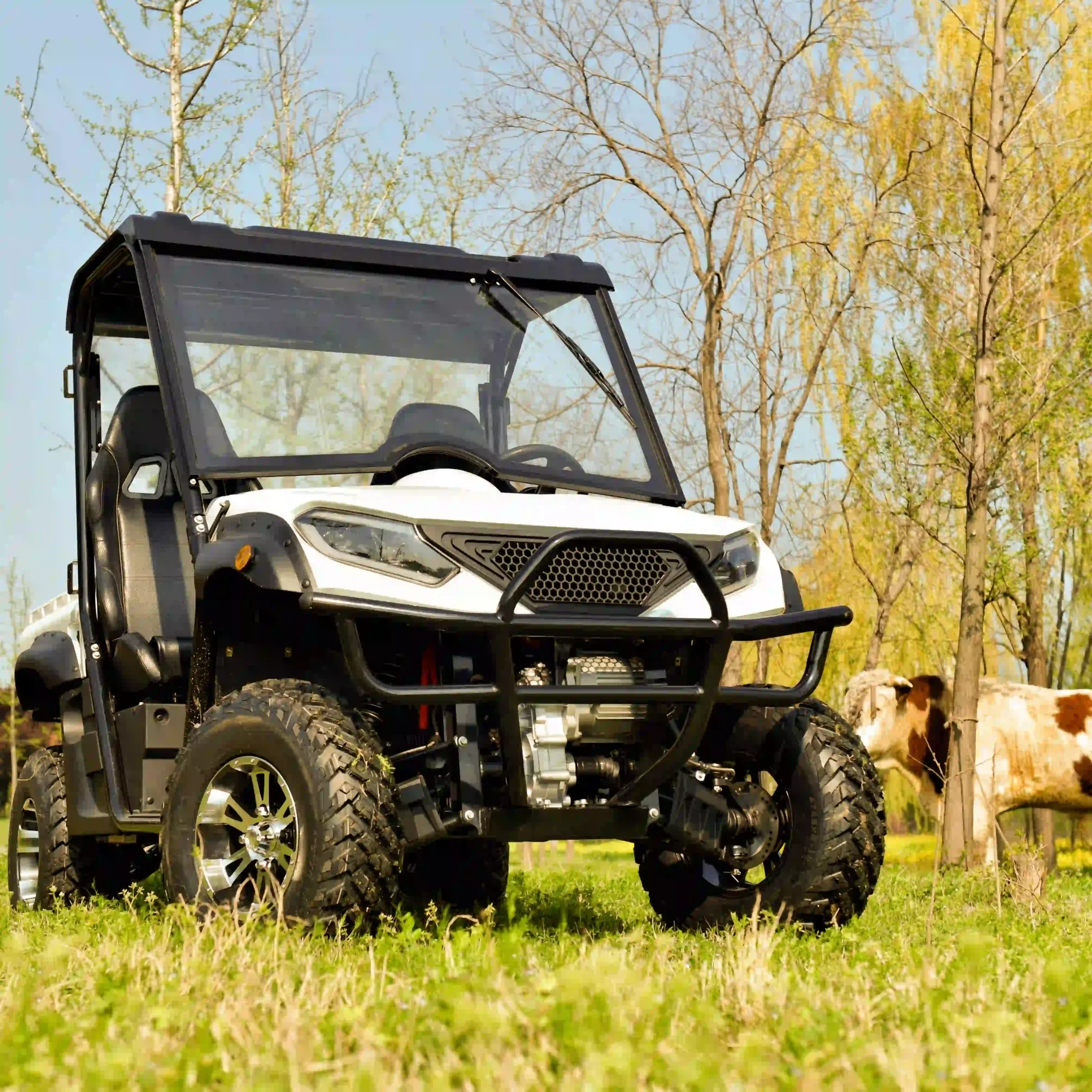
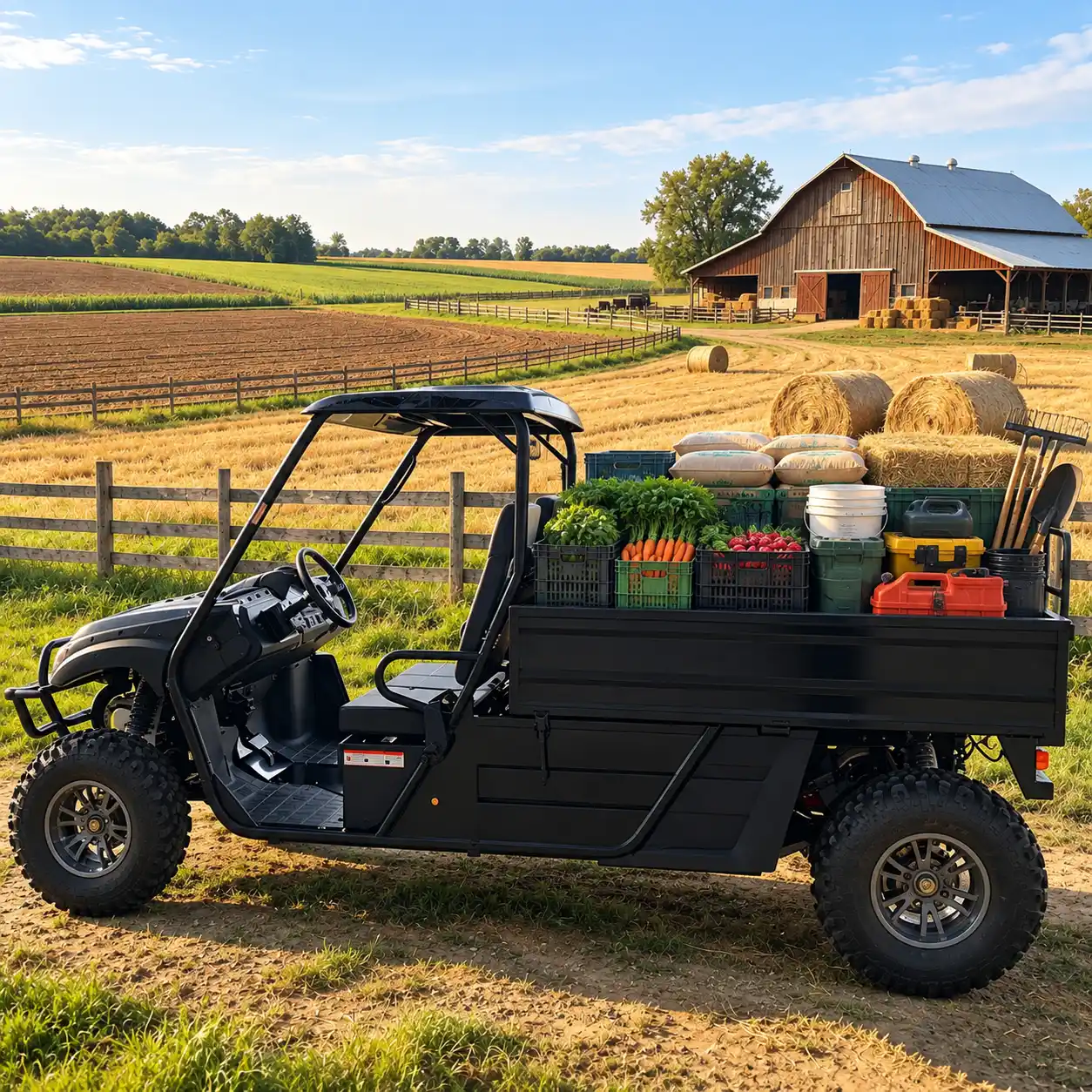
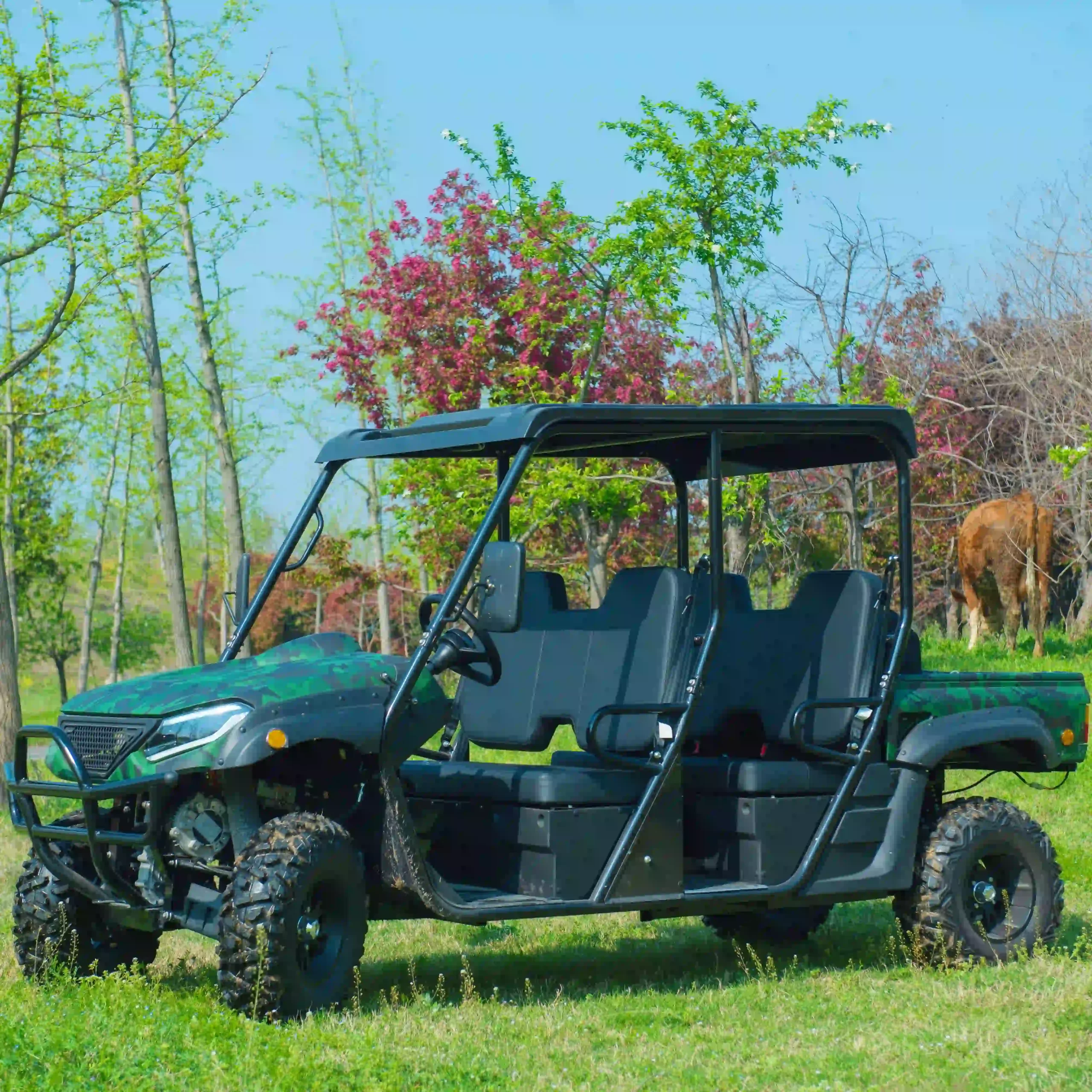
Operational users: priority load, towing capacity, body durability, cargo bucket utility; recreational cross-country users: priority range, passability, suspension performance, speed performance; commercial operation and maintenance users: priority comfort, stability, low failure rate, compliance. Mixed-use scenarios require a balance between performance and practicality, without blindly pursuing the ultimate in a single parameter.
Battery is the core of electric UTV, preferred LFP lithium iron phosphate battery, life up to 5-8 years, cycle times far more than ordinary lithium batteries, high temperature resistance, strong stability, suitable for long-term high-frequency use. The official range of market models is generally 40-80 miles, but the real working conditions, load, climbing, high-speed driving, cold weather will lead to range shrinkage of 30%-50%, the purchase must be based on the actual working conditions of the range, do not trust the official nominal data. At the same time, priority should be given to models that support 110V/220V dual-mode charging and are equipped with energy recovery brakes, so as to reduce charging limitations and extend the length of a single operation.
Mainstream high-quality models have an equivalent horsepower of 50-110 hp and strong torque output to meet the demand for heavy-duty hill climbing; the speed range of 25-55mph is suitable for both work and leisure scenarios. It is recommended to give priority to models with 2WD/4WD switching, differential lock, ground clearance of 10-12 inches or more, and independent long-travel suspension, which are perfectly suited to complex outdoor road conditions such as mountainous terrain, mud, and steep slopes.
For daily work, we prefer models that can carry 800-1250lbs and tow 1500-2500lbs, and for heavy-duty work, we need to choose the top-of-the-range version. Meanwhile, towing and hauling heavy loads will significantly compress the range, so you need to reserve enough range when purchasing. For passenger demand, you can choose the 2-6 seat layout according to the scenario, and give priority to the 4-seat and above passenger version for multi-person commuting.
High-end brands (Polaris, John Deere) have solid workmanship, complete accessories, perfect dealer network, and timely after-sales response, which is suitable for long-term high-frequency operation; affordable imported models have high cost performance and are only suitable for mild low-frequency use. Electric UTVs have almost no wearing parts, and their long-term reliability mainly depends on body work, battery warranty and brand after-sales system.
In 2026, the price range of electric UTVs in the market will be US$10,000-30,000, with the basic model costing US$11,000-15,000, and the price of the top model costing more. Although the initial purchase price is higher than fuel models, the long-term operation and maintenance cost advantage is significant. At the same time, California, San Jose and other regions have exclusive subsidies: Silicon Valley clean energy subsidies, agricultural zero-emission vehicle vouchers (up to $13,500), community power company instant rebates, and so on, a number of subsidies can be stacked, significantly lowering the threshold for the purchase of the vehicle.
Rigorously required essential features: anti-roll-over protection structure (ROPS), seat belts, LED lighting, hydraulic brakes, electric power steering, self-unloading bucket; advanced comfort features: closed cockpit, warm air system, Bluetooth audio-visual, anti-plosion tyres. When choosing, priority is given to all basic safety configurations, and comfort accessories are added on demand to avoid ineffective premiums.
Batteries are suitable for mild climatic conditions, and models with battery temperature control systems should be prioritised for long term high temperature and cold environments. At the same time, electric UTVs are not subject to emission restriction policies, and are more compliant for use in scenic spots, protected areas, and residential areas with strict environmental control, and the second-hand value retention rate is increasing year by year.
Combining the parameters of mainstream models, user reputation and scene suitability, we have compiled a precise model selection reference, covering all price points and scene requirements.
Core parameters: 110 hp equivalent, 140 lb-ft of torque, 29.8kWh high-capacity battery, maximum 80-mile range, 1,250 lb of load capacity, 2,500 lb of towing capacity, and a top speed of 55mph.
Strengths: strong power, solid range, top off-road performance, intelligent on-board system, comprehensive dealer after-sales network, combining heavy-duty work and outdoor off-roading.
Shortcomings: high price, high landed cost.
Suitable scenarios: mixed working conditions, mountain off-road, heavy-duty farmland operation, high-frequency long-term use.
Core advantages: deep ploughing of agricultural operation scenarios, strong body durability, suitable for all kinds of agricultural implements, stable load, very low failure rate, excellent smoothness in low-speed operation, and very low long-term operation and maintenance costs.
Shortcomings: Extreme cross-country speed, power is slightly inferior to Polaris, and leisure attributes are weak.
Scenarios: daily heavy-duty operation and maintenance of farms, ranches and estates, and purely commercial operation scenarios.
Core advantages: strong torque output, excellent passability of the chassis, designed for high-intensity off-road, complex mountain road conditions, fast speed, strong ability to get out of trouble.
Suitable scenarios: outdoor adventure, mountain cross-country, high-intensity unpaved road driving.
Core strengths: affordable price, support for agricultural subsidy claims, complete basic operational configuration, meet light agricultural, park operation and maintenance needs.
Shortcomings: general performance and durability, relatively weak after-sales system, not suitable for high-frequency and heavy-duty use.
Suitable scenarios: light operation, low-frequency use, limited budget entry users.
Electric UTVs of the same level are priced $3,000-15,000 higher than fuel UTVs upfront, and with accessories such as roofs, doors, winches, and self-unloading buckets, the overall upfront investment is even higher, which is also the primary concern of most users.
The energy cost of electric UTV is about $0.09/mile, while that of fuel UTV is about $0.15/mile, which saves more than 40% of energy consumption; meanwhile, the maintenance cost of electric model is reduced by 50-70%, with no expenditure on routine maintenance such as oil, filter, exhaust system, and so on. According to the average annual mileage of 1,000-2,000 miles, the total operating cost for 10 years: fuel UTV about 15,500 U.S. dollars, electric UTV only 4,500 U.S. dollars, long-term savings of 7,000-11,000 U.S. dollars.
California, San Jose and other regions in the United States have generous subsidy policies: San Jose clean energy up to $4,000 instant rebate, Silicon Valley clean energy subsidies of $2,000, agricultural zero-emission vehicle vouchers of up to $13,500, a number of subsidies can be stacked, the maximum reduction of $15,000 in the purchase of a car, significantly wipe out the upfront premium of the electric model, and the landed price of some models is even lower than that of the fuel version.
Comprehensive energy consumption, maintenance, subsidy income, electric UTV normal use of 3-5 years to recover the upfront price difference, 5-7 years into the pure income stage. Battery warranty is generally more than 5 years, the service life of 5-8 years, mild climate battery decay is slow, no need to replace frequently, superimposed on the higher second-hand value retention rate, long-term cost-effective far more than fuel UTV.
GET AN INSTANT QUOTEIn 2026, electric UTVs have got rid of the early short board of ‘weak power and short range’, and with the core advantages of strong torque, zero emission, low noise, low cost and less maintenance, they are fully adapted to the needs of the whole scenarios of agriculture, ranching, commercial, off-road, industrial operation and maintenance, etc. The core logic of selection is not to pursue the top of the range. The core logic of the selection is not to pursue the top-specification and high price, but to give priority to scene adaptation, supplemented by pragmatic parameters, and to give priority to long-term cost over short-term price. With the iteration of new energy technology and the tightening of environmental protection policies, electric UTVs will fully replace traditional fuel models and become the mainstream choice for outdoor work and leisure off-road.
Mainstream LFP lithium iron phosphate batteries have a service life of 5-8 years under normal maintenance, and the cycle life can reach 2000-5000 times. Manufacturers generally provide more than 5 years of battery warranty, and the battery degradation rate is slow under the mild climate environment, so the stability is excellent in long-term use.
Very suitable. Electric UTVs have sufficient instantaneous torque, excellent heavy-duty and hill-climbing ability, quietness that does not disturb livestock, zero-emission that is suitable for field operations in closed sheds, simple maintenance, and long-term high-frequency use, which makes them one of the most optimal equipments for agricultural and animal husbandry scenarios at present.
Yes. Under heavy-duty towing and climbing conditions, the range will be reduced by 30%-50%. When purchasing, you need to reserve enough range, or choose a high-capacity battery version to avoid power cuts in the middle of the operation.
You can enjoy $2,000 subsidy for Silicon Valley Clean Energy, up to $4,000 instant rebate for San Jose Clean Energy, and up to $13,500 voucher for Zero Emission Vehicles for Agriculture, and many policies can be stacked to significantly reduce the cost of purchasing a vehicle.
An electric UTV is better. Its ultra-low noise operation will not disturb wild animals, zero emission and no odour, while the power response is faster and the handling is smoother, which is suitable for the complex road conditions in the mountains and forests, making it the preferred vehicle for hunting scenarios.
Explore our high-performance electric utility vehicles designed for tough terrains, off-road adventures, and sustainable utility tasks. Direct factory pricing.


-150x150.png)