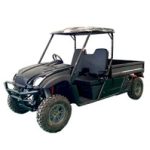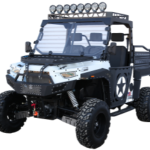
As the demand for outdoor work, farm operation and maintenance, wild hunting and leisure off-road scenarios escalate, the shortcomings of traditional fuel UTVs are gradually coming to the forefront: high fuel expenses, frequent maintenance, ear-splitting noise and exhaust gas pollution problems have made more and more users start to seek for more efficient, environmentally friendly and hassle-free alternatives. In this context, electric UTV (electric side-by-side all-terrain vehicle) has become the mainstream upgrading choice in the field of all-terrain vehicle by virtue of mature battery technology, stable power output and intelligent configuration.
UTV, also known as Utility Task Vehicle (UTV) or Side-by-Side All Terrain Vehicle (Side-by-Side), is a hardcore vehicle designed for off-road operation and outdoor recreation, which is different from conventional off-road vehicles, and is more suitable for utility operations and travel needs on complex unpaved roads. Electric UTVs are purely electric versions of UTVs with power batteries as the core power source, perfectly inheriting the hardcore passability of traditional UTVs while abandoning the inherent drawbacks of fuel power.
Whether it is electric or fuel UTV, the core basic configuration remains the same, including side-by-side seating for 2-6 people, automotive-style steering wheel and pedal control structure, exclusive cargo/self-unloading hopper, as well as high ground clearance, 2WD and 4WD systems and professional off-road suspension, which can be easily adapted to the farms, construction sites, mountains, manor houses and other complex terrains. It is mainly used for farming operation and maintenance, hunting equipment transportation, site maintenance, cross-country leisure and other scenarios. The electric UTV, with its pure electric power structure, has the unique advantages of zero emission, low noise, fewer failures, and easy operation and maintenance, realizing the double upgrade of performance and practicality.
Although the initial threshold of purchasing a vehicle is slightly higher, the total cost of ownership (TCO) for long-term use is much lower than that of fuel models, and the cost-effective advantage in high-frequency use scenarios is particularly prominent. The cost savings are mainly reflected in the two dimensions of energy consumption and maintenance.
Measured data show that the energy cost per mile of electric UTV is only $0.09, while the cost per mile of fuel UTV is as high as $0.15 or more, and long-term high-frequency use can save hundreds of dollars per year in energy consumption. Combined with household photovoltaic solar energy and low valley electricity charging program, the energy cost can be further compressed, realizing nearly zero-cost operation.
Fuel UTVs require regular replacement of oil, filters, spark plugs, fuel cartridges, as well as maintenance of CVT belts, cooling systems and fuel lines, with annual maintenance costs as high as $800-1,000; whereas electric UTVs, with their simple structure and few moving parts, do not require the abovementioned routine maintenance, and need only to regularly check the status of tires, brakes, suspensions and batteries, with an average annual maintenance cost of less than $400, reducing overall maintenance workload by more than 70%. The average annual maintenance cost can be controlled within $400, and the overall maintenance workload can be reduced by more than 70%.
From the perspective of a ten-year long-term ownership cycle, the industry’s authoritative calculation data shows that the ten-year comprehensive cost of fuel UTVs is about $15,550, while electric UTVs only cost $4,483, a direct savings of more than $11,000. Even taking into account the battery replacement cost of about $4,000 in the 8-10 year cycle, the final savings will still be about $7,000. Most regular users can realize the cost back in 5-7 years, which makes it cost-effective to hold the vehicle for a long period of time.
Of course, electric UTVs also have certain cost shortcomings: the initial purchase premium is higher, and the cost advantage is difficult to be reflected in the case of short-term holding (less than 3 years) and low-frequency use; at the same time, charging speed is slower than refueling, which may affect the operational efficiency when there is no spare vehicle. Overall, high-frequency use, own site can be charged, the pursuit of long-term savings users, can maximize the enjoyment of its cost dividends.
Electric UTVs are the most environmentally friendly models in the current all-terrain operation and outdoor recreation scenarios. Whether it’s the immediate operation status or the whole life cycle, they are far better than fuel UTVs, perfectly matching the needs of ecological protection and site compliance operation.
During operation, the electric UTV realizes zero tailpipe emission and emits no pollutants such as carbon dioxide, nitrogen oxides and particulates during operation and driving, which will not cause air pollution and ecological damage, and can be safely used in greenhouses, closed warehouses, eco-parks, nature preserves and other scenarios with air quality requirements. On the other hand, fuel UTVs continue to emit exhaust gases, which not only pollute the environment, but also damage the local ecology, and their use has been explicitly restricted in most ecologically sensitive areas.
From a full life cycle perspective, even after accounting for carbon emissions from battery production and electric power generation, lifetime greenhouse gas emissions from electric UTVs are still 40%-70% lower than fuel models. With the popularization of clean energy sources such as photovoltaic and wind power, the upgrading of the power grid to low-carbon, and the continuous improvement of battery recycling technology, its environmental advantages continue to expand. The only thing to note is that areas with a high proportion of thermal power, the emission reduction effect will be slightly weakened, but still comprehensively better than fuel models.
Noise control is the signature advantage of electric UTVs over fuel models, and it is also the core need of users in hunting, residential areas, breeding farms, scenic spots and other scenarios. The noise difference between the two is huge, and the actual experience is extremely different.
Data show that the fuel UTV idling to full throttle operation, the noise can reach 80-100 decibels, the original factory routine conditions generally maintain 85-95 decibels, the continuous roar is not only easy to trigger driver and passenger auditory fatigue, damage to hearing, but also disturb the wildlife and livestock. The noise of electric UTV operation is only 45-70dB, no engine roar, only produce slight tire friction, wind noise and suspension sound. Acoustic data show that every 10 decibels of noise doubles the loudness, a 90 decibels of fuel UTV, loudness is 60 decibels of electric UTV 8-16 times.
Ultra-low noise brings great scene suitability. For hunting enthusiasts, silent operation will not disturb the prey, can be realized close to the covert approach, greatly enhance the success rate of hunting; for breeding farms, no noise interference can let livestock and poultry to maintain emotional stability, to avoid stress reaction, help breeding quality and efficiency; for residential areas, golf courses, scenic spots, parks and other scenarios, can be avoided to noise complaints, in full compliance with the venue noise control standards. At the same time, silent operation can significantly reduce the fatigue of drivers and passengers, long-time work, riding without wearing soundproofing equipment, normal conversation without pressure.
It should be objectively stated that the electric UTV is not absolutely zero noise, tire friction at high speeds, slight motor hum still exists, but compared to fuel models, the noise control effect has achieved a qualitative leap.
Relying on the inherent advantages of the pure electric power architecture, the ride quality, handling precision and comfort of the electric UTV surpasses that of the traditional fuel UTV, completely solving the pain points of the fuel model, such as low-speed stuttering, strong vibration, and lagging handling.
The advantages of electric UTVs are especially prominent in low-speed working conditions. Fuel engine needs to increase the speed to output power, low-speed driving is prone to stuttering, fluttering, power lag, poor handling accuracy; while the electric motor can realize 0 speed full torque output, power output linear, smooth, no shift stuttering, no power interruption, with a minimalist electronic control logic, the throttle response is precise and controllable. At the same time, the electric structure has very few moving parts, almost no engine vibration, long time low-speed operation, off-road riding will not produce a strong sense of vibration, greatly reducing driving fatigue.
The smooth and precise handling characteristics make the electric UTV extremely suitable for fine-tuned operations: reversing and docking trailers, navigating narrow mountain roads, hauling cargo at low speeds, and fine-tuned maintenance of the site, etc., all of which can be accurately handled and stably passed to eliminate the safety hazards brought about by the sudden fluctuations. In addition, the dual support of mute + smooth, so that outdoor riding closer to nature, family leisure trips, scenic spots, riding experience has been greatly upgraded, the user can enjoy the outdoor scenery in an immersive manner, without the need to be disturbed by noise and vibration.
Many users have cognitive misconceptions that electric UTVs are weak in power and poor in performance, but in fact, in real off-road and operational scenarios, the real-world performance of electric UTVs far exceeds that of fuel models, and the core advantage is the instantaneous outbreak of torque.
The peak torque of the fuel engine needs to be released after pulling up the speed, and there is obvious power lag when starting, climbing, and heavy load starting, and it is easy to be underpowered and lack of power when climbing under load conditions. On the other hand, the electric motor can output 100% peak torque at the moment of stepping on the electric door, without warming up and speed accumulation, which makes the starting explosive force stronger and the power response more timely.
In the real-world scenario, this advantage is of significant value: when climbing steep slopes, the power continues to be output linearly, and it is not easy to have power attenuation and skidding problems; when heavy-duty towing and cargo hauling, the start is smooth and does not lag, and the loading capacity is stable; when traversing uneven and complex cross-country roads, the power is on demand, and it is more powerful and stable, which is perfectly suited to all kinds of hard-core operations and cross-country needs.
Compared with the cumbersome process of frequent trips to the gas station for fuel UTVs, electric UTVs have a more flexible and convenient way of replenishment, which completely reconstructs the user’s daily life and realizes autonomous and controllable energy.
There is no restriction on the replenishment scenarios, and users can directly complete the charging in homes, warehouses, farms, workshops and garages. Users can use 110V ordinary household sockets for slow charging in daily life, and can automatically replenish energy when parked at night, with full power available on the next day; users with high-frequency operations can add 240V Level 2 fast-charging equipment, which can significantly shorten charging time and meet the needs of high-intensity operations. There is no need to go to the gas station, which completely eliminates the trouble of gasoline queuing and fuel storage.
At the same time, the electric UTV supports diversified energy solutions, users can match the site solar photovoltaic system, wind power, valley power resources, to further reduce the cost of energy. Charging with nighttime low valley electricity prices or relying on photovoltaic to realize self-generation and self-consumption can not only realize extreme money saving, but also get rid of the energy dependence on traditional fuel and realize site energy independence. Some of the new models also support the V2L external discharge function, which can be used as an emergency mobile power source to meet the needs of outdoor operations and emergency power supply, and the practicability is greatly improved.
Conventional electric UTVs have a range of 30-80 miles on a full charge, which fully meets the daily needs of most farm operations and maintenance, site maintenance, short-distance cross-country, and hunting trips. Only extreme long-distance traversing, no power supporting remote area operations, there will be a short range, the user can be flexible according to their own scenarios adapted.
Less maintenance, low failure and high stability are the core highlights of long-term use of electric UTVs, which is especially suitable for users and enterprise fleets who do not have time to care for their vehicles and pursue high efficiency.
The maintenance system of traditional fuel UTVs is cumbersome and high-frequency, requiring regular replacement of oil, three filters, spark plugs, coolant, as well as maintenance of the CVT drive belt, fuel system, transmission structure, fast wear and tear of components, high probability of failure, which is not only time-consuming and labor-intensive, but also prone to vehicle breakdowns due to omissions in maintenance and shutdowns.
Electric UTV abandons the complex internal combustion engine and transmission structure, the core components are only batteries, motors, electronic control system, no wear and tear of the fuel system, transmission parts. Everyday only need to check the tire wear, brake status, suspension lubrication and battery health, with the system automatic detection, almost no need for manual complex maintenance. Ten-year cycle maintenance data show that the total cost of ten-year maintenance for fuel UTVs is about $8,800, while electric UTVs only need $4,045, saving more than $4,755, and the downtime is greatly reduced, and the vehicle attendance rate is higher.
Modern lithium battery technology is mature, standardized use of the premise, the battery life of up to 8-10 years, no need for frequent replacement, only need to avoid long-term power loss, extreme high and low temperature storage can be, maintenance threshold is extremely low.
Relying on the inherent advantages of pure electric electronic architecture, the intelligent and digital configuration of electric UTVs comprehensively crushes the traditional fuel UTVs, and is more suitable for the modern user’s car habits and refined management needs.
In terms of hardware configuration, most electric UTVs are equipped with 7-10-inch high-definition intelligent touch screen, which can real-time display core information such as battery power, remaining range, charging status, vehicle fault data, etc., so that the vehicle condition can be seen at a glance; equipped with back-up camera, Bluetooth audio-visual and GPS topographic navigation and other practical configurations, which take into account both safety and entertainment.
At the level of intelligent functions, it supports cell phone APP interconnection remote control, which can locate the vehicle in real time, monitor the battery health, receive fault warning, and view the driving data, which is suitable for intensive fleet management. Meanwhile, it is equipped with multi-mode riding regulation, supporting exclusive modes such as economy, standard, sport, work, snow removal, etc. It can switch the power output logic according to the road conditions and operational needs, and with the energy recovery system, the range is further improved. In addition, the vehicle supports OTA remote upgrading, so you can update the system functions without going to the store, and continue to optimize the experience of using the vehicle.
With the comprehensive advantages of zero emission, low noise, high smoothness, strong power and easy maintenance, the electric UTV breaks through the scene limitations of fuel models and can be widely adapted to multi-industry, multi-scene operation and leisure needs, and is a multi-functional vehicle with strong versatility.
In the field of agricultural farming, it can be used for field inspection, feed transportation, livestock inspection, field extermination, quiet and no disturbance to livestock and poultry, no exhaust pollution of farmland, suitable for indoor and outdoor full-scene operation; in the field of hunting and leisure, quiet and hidden, precise control, suitable for field investigation, equipment transportation, wildlife observation; in the municipal government, scenic spots, golf courses, it can meet the needs of field maintenance, patrol duty, visitor feeder, and meet the environmental protection and noise control regulations; in the municipal government, scenic spots, golf course, it can meet the needs of field maintenance, patrol duty, visitor feeder, and meet the environmental protection and noise control regulations. In municipalities, scenic spots and golf courses, it can meet the needs of site maintenance, patrol duty and tourists’ feeder, and meets the requirements of environmental protection and noise control; in the field of industrial warehousing, it can be adapted to indoor material transfer and warehouse inspection with zero exhaust, and solves the problem of indoor prohibition of fuel models; meanwhile, it can also be used in eco-tourism, campus security and emergency rescue scenarios, and its adaptability is far more than that of traditional UTVs.
If your vehicle scenario meets the following conditions, electric UTV is the optimal solution: daily short- and medium-distance field work and leisure riding; pay attention to environmental protection and quietness, and have control requirements for field noise and emission; own site can realize home charging, and can be paired with photovoltaic energy; plan to hold the vehicle for a long time (more than 5 years), and pursue low-maintenance maintenance, low-cost, and high peace-of-mind; and pay attention to intelligent configurations and comfortable driving experience.
The following scenarios are more recommended to choose fuel UTV: frequent long-distance remote crossing without power supply conditions; long-term high-speed and heavy-duty towing operations; short-term use of the vehicle (less than 3 years), with a limited budget; lack of power infrastructure in the operation area, and high-frequency use of the vehicle in extreme low-temperature environments.
From a comprehensive point of view, electric UTV is not a simple alternative to fuel UTV, but a fully upgraded version of all-terrain utility vehicle. It breaks the traditional UTV high cost, high pollution, high noise, high maintenance drawbacks, while taking into account the core advantages of strong power, smooth handling, intelligent and convenient, ultra-low operation and maintenance, and realizes the comprehensive leadership in economy, environmental protection, sense of experience, practicality, and sense of science and technology in five dimensions.
For the vast majority of individual users, farm operators, park operation and maintenance, and commercial fleets, electric UTVs have become the most worthwhile all-terrain operation and leisure vehicle in 2026 by virtue of their core values of long-term low cost, full-scene adaptability, and durability, and they are the choice of the future that takes into account the practical value and long-term cost-effectiveness.


-150x150.png)