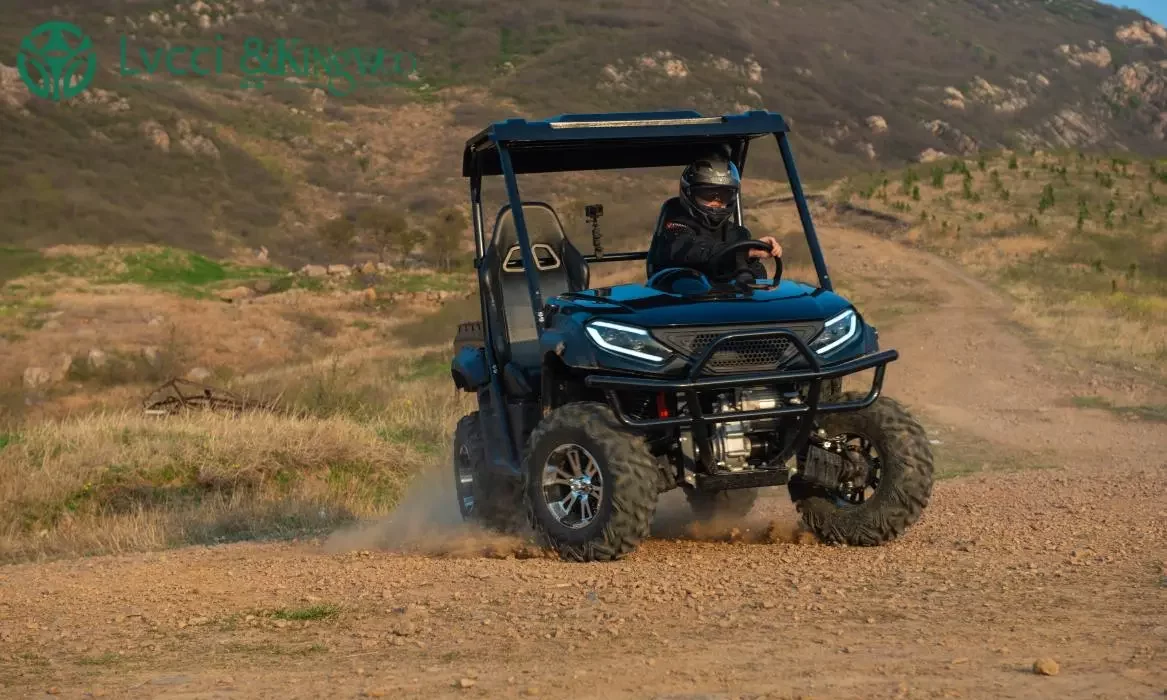
Traditional fuel UTVs have long dominated outdoor operations, agricultural O&M, and hunting off-road scenarios, but there are pain points such as loud noise, expensive maintenance, and exhaust pollution. With the iteration of electrification technology, electric UTV (electric side-by-side off-road mission vehicle) short boards are basically optimized, and with the advantages of quietness, low cost, and high torque, it has become the preferred alternative for high-frequency short- and medium-distance outdoor scenarios in 2026.
Electric UTV is a battery-driven multifunctional off-road task vehicle, different from the fuel UTV combustion engine structure, relying on lithium-ion + motor drive, not a simple “oil-to-electricity”, is optimized for outdoor scenarios of the special purpose vehicles, the complete inheritance of the fuel UTV people, cargo, four-wheel-drive cross-country core functions.
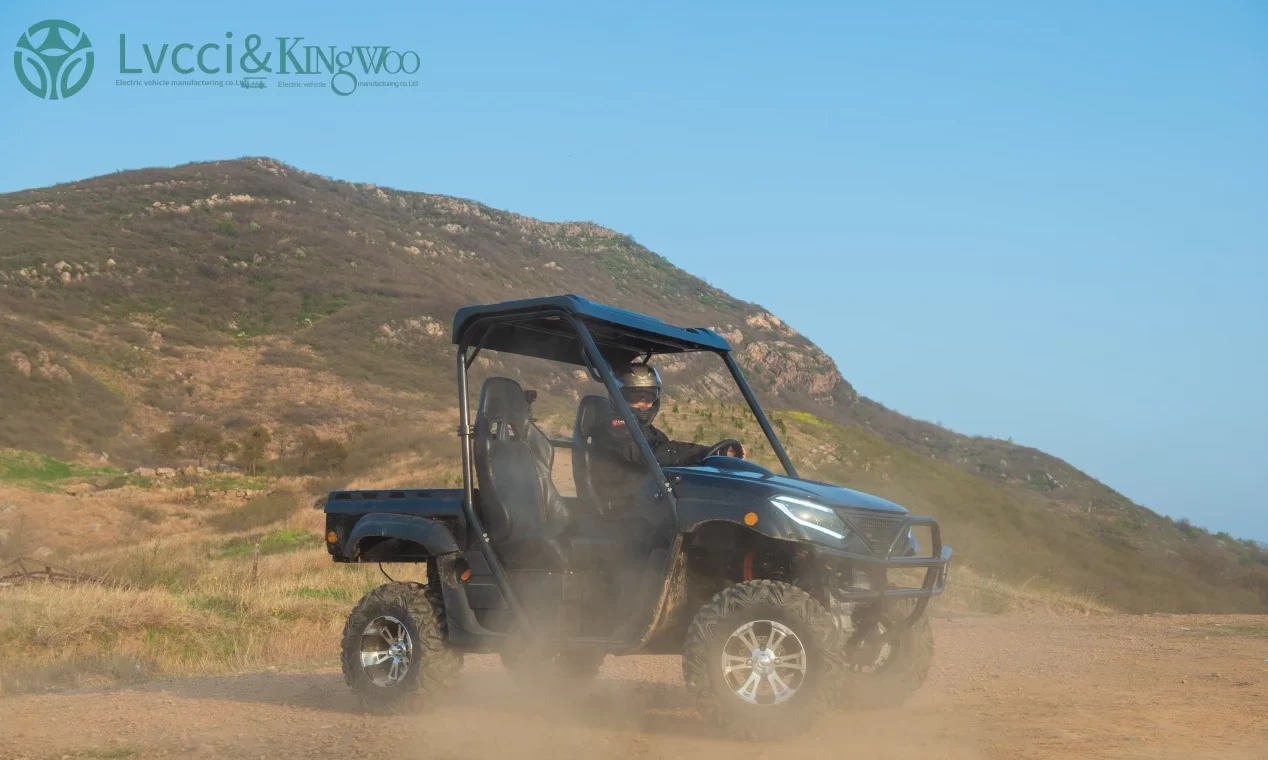
In terms of design, the body structure of the electric UTV is similar to that of the fuel model, which is suitable for all kinds of outdoor working conditions. It provides side-by-side seating for 2-6 people, which is suitable for single-person operation, multi-person collaboration and leisure travel; it is equipped with professional steering, four-wheel drive system, cross-country suspension and large cross-country tires as standard, which provides excellent passability. The rear large-capacity cargo hopper can load materials and agricultural tools, realizing the integration of people-carrying, cargo-carrying and towing. The sturdy frame, high ground clearance and anti-impact design are suitable for farms, mountains, construction sites, scenic spots and other scenarios, and can replace fuel UTVs to complete operations and off-road.
Electric UTVs rely on an intelligent electronic closed-loop control system, with a core divided into five modules, which provides stable operation and a much lower failure rate than fuel models.
As the only source of energy for the whole vehicle, it directly determines the range, performance and service life of the vehicle. Currently, high-end electric UTVs are equipped with high-capacity high-voltage lithium-ion batteries, and the benchmark model is divided into 14.9kWh basic version and 29.8kWh high-matching version batteries, which are suitable for different range requirements, while the entry model adopts 48V lithium-ion batteries, which takes into account the cost-effectiveness and the basic operational capability.
The battery adopts a center-mounted low layout, which effectively reduces the center of gravity, improves cross-country stability, and avoids the risk of rollover. At the same time, it is equipped with anti-collision, waterproof, and dust-proof protective shells, which can withstand the impact of debris and muddy water immersion, and is suitable for the complex and harsh outdoor environments.
It consists of on-board charger, inverter, motor controller and BMS battery management system. The on-board charger is compatible with home charging and fast charging modes, and the high-end model supports 6-9kW high-power fast charging, which significantly shortens the replenishment time. The inverter and motor controller can accurately convert and regulate power, and output power linearly according to road conditions, load and driving mode, eliminating power jams and overload loss.
The BMS system monitors the battery data in real time to avoid the risks of overcharging, over-discharging, overheating and short-circuiting, and the heat dissipation system ensures the stable operation of the battery under high-intensity operation and prolongs its service life.
Compared with the fuel engine, it can realize full torque output at 0 speed, and the performance of low-speed climbing and heavy-duty traction is far better than that of the same-class fuel vehicles. The model abandons the complex CVT clutch and gear structure of fuel vehicles, with simple transmission process, low loss and low failure rate, and some high-end models are equipped with synchronous belt transmission for better durability. Meanwhile, it supports two-wheel drive, four-wheel drive and full-time four-wheel drive free switching, with high and low-speed gears and locking differentials, which can be adapted to the needs of mud, steep slopes, gravel and other all-terrain driving.
Brake energy recovery system is an exclusive energy-saving advantage of electric UTV. When the throttle is released or the brakes are lightly applied, the motor switches to power generation mode, utilizing the inertia of the vehicle to convert the mechanical energy into electrical energy for recharging the battery. This function not only realizes smooth deceleration and reduces the wear and tear of brake parts, but also improves the range by 10%-15% in undulating road conditions, significantly increasing the energy utilization rate, while the emergency braking is completed by the hydraulic disc brakes, which takes into account both energy saving and safety.
The entire vehicle is equipped with an independent 12V low-voltage auxiliary electrical system, which supplies power to lights, instruments, switches and other accessories through a converter. It adopts the design of electronic non-mechanical gearshift, and realizes in/out switching by controlling the positive and negative poles of the motor, which is simple to operate. With VCU vehicle controller, it can intelligently complete mode switching, traction control, overload protection and other full-automatic regulation, significantly reducing the operation threshold, so novices can quickly get started. The whole set of electric system structure is streamlined, intelligent and controllable, which is the core key of electric UTV with low failure and easy operation and maintenance.
The core reason why electric UTVs have been able to quickly capture market share and replace traditional fuel models in recent years lies in their all-round advantages. Compared with fuel UTVs, which have mature technology but obvious shortcomings, electric UTVs have realized comprehensive upgrades in environmental protection, user experience, maintenance costs, operational performance and other dimensions, and are especially suitable for daily high-frequency, short- and medium-distance outdoor work and leisure scenarios, making them a new-generation off-road utility vehicle with both cost-effectiveness and practicality.
Zero-emission and more compliant: no exhaust pollution, suitable for ecological scenic spots, nature reserves, farms and other restricted areas, in line with environmental policy requirements.
Quiet and non-disturbance: extremely low operating noise, not disturbing the people, livestock and wildlife, suitable for hunting, ranch operation and maintenance, park patrol scenarios.
Stronger low-speed power: 0 speed full torque output, low-speed traction is 2 times that of fuel vehicles, climbing, heavy load, low failure rate, maintenance is very simple: no engine, oil circuit, spark plugs and other wearing parts, annual maintenance costs than fuel vehicles to reduce 60% -70%, downtime for maintenance has been reduced significantly.
Extremely low cost of electricity: the cost of energy consumption per kilometer is only half of that of a fuel car, and ten years of high-frequency use can save thousands of dollars in energy consumption costs.
More comfortable ride: linear power without stuttering, low battery reduces the center of gravity of the body, less bumps and sideways tilting, not easy to fatigue for long time operation.
Intelligent, convenient and worry-free: charging can be done at home, no need to run to the gas station, and it comes with fault self-test and power display functions, so the threshold of operation and maintenance is low.
Although electric UTV has outstanding advantages and strong comprehensive strength, it is not an all-purpose vehicle, limited by the current battery technology and industry development stage, there are still some short boards and limitations in use. 2025-2026 electric UTVs on the market are more suitable for short- and medium-distance, high-frequency, regular outdoor work and leisure scenes, and are not suitable for extreme high-intensity, ultra-long distance, and non-supply of the field scenes. Objectively recognize its shortcomings, in order to accurately match their own needs, to avoid blind purchase.
Limited range: the official range is 50-80 miles, but the actual range is only 45-75 miles under heavy load, low temperature, and muddy road conditions, which can’t support ultra-long-distance, no-supply field operation.
Low replenishment efficiency: slow charging takes 9-18 hours, and fast charging takes 3-4 hours, much slower than the efficiency of a fuel car that takes a few minutes to fill up, limiting high-intensity continuous operation.
Heavy body: Li-ion batteries cause the whole vehicle to be heavier, slightly less flexible in soft sand, narrow and complex terrain, and easier to get stuck in the car.
Weak adaptation to extreme environments: low-temperature range shrinks by 20%+, high-temperature and high-intensity operations trigger power limitation, high performance battery replacement cost: after 5-8 years of battery decay, the replacement cost is about $3,500-4,000, which is the main expenditure in the later stage (mainstream brands come with a 5-8 year battery warranty).
With the rapid development of the industry, the model system of electric UTVs continues to improve, and the positioning, performance, and adaptability scenarios of different models vary greatly. According to the use of purpose, the number of seats, body size, drive mode, battery configuration of the five dimensions, electric UTV can be divided into a number of categories, the user can according to their own operational scenarios, the use of demand for accurate purchase, to avoid the emergence of the “too big for too little” or “lack of performance avoiding the problems of “too big for the job” or “insufficient performance”.
This is the model with the highest market share, focusing on heavy-duty, traction, and durability, with the core adapted to commercial scenarios such as agricultural planting, ranch farming, site operation and maintenance, and construction site operation. The model focuses on optimizing the load capacity, traction performance, body strength and range stability, weakening the high-speed performance and focusing on low-speed and high-intensity operations. Equipped with large-capacity hopper, high-strength suspension, four-wheel drive cross-country system, the load capacity can be up to 1,000-1,500 pounds, and the traction weight is 2,000-2,500 pounds, which is suitable for daily high-frequency and heavy-duty operations.
The main focus is on quiet and stealthy, lightweight and flexible, and wild passability, designed for outdoor hunting, wildlife observation, and mountain adventure. In terms of basic practical functions, it focuses on optimizing the effect of silence and low-speed handling precision, and some models are equipped with camouflage paint, field protection accessories, and non-slip cross-country tires, which enable them to achieve zero-noise sneaking without disturbing wild animals.
Taking into account the functions of short-distance cargo carrying and equipment transportation, they are perfectly suited for field hunting, mountain forest survey and outdoor leisure scenes.
These models are fewer in number and are a high-end niche category of electric UTVs, focusing on high-speed cross-country, extreme handling, leisure and recreation, and targeting fuel sports UTVs, with a focus on optimizing the motor power, body handling, shock absorption and top speed performance, which is more powerful and faster, and is suitable for professional cross-country enthusiasts. However, due to the limitation of battery energy consumption, the range is relatively low and the price is high, which is not suitable for daily heavy-duty operation.
Two-seater version
Compact body, flexible steering, cost-effective, suitable for single and two-person daily operations, suitable for orchards, narrow woodlands, small sites such as transportation and maintenance of space-constrained scenes. Compact body size, convenient transportation and parking, basic load and traction performance can meet the needs of light operations.
Four-passenger version
Mainstream popular models in the market, taking into account the multiple functions of carrying people, cargo and cross-country, suitable for family leisure, multi-person operation, team operation and maintenance and other scenarios, balancing the practicality and flexibility.
Large Crew Edition for five to six persons
It is a heavy-duty flagship model with larger body size and more space, specially designed for large farms, scenic spots, factories, construction sites, team operation and maintenance, and can carry many staff members at the same time, taking into account the transfer of bulk personnel and material transportation, suitable for large-scale commercial scenarios.
2WD version
Simple structure, lower energy consumption, more affordable, suitable for flat roads, courtyards, leveled farmland and other simple terrain, only to meet the needs of basic mobility, light cargo needs, cross-country performance is weak, the current market share is decreasing year by year.
4WD/AWD four-wheel drive version (mainstream)
It supports two-wheel drive and four-wheel drive free switching, equipped with high and low-speed gears, locking differential, lawn protection mode, taking into account energy-saving and cross-country performance, and can be adapted to all-terrain scenarios, and flexibly adapted to flat surfaces and complex cross-country conditions, and it is the preferred drive mode of the vast majority of users at the present time.
48V entry-level lithium models
Small battery capacity, low price, range of 30-50 miles, moderate power parameters, suitable for light daily operations, short-distance transportation, adapted to limited budget, less frequent users.
72V+High Voltage Lithium Ion Models
Equipped with 14-30kWh high-capacity lithium batteries, stronger power, longer range (up to 80 miles), support for fast charging, vehicle performance, stability, durability, comprehensive upgrade, suitable for high-frequency, high-intensity commercial operations, is the preferred choice of high-end users.
Battery determines the range, power, life and safety of electric UTVs, and the choice depends on the type of battery, capacity, actual range and heat dissipation. Priority is given to lithium iron phosphate, which is safe, durable and heat-resistant, and suitable for long-term outdoor use. The larger the capacity, the stronger the range: 7-8kWh for short-distance light loads, 14.9kWh for daily use, and 29.8kWh for all-day high-intensity work. The official range is false, buy 20% mileage allowance; choose air-cooled/liquid-cooled batteries to reduce high and low temperature loss and prolong battery life.
Power parameters (equivalent horsepower, peak torque, maximum speed, driving mode) are the core evaluation basis for the operational capability of electric UTVs. Electric UTV mainly focuses on low speed and high torque, so give priority to torque and do not pursue high speed. Regular models are recommended to have equivalent horsepower ≥100 hp and peak torque ≥130 lb. ft. to easily handle heavy loads, climbing, and towing. Preferred Economy / Standard / Sport three power modes: Economy mode saves power and increases range, suitable for light loads on flat roads; Sport mode full power output, suitable for off-road, hill climbing and heavy loads. Daily operation 25-30mph speed is enough, blind pursuit of high speed will greatly consume power and shorten range.
Load and towing parameters determine the load carrying capacity of electric UTVs, so choose according to your needs to avoid insufficient load carrying capacity. Mainstream medium-sized vehicles have a payload of 1,500 pounds, a bucket capacity of 1,000 to 1,250 pounds, and a towing capacity of 2,000 to 2,500 pounds, making them suitable for material transport and trailer towing. For light work in yards and orchards, choose the 1,000-lb. bucket and 1,500-lb. towing entry model; for heavy-duty scenarios such as farms and construction sites, choose the top-end heavy-duty model. Also look for hopper size and opening and closing configurations for easy loading and unloading of large loads.
Terrain suitability look at the drive, ground clearance, suspension, tires, four parameters to determine the application of the vehicle scene. For complex road conditions, choose a model with switchable 2WD/4WD, high and low-speed gears, and differential locks to balance power saving and off-roading. Ground clearance is at least 11 inches, and 13-14 inches on mountainous and muddy terrain to prevent chassis scuffing; the longer the suspension travel, the better the shock absorption and passability. The longer the suspension travel, the better the shock absorption and passing performance. With large size off-road anti-skid tires to improve the grip; lawn mode is better, yard, scenic area work without hurting the ground.
The charging configuration depends on the power of on-board charger, charging mode and fast charging/exchange function. 3kW on-board charger is suitable for household slow charging; 6-9kW high-power fast charger is chosen for high-frequency operation to shorten charging time. Preferred 110V household, 220V industrial double charging models, multi-scene power supply universal. Inconvenient to connect to the power supply for a long period of time, you can choose the power exchange model, which can replenish the energy in minutes; the removable battery is more convenient for outdoor replenishment and maintenance.
Vehicle size affects parking, transportation and access. Choose a compact body for narrow orchards and forest paths for flexible steering; choose a full-size body for heavy loads in open areas for more stable loads. The weight of the whole vehicle should be balanced, too heavy is easy to fall into the soft ground, too light is unstable at high speed, choose according to your needs.
Selection focuses on warranty and safety configuration: mainstream battery warranty 5-8 years, the vehicle 2-3 years, prefer long warranty, after-sales network sufficient brand, reduce maintenance expenses. The standard safety features include anti-roll bar, reinforced seat belts, and hydraulic brakes. Additional configurations on demand: electronic power steering, intelligent instrumentation, self-diagnostic fault detection, winch lamps can be added; priority IP65 and above dustproof and waterproof models, suitable for outdoor rain, snow, sand and dust environments.
Combining the performance advantages and shortcomings of electric UTV, its core adaptability has fixed charging conditions, short and medium distances, high frequency, normalized operation and leisure scenes, in the noise control, environmental protection limitations, refinement of the operation scene, the advantage of crushing fuel UTV. the following six core application scenarios, but also the current electric UTV users are most concentrated in the field of accurate matching to determine whether it is worthwhile to get started.
Farms and ranches are the core of electric UTVs. Farms can be used to transfer agricultural materials and tools, patrol the fields for plant protection, and realize traction and spraying operations with the trailer; ranches run quietly without disturbing the livestock, and the zero tailpipe is a clean breeding environment. The whole machine has lower energy consumption and maintenance cost, which is suitable for long-term use in large-scale farming.
With large private estates and villa courtyards, electric UTV is a good tool for site operation and maintenance: it can remove debris, transfer firewood and stone earth, trim lawn, clean shrubs and sweep snow, replacing many small machines with one machine. Quiet and zero emission, no noise and exhaust gas, home charging can be, operation and maintenance of worry, long-term use of low cost, suitable for high-end private areas of fine management.
The electric UTV is suitable for core hunting and field survey scenarios: silent sneaking can be used to get close to the prey and increase the success rate of hunting; it can carry hunting gear and transfer the prey, as well as take care of forest clearing, spot building and forest inspection. Zero emission and low noise, without disturbing wild animals and destroying the ecology, it is suitable for the operation in ecological forest areas and protected areas.
Commercial sites such as parks, scenic spots, factories and other commercial sites are restricted to fuel vehicles, and electric UTVs with low noise and zero emission are suitable for control requirements. It can be used for patrolling, cleaning, landscaping, equipment maintenance, personnel transfer and other work. Lower energy consumption and maintenance costs in bulk purchase, taking into account the site environment and service experience, is the preferred choice for commercial operation and maintenance.
Electric UTVs are suitable for small construction sites, warehouses and factories: short-distance transfer of building materials and tools, connecting workers, and site inspection and maintenance. Zero emission is suitable for indoor work, purifying the workshop environment; easy to operate, low failure rate, easy maintenance, suitable for high-frequency short-distance work, improving efficiency and reducing costs.
For outdoor and off-road enthusiasts, electric UTVs are a good choice for family short-distance recreation. The whole vehicle runs smoothly, no vibration noise, high driving comfort, simple and safe operation, the elderly and novices can easily get started. It can be used for short-distance traversing in mountains and forests, playing in the countryside, transferring outdoor camping equipment and other leisure scenarios, taking into account the fun and safety, and providing convenience for family outdoor trips.
Compared with the complex structure of fuel UTVs, the maintenance process of electric UTVs is extremely simple and low-cost, but the core maintenance focuses on the three core components of the battery, electronic control and electrical system. Scientific and standardized daily maintenance can effectively extend the service life of the battery and the whole vehicle, maintain peak performance for a long time, reduce the probability of failure, and maximize the utilization rate of the equipment.
Battery is the core valuable component of electric UTV, the main points of maintenance: maintain 20%-90% of the capacity, not deep power loss, use up the power in time; avoid sun exposure, low temperature open-air charging, room temperature indoor charging is better. Long-term idle charging to 80%, with trickle charging regular replenishment to prevent aging; regular maintenance of 12V sub-battery, clean and rust-proof reinforced wiring. Use only the original charger to prevent damage to the electronic control and battery.
Five-minute quick inspection before use: check tire pressure wear, brake performance, suspension screws, and battery wiring for rust and looseness. After muddy wading operation, rinse the body with low-pressure water, clean up the chassis and heat dissipation ports, and prohibit high-pressure direct spraying of the battery electronic control interface to prevent short-circuit corrosion.
Every 1,000 miles or annual full maintenance, shortened cycle for heavy-duty muddy conditions: change brake, transmission, differential oil; clean motor cooling components; replace drive belt with belt adjustment; test battery, electronic control and upgrade ECU firmware. High-voltage circuit overhaul by the official after-sales service, private dismantling is prone to failure and out of warranty.
When storing the car after long-term suspension, first thoroughly clean the whole car, remove mud, sand, oil, corrosive sundries; charge the battery to the standard capacity, disconnect the auxiliary battery power supply to avoid static power loss; park the vehicle in a dry, ventilated, room temperature indoor environment to avoid open-air exposure to the sun, rain and freezing; long term storage of the body can be elevated, to avoid the tire deformation and aging of the long term pressure.
Avoid prolonged full-loading and heavy loading, continuous climbing to avoid accelerated wear and tear of batteries and motors; avoid driving in excess of the water wading depth to prevent water failure of the electrical system; avoid frequent rapid acceleration and braking to reduce waste of energy and wear and tear of components; update the firmware of the vehicle system in a timely manner to repair system loopholes and optimize the performance of the use of the vehicle.
Most of the users are confused between electric and fuel UTVs, and the core dispute is the price and cost-effectiveness. In order to make the selection more objective, we combine the market price, energy consumption, maintenance, repair and other real data from 2025-2026 to carry out a 10-year full life cycle cost comparison, accurately measure the actual cost of use of the two models, and visualize the difference in cost performance.
Energy consumption is the core expense of long-term use. Under regular use, the total fuel cost of a fuel UTV in 10 years is about $6,000-7,000, with an average cost of $0.15 per mile. For electric UTVs, charging with utility power at home, the ten-year electricity cost is only US$400-2000, with an average energy cost of US$0.09 per mile, saving more than 40% of energy consumption, and under high-frequency usage scenarios, the ten-year energy cost can be saved more than US$6,000, which is a very significant energy-saving advantage.
Fuel UTVs have complicated spare parts and need to replace oil, filters, spark plugs, drive belts, etc. every year, with a ten-year maintenance cost of US$8,000-9,000; electric UTVs have no engine consumables and only maintain tires, brakes, and suspensions, with a ten-year maintenance cost of only US$2,000-3,000, a reduction of 60-70% in maintenance expenses, a low failure rate, and less downtime and wear and tear.
Fuel UTVs need to replace engine, transmission and other core components for long term use, with maintenance costs increasing year by year. The only big expense for electric UTVs is battery replacement. After 5-8 years of normal use, the battery capacity will decline and the replacement cost will be about US$3,500-4,000. However, the 5-8 year warranty of mainstream brands can cover most of the use cycle, and most users do not need to replace the battery at their own expense within 10 years.
Under the same working conditions, the total cost of an electric UTV in ten years is US$7,000-11,000 less than that of a fuel model: 4-5 years of payback for commercial HF and 6-7 years for personal use, which is far more cost-effective than that of a fuel model in the long term. The electric model is quiet, environmentally friendly, suitable for a wide range of scenarios, and comfortable to drive, while the fuel model only has a lower purchase price, is easier to refuel, and has a higher long-term cost of ownership.
To summarize, electric UTVs are not a simple substitute for fuel models, but an upgraded product suitable for all kinds of outdoor work and leisure. Relying on the advantages of zero emission, quietness, and low energy consumption for maintenance, it is suitable for short- and medium-distance high-frequency scenarios such as agricultural, commercial, and hunting, etc. However, due to technological constraints, there are shortcomings in range, charging, cost of purchasing a vehicle, and adaptability to extreme conditions, and it is not suitable for long-distance extreme operations without refueling.
Comprehensive comparison of all dimensions, we give a precise purchase conclusion:
People worth getting: farmers, estate owners, outdoor enthusiasts, scenic spots and factory operation and maintenance teams with fixed charging conditions, daily short- and medium-distance operations, field operation and maintenance, yard maintenance, hunting and leisure. This kind of users can fully utilize the advantages of electric UTVs, and the long-term use of cost-effective and the use of experience far exceeds that of fuel models.
It is not recommended to start the crowd: no fixed charging conditions, the need for ultra-long-distance field operations, all-weather uninterrupted high-intensity extreme cross-country, limited budget and low-frequency use of the user, give priority to fuel UTVs more suitable.
In the future, with the continuous upgrading of battery, fast charging and intelligent technology, the short board of electric UTV will be gradually made up, and the cost-effectiveness, practicability and scene suitability will continue to improve, and it is expected to become the mainstream of the UTV market in the next 5 years.
If your use scenario matches the advantages of electric UTVs, there is no need to be overly entangled in the shortcomings, combined with your own needs and precise selection, you can enjoy lower cost, higher quality, more environmentally friendly outdoor work and leisure experience.


-150x150.png)