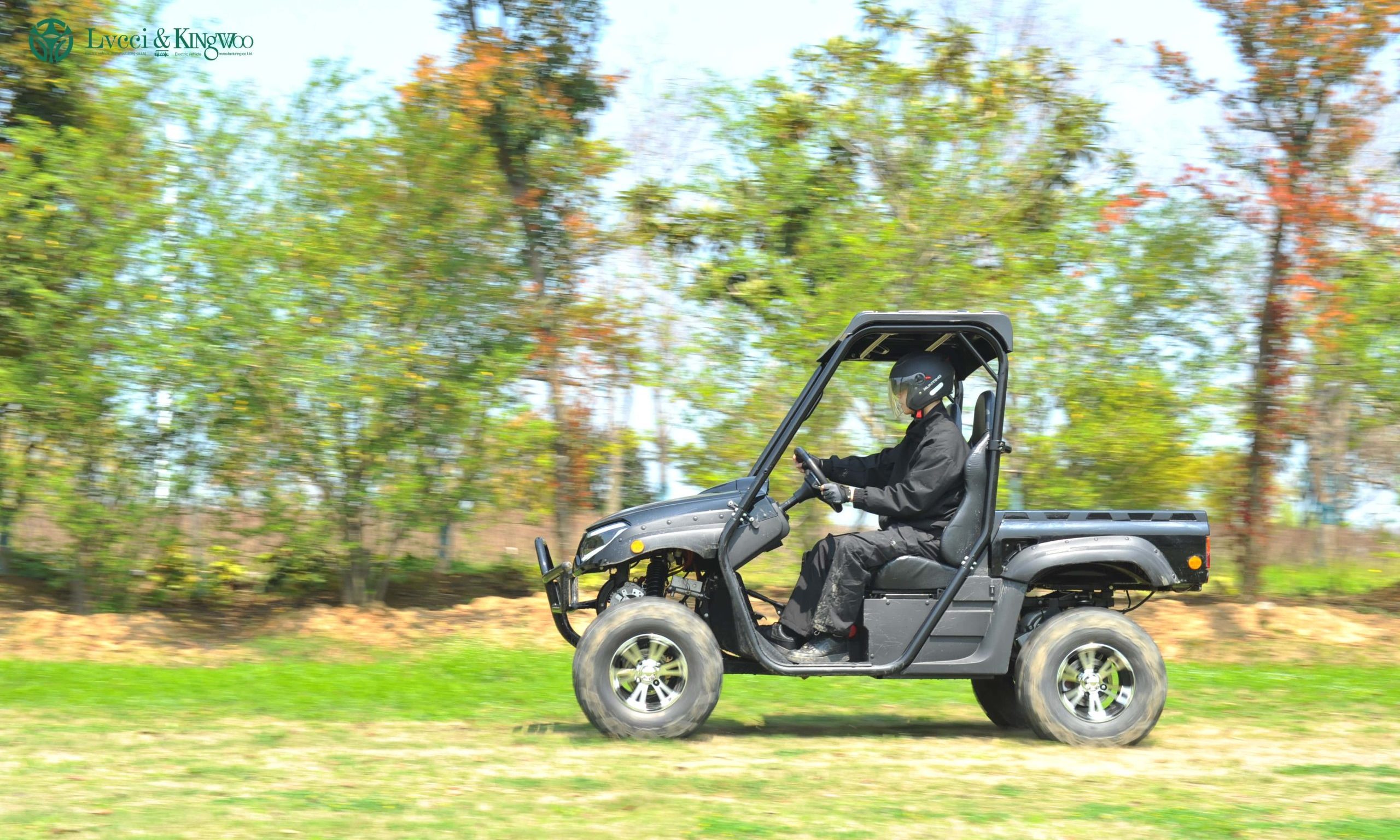
UTV, also known as Utility Terrain Vehicle or Side-by-Side, is a professional off-road equipment that combines operational utility and outdoor recreation. Unlike traditional single-rider ATVs, UTVs are designed with side-by-side seating for two or more people, and are equipped with steering wheels, foot pedals, gas pedal brakes, anti-roll bars, and seat belts, making the driving experience closer to that of a passenger car.
However, UTVs have been traveling for a long time in mud, sand, gravel, water and other harsh environments, and also have to withstand heavy loads, bumps, climbing and other working conditions, so the wear and tear of the vehicle parts is much faster than that of ordinary road vehicles. If you ignore the daily maintenance, it is easy to appear power attenuation, braking failure, parts corrosion, sudden failure and other problems.
In this article, we will combine the standardized maintenance cycle with the core component maintenance skills to put together a complete set of UTV maintenance program that can be landed.
Many vehicle owners have maintenance misunderstandings, thinking that the vehicle can run normally without maintenance. As a matter of fact, the harsh operating environment of UTVs will continue to wear out parts and components, and hidden damage will continue to accumulate, which will eventually lead to safety accidents and high repair costs. Standardized regular maintenance is the core foundation for stable vehicle operation.
Cross-country terrain is complex, bumpy roads, steep slopes, wading sections of the vehicle braking, steering, tires, suspension system requirements are extremely high. Worn brake pads, loose steering parts, and tires with abnormal pressure will directly cause the vehicle to lose control.
At the same time, broken seat belts, aging anti-roll bars, and malfunctioning lights can significantly increase the risk of injury after a rollover or collision. Daily routine inspection and maintenance, can be timely investigation of potential safety hazards, from the root to avoid cross-country driving safety accidents.
Clogged air filter, deteriorated oil, faulty cooling system, will directly cause engine power, fuel consumption, idling and other problems. Long-term neglect of maintenance will make the vehicle performance continue to decline, unable to play the original design of cross-country and load capacity.
Standardized maintenance can make the engine, transmission system, walking system is always in the best working condition, reduce halfway break down, power jam, parts failure and other unexpected conditions, so that every trip and operation are stable and reliable.
UTV belongs to high-value equipment, and the engine, transmission system and suspension system are the core valuable parts. Rust and corrosion caused by mud and water, wear and tear of components caused by sand and dust, and loss of parts caused by dry friction will accelerate the aging and scrapping of the vehicle.
Regular oil change, lubrication, cleaning, rust removal and other maintenance operations can effectively reduce the internal wear and corrosion of parts and components, all-round protection of the core assembly, significantly extend the normal life cycle of the vehicle, maximize the value of equipment investment.
The cost of preventive maintenance is much lower than breakdown repair. Most serious UTV failures, such as engine cylinder pulling, transmission system damage, brake system scrapping, are caused by the long-term accumulation of tiny hidden problems.
Regular maintenance can take care of minor faults and wear and tear in time to prevent minor problems from becoming major ones. At the same time, vehicles in good condition have a higher fuel/electricity utilization rate, which can effectively reduce the daily energy costs and make long-term use more cost-effective.
Regardless of whether it is a subsequent replacement for a new vehicle or a second-hand resale, UTVs with complete maintenance records and in good condition will be recognized and offered at a higher price in the market. Professional and regular maintenance traces are the best proof of the vehicle’s high quality condition.
The original maintenance parameters of different brands and models of UTVs vary slightly, and vehicle owners need to follow the requirements of vehicle manuals as a matter of priority. At the same time, vehicles that have been used for a long time in harsh working conditions such as mud, dust, heavy loads, and wading in water need to shorten the regular maintenance intervals by half in order to adapt to high-intensity use scenarios.
Pre-trip inspection is the lowest cost and most effective maintenance method, which can effectively avoid most of the sudden failures and is suitable for all fuel and electric UTV models.
Focus on checking the condition of tires, including tire pressure, tread wear, sidewall damage, embedded gravel and other issues to ensure that the tires are suitable for the current terrain. At the same time, check the oil and water level of the whole vehicle, oil, coolant, brake fluid need to be kept in the standard scale range, to eliminate the lack of liquid driving.
Carefully check the body chassis, piping position whether there is oil leakage, water leakage hidden danger, check the whole car whether the bolt is loose. After starting the vehicle, test the response sensitivity of the brake, steering, and gas pedal to ensure smooth handling without lag.
Finally, check the integrity of the lights, seat belts, and anti-roll bar, and clean up the mud and debris accumulated in the air intake to avoid air intake clogging that affects power output.
After completing high-intensity cross-country and muddy driving, the whole vehicle needs to be cleaned in a timely manner, thoroughly removing mud and sand in the chassis, wheel hubs, and suspension gaps, to prevent dirt from accumulating and corroding the metal parts and wearing out the rubber fittings.
Focus on cleaning the air filter, sand and dust environment filter is very easy to clog, directly affecting the engine air intake efficiency and power performance. At the same time, check the surface condition of the drive belt to see if there are cracks, peeling, aging wear and other problems.
Make up grease lubrication for the grease nipple of the suspension and steering system to eliminate friction noise of parts, reduce joint wear and ensure smooth operation of steering and suspension.
This is the core routine maintenance node for UTVs, and is the key to maintaining the vehicle’s stable performance. First, the engine oil and oil filter need to be changed to thoroughly remove metal shavings and impurities from the oil and protect the internal parts of the engine.
According to the state of the filter element, clean or replace the air filter element and fuel filter element, to avoid clogging caused by a drop in power and higher fuel consumption. Comprehensively inspect the brake system, including brake pad thickness, brake disc wear, brake line sealing, and brake fluid status.
Check the oil and water level of the transmission and gear box to ensure adequate lubrication of the transmission system. Fully lubricate the throttle cable, brake cable, and movable joints to eliminate dryness and jamming problems.
Finally, clean up the battery terminals dust and oxides, test the battery voltage, to ensure that the vehicle starts and electrical equipment work properly.
Annual in-depth maintenance requires replacement of transmission fluid, differential fluid, gear oil, and thorough renewal of transmission system lubricants to avoid gear wear and transmission rattles caused by deterioration of the fluid.
The second comprehensive inspection of the drive belt, wear and tear, aging and cracked belts need to be directly replaced to eliminate the risk of driving interruption with anchoring. Test the coolant status, according to the service life and cleanliness, to determine whether the need to replace the antifreeze.
Carry out a detailed inspection of the shock absorbers and suspension components of the whole vehicle to see if the shock absorbers are leaking oil, whether the rubber sleeve is cracked, and whether the ball head is loose. Also check the status of the spark plugs, replace and calibrate the valve lash if necessary.
The vehicle is required to change the oil and water of the whole vehicle, flush the engine, cooling system and transmission system, and remove the internal oil sludge and impurities.
In-depth maintenance of the brake system, checking calipers, distributor pumps and pipelines for hidden problems, and replacing aging parts. Deeply clean the radiator, dredge the cooling fins to eliminate the high temperature failure caused by poor heat dissipation.
Finally, the engine, transmission system, and chassis structure will be examined in all aspects, and hidden faults will be repaired in advance, so that the old car can restore its peak performance.
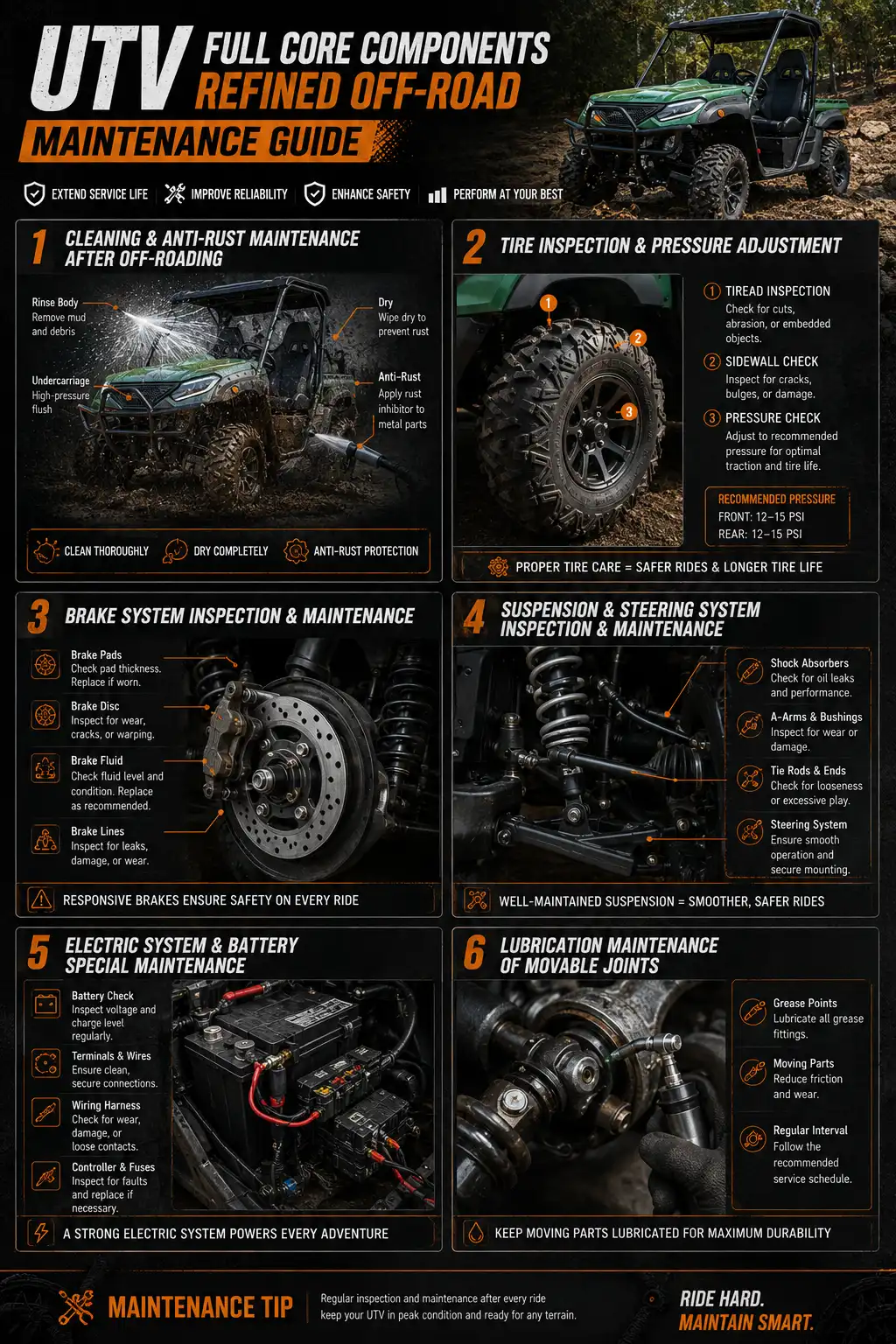
Many car owners only pay attention to mechanical maintenance, but ignore the body cleaning, which is the main reason for the early aging of UTV. Off-road residual mud, sand and water will continue to adsorb moisture and corrode chassis metal, piping, bearings and seals.
Dried mud will clog the radiator, air intake, transmission compartment, resulting in poor heat dissipation, power loss and accelerated belt wear. Prolonged lack of cleaning can also cause rubber fittings to deteriorate and crack, and circuit connectors to oxidize and malfunction.
The correct cleaning process can take into account the degree of cleanliness and vehicle safety: After the vehicle is turned off and cooled down, first use low-pressure water to rinse the body, chassis, wheel hubs large pieces of mud and sand, and leave it to soften the stubborn dirt. Use special off-road vehicle cleaner or neutral foam cleaner, evenly spray the whole car crevices.
Wait 5-10 minutes for the agent to decompose the dirt, then use a soft brush to gently scrub, focusing on cleaning the radiator, transmission compartment, chassis crevices. The whole process prohibits high-pressure water gun direct spray bearings, seals, circuit connectors, cooling fins, to avoid high-pressure water damage to precision parts.
After the completion of cleaning, use a hair dryer or air compressor to blow dry the seams of the car to avoid residual moisture. Finally, the plastic parts spraying maintenance agent, metal parts to do anti-rust treatment, the activity of the joints to supplement the coating of grease, to complete a full set of protection.
UTV tires are the only parts that contact the terrain. Abnormal tire pressure, uneven wear and broken carcass will directly affect the vehicle’s grip, stability and braking effect, and is also one of the main causes of cross-country accidents.
Different terrains need to match the exclusive tire pressure: the regular tire pressure of 14-20PSI on hard surface; rocky climbing road condition to adjust down to 12-14PSI, to enhance the cushioning; sandy, muddy road condition down to 8-12PSI, to enhance the tire buoyancy, to avoid getting stuck in the car. When driving with heavy loads and people, you need to adjust the tire pressure appropriately to prevent excessive deformation of the carcass.
Daily need to regularly check the degree of tread wear, clean up the gravel and debris embedded in the tread, and check whether there are bulges, cracks and breaks in the tire wall. Tires must be replaced in a timely manner when the tread depth is less than 1/16 inch for off-road safety.
Every 500-1000 miles or routine maintenance cycle, perform tire rotation to equalize the wear rate of all four tires. Appropriately adjust the tire pressure when parked for a long time, or use a tire carrier to avoid flat spot deformation of the tires.
UTV brakes are exposed to mud, sand, water and gravel for a long period of time, and brake pads and discs are easily stained and worn out, and after wading in the water, brakes become soft and braking power fades, so it is important to maintain them.
Every time you step on the brakes before you go out, feel the feedback from the pedal. Under normal conditions, the brake pedal is tight, no false position, and no spongy feeling. When you test drive the vehicle, observe whether the braking is linear and does not run off, brake lag, run off, abnormal noise need to immediately troubleshooting.
Regularly check the thickness of brake pads, brake disc wear grooves, and see if the brake lines are aging and cracked, leaking fluid. After driving in mud or wading in water, apply the brakes gently at low speed for a certain distance to dry the brake discs and avoid rust and brake failure.
Replace the brake fluid according to the maintenance cycle, the brake fluid will absorb water and lower the boiling point if used for a long period of time, and it is easy for air resistance to occur under high temperature working conditions, resulting in brake failure. Brake rattling, pedal sinking, braking force drop and other problems, need to stop immediately for maintenance.
The suspension and steering system carries all the bumps and impacts of the UTV, and the ball joints, tie rods, rubber bushings, bearings and other accessories are very easy to wear and aging, which will lead to loosening of the steering, body shaking, and loss of control of cross-country once it fails.
For daily inspection, you can drive the direction left and right in the same place to feel whether the steering is smooth, without any stuttering, rattling or excessive false position. Press the corners of the body to test the rebound state of the shock absorber, normal rebound dry, no second bounce, no stuttering.
Regularly check the A-arms, tie rods, and ball head dust covers. Broken dust covers will cause mud and sand to enter the inside of the joints and quickly wear out the precision parts. Also check the shock absorbers for oil leaks, loose screws, and cracked and aging rubber sleeves.
After each muddy drive, fill up the grease nipples with waterproof and high-temperature resistant grease in time, and clean up the excess grease to avoid adsorption of mud and sand. Modification of elevated, replacement of large-size tires, vehicles need to shorten the maintenance interval, more frequent check suspension steering components.
Circuit system is the core of the UTV pivot, electric UTV is dependent on high-voltage battery packs, controllers, motors work, moisture, oxidation, line damage, it is very easy to cause failures and even safety hazards.
Conventional 12V batteries need to be checked regularly to see if the shell is bulging and leaking, and whether the terminals produce white oxidized powder. Apply insulating grease after cleaning up the oxidized matter, and isolate the moisture to prevent secondary oxidation. Full battery voltage standard 12.6-12.8V, low voltage needs to be replenished in time to avoid sulfation damage to the battery.
Electric UTV need to focus on the maintenance of high-voltage battery pack, daily use will try to maintain the power in the 20% -80% range, to avoid full power exposure, power loss long-term parking. Regularly check the battery cooling system to ensure smooth heat dissipation and prevent high temperature degradation.
Regularly check the wiring, plugs and fuses of the whole vehicle, and fix the loose wiring harnesses to avoid bumps and wear and tear. When cleaning the vehicle, it is strictly prohibited to spray high pressure directly on the circuit compartment and battery compartment, and blow dry all the joints and crevices of water to prevent short-circuit failure.
A large number of metal movable joints of UTV are exposed for a long time, and the lubricating grease is easy to be washed away by rain and polluted by mud and sand, and the dry friction will wear out the parts quickly and produce problems such as abnormal noise, stuttering and jamming.
The core lubrication points include suspension ball joints, steering tie rods, door hinges, cargo hinges, gas pedal and brake lines, and 4WD transmission joints. Water-resistant, high-temperature-resistant, extreme-pressure type special grease should be used, which is suitable for off-road harsh working conditions.
Before lubrication, the surface of the point must be cleaned of sand and dirt, and it is forbidden to make up the grease with dirt, so as to avoid mixing sand and dirt into the grease to form abrasive particles, which will accelerate the wear of the parts. Each grease nipple appropriate amount of grease injection, squeeze out a small amount of new grease can be, do not over-injection of grease to break the dust cover.
Note that WD-40 can only be used for rust removal, cleaning, penetration loosening, can not replace the long-lasting grease, long-term use will aggravate the wear of parts. After driving in mud and water, you must make up the whole car lubrication in time.
Many UTV failures are not caused by use, but by incorrect storage. Idle for a long time, sealed in winter and parked in the open air, it is easy to have problems such as battery loss, flat tire spots, deterioration of oil circuit, rusting of parts and damage by rodents.
Thoroughly clean the whole car before parking, remove mud and dirt, and do a good job of rust prevention and lubrication. Fuel models fill the tank, add fuel stabilizer, start the engine running for a few minutes, so that the stabilizer covers the fuel line.
Connect the battery to a smart charger to keep topping up, or disconnect the negative terminal to avoid losing power. Adjust tire pressure appropriately and park on a flat hard surface to avoid deformation of tires under long-term pressure. Cover the whole car with a breathable car coat to prevent dust and moisture.
Priority is given to dry and ventilated indoor garage storage, avoiding open-air sunshine and rain. Replace the oil and filter before storage, the old oil contains a lot of impurities, long-term static will corrode the internal engine.
Thoroughly clean the whole car and do a full set of rust prevention and lubrication maintenance, check and replenish the coolant and brake fluid. Remove the battery and store it indoors at a constant temperature, and replenish it regularly with a smart charger to extend the battery life significantly.
Elevate the body or use a tire carrier to completely release tire pressure and eliminate flat spot deformation. Place rodent repellents in the cabin and cockpit, and seal the air intake and exhaust ports to prevent rodents from nesting and biting the wires.
After long term storage, you need to re-install the battery, check the oil and water, tire pressure, belt and pipeline. After completing the vehicle appearance and function check, test drive at low speed to make sure there is no abnormality before normal operation and cross-country use.
The chassis, tires, brakes, suspension, cleaning, storage and maintenance of the two types of UTVs are basically the same, but the structure of the power system is very different, and the maintenance costs and priorities are completely different.
Fuel UTVs have a complex structure, with many maintenance items and high frequency. Regular replacement of oil, filter, air filter, fuel filter, spark plugs, drive belt, cleaning of oil circuit, cooling system is required. Long-term use, accessories and labor maintenance costs are higher, and there are more failure points.
Electric UTV has no engine and no fuel system, eliminating a large number of items such as oil replacement, filter replacement, spark plug maintenance, and reducing the routine maintenance workload by more than 60%. Relying on the energy recovery braking system, the wear and tear of brake pads and discs are greatly reduced, and the maintenance cycle of the braking system is longer.
The core of the maintenance of electric UTV focuses on the high-voltage battery pack, motor, controller and cooling system. It is necessary to focus on moisture-proof, temperature control, standardized charging and discharging, and high-voltage system failures must be overhauled by professionals and disassembly is prohibited.
Overall, electric UTVs have lower long-term maintenance costs, lower failure rates, and more trouble-free operation, and are suitable for daily field operations and short-distance cross-country; fuel UTVs are more suitable for long-distance traversing, heavy-duty towing, and field conditions without charging conditions.
Most vehicle failures stem from wrong maintenance habits, avoid these common misunderstandings, can effectively reduce failures, extend the life of the vehicle, while saving a lot of maintenance costs, is the basic maintenance of common sense that owners must master.
Many owners simply wipe the body after running cross-country, ignoring the chassis, crevices, transmission parts of the mud and sand residue, long-term accumulation will trigger metal corrosion, parts clogging, abnormal wear and tear of fittings, which is the cheapest but the most critical maintenance steps.
Different road conditions on the tire pressure requirements are very different, tire pressure is too high or too low, will lead to lack of grip, driving bumps, abnormal tire wear, serious cases of flat tires, stuck in the car and other dangerous situations.
Cheap use of low-quality oil, filter, brake fluid, will directly damage the engine, transmission system, braking system, resulting in irreversible component damage. At the same time, don’t wait until the belt cracks and breaks, parts rattling seriously, operation jamming and malfunctioning before maintenance, all wear and tear hidden dangers need to be investigated in advance, replaced in advance, to prevent the problem before it occurs.
The durability, safety and driving performance of UTVs are never determined by the quality of the vehicle itself, but are realized by scientific, regular and meticulous daily maintenance.
As a professional off-road equipment adapted to harsh working conditions, every smooth operation and every safe off-road trip of UTV cannot be separated from standardized cycle maintenance and refined parts maintenance.
Abandon the wrong maintenance misunderstanding, strictly follow the maintenance cycle, do a good job in cleaning, lubrication, inspection, oil change, storage and other full-process maintenance, not only can completely avoid the common problems of halfway breakdown, brake failure, power attenuation, etc., to protect the safety of outdoor driving and operation, but also can effectively reduce the long-term maintenance costs, greatly extend the service life of the entire vehicle, so that the car to maintain the peak condition for a long time, while stabilizing the vehicle residual value of the second-hand.
Regardless of whether you are using a fuel UTV or an electric UTV, adhering to scientific maintenance is the most cost-effective and secure way to use the vehicle, making every cross-country crossing and field operation more secure and reliable.


-150x150.png)