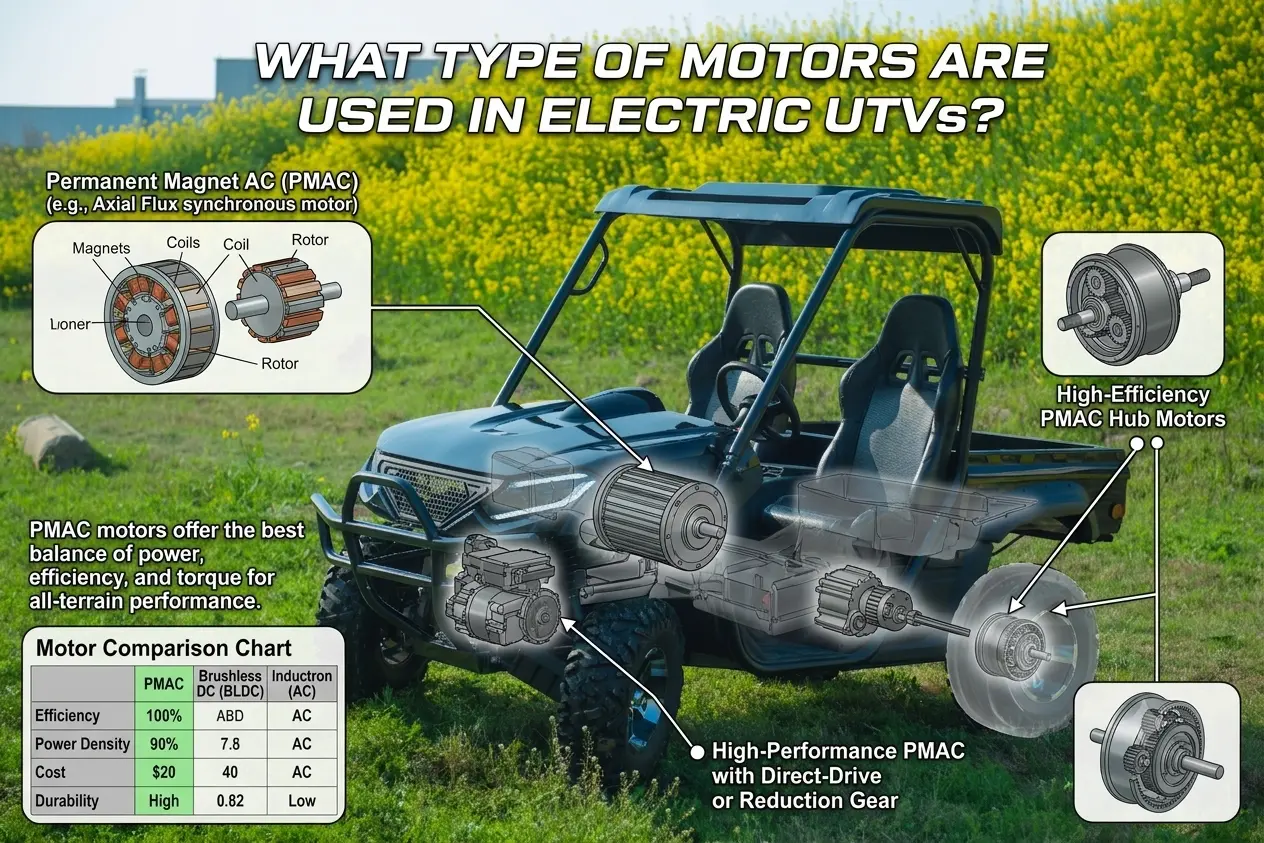
Many users only pay attention to surface parameters such as horsepower, endurance and load when purchasing electric UTV, but ignore the core hardware of motor type. As the power heart of electric UTV, the motor directly determines the dynamic response, off-road performance, endurance performance, running noise and service life of the vehicle. It is also the core difference of electric UTV with different price and positioning.
Most of the new high-end electric UTVs on the market are equipped with permanent magnet synchronous motors. The mid-end cost-effective models mostly use brushless DC motors, while the old entry-level models are mainly AC induction motors.
Electric UTV motor relies on the principle of electromagnetic induction (Lorentz force principle) to work, the core role is to convert the power battery’s electrical energy into mechanical torque, drive the wheel to run. This is completely different from the internal combustion engine working logic of fuel UTV: the fuel engine relies on fuel combustion explosion to push the piston to do work, and the speed needs to climb to output peak torque; while the electric motor can output instantaneous peak torque at 0 speed, and the starting, climbing and heavy-load traction capabilities are significantly ahead of those of the same class of fuel models, while running more smoothly and with lower noise.
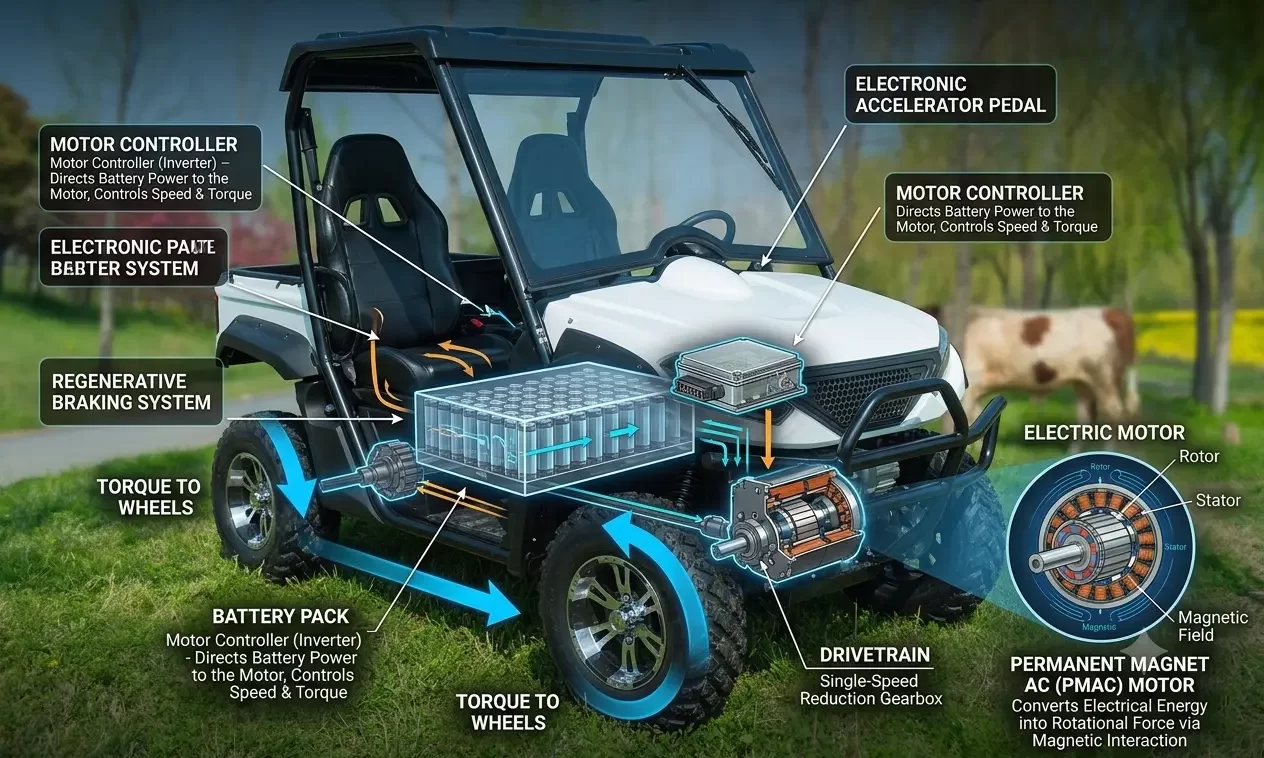
motor can not work alone, need to cooperate with the whole powertrain operation, complete core components include:
High-voltage lithium battery pack: mainstream production models are equipped with lithium ion batteries of 14.9 – 30kWh and above, which are responsible for storing DC power and are the power source of the whole vehicle.
Inverter/motor controller: the “brain” of the powertrain, which converts battery DC into AC, accurately regulates power output, speed and torque, and adapts to different driving scenarios.
Electric motor: The core power unit of the vehicle determines the upper limit of the vehicle’s basic performance.
Reduction gear/single-speed gearbox: match the high speed characteristics of the motor, reduce the speed, amplify the torque, adapt the wheel speed, and ensure the dynamic stability of off-road and heavy load conditions.
Heat dissipation and power management system: real-time control of motor and electric control temperature, avoid high temperature power reduction, burn machine, ensure the stability of long-term heavy load operation.
All electric UTV motors are composed of two core structures:
stator and rotor: stator is a fixed component, which generates rotating magnetic field after electrification; rotor is a rotating component, which rotates by magnetic field adsorption and repulsion, and continuously outputs torque.
Complete power flow process: driver steps on accelerator → controller receives signal → inverter completes AC/DC conversion → stator generates rotating magnetic field to drive rotor to run → motor output torque is transmitted to wheels through transmission structure → vehicle driving; when deceleration or light braking, motor is switched to generator in reverse, kinetic energy is converted into electric energy through energy recovery braking to recharge battery, which can improve 10%-15% of complex terrain endurance.
At present, there are four main motor types in the electric UTV market, the performance, cost and application scenarios of different motors vary greatly, among which permanent magnet motors have become the mainstream of the industry, and old models are mostly equipped with induction motors or brushed DC motors.
permanent magnet synchronous motor is the standard motor of the new high-end electric UTV, and it is also the most balanced power scheme with comprehensive performance, which is favored by first-line brands.
The motor rotor built-in permanent magnet, relying on the output of the controller sine wave current drive, magnetic field smooth operation, motor rotor and magnetic field speed synchronization, operation accuracy is extremely high. The core efficiency can reach more than 95%, torque density, dynamic smoothness and quietness are all top levels in the industry, and the whole process can maintain efficient operation without obvious efficiency attenuation.
Typical model case: Polaris Ranger XP Kinetic series, equipped with built-in permanent magnet synchronous motor, can output 110 horsepower, 140 pounds·feet peak torque, support 2500 pounds traction weight, 1250 pounds load, performance comparable to mainstream fuel UTV.
Core advantages: 0 speed full torque output, strong starting explosive force; smooth operation without setback, extremely low noise; high energy conversion rate, longer battery life under the same battery capacity; stable performance in full speed range, suitable for climbing, muddy off-road, heavy-load traction and other high-intensity conditions.
Limitations: rely on rare earth permanent magnet materials, manufacturing costs are higher; there is a slight risk of demagnetization under high temperature extreme conditions, and professional liquid cooling systems must be used.
Applicable scenarios: professional farm heavy load operation, high-intensity off-road, long-term high-frequency use, high-end working conditions with high requirements for endurance and quietness.
Brushless DC motor is the mid-end benchmark solution of electric UTV, widely used in affordable production models, modified DIY models, perfect balance of performance and cost, high market penetration.
BLDC motor adopts electronic commutation technology, cancels traditional mechanical carbon brush, relies on trapezoidal wave current drive, mainstream adaptation 48V, 72V low voltage system, simple structure, low failure rate. Compared with permanent magnet synchronous motors, the control logic is simpler and the cost is lower, while retaining the core advantages of low maintenance and long life of brushless motors.
Typical model cases: Intimidator Classic series and many other domestic, imported mid-range civil electric UTV, peak horsepower up to 30, to meet the daily basic operation needs.
Core advantages: outstanding cost performance, low purchase and maintenance costs; excellent low-speed torque performance, suitable for flat farming, short-distance commuting; no carbon brush wear, long service life, low failure rate.
Limitations: slight torque fluctuation exists in operation, smoothness and quietness are weaker than PMSM; efficiency attenuation is obvious under high speed condition, and high speed performance is ordinary.
Applicable scenarios: daily light farming, hunting in the mountains, short-distance transportation in the field, and civilian scenarios with limited budget.
AC induction motor is the early power solution of electric UTV, which is more common in old models and entry-level low-cost models many years ago. It has been gradually replaced by permanent magnet motor.
The rotor of the motor has no permanent magnet, operates by magnetic field generated by electromagnetic induction, has extremely simple structure, has no fragile precision parts, has extremely strong high temperature resistance and overload resistance, has full durability, does not need rare earth materials, and has extremely low manufacturing cost.
Typical model cases: old Polaris Ranger EV, some Hisun, Club Car entry-level electric UTV, early 48V version peak horsepower about 30.
Core advantages: solid structure, high temperature resistance, durability; low cost, stable supply chain, no risk of rare earth material shortage.
Limitations: low torque density, weak starting at low speed, poor climbing and heavy load performance; energy conversion rate of only 85%-92%, weak endurance performance; larger volume and weight under the same power.
Applicable scenarios: replacement of old equipment, extremely low budget entry use, low-intensity scenarios requiring only simple transportation.
Brushed DC motor is the earliest electric power solution, has basically withdrawn from the modern electric UTV market, only used for ultra-low power simple field scooter.
The motor relies on mechanical carbon brush contact commutation work, there is physical friction during operation, carbon brush long-term wear needs to be replaced regularly, maintenance is cumbersome; at the same time friction will produce a lot of heat, energy loss, very low efficiency, noise and failure rate is much higher than brushless motor.
Due to outstanding performance, high maintenance cost and short service life, it is completely unable to meet the outdoor operation and off-road requirements of UTV, and has been completely eliminated by the industry.
Axial flux motor is a cutting-edge technology in the field of new energy, with ultra-high power density, smaller volume, stronger power, and better heat dissipation efficiency than traditional motors. At present, this technology has not been popularized to the electric UTV industry, and only a small number of high-end modified models have been piloted, which is expected to become the upgrading direction of high-performance UTV in the future.
In addition to the motor type, the number of motors directly affects the off-road performance and adaptation scenarios of the vehicle. The mainstream market is divided into two layouts: single motor and dual motor:
Single motor layout (industry mainstream): adopt central single motor with traditional transmission shaft and differential structure, simple structure, low failure rate, lighter weight, more stable endurance performance, lower purchase and maintenance cost, enough to cope with more than 90% of farming, hunting and daily off-road scenes. Most mass production electric UTV adopts this scheme.
Dual motor layout (high-end performance model): The front and rear axles are independently equipped with dual motors, which can achieve precise torque vector control and automatically distribute wheel power when slipping. The grip and trafficability in extreme off-road, muddy, and steep slope conditions are far superior to those of single-motor models. Acceleration performance is stronger. Disadvantages are complex structure, high cost, larger body weight, slight endurance loss, only suitable for professional extreme off-road, heavy-duty high-intensity operation scenarios.
For the convenience of rapid selection, the following from the core dimensions that users are most concerned about, intuitive comparison of the comprehensive performance of the three mainstream available motors:
In order to facilitate rapid selection, the following six core dimensions from comprehensive efficiency, torque density, quiet smoothness, acquisition cost, durability, applicable positioning, detailed disassembly of permanent magnet synchronous motor (PMSM), brushless DC motor (BLDC), AC induction motor performance differences, for the purchase to provide intuitive reference:
Permanent magnet synchronous motor (PMSM) has the best efficiency performance, the overall efficiency can reach 90%-97%, and it can maintain high efficiency operation under all driving conditions, almost no obvious efficiency loss; brushless DC motor (BLDC) comprehensive efficiency is at a high level, the interval is 85%-95%, and only a small efficiency attenuation occurs under high speed driving conditions; AC induction motors perform well in efficiency, ranging from 85% to 92%, but the load fluctuates greatly and the efficiency stability is poor when working conditions change.
permanent magnet synchronous motor torque density is excellent, can achieve small volume output large torque, power adaptability is very strong; brushless DC motor torque density is high, low speed torque reserve is sufficient, fully meet the daily basic operation requirements; AC induction motor torque density is medium, the same motor volume, power output and traction capacity is relatively weak, heavy load, climbing scene performance is inferior.
Permanent magnet synchronous motor has the best running texture, minimal torque fluctuation, smooth running without interruption, and extremely low running noise; brushless DC motor has general smoothness and quietness, with slight torque fluctuation and fine running noise in the working process; AC induction motor has moderate overall performance, without obvious abnormal noise, but its smoothness is not as good as permanent magnet brushless motor.
Permanent magnet synchronous motor relies on rare earth permanent magnet materials, precision electronic control system, high manufacturing cost and vehicle acquisition cost; brushless DC motor has simple structure, mature control logic, medium acquisition cost, and extremely high cost performance; AC induction motor does not require permanent magnet materials, has a simple structure, and has a mature and stable supply chain. It is the lowest cost type among the three types of motors.
AC induction motor durability is excellent, no precision permanent magnet structure, high temperature resistance, anti-overload, anti-aging ability, adapt to harsh working conditions; permanent magnet synchronous motor durability is excellent, long-term stable work, performance mainly depends on the supporting heat dissipation system; brushless DC motor no carbon brush wear failure, low failure rate, maintenance-free, long service life, excellent overall durability performance.
Permanent magnet synchronous motor is mainly used in high-end flagship market, specially adapted to heavy duty operation, high-intensity off-road, high-frequency long-term use of professional scenes; brushless DC motor is positioned in the middle-end civilian market, adapted to daily farming, mountain hunting, short-distance travel and other general scenes; AC induction motor is only suitable for old equipment replacement, extremely low budget entry, simple field travel and other low-intensity use scenarios.
At present, the brand-new mass production electric UTV has completely eliminated the brushed motor. PMSM and BLDC brushless motors monopolize the market. The core reason is that the brushless design solves the pain point of the traditional motor from the root and perfectly adapts to the harsh outdoor conditions:
Abandon carbon brush mechanical contact commutation, rely on electronic program control, no wear parts, no need to regularly replace consumables, greatly reduce outdoor equipment maintenance costs and downtime.
High efficiency and power saving, longer battery life
Brushless structure reduces friction and power loss, efficiency is 10%-20% higher than brushed motor, under the same battery capacity, the battery life advantage is significant, suitable for outdoor long-distance operation needs.
Smaller, lighter weight, but more torque and power output, optimized body weight, improved vehicle flexibility and off-road trafficability.
Wide scene adaptation: no carbon brush spark, no mechanical friction noise, quiet operation, completely suitable for hunting, residential peripheral operations and other noise-sensitive scenes.
It can perfectly match modern functions such as energy recovery braking, multi-power mode adjustment, intelligent torque distribution, etc. to improve vehicle practicality and intelligent level.
When purchasing electric UTV, most users are easy to confuse horsepower and torque. For UTV operation and off-road scenes, torque is far more important than horsepower.
Represents the torsional traction force of the vehicle, and determines the core ability of starting, climbing, dragging heavy objects and getting out of mud. The characteristic of 0 speed and full torque of electric motor is the core advantage of electric UTV rolling fuel model. The torque value shall be given priority in daily heavy load and off-road scenes. It is suggested to select torque model above 100lb-ft for heavy operation.
Represents the ability to continue to do work, which mainly affects the stability of continuous driving at extremely high speeds and high speeds, and has little impact on daily low-speed operations and short-distance off-road. 70 horsepower can meet the demand in conventional civil scenarios, and it is recommended to select models above 100 horsepower for high-intensity continuous operation.
Simple summary: torque is responsible for taking you out of trouble, horsepower is responsible for taking you to keep running, 90% of UTV practical scenarios, torque priority is higher than horsepower.
When many users purchase electric UTV, it is easy to fall into the misunderstanding of “the bigger the parameter, the better, the top must be the best”, but in fact there is no absolute best motor, only the most suitable motor. Different motor types, motor layouts (single motor/double motor), power torque parameters, corresponding to completely different use scenarios, terrain conditions and operation intensity.
If your use scenarios are mainly farm daily farming, material dragging, agricultural implement traction, steep slope driving in mountainous areas, continuous full load load, low speed traction force, continuous power stability and endurance of vehicles are extremely high, permanent magnet synchronous motor (PMSM) power scheme is preferred.
Core selection logic: PMSM high torque density, more than 90% of the ultra-high energy efficiency, 0 speed full torque output characteristics, perfect for heavy load start, climbing out of trouble, long-term load operation requirements, compared with BLDC and induction motor, heavy load conditions are not easy to lose power, not easy to decay at high temperature, endurance performance is more stable, long-term high-frequency use failure rate is lower.
Configuration and parameter recommendation: give priority to single motor layout (strong stability, better endurance, simple maintenance), heavy limit traction, muddy mountain area can upgrade PMSM dual motor; torque recommended above 100lb-ft, horsepower 70HP-110HP, priority equipped with liquid cooling system, adapt to more than 2000 pounds of traction weight, more than 1000 pounds of load requirements.
Pit avoidance reminder: BLDC or AC induction motor is not recommended for this scenario. Under high load, it is easy to have weak power, speed jitter and greatly reduced battery life. Long-term heavy use will accelerate motor aging.
The vast majority of individual users, small farms, hunting enthusiasts belong to this type of scenario: no extreme heavy load, mainly used for forest shuttle, field patrol, short-distance material transportation, light dirt road off-road, pay attention to silence, low maintenance cost and high cost performance.
Core selection logic: Brushless DC motor (BLDC) is the optimal solution for this scenario. BLDC motor has sufficient low-speed torque, quiet operation, maintenance-free and extremely low failure rate, fully meeting the needs of light off-road and daily operation. Compared with PMSM, BLDC motor has lower purchase cost and outstanding cost performance advantage. It is the golden choice for civilian mid-range electric UTV.
Configuration and parameter recommendation: standard single motor layout can meet the full scene use, no need to blindly upgrade dual motors; conventional 30HP-70HP horsepower, medium torque parameters, adapt to 48V/72V mainstream low voltage system, enough to deal with flat, gentle slope, conventional dirt road terrain.
Adaptation advantages: silent operation in hunting scene will not disturb wild animals, maintenance-free design of agricultural and forestry operation can reduce equipment maintenance time, daily short-distance use life is completely sufficient.
For users with limited budget, low frequency of use and simple working conditions, there is no need to pursue high-end permanent magnet motors. AC induction motors are sufficient to meet basic use needs.
Core selection logic: AC induction motor structure is extremely simple, high temperature resistance, overload resistance, low cost, almost no precision wearing parts, extremely low intensity use scenarios, durability advantages are obvious, there will be no complex electronic control failure, and the later maintenance cost is extremely low.
Applicable boundary: only suitable for flat driving, no heavy load, no steep slope, no complex off-road terrain, not suitable for high-frequency, long-term continuous operation, low-speed weak short board can be completely ignored in simple scenes.
Aimed at off-road enthusiasts and professional outdoor teams. They often drive on extremely complex terrain such as mud, rocks, deep pits, and steep slopes. They frequently need to slip out of trouble, cross axle traffic, and high-speed crossing. For users, the core pursuit is ultimate trafficability and dynamic response speed.
Core selection logic: PMSM permanent magnet synchronous motor + dual motor layout combination scheme is preferred. Double motors can realize independent torque vector control of front and rear axles, intelligent power distribution when wheel slip, ability to get out of trouble and ground gripping performance far exceed traditional single motor + differential structure; with PMSM high speed stability and instantaneous explosive force, extreme terrain power is not stuck and attenuated.
Supplementary explanation: The only shortcomings of this scheme are higher purchase cost, slightly larger body weight and slight endurance loss. However, for professional off-road scenarios, performance priority is much higher than endurance and cost, which is the mainstream upgrade direction of high-performance electric UTV at present.
For users who have personal DIY modification and electric transformation of old models, priority should be given to weighing installation difficulty, versatility and cost of accessories: BLDC motor is preferred for limited budget and simplicity of modification; In pursuit of ultimate performance, endurance and experience after modification, small PMSM motor can be selected; Induction motor and brushed motor are not recommended. The former has weak performance, while the latter has high failure rate and no modification value.
Heavy duty farming, traction operation, steep slope high intensity working conditions: preferred permanent magnet synchronous motor (PMSM) single motor, heavy off-road can be upgraded dual motor, high torque, high energy efficiency, stable power.
Mountain hunting, light off-road, daily agriculture and forestry: preferred brushless DC motor (BLDC), cost-effective, silent maintenance-free, perfect for most civilian scenarios.
Low budget, field transportation, old equipment replacement: choose AC induction motor, durable structure, low cost, to meet the basic use needs.
Extreme all-terrain crossing, professional off-road modification: PMSM dual-motor configuration is optimized, relying on torque vector control to achieve ultimate escape performance and dynamic ground gripping ability.
90% of ordinary users do not need to blindly match, priority is given to matching motor types according to “load strength + terrain complexity + budget”, rejecting excess performance and insufficient power, in order to balance practicality, stability and cost performance.
Heavy-duty farming, traction operation, steep slope off-road: permanent magnet synchronous motor (PMSM)+ single/double motor is preferred, with high torque, high efficiency, stable endurance and long-term high-intensity working conditions.
Daily hunting, light farming, budget priority: preferred brushless DC motor (BLDC), full cost performance, performance fully meet the civilian general scene.
Very low budget, simple transportation, old equipment replacement: AC induction motor can be selected, mainly durable and affordable, to meet the basic use needs.
Extreme off-road, professional modification, all-terrain crossing: PMSM dual-motor configuration is optimized, relying on torque vector control to achieve extreme escape and passing performance.
Electric UTV motor itself maintenance-free, but outdoor muddy, high temperature, heavy load conditions will accelerate the loss, do a good job of simple maintenance, can make the motor life throughout the life cycle of the vehicle:
High temperature is the biggest killer of the motor, regularly clean the sediment of the cooling fan and radiator, check the coolant status regularly for liquid cooling models; avoid climbing and dragging at full load for a long time, and prevent motor high temperature power reduction and demagnetization.
Avoid battery deep loss, high temperature fast charge, stable voltage and current output can reduce motor, electric control load loss, indirectly protect motor core performance.
Avoid frequent violent acceleration, high rotation and idling, gently step on the accelerator, reasonably use the energy recovery function, and reduce the impact load of the motor.
Check whether the line connector is loose and corroded after rain and muddy operation; keep the battery 30%-50% of the charge when parked for a long time, store it in a dry and ventilated environment, and start the operation regularly.
The motor type of electric UTV, which directly determines the core performance, use cost and scene adaptation of the vehicle. At present, the mainstream pattern of the industry is clear: permanent magnet synchronous motor (PMSM) has become the absolute core of high-end heavy-duty and high-performance electric UTV with the advantages of high efficiency, silence and high torque; brushless DC motor (BLDC) has stabilized the mid-end civilian market with high cost performance; AC induction motor is only retained in the old entry model, and brush motor has been completely eliminated.
Users do not need to blindly pursue top matching when purchasing, just combine their own budget, operation intensity, use scene matching motor type: daily household light use BLDC, professional heavy off-road PMSM, you can achieve the best balance between cost performance and practicality.


-150x150.png)