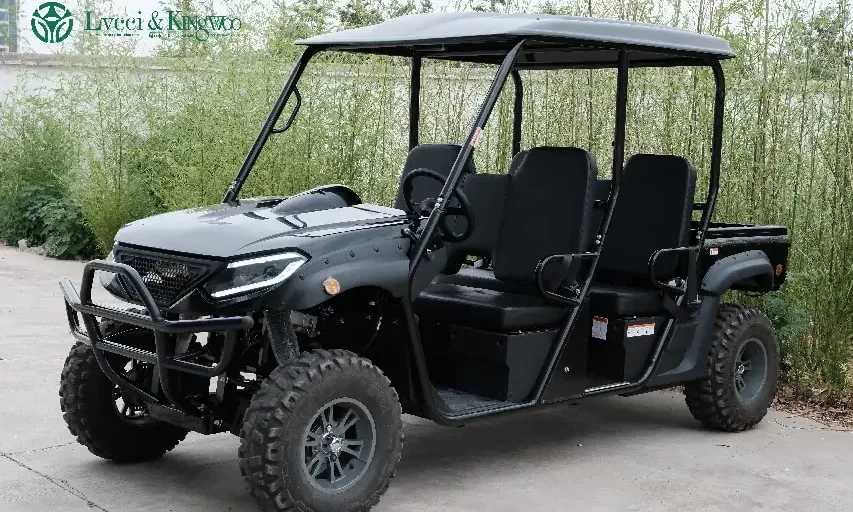
UTV all-terrain vehicle riding at night is the ultimate experience for off-road enthusiasts. Farewell to the crowds during the day, accompanied by the starry sky galloping through the mountains, deserts and forests, the cool night temperature can also greatly improve the riding comfort, bringing completely different fun from daytime off-road.
However, compared with daytime riding, there are many hidden risks in night cross-country. Insufficient light, reduced terrain recognition, and increased environmental variables at night. A little negligence may cause obstacle collisions, trapped vehicles, lost or even rollover accidents.
Many novice riders mistakenly believe that the original headlights and basic protective gear are sufficient to cope with night riding, which is also the core reason for the frequent occurrence of night off-road accidents. A set of professional modified lighting system, complete safety protection equipment, and standardized riding skills are the core guarantee for safe off-road at night.
This UTV night cycling guide will explain the core difficulties of night cycling, necessary lighting equipment, complete safety equipment, type selection skills, riding specifications and pit avoidance points in all directions. At the same time, it will supplement the special riding attention of electric UTV to help you create a perfect night cross-country plan and ease the fun of night cross-country.
The risk of UTV riding at night is not caused by a single lack of light, but the result of multiple factors such as vision, environment, terrain, and operation. Fully understand these hidden dangers, in order to accurately match the lighting and equipment, from the root to avoid safety problems.
The brightness and illumination range of the original car lights are very limited and cannot be adapted to complex off-road terrain. Many riders will have the problem of “speeding lighting”, that is, the speed exceeds the effective illumination distance of the light, leaving themselves a serious shortage of reaction time to avoid obstacles.
Low light environment at night will greatly weaken the human eye’s depth perception, distance judgment and peripheral vision. The potholes, steep slopes, curbs, and rocks that are clearly visible during the day will become blurred in the dark, and misjudgments are prone to occur.
At the same time, the problem of sight interference in night cross-country is prominent. Dust and fog will reflect the lights to form glare, which not only blocks the road conditions ahead, but also causes visual fatigue to the rider, further reducing the accuracy of road conditions.
Night is the active time for wild animals. Animals often cross the track suddenly in off-road venues such as mountains, woodlands and deserts. If riders do not have time to brake, they will cause collision accidents, causing vehicle damage or personnel injury.
The dark environment will completely erase the familiar terrain landmarks of the day. Both novice and old riders are prone to get lost and break away from the riding team, and fall into the plight of isolation and helessness in the field without people.
The temperature will drop rapidly at night, especially in desert and mountain forest areas, where the temperature difference between day and night is great. Thin riding clothing can not resist low temperature, not only will cause body discomfort, but also lead to stiff hands and feet, affecting the flexibility of vehicle control.
On top of that, the familiar day track is completely transformed at night. The difficulty of soft sand, muddy roads and rock climbing areas will be magnified, the recognition degree will be greatly reduced, and the rider’s concentration and vehicle control technology will be higher.
The risk of mechanical failure of the vehicle is infinitely magnified at night. Simple tire burst, loose parts and vehicle trapping problems during the day will become difficult to investigate and rescue in a dark and low-temperature field environment, which will easily lead to long-term detention.
UTV’s high weight, dynamic cross-country, and shortened night reaction time will greatly increase the probability of rollover, loss of control, and collision. At the same time, the line of sight is blocked at night, the communication and formation maintenance of team riding are greatly improved, and riders are easily separated by terrain and dust, resulting in problems of falling behind and losing contact.
Lighting is the core safety equipment for UTV riding at night. A single original car lamp cannot cover the whole scene off-road demand. A set of layered and complementary modified lighting systems can not only solve the problem of lighting far away from the front, but also complement the vision of the side, chassis and blind area, so that oneself can be clearly identified by other riders at the same time.
The vast majority of UTV original equipped with halogen basic lights, can only meet the low-speed short-distance commute use. This kind of lamp brightness is low, the irradiation angle is narrow, the penetration is very poor, in the dust, fog, night environment almost failure.
More importantly, the original headlights are prone to blind spots in lighting, which cannot cover the side track and chassis terrain, which is also the main cause of scratching, car sinking and collision accidents at night.
Professional modified LED lights have the advantages of high brightness, high waterproof and shockproof, and wide irradiation range. They can be adapted to all scenes such as high-speed desert cross-country, low-speed rock climbing, and narrow forest crossing, and perfectly solve all the short boards of original lights.
The high-quality night lighting system rejects the “single strong light” and requires a variety of lighting to complement each other, perform their respective duties, and cover the needs of the riding vision in all directions.
LED strip light (main front lighting): This is the basic core configuration of night UTV modification, which is mainly responsible for long-distance and large-scale front lighting. The straight light line is focused, suitable for high-speed desert long-distance riding. The arc lamp has a wider illumination angle and is suitable for complex tracks with multiple corners. With spot + flood combined beam, it can not only see the road conditions in the distance, but also cover the wide road in the vicinity, thus completely eliminating the hidden danger of “speeding lighting. Usually installed on the top of the roll cage or the front bumper, it is a just-needed configuration for high-speed night riding.
Square/round spotlights (complementary lighting): spotlights are small in size and flexible in installation, and can be freely arranged on the top of A- pillar, bumper, shock tower, etc. Its core function is to fill in the blind area of long and long lights, illuminate the gaps in the near roads and bends with precision, avoid the appearance of the empty vision, and effectively relieve the tunnel vision of night riding.
Curving auxiliary light (side view only) is specially designed for the blind area of the curve at night. The light is obliquely illuminated outward, which can illuminate the ribbles, potholes and roadsides on the edge of the track and the inside of the curve in advance. For narrow roads between forests and multi-winding mountain races, this set of lights can greatly reduce the risk of turning loss control, and it is a necessary configuration for technical cross-country.
Chassis rock lamp (short-distance terrain lighting): As a technical off-road exclusive light, the chassis lamp is installed on the wheel arch, under the chassis, and at the bottom of the bumper. It can clearly illuminate the rocks, sand and potholes around the tires, help riders to accurately judge the landing point of the wheels, avoid sidewall scraping and underpinging the car, and perfectly adapt to rock climbing and low-speed riding scenes in complex terrain.
LED flagpole light (passive identification safety light): Different from lighting lights, the core function of flagpole lights is “being seen”. The tall flexible lamp body can climb over sand dunes and hillsides, allowing other riders at long distances to clearly identify the position of the vehicle in dusty and dark environments, preventing rear-end collisions and collisions. It is also a mandatory equipment for night riding in most public off-road venues.
In addition to the core lights, some advanced configurations can further enhance the safety of night riding. The upgraded LED headlights can replace the original halogen lamps with higher brightness, lower energy consumption and softer light.
White/amber dual-color light is an artifact of bad weather. White light is used for lighting on clear and dark nights. Amber light can effectively penetrate dust, fog, and light snow, reduce light reflection and glare, and improve the clarity of vision in bad road conditions.
Reverting lights, warning strobe lights, work lights in the car atmosphere is also very practical. Reversing lights solve the problem of blind spots in reversing at night. Strobe lights are used for team riding warnings. Interior lights are convenient for riders to check equipment and navigation at night.
Light selection can not only look at the brightness, parameter matching, quality and durability is the key. First of all, we should pay attention to the beam mode. The concentrated beam is suitable for high-speed and long-distance riding, the flood beam is suitable for short-distance and wide-width road surfaces, and the combined beam is suitable for all scenes.
Second priority to choose high protection grade products, must meet the IP67/IP68 waterproof and dustproof standards. The off-road environment is dusty and ponding, and the low-protection lamp is easy to enter water and ash, and there are problems of stroboscopic and damage.
At the same time to take into account the anti-shock, anti-corrosion performance. UTV has severe off-road bumps and frequent body vibration. The lights of reinforced lamp body and shockproof wire can adapt to complex road conditions for a long time and avoid fracture and failure.
Finally, reasonable control of power consumption, especially electric UTV, need to choose low energy consumption and high brightness LED lights, to avoid excessive power consumption of high-power lights, shorten the cruising range.
Lighting solves the problem of “visible”, while safety equipment ensures “riding steadily and protecting”. Night riding protection priority is much higher than the day, a full set of compliance equipment can effectively avoid collision, low temperature, sudden accidents caused by personal injury.
Professional certified helmets :DOT, ECE, Snell certified full helmets or combined helmets are the first requirements for riding. The fault tolerance rate of night accidents is extremely low. The whole helmet can protect the head in all directions, resist impact and gravel impact, and have good ventilation at the same time, which is suitable for long-term night riding.
Transparent Anti-Fog Goggles: Daytime dark, specular lenses are absolutely prohibited. Transparent or light color anti-fog goggles must be worn at night, which can not only maximize the use of ambient light, see the road conditions clearly, but also block dust, mosquitoes and gravel, and avoid temperature difference fogging to block the line of sight.
Professional riding gloves and high-top boots: Thickened non-slip riding gloves can improve the grip of the steering wheel, buffer the vibration of the body, resist the low temperature at night, and protect the hands from wear. High-top cross-country boots can fix the ankle, prevent sprains, resist the impact of gravel and hard objects, and improve the support of the foot.
Layered protective clothing: do not wear shorts, short sleeves, loose clothing riding. Need to wear long-sleeved trousers basic protective layer, with windproof warm coat, suitable for night cooling environment. Loose clothes are easily hooked by foreign objects, increasing safety risks.
Chest armor, knee pads, elbow pads, neck pads and other armor equipment, suitable for high-intensity technical off-road scenes. When riding on rock climbing and bumpy track, it can effectively buffer the impact, protect the trunk and joints, and reduce the risk of injury.
Reflective clothing and reflective stickers are exclusive equipment for night. When riders get off the bus for maintenance and explore the road on foot, the reflective material can greatly improve their identification and avoid being accidentally injured by other vehicles.
Night team riding visual communication is basically invalid, walkie-talkie is the core communication tool. It can broadcast road conditions in real time, remind risks and synchronize riding status to avoid disconnection and loss of contact.
Offline GPS navigation equipment is essential. Terrain landmarks disappear at night, mobile phone signals are easy to be interrupted, and downloading offline track maps or special navigators in advance can effectively avoid the problems of getting lost and deviating from the track.
The rescue difficulty of vehicle failure and personnel injury at night has been greatly increased. A full set of emergency materials is the guarantee of riding at night. First aid kits, fire extinguishers, basic maintenance tools and tire repair kits must be prepared.
At the same time, trailer belt, rescue equipment, spare fuse, portable charging treasure, headlights, spare drinking water and high-calorie snacks shall be equipped to deal with emergencies such as vehicle trapping, power failure and long-term detention.
There is no universal light set, different cross-country terrain, riding style, the corresponding light combination is completely different. According to their own common riding scene with equipment, in order to take into account the practicality and cost-effective.
The core requirement is long-distance vision, and 30-40 inch long strip condenser/combined beam lamp is preferred, with high-brightness flagpole lamp. High-speed riding needs to predict the road conditions in the distance in advance. Flagpole lights can keep the team visible in dusty environment. Amber lights are optional to cope with dusty weather.
The core requirements are side vision and curve lighting, with priority given to A- pillar curve lights, square supplementary light spotlights, supplemented by short strip lights. Focus on making up the blind spots on both sides of the curve and track to avoid branches and stones from rubbing against vehicles.
The core requirement is close-range terrain identification, with chassis rock lights and low-level spotlights as the main focus, to accurately illuminate the terrain around the tire, assist in judging the wheel landing point, and avoid bottom and sidewall damage.
The most widely adapted general scheme, the medium and long combination beam strip lamp + curve fill lamp + basic flagpole lamp, taking into account long-distance, side and close-range vision, meeting the needs of most amateur players for night riding.
High-quality equipment is the foundation of safety, and standardized riding skills are the core of avoiding risks. Night riding must abandon the habit of daytime riding and deal with complex environments with conservative and cautious operating principles.
Eliminating “speeding lighting” is the first criterion for night riding. To ensure that you can stop smoothly after you find an obstacle.
Compared with the daytime, the night riding speed needs to be greatly reduced, and the speed needs to be further slowed down in complex tracks, dusty sections and areas with many wild animals. At the same time, increase the distance between the car and the car, avoid the dust in front of the car blocking the line of sight, and reserve sufficient reaction time.
It is absolutely forbidden to explore strange tracks and take short cuts at night. Dark environment will cover up terrain defects, and deep pits, steep slopes and dark barriers on unfamiliar roads cannot be quickly identified, which can easily lead to out-of-control rollover accidents.
Only choose to ride completely during the day and cross-country at night, and record the difficulties and dangerous points of the track in advance.
Resolutely put an end to single-person night cross-country, no one to help, vehicle trapping, failure, injury will become a serious safety hazard. Must use double and above team riding buddy safety mode.
The team needs to set up a leader and a finishing rider. The leader is familiar with the track, controls the speed, and the finishing rider prevents personnel and vehicles from falling behind. Keep the walkie-talkie unblocked in the whole process, unify the riding signal, and broadcast the road condition risk in time.
Adjust the light angle in advance, and the lamp body is slightly tilted downward to avoid the light shining directly ahead, causing reflective glare at the front of the car and affecting its own line of sight. At the same time, avoid strong light direct to the riders, causing blindness to others.
In dusty and foggy weather, switch amber lights in time to reduce light scattering and improve visual clarity. According to the road conditions, the auxiliary lights are switched on and off, the side lights are turned on and the main long lights are turned on and on, which is reasonable to use.
Don’t just stare at the bright area in the center of the light when riding at night. You need to continuously scan the edge of the light and the dark area in the distance, and pay attention to the reflective eyes of wild animals and the undulating changes of terrain.
Allow 15-20 minutes of dark light adaptation time before riding to adapt your eyes to the dark environment. Keep awake throughout the whole process, eliminate fatigue, drunk riding, and avoid accidents caused by decreased reaction speed.
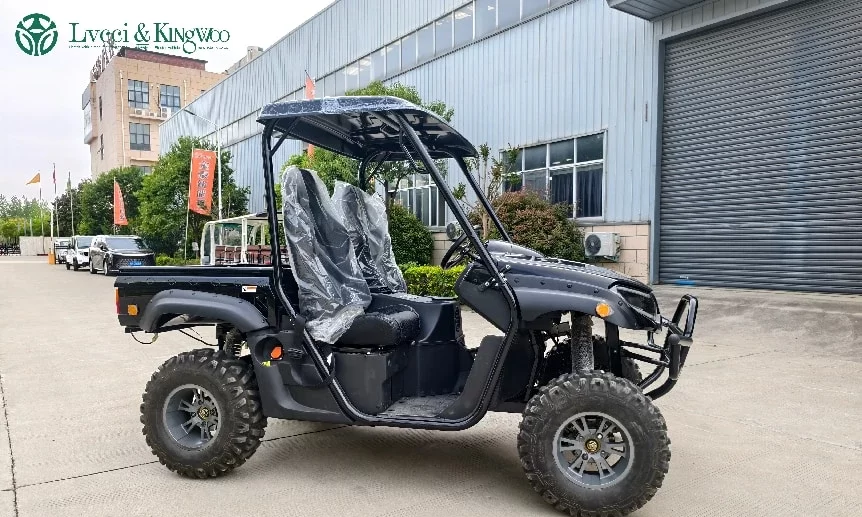
With the advantages of quiet, environmental protection and light operation, electric UTV has become a new choice for off-road. However, compared with fuel UTV, electric vehicles have exclusive characteristics of battery life, power supply characteristics and mute effect, and extra attention should be paid to night riding.
LED lights and on-board electronic equipment will continue to consume battery power, and the energy consumption of night riding is much higher than that during the day. It is necessary to start with full power in advance and reserve sufficient battery life allowance to avoid power exhaustion in remote areas. Check the remaining battery power in real time, and turn off unnecessary lighting equipment in time to save energy.
Low temperature at night will greatly reduce the capacity and output power of lithium batteries and lead-acid batteries, resulting in shrinking battery life and reduced power. Before riding in a low temperature environment, the battery can be preheated in advance, and the engine can be warmed up for short-distance low-speed driving to avoid violent driving and increasing energy consumption.
Electric UTV has almost no engine noise and has the advantage of quiet and no damage to the environment, but the disadvantage is that other riders and wild animals cannot predict the approach of vehicles through sound. The flagpole lights and warning lights must be turned on throughout the process, and the recognition degree must be improved by lights and interphone.
The kinetic energy recovery braking effect of the electric UTV is different from the brake feel of the fuel car. The bumpy and slippery track at night needs to adapt to the braking rhythm in advance to avoid sudden deceleration leading to out of control of the body. The steep slope section should be carefully controlled to adapt to the kinetic energy recovery characteristics.
Electric UTV can’t replenish energy as quickly as fuel vehicles, and there is no charging condition in the field at night. It is necessary to plan the route in advance, avoid remote areas without rescue, and make rescue plans for vehicle failure and power exhaustion in advance.
Most night riding accidents stem from the habitual misunderstanding of the rider. Seemingly small operational negligence, in the dark environment will be infinitely magnified, causing serious consequences.
Do not rely too much on the original lights, the lighting range and brightness of the original lights can not support high-speed, complex terrain night riding, long-term use is prone to blind spot accidents.
Do not blindly pursue ultra-high brightness light, only look at the lumen value does not look at the beam quality. Inferior strong light will produce serious glare, reflection, the formation of tunnel vision, but narrow the visual range, the loss outweighs the gain.
Do not ignore low-temperature protection and visual equipment. Cooling at night can easily lead to body stiffness. No reflective equipment is easily injured after getting off the bus. Basic protection must not be omitted.
Do not skip the pre-match inspection. Minor failures of the lighting circuit, battery power, tire status, and brake system will become fatal hazards at night. A full set of inspections must be completed before each night ride.
Avoid fatigue, distracted riding, night visual pressure is much greater than the day, energy is not concentrated will greatly reduce the reaction speed, unable to avoid sudden obstacles and wild animals in time.
The careful pre-match inspection is the last line of defense for safe riding at night. A full set of inspection covers vehicles, lights, equipment, materials, routes, all-round elimination of hidden dangers.
Check the tire pressure, tread pattern and sidewall integrity, tighten the wheel hub screws, test the brake sensitivity and brake fluid level, and investigate the hidden dangers of braking. Check the status of engine oil, coolant and fuel/electricity, and supplement consumables. Check the battery wiring and line integrity, and check the light short circuit and looseness. Finally, test the steering, suspension and chassis guard to ensure the normal operation of the whole vehicle.
Test the original headlights, tail lights, brake lights, reversing lights and all modified auxiliary lights one by one to ensure that there is no flicker and no failure. Adjust the light irradiation angle to eliminate glare and lighting dead corners. Prepare spare fuses, bulbs and portable headlights for sudden light failure. Switch the amber light mode in advance in dusty and foggy days.
Confirm that the certified helmet, transparent anti-fog goggles, riding gloves and high-top boots are fully worn. Check that long-sleeved trousers, warm coats and reflective clothing are in good condition. Advanced armor equipment should be worn as required to prevent naked riding.
Equipped with first aid kit, fire extinguisher, maintenance tools, tire repair kit, trailer rescue equipment. Prepare charging treasure, drinking water, warm clothes and backup power supply. Test the signal of walkie-talkie and GPS navigation equipment is normal, and download the offline track map in advance.
Only choose to be familiar with the track during the day, and share the riding route and return time in advance to those who have not traveled. Confirm team formation, riding signal, communication channel, query real-time weather, avoid bad weather riding. Put an end to single cross-country in the whole process and implement the team safety riding system.
Summary
There is no substitute for the fun of UTV night riding, but safety is always the first prerequisite for off-road. All risks of night riding can be effectively avoided through professional lighting modification, complete safety equipment, standardized riding skills, and meticulous pre-competition preparation.
A layered and complementary lighting system can help you completely solve the blind area of night vision and realize “seeing far, seeing completely, and being seen”. A complete set of standard protective equipment and emergency supplies to protect the safety and stability of the vehicle.
In particular, electric UTV riders need to focus on battery power consumption control, low temperature adaptation and visual protection, and adapt to the exclusive characteristics of the vehicle. Abandon bad riding habits, adhere to the principle of low speed, familiar with the road, team, cautious night riding, in order to enjoy long-term peace of mind cross-country fun.


-150x150.png)