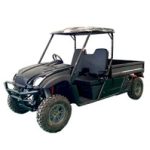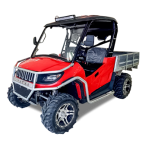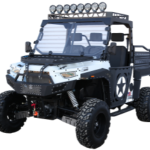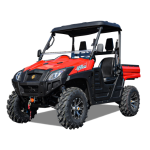
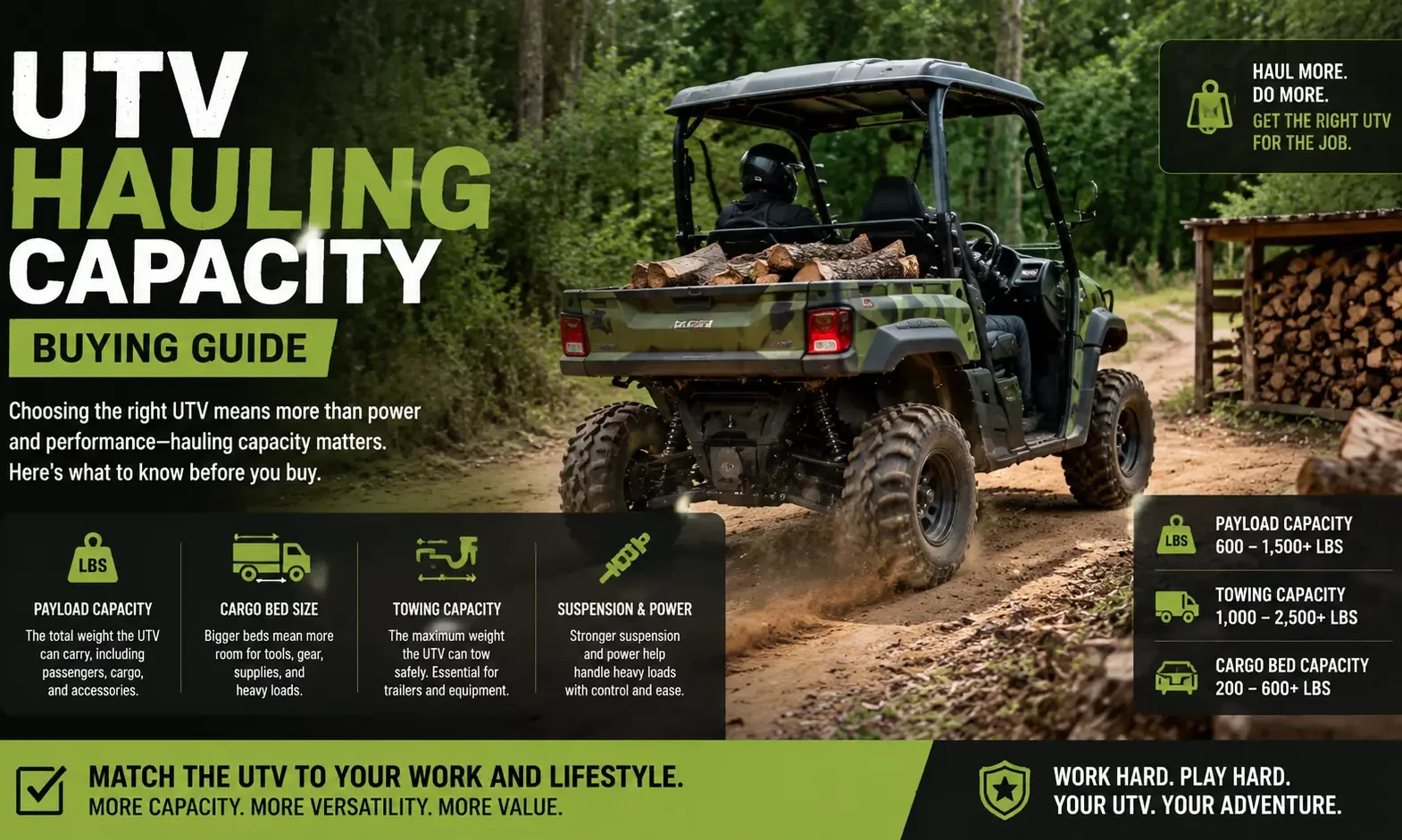
The load capacity of UTV (all-terrain multi-function vehicle, also known as side-by-side SxS) refers to the maximum weight limit that the vehicle can safely carry and tow goods. At present, the propaganda caliber of major manufacturers and distributors is not uniform, and the definition of load parameters is different.
Load capacity of carriage: refers specifically to the pure cargo weight that can be carried by UTV cargo hopper and dump box, and is also the “load parameter” commonly used by manufacturers in publicity “. The load capacity of the cargo hopper of mainstream models is 300-1000 pounds, and the high-end and heavy-duty models can reach half a ton. Only the weight of materials, tools, agricultural materials and other goods in the carriage is calculated, and the load of drivers and trailers is not included.
Vehicle payload: This is the most critical comprehensive load parameter, covering all additional loads of the vehicle. Specifically, it includes the weight of the driver and passengers, the cargo in the car, the on-board accessories, the weight of the fuel/battery, and the vertical pressure of the trailer. This parameter is derived from the gross vehicle weight rating (GVWR) minus the empty weight of the vehicle. The conventional UTV payload is 500-1500 pounds, and the high-end heavy-duty models can exceed 1500 pounds.
Drag load capacity: different from carriage load, it refers to the maximum total weight (trailer + cargo) of UTV towing trailer and small equipment through the rear traction hook. The towing capacity of most engineering and agricultural UTV is much higher than that of carriage load, with the mainstream range of 1000-2500 pounds and professional heavy-duty models reaching 3500 pounds.
The weight of the goods, personnel and equipment directly placed in the carriage will all act on the frame, suspension, tires and axles of the vehicle, which requires extremely high structural strength of the body.
Most of the weight of the load towing the trailer is carried by the trailer tires. UTV only provides traction, and only a small amount of vertical pressure (towing tongue weight) is included in the vehicle payload.
Confusing the two parameters can cause serious pitfalls. Overloading will cause body deformation, suspension failure, and longer braking distance; overloading and dragging will cause transmission system overload, weak climbing, and loss of control of the vehicle. The risk will be greatly increased in muddy, steep, and rugged terrain.
The rated load marked by the manufacturer is based on the calculation of the smooth and hard ideal road surface. In the actual outdoor operation, the load capacity will be greatly reduced.
Muddy, sandy, and gravel uneven roads will increase driving resistance and reduce tire grip; long-distance climbing and downhill will increase the load on the power and braking system. In addition, the uneven placement of goods, the installation of heavy refitting parts, high-speed driving and other behaviors will further compress the effective load space.
Daily use must be strictly lower than the official rated parameters, reserve sufficient safety margin, adapt to complex outdoor conditions.
When purchasing, check the 4 core data first: the rated load of the carriage, the payload of the whole vehicle, the drag load and the manufacturer’s exclusive parameter definition. Combined with their own operating terrain, load frequency, comprehensive judgment of vehicle bearing capacity, do not blindly refer to publicity gimmicks.
The load limit of electric UTV is not determined by a single parameter, but the result of the synergy of vehicle power, structure and configuration. From the original design parameters to the actual outdoor working conditions, multiple conditions jointly determine the real heavy load performance of the vehicle.
Compared with fuel UTV, the biggest advantage of electric UTV is the instantaneous high torque at the start. The motor can output peak power without increasing speed, which is perfectly suitable for high-frequency operation scenarios such as heavy-duty starting, steep slope climbing, low-speed load driving, etc.
The power of the motor directly determines the continuous load capacity. High-power motors of 2000W-5000W and above can stably support continuous heavy load and long-distance towing without power attenuation and overload jam. Low-power motors are only suitable for light-load leisure scenarios and cannot meet the needs of agricultural and engineering heavy loads.
The high-quality continuously variable transmission and clutch transmission system can avoid the problems of slipping, overheating, and power loss during heavy-duty driving, and continuously and stably output power.
Driving form is the key to off-road load. The 2WD two-wheel drive model is only suitable for light-load operations on flat roads and is more cost-effective. The 4WD four-wheel drive model has stronger grip performance. In complex terrain such as muddy, potholes, and steep slopes, it can effectively avoid skidding and sinking, and greatly improve the effective load capacity under complex working conditions.
Heavy-duty UTV must be equipped with high-strength thickened steel frame, which is more rigid, not easy to deform, and can withstand full-load pressure and outdoor bumpy impact for a long time. The lightweight frame is only suitable for leisure transportation, and long-term heavy load is prone to body distortion, solder joint cracking and other problems.
The gross vehicle weight rating (GVWR) is the absolute standard for safe load-bearing of the body, and the weight of the empty vehicle will occupy part of the payload. Heavy-duty UTV with large size and high rigidity frame, the overall bearing stability and safety are far better than small lightweight models.
The suspension system directly determines the passability and stability of heavy load conditions. Special extended travel suspension for heavy loads (8-12 inches travel), with high-strength springs and shock absorbers, can filter road bumps under full load.
The high-quality heavy-duty suspension can effectively avoid the bottom of the chassis and the failure of the suspension overload. When working in rough terrain, it always keeps the body stable, protects the frame, tires and transmission system, and prolongs the service life of the vehicle.
The tires must match the maximum full load weight of the vehicle, and the thickened tires with high load specifications have stronger bearing capacity, wear resistance and puncture resistance. Widened off-road tires can also improve the grip on complex roads and avoid heavy load skidding.
The braking system determines the safety of heavy load driving. High-strength braking configurations such as four-wheel hydraulic disc brakes can quickly brake vehicles under full load and drag. At the same time, the exclusive heat dissipation system can avoid power and brake overheating caused by long-term heavy load and long downhill driving.
Bucket size, reinforcement technology, self-unloading design, directly determine the cargo carrying capacity and loading and unloading efficiency. In agricultural and engineering scenarios, priority is given to the reinforcement and widening of the cargo hopper and hydraulic dump configuration, which is suitable for the transportation of various materials such as sand and gravel, agricultural materials and tools.
Standardized 2-inch heavy-duty traction hook is the core configuration for stable towing trailers and small equipment. It can expand various towing accessories to meet diversified heavy-duty needs.
UTV on the market is divided into four categories: entry-level leisure, medium-sized practical, heavy-duty engineering and sports cross-country. The load and drag parameters of different models vary greatly, and the application scenarios are completely different.
Carriage load: 300-600 pounds, vehicle payload: 500-1000 pounds, towing capacity: 1000-1500 pounds.
This type of model focuses on lightweight, high flexibility, suitable for courtyard care, outdoor camping, light sightseeing and other light-load scenes, not suitable for long-term heavy-duty operations, representative models for small entry-level rangers, pioneer 500 series and other basic models.
Carriage load: 600-1000 pounds, vehicle payload: 1000-1500 pounds, towing capacity: 1500-2500 pounds.
This is the mainstream vehicle for agricultural, garden and courtyard operations, with balanced bearing capacity and high cost performance. It can normally transport agricultural materials, fertilizers, seedlings and small tools, and is suitable for most daily outdoor operations, covering popular vehicles such as Honda Pioneer 700/1000, Polaris Ranger mid-range models and Kawasaki mules.
Carriage load: 1000-1500 pounds, vehicle payload: 1500-2150 + pounds, towing capacity: 2500-3500 pounds.
It is specially designed for construction, heavy-duty operations in large farms and pastures. It is equipped with reinforced frame, high-power power system and four-wheel drive heavy-duty configuration. It can carry heavy materials and drag large-scale equipment for a long time. Representative models include Polaris Ranger XP/XD1500, Bombardier Guard HD series and other commercial-grade models.
This type of vehicle focuses on off-road performance and speed-up experience. The carriage load and vehicle payload are generally low, there is no exclusive heavy-duty design, and the towing capacity is mostly within 1500 pounds. Only suitable for mountain crossing, sand dune cross-country and other entertainment scenes, not suitable for any normal load operation.
At this stage, the parameters of high-end electric heavy-duty UTV have been matched with standard fuel vehicles. The mainstream high-duty vehicles can achieve 1000-1250 pounds of carriage load and 2500 pounds of towing capacity, fully meeting the requirements of conventional heavy-duty vehicles. The entry-level electric model has a low carrying capacity, only suitable for light-load scenarios, and needs to be distinguished when purchasing.
Recommended parameters: carriage load 400-800 pounds, vehicle payload 500-1000 pounds, towing 1000-1500 pounds.
The scene is mainly lightweight, the core requirements are flexible and lightweight, lower energy consumption, ride comfort. Without high load parameters, entry-level and medium-sized basic models can meet the transportation needs of daily tools and camping equipment.
Recommended parameters: carriage load 600-1000 pounds, vehicle payload 1000-1500 pounds, towing 1500-2500 pounds.
It is necessary to take into account the carrying of personnel, prey and outdoor equipment, and at the same time adapt to rugged road conditions in mountains and forests. It is preferred to select vehicles with high ground clearance, quiet operation and balanced bearing capacity, which are suitable for field operations on complex terrain.
Recommended parameters: carriage load 800-1250 pounds, vehicle payload 1200-1700 pounds, towing 2000-2500 + pounds.
High-frequency transportation of feed, fence building materials, soil, forage, seedlings and other materials, the load stability and durability requirements are extremely high. Priority is given to models equipped with dump trucks, four-wheel drive systems, and durable suspension, which greatly improves operating efficiency.
Recommended parameters: carriage load 1000-1500 pounds, vehicle payload 1500-2150 + pounds, towing 2500-3500 pounds.
Need to carry long-term heavy building materials, construction tools, drag small engineering equipment. Must choose full-size heavy-duty commercial UTV, relying on reinforced frame, high-power power, heavy-duty four-wheel drive system, to deal with high-intensity heavy-duty operations.
Priority is given to medium-sized full-sized 1000-pound cargo bucket models with a towing capacity of 2,000-2,500 pounds, taking into account daily light-load leisure and occasional heavy-duty operations, and balancing performance, price and flexibility. It is the best choice for most domestic and small-scale site users.
If the daily operation is mainly muddy, sandy, steep slope and gravel road, a load level shall be upgraded on the basis of the original demand. Complex terrain will greatly reduce the effective load, and higher chassis rigidity, power reserve, and suspension configuration can ensure the safety of heavy-duty driving.
The payload is all the weight that the vehicle itself can carry, including people, goods, accessories, and traction tongues, which tests the overall structural bearing capacity of the vehicle body. The towing capacity is the weight of the external load that the vehicle can pull. It mainly tests the power system and traction, and most of the load is taken by the trailer.
When towing, 10%-15% of the towing tongue weight will be generated, which will directly occupy the payload of the whole vehicle. Many models have high drag parameters, but after superimposing personnel, cargo, and tongue weight, the payload can easily exceed the standard, causing safety hazards.
Take the carriage load as the core (agricultural materials, building materials and tool transportation): give priority to the payload + carriage load. The drag parameter is only used as an auxiliary reference. Insufficient carrying capacity of the body will directly lead to normal operation.
Take trailer towing as the core (equipment towing and material trailer transportation): give priority to towing capacity and reserve sufficient payload margin to offset towing tongue weight and personnel weight.
Operation + drag and drop mixed use: the two parameters must be balanced to meet the standards, and the payload needs to reserve more margin, which is the core index that is most likely to exceed the limit in daily use.
Pure leisure transportation, light load use: only need to pay attention to the payload and carriage load, high drag parameters have no practical significance, but will increase the cost of car purchase.
Commercial heavy-duty full-scene operation: must meet the high payload, high drag capacity, high strength body configuration, indispensable.
In most daily operation scenarios, the payload is the more critical limiting factor and the most overlooked parameter. Do not be misled by the ultra-high drag parameters, be sure to combine their own usage habits, two-way check the two core data.
On-board load statistics: count the weight of daily drivers and passengers, the weight of conventional goods in the carriage, and the weight of fixed modified accessories (winch, snowboard, ceiling, door).
Towing weight statistics: count the weight of empty trailer, the maximum load weight of trailer, and calculate the total towing weight. The data is preferentially measured by weighing, and conservatively estimated without measured data.
Calculation formula: required payload = total weight of drivers and passengers + weight of modified parts + weight of towing tongue (applicable to towing scenarios).
The towing tongue weight is estimated according to 10%-15% of the total weight of the trailer. After all data accounting is completed, an additional safety margin of 20%-30% will be added to adapt to complex road conditions and temporary weight gain requirements.
The maximum weight of goods placed in the cargo hopper is calculated separately, without including the weight of personnel and trailer, and the safety margin is also increased by 20%-30%, so as to match the rated load parameters of the carriage of the vehicle type.
Calculation formula: required towing capacity = empty trailer weight + trailer maximum cargo weight, superposition 20%-30% safety margin, and check whether the remaining payload is sufficient to avoid the contradiction between towing standard and vehicle overload.
For long-term operation on soft ground, steep slope and rugged terrain, it is necessary to further improve the parameter standard on the basis of the calculation results, reduce the actual load value, and avoid vehicle overload loss and safety loss.
Most buyers only focus on eye-catching drag large parameters, ignoring the core on-board payload. In the end, there is sufficient towing capacity, but it is directly overloaded after carrying people and cargo. This is the most common mistake in purchasing.
Only calculate the weight of the goods and forget the weight of the refitted accessories such as drivers and passengers, ceilings, doors, winches, etc. These loads will directly occupy the effective load, resulting in parameters that seem to meet the standards and seriously exceed the limit in actual use.
The simplified and rounded parameters advertised by merchants are often based on ideal working conditions, and there are differences in load parameters for models with different configurations of the same model. Just look at the publicity page without checking the official data of the manual, it is easy to buy models with inconsistent parameters.
Ignoring complex working conditions such as muddy, sandy, and steep slopes, the vehicle is used directly in accordance with the official ideal parameters, resulting in insufficient power, slipping, and body overload and wear, which greatly shortens the service life of the vehicle.
Just in accordance with the maximum load demand to buy models, without any margin. In the face of uneven cargo placement, temporary weight gain, and complex road conditions, there is no room for fault tolerance, and long-term full-load operation will accelerate vehicle aging.
Only pursue high drag or high on-board parameters, ignoring the supporting performance of suspension, tires, brakes, and frame. A single high parameter is meaningless. Only when the vehicle configuration meets the standard can safe heavy load be realized.
It only adapts to the current light load demand, ignoring the demand for agricultural materials and heavy-duty engineering operations in the later period, resulting in insufficient carrying capacity of the vehicle soon after use, requiring a second change of vehicle, wasting the purchase budget.
With the advantages of quiet, zero emission, low maintenance and instantaneous large torque, electric UTV has become the mainstream choice for agricultural and field operations.
The parameters of high-end heavy-duty electric UTV have been compared with standard fuel vehicles, which can realize 1000-1250 pounds of carriage load and 2000-2500 pounds of towing capacity, meeting most heavy-duty scenarios. Entry-level electric models have low carrying capacity and are only suitable for light-load leisure use.
The motor has zero-speed peak torque output, starting and climbing heavy-duty power far exceeds that of fuel models of the same level, and low-speed and heavy-duty driving is more stable and not stuck. At the same time, the operation is quiet, no exhaust emissions, suitable for farms, residential areas, indoor and outdoor alternate operation scene, and the daily maintenance cost is very low.
The larger weight of the power battery will increase the weight of the empty vehicle and indirectly compress the payload space. When purchasing, it must be confirmed that the payload marked by the official label already includes the dead weight of the battery, and the parameters of the fuel vehicle must not be directly matched.
Official endurance data are no-load flat road test results. Under full load, dragging, climbing and low temperature environment, the endurance will be reduced by 30%-50%. When purchasing, it is necessary to reserve sufficient endurance allowance to match the daily operation mileage and avoid power failure during operation.
Electric UTV needs stable charging conditions, daily high-frequency heavy-duty operations, and needs to match fast charging or full charging conditions at night. For multi-shift continuous operation scenarios, it is necessary to reasonably plan the charging time to avoid insufficient battery life affecting the operation progress.
Long-term high-frequency heavy load will accelerate battery decay, the purchase of focus on battery warranty policy, capacity retention standards. Although the purchase price of electric UTV is higher, but the lower energy consumption and maintenance costs, long-term use of cost-effective far more than fuel models.
Moderate load, fixed operation route, charging conditions, pay attention to silent environmental protection, give priority to electric UTV. All-weather uninterrupted limit heavy load, no charging conditions, extreme cold operation scenarios, more suitable for fuel, diesel UTV.
High torque power system is preferred, torque is more important than peak horsepower, suitable for heavy load starting and climbing. With durable heavy-duty transmission system to avoid slipping and overheating. The standard four-wheel drive differential lock improves the grip of complex terrain and heavy loads. At the same time, it is equipped with an enhanced heat dissipation system to prevent continuous heavy-duty power attenuation.
Selection of thick high-strength steel frame, high GVWR rated total weight design, anti-deformation, anti-bump ability is stronger. Reasonable vehicle weight improves driving stability and provides solid structural support for heavy load and towing operations.
The special extended stroke shock-absorbing suspension for heavy loads does not touch the bottom when fully loaded, and the driving is more stable. High-load specifications thick off-road tires, load-bearing, anti-build, grip excellent performance. Four-wheel hydraulic disc brake system, with auxiliary braking function, to ensure the safety of heavy downhill, drag operation braking.
Reinforced cargo hopper above 1000 pounds, with multi-point fixed buckle to prevent goods from shaking and shifting. Hydraulic/pneumatic self-unloading configuration, greatly improve the efficiency of loose material loading and unloading. Standard 2-inch heavy-duty traction hook is standard, suitable for all kinds of drag accessories.
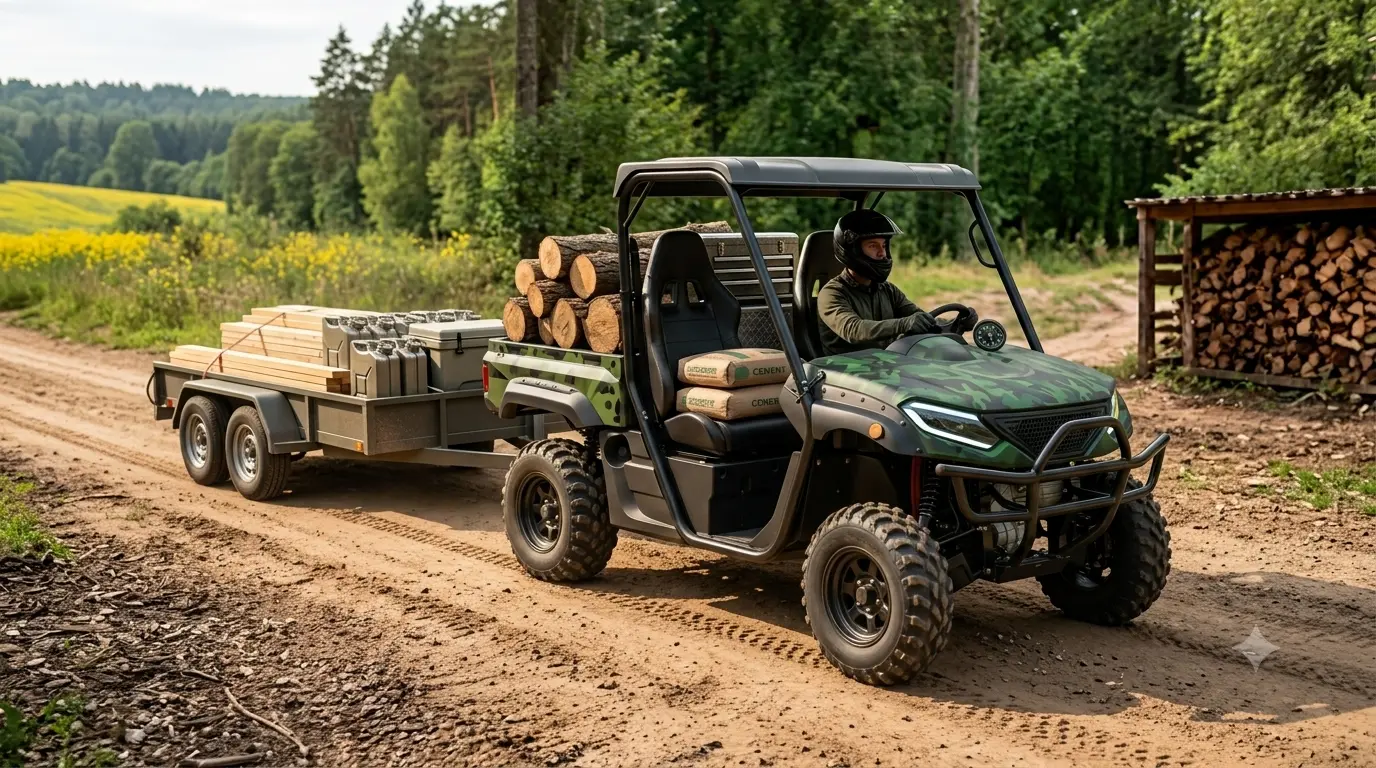
Sort out the daily routine load and maximum limit load, calculate the drag tongue weight, and reserve 20%-30% safety margin. Identify the core operation terrain and determine the priority of on-board loading and towing operations.
Check the three core data of carriage load, vehicle payload and towing capacity, confirm the GVWR rated gross weight and tongue weight limit, and calculate the dead weight of the empty vehicle and the remaining available load.
Check whether the power torque, transmission heat dissipation and four-wheel drive system are suitable for heavy load. Confirm that the reinforced frame, heavy-duty suspension, high-load tires, and reinforced braking meet the standards. Verify the strength of the cargo hopper, self-unloading function, and heavy-duty traction hook configuration.
Confirm that the load parameters include the dead weight of the battery, and verify the real endurance and low temperature performance of heavy load. Match your own charging conditions and check the battery warranty and long-term decay guarantee.
No parameter confusion, no load omission, no condition neglect, reserve sufficient safety margin, hardware configuration and load parameter matching, taking into account the current and future use needs, not blind premium, not low allocation.
The official load and drag parameters of high-end heavy-duty electric UTV have been completely compared with the same-level fuel models. And the instantaneous high torque characteristic of the motor makes the actual experience of electric UTV in heavy load starting and steep climbing better than that of fuel vehicles. Only in the all-weather uninterrupted limit heavy load, extreme cold no charging scenario, fuel models have more advantages.
Will. Full load, dragging and climbing will attenuate the endurance by 30%-50%, and the attenuation will be more obvious in low temperature environment. When purchasing and using, the endurance margin must be reserved, and the available mileage is estimated according to the actual heavy load condition, instead of the official no-load endurance data.
Very necessary. Farms and pastures are muddy, potholes and soft roads, and two-wheel drive vehicles are extremely easy to slip and sink under heavy load. The four-wheel drive model has stronger grip and higher load stability, which can adapt to complex farmland terrain and greatly improve operation efficiency and safety.
It is strictly prohibited to modify the frame, suspension and power system without permission to break through the rated load parameters of the original factory, which is illegal modification and has great potential safety hazards. The effective load stability under real working conditions can be improved by standardizing the placement of goods, reducing the load of invalid modification, adapting to the terrain and reasonably reducing the load, and selecting the original heavy-duty accessories.


-150x150.png)