With the popularity of outdoor operation, farm operation and maintenance, mountain off-road and outdoor hunting scenes, electric UTV (side-by-side multi-function task vehicle) gradually replaces traditional fuel UTV by virtue of its core advantages such as zero exhaust emission, silent operation, instant high torque and low maintenance cost, becoming the mainstream choice for commercial and civilian outdoor equipment.
This article is a guide to troubleshooting and maintenance of electric UTV in all scenarios. From the disassembly of core system principles, symptomatic solutions to common faults, use of professional diagnostic tools, full-cycle preventive maintenance, to professional maintenance definition and warranty rights protection skills, it comprehensively covers the needs of users, helps zero-based vehicle owners and site operation and maintenance personnel to quickly locate faults, independently solve routine problems, and at the same time prolongs the service life of equipment and reduces the failure rate through scientific maintenance. Maximize the efficiency and cost performance of electric UTV.
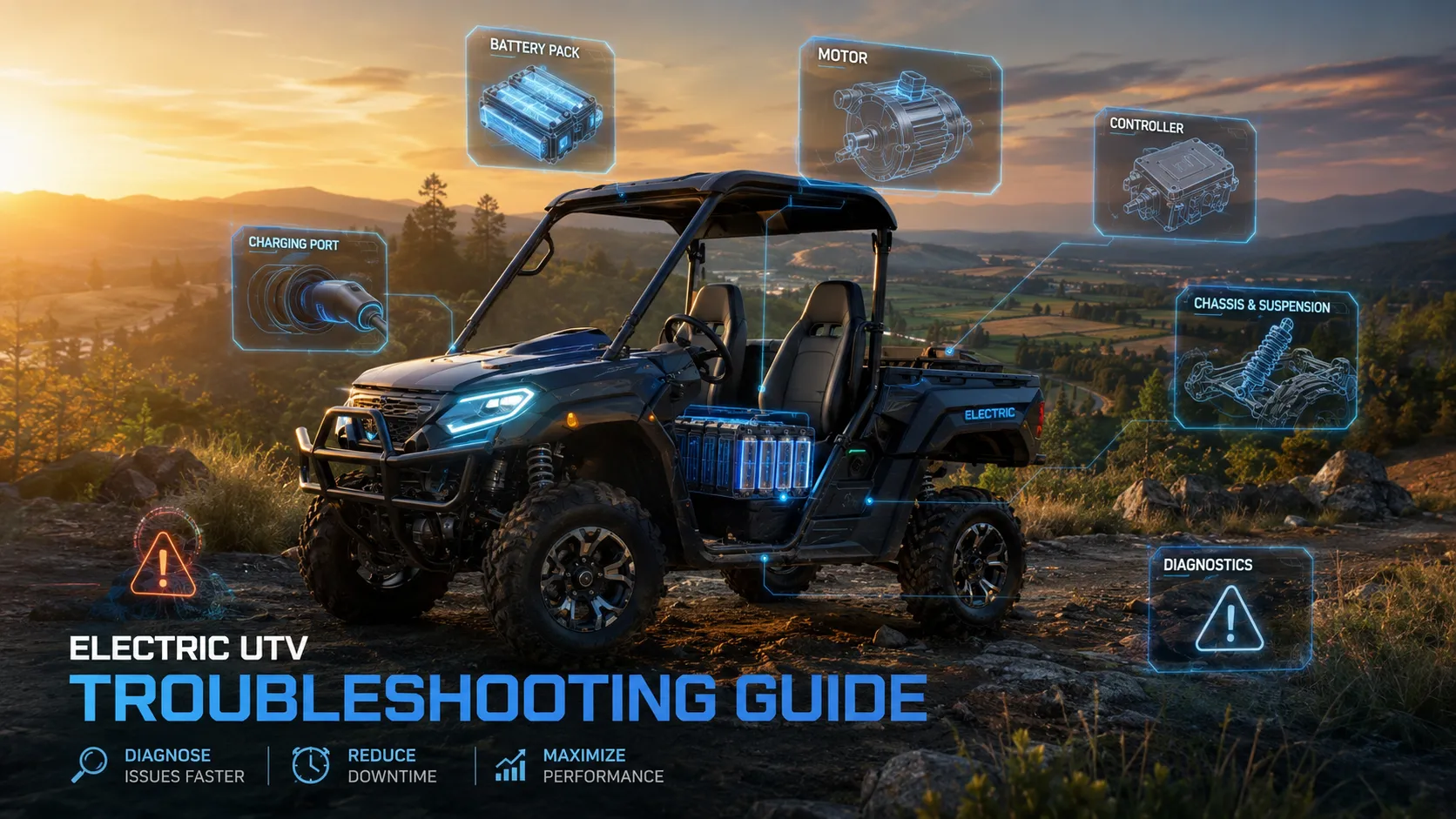
All kinds of failures of electric UTV basically originate from the abnormal operation of the six core systems.
Battery and BMS system is the power core and safety guarantee of electric UTV.Currently, mainstream models are equipped with LFP lithium iron phosphate batteries, which are suitable for harsh working conditions such as heavy outdoor loads, high and low temperatures, and bumps. The battery capacity directly determines the vehicle’s battery life and operating time.BMS battery management system is responsible for real-time monitoring of battery voltage, temperature, power and other data, providing multiple protection for overcharge, overdischarge, overtemperature and cell balance, and docking with vehicle control system.The daily failures such as battery life attenuation, charging failure, driving power failure, etc. are mostly related to battery loss or BMS safety protection trigger.
Motor and transmission system is the core of vehicle power output, mainstream brushless motor high energy efficiency, large starting torque, off-road, heavy load performance is better than traditional fuel UTV.The models are divided into two-wheel drive and four-wheel drive versions, supporting multi-gear and multi-driving mode switching, adapting to different working conditions such as flat road, off-road and heavy load.The whole set of transmission structure is simplified, there are no complex and vulnerable parts of the fuel engine, the mechanical failure rate is low, and the high-frequency maintenance items such as oil replacement and oil circuit maintenance are omitted, which are the key reasons for the lower operation and maintenance cost of electric UTV. The abnormal motor will directly lead to problems such as insufficient power and speed-up.
MCU motor controller and VCU vehicle controller is the electric control core of electric UTV, coordinating the power output and intelligent operation of the whole vehicle.MCU is mainly responsible for power conversion, precise adjustment of motor speed and torque, and control of downhill energy recovery function to assist in improving endurance.VCU linkage battery, motor, braking, thermal management and other subsystems, intelligent distribution of energy consumption, with fault self-test, early warning and power limit functions.The electronic control faults such as throttle lag, power jam, system error, limp mode, etc. mostly come from abnormal program of two controllers, signal failure or sensor damage.
Charging and power electronic system is an auxiliary core system to ensure normal charging and stable power supply of vehicles, mainly including on-board charger, DC-DC converter and thermal management system.The on-board charger is responsible for the mains conversion to meet the charging needs of the vehicle; the DC-DC converter completes the conversion from high voltage to low voltage to supply power for low voltage accessories such as lights, meters and speakers.The thermal management system dissipates heat or preheats the battery, motor and controller through air cooling or liquid cooling, avoids high temperature overload and low temperature performance attenuation problems, stabilizes the working state of core components, reduces hidden faults caused by temperature, and ensures long-term stable operation of equipment.
Mechanical Systems Chassis, suspension and braking systems are the mechanical basis for electric UTV to cope with complex off-road conditions.High-strength off-road chassis with sunken battery layout effectively reduces the center of gravity of the body, giving consideration to driving stability and battery protection effect.The independent suspension + differential lock structure adapts to high torque output, cushions bumpy road conditions, and improves off-road trafficability.The vehicle adopts mechanical braking + regenerative braking dual mode, giving consideration to safety and energy saving, and matching parking braking to meet the requirements of ramp operation.The instrument panel can display fault code, electricity, temperature and other data in real time, providing intuitive reference for troubleshooting.
Electronic safety and auxiliary accessories system ensures vehicle driving safety and scene adaptation ability.The model is equipped with basic safety configurations such as anti-roll frame, seat belt, safety interlock, warning light, etc., and the high-end model is equipped with intelligent auxiliary function to improve outdoor operation safety in an all-round way.The vehicle can be equipped with winch, cargo box, drag accessories, etc. as required to adapt to multiple scenarios such as farm transportation, off-road, hunting, etc.The electronic circuit of the whole vehicle is highly integrated, but outdoor muddy water, dust and long-term bumps are easy to cause aging of the circuit and moisture and oxidation of the interface, which are the main causes of small electrical faults of the vehicle and need regular inspection and maintenance.
Although the overall failure rate of electric UTV is much lower than that of fuel models, the exclusive battery, electronic control and charging system failures are more concentrated.Most users encounter problems such as flameout, poor battery life, failure to charge, weak power, system error, etc., with clear fault causes and standardized solutions.This section sorts out the common high-frequency faults of mainstream models of the whole network, with precise symptoms, core causes and DIY repair solutions that can be landed, 80% of the routine faults can be solved without professional equipment.
Battery is the most vulnerable component of electric UTV, and it is also the core factor affecting the use experience of vehicles. Long-term improper use, poor environmental operation and inadequate maintenance will cause various battery problems.
Core fault symptoms: vehicle life is obviously shortened, the gap between full battery life and factory life is too large, low voltage error is suddenly prompted during driving, power off and flameout without reason in the middle of operation, battery is quickly powered off after full charge, vehicle cannot be started, and battery loss is serious after long-term standing.
Main failure causes: long-term deep discharge (recharge after battery depletion), long-term operation and storage in high and low temperature extreme environments, oxidation and corrosion of battery terminals, loose lines, unbalanced cell voltage, parasitic power consumption of external accessories, charger mismatch or failure, natural aging and decay of the battery.Among them, low temperature in winter is the primary cause of battery life shrinkage, high temperature and heavy load operation will accelerate battery aging, long-term idle maintenance will cause battery loss imbalance.
Failure to start without reason, sudden flameout during driving, repeated power-off restart, electric UTV high-frequency high-frequency fault, mostly concentrated in circuit connection, electric control protection, power supply abnormality three dimensions, fault randomness is strong, troubleshooting difficulty is relatively high.
Core fault symptoms: turning the key can not turn on the power, driving without reason shutdown, intermittent operation of equipment, need to switch the key repeatedly to restore normal, frequent triggering of limp mode during driving.
Main causes of failure: Loosening of high-voltage line connector and outdoor muddy water erosion lead to corrosion and oxidation of line terminals, main fuse blowing, poor contact of contactors and ignition switch failure;BMS battery system and MCU motor controller detect overcurrent, over-temperature and abnormal signal, triggering automatic power-off protection; 12V auxiliary low-voltage battery loses power and voltage, which cannot support normal operation of electronic control system; throttle position sensor failure and controller program jam of some Hisun models will also cause intermittent power-off.
High-voltage safety warning: electric UTV high-voltage battery voltage can reach hundreds of volts, with electric shock risk, check high-voltage lines, battery modules, controllers and other high-voltage components, must first cut off the main power supply, wear insulation protection tools, non-professionals are prohibited to disassemble high-voltage components.
Charging failure directly lead to the vehicle can not be used normally, most charging problems are not battery damage, but interface, circuit, system protection, environmental factors, can be quickly self-repaired.
Core fault symptoms: charger plug no response, indicator flashing error, charging midway automatic disconnect, long time can not be fully charged, vehicle does not recognize charging signal.
Main fault causes: charging interface wear, water ingress, dust accumulation, loosening, charging wire damage aging; use of poor quality plug, too long extension cable leads to unstable power supply;BMS detects abnormal battery temperature, abnormal voltage, battery failure, triggering charging protection; vehicle charger failure, charging circuit fuse blown; some Polaris Kinetic models have exclusive charging failure caused by water ingress.
Motor controller is the core of power output, once abnormal, it will directly lead to vehicle power jam, speed-up weakness, abnormal operation, is the core electronic control failure affecting driving experience.
Core fault symptoms: vehicle enters limp speed limit mode, throttle response delay, acceleration weakness, heavy load climbing power sudden drop, motor operation abnormal sound, instrument panel pop-up controller fault code.
Main fault causes: long-term heavy load, high temperature environment continuous operation, resulting in overheating of motor and controller trigger cooling protection; controller firmware program stuck, version is too low; outdoor bumping vibration causes internal circuits, sensors loose damage; current, temperature sensor data abnormal, resulting in power regulation disorder.
Many users feedback that the more the vehicle is used, the more electricity consumption, the shorter the battery life, and the power is not as good as that of the new car. In addition to battery aging, most of them are caused by usage habits and working conditions factors, which can be optimized through debugging to restore performance.
Core fault symptoms: greatly shortened battery life under the same working conditions, weak no-load power, weak climbing, frequent triggering of power limit, abnormally high energy consumption data.
Main fault causes: battery natural aging, low temperature environment energy consumption increase; tire pressure is insufficient, body load is too large, muddy steep slope complex terrain increases energy consumption; long-term uncalibrated energy recovery system, battery cells slightly unbalanced; long-term use of sports mode, abnormal energy consumption parameters of electronic control system.
In addition to core faults, electric UTV also has various high-frequency minor faults, which do not affect core driving, but will affect the use experience and equipment life, so it needs to be checked and repaired regularly.
Common problems: lamp flashing, horn failure, instrument panel black screen and other 12V low voltage electrical fault; body plastic shell cracking, chassis mud and water ingress, line moisture; brake wear, brake feel deterioration; seat belt interlock failure leading to vehicle speed limit; electronic system error after wading.
In order to further improve the troubleshooting efficiency, summarize the core skills common to all vehicle models: consult the original vehicle manual first, compare the exclusive fault code and reset process; Follow the principle of “simple first, then complex”, check the basic items such as battery capacity, interface, fuse, tire pressure, etc., and then check the core components of electronic control and battery; Make good use of the vehicle’s own diagnostic function, record the environment, working condition and temperature of fault occurrence, and accurately lock the cause; Insist on daily preventive maintenance, regularly clean equipment, check circuits and update firmware; high-voltage electric control, complex faults shall not be disassembled blindly, and professional help shall be sought in time; maintenance records shall be kept throughout the whole process of new vehicles to guarantee warranty rights and interests.
Electric UTV is a highly electronically controlled outdoor equipment. Most hidden faults cannot be directly identified by the naked eye. Relying on professional diagnostic tools and standardized detection processes, it can quickly and accurately lock fault points, avoid blind maintenance and invalid replacement problems, greatly improve maintenance efficiency and ensure stable operation of equipment.The following is a brief introduction to the core definitions and functions of various commonly used diagnostic tools and detection processes.
On-board diagnosis function is the basic self-test system built in the original electric UTV, without any external equipment. It is the basic tool for users to easily troubleshoot daily faults and adapt to the routine self-inspection scenarios of all models.
Basic DIY manual tools are simple tool sets for owners to independently check conventional mechanical and electrical obvious faults. The operation threshold is low and the practicality is strong. It is an essential tool for daily maintenance and investigation.
Advanced professional diagnostic tools are special detection equipment for complex electric control faults and hidden faults of electric UTV. They rely on vehicle CAN bus communication protocol to read deep operation data and make up for the detection shortcomings of basic tools. They are mostly used in professional operation and maintenance scenarios.
Scientific periodic maintenance can greatly reduce failure rate, prolong battery life and reduce maintenance costs, which is the core to ensure long-term stable operation of equipment.The following is a general maintenance scheme for all scenarios. The maintenance cycle shall be shortened under severe working conditions.
Complete basic inspection 5 minutes before each use, which can avoid 90% sudden shutdown fault: confirm that the battery has sufficient remaining power, try to keep more than 30% of the battery power to drive, check whether there is fault warning lamp and error code on the instrument panel; Check whether the tire pressure of four wheels meets the standard, whether the tread is damaged, bulging and mixed with gravel; Test the feel and brake sensitivity of brake pedal, and check the abnormal brake noise and leakage problems; Verify that the lights, horns, reversing prompts and instrument displays are all normal; check whether the liquid levels of brake oil, gear oil and coolant (liquid-cooled models) meet the standards; check whether the chassis, battery compartment and wiring harness are loose, damaged, accumulated mud and accumulated water around the vehicle body; clean up sundries at the radiator air outlet to ensure smooth heat dissipation.
Basic cleaning inspection shall be carried out every week, and in-depth special maintenance shall be completed every month: clean the dust and oxide layer of battery terminals, apply insulating grease to prevent corrosion and poor contact; connect battery maintenance device when standing still to avoid long-term idle power loss; detect the voltage of 12V auxiliary low-voltage battery, timely supplement power when power loss occurs, and replace aged battery; visually inspect the wear of brake pads and brake discs, and predict the replacement cycle of wearing parts in advance; Check whether the suspension and steering system is loose, oil leakage and excessive clearance, and tighten and adjust it in time; comprehensively check the charging gun, charging interface and charging circuit status, and test whether the charging function is normal; log in the on-board system or contact the dealer, check whether there is official firmware update, and optimize the system operation logic.
According to the standard maintenance cycle of working hours/mileage combined with the triple standard of vehicle service time, driving mileage and service time. The maintenance cycle shall be halved under severe working conditions (muddy, dust, heavy load and high and low temperature environment):
New car running-in period (25-50 man-hours/250-500 miles): all-round in-depth inspection of the whole vehicle, tightening all body screws and line interfaces, calibrating battery working conditions, completing running-in and debugging of new vehicle equipment, which is the key node for stable use of new vehicle;
routine maintenance (50-100 man-hours/500-1000 miles/3-6 months): check brake, suspension and steering system conditions, lubricate mechanical moving parts, replace gearbox lubricating oil, deeply clean battery compartment and electronic control area, check circuit hidden dangers;
intermediate maintenance (200-500 man-hours/1000-2000 miles/year): change brake oil, gear oil, comprehensive inspection of electrical system wiring and interfaces, inspection of battery capacity and health by professional equipment, inspection of shock absorber conditions;
advanced maintenance (More than 1000 miles/2-3 years): replace coolant for liquid-cooled vehicles, complete in-depth diagnosis and inspection of BMS of the whole vehicle, comprehensively check the insulation status of high-voltage lines;
long-term maintenance (2-5 years): replace oil and water consumables of the whole vehicle, professionally detect battery attenuation degree, and evaluate the necessity of battery replacement.
Battery is the most expensive and core component of the whole vehicle. The maintenance quality directly determines the service life and use cost of the equipment: the daily power consumption is maintained in the range of 20%-80%, avoiding long-term full charge storage and deep power loss; when idle for a long time, the battery capacity is maintained at 50%-80%, placed in a dry environment at normal temperature, equipped with battery maintainer; the battery compartment is kept dry and clean throughout the process, to prevent muddy water and dust accumulation, and to prevent moisture and short circuit; Complete a complete charge and discharge cycle once a month, assist BMS cell balance, repair slight cell imbalance; conduct battery health test once a year, predict attenuation failure in advance; eliminate charging immediately after high temperature exposure, and force fast charging in low temperature environment.
Long-term operation in dust, mud, wading, heavy load, extreme high and low temperature environment, double the maintenance frequency, focus on cleaning the electronic control interface, battery cooling system, chassis gap, timely replacement of wear consumables.When the equipment is idle and sealed for a long time, it is necessary to complete the cleaning and maintenance of the whole vehicle, adjust to the standard electric quantity, pad the tire to avoid deformation, lubricate the mechanical parts, and do a good job of dust, moisture and rat protection; before starting again, complete the comprehensive inspection of the whole vehicle, power supplement commissioning, and confirm that there is no fault before normal use.At the same time, it is suggested to establish equipment maintenance account to record working hours, mileage, maintenance items and fault records, so as to realize refined operation and maintenance.
Electric UTV integrates high-voltage battery, precision electronic control module and intelligent control system. The equipment structure is precise and there are high-voltage safety hazards. Improper disassembly can easily cause secondary damage or safety accidents.Distinguish DIY maintenance and repair items that can be handled independently from maintenance scenarios that must be professionally involved, and master official warranty rules, pit avoidance taboos and formal claim procedures skillfully, which can help users operate and maintain equipment safely in daily use, effectively avoid warranty failure problems, protect their legitimate rights and interests to the greatest extent, and reduce long-term maintenance costs.
Combined with the structural characteristics and safety specifications of electric UTV, maintenance projects can be divided into safe independent DIY projects and professional technician exclusive maintenance scenarios. Users can clearly distinguish and standardize operation, taking into account convenience of use, equipment and personal safety.
| Maintenance classification | Specific project description |
| DIY project (no high pressure risk, basic operation) | 1. Daily routine self-inspection of the whole vehicle, including electric quantity verification, fault lamp detection, visual inspection of chassis and appearance, and detection of obvious hidden dangers in advance;2. Tire pressure calibration, tread wear inspection and debris cleaning, adjust tire pressure according to working conditions to ensure driving stability;3. Clean and maintain the body, battery compartment and charging interface, clean muddy water and dust, and avoid small electrical faults caused by moisture;4. Battery terminal base maintenance, cleaning slight oxidation, insulation protection, to ensure good line contact;5. Low voltage fuse replacement, brake oil, gear oil and other conventional oil and water supplies supplement to meet the basic equipment operation loss. |
| Professional maintenance scenarios are required (high-pressure, precision, safety core systems) | 1. Maintenance and commissioning of all high-voltage components, including high-voltage battery pack, high-voltage circuit, inverter, MCU/VCU, BMS system maintenance calibration, to avoid high-voltage electric shock risk;2. Maintenance of load-bearing safety systems such as braking, steering, suspension and frame to avoid potential safety hazards caused by non-professional commissioning;3. Repeated hidden faults of vehicles, continuous error reporting, frequent limp, independent troubleshooting of unsolvable difficult problems;4. Deep debugging projects requiring special equipment, firmware refresh, and electronic control parameter calibration;5. Detection and repair of hidden dangers of the whole vehicle after wading, collision, rollover and severe collision;6. During the warranty period, battery, power, electronic control core parts failure, handed over to the official after-sales maintenance, guarantee warranty rights. |
At present, mainstream brands of electric UTV on the market are equipped with perfect official warranty policy, the whole vehicle and core components are separately guaranteed, and the battery has an independent and longer warranty period, which is the core focus of equipment after-sales guarantee.Under the premise of compliant use and normal maintenance, equipment with original quality problems can enjoy free maintenance and replacement services.
| Warranty Category | Warranty Coverage |
| Battery Pack Warranty | Covers original process defects, abnormal cell performance, large capacity attenuation under compliance use, etc.Most brands adopt proportional warranty rules. If the battery capacity is lower than the official standard value during the warranty period, users can enjoy free maintenance, battery maintenance or battery replacement service. |
| Power electronic control system warranty | It covers core electronic control components such as motor, motor controller, VCU vehicle controller, BMS battery management system, etc.Under the compliance use scenario, the equipment has original hardware damage, program failure, function failure and other problems, which belong to the official warranty scope and can be repaired and replaced free of charge.
|
| Body structure warranty | Original assembly defects and material problems covering body load-bearing structures such as frames and suspensions.Structural deformation, cracking and damage caused by non-human impact and unauthorized modification are not covered by the warranty. Free maintenance can be enjoyed for quality problems of the original factory. |
| General warranty criteria | All warranty services are only for non-human faults under the premise of compliance use and regular maintenance. Standardizing vehicle use and keeping maintenance records are the necessary basic conditions for enjoying complete warranty rights and interests. |
Many user equipment can not enjoy the warranty smoothly after failure, most of which are artificial de-insurance caused by irregular daily operation and maintenance.To continue to retain the full warranty benefits, you need to avoid the following taboos and strictly follow the original use and maintenance specifications.
| Taboo type | Omit specification maintenance |
| Failure to maintain in accordance with specifications | Failure to maintain periodically according to the manufacturer’s manual, lack of complete maintenance records, and official decision to waive warranty rights and refuse claims after equipment failure. |
| Privately modified equipment | Unauthorized modification of battery, electronic control, power system, installation of non-original accessories, will directly lead to the core parts of the vehicle out of warranty, loss of warranty qualification. |
| Dismantling high-pressure parts without permission | Unauthorized disassembly of high-pressure components, destruction of equipment original seals, disassembly marks are an important basis for the official determination of man-made damage and rejection of warranty.
|
| Use of non-original consumables | Long-term use of non-original chargers, inferior oil and water consumables, non-compliant accessories, resulting in equipment damage, all outside the warranty scope.
|
| Use in bad working conditions | Long-term overload operation, violent driving, improper wading, long-term exposure and other artificial illegal use, resulting in equipment wear and failure, can not enjoy the warranty. |
| Failure delay repair | Equipment failure after the fault operation, delay maintenance, resulting in fault expansion, secondary damage to parts, damage to the expanded part of the warranty will not be given.
|
When the electric UTV has compliance failure during the warranty period, apply for warranty according to the standardized process, which can greatly improve the claim efficiency, quickly complete the equipment repair and replacement, and protect its own rights and interests to the greatest extent.
| Claim procedure | Specific operation content |
| Fault forensics retention | At the first time when the fault occurs, completely record the fault symptoms, instrument panel fault code, vehicle mileage and on-site use conditions through photos and videos, and keep a full set of valid fault certificates. |
| Data collation and archiving | Unify vehicle purchase vouchers, regular maintenance records and past maintenance documents to ensure that the data are complete and available, as the core basis for official warranty verification. |
| Official after-sales report | Contact the brand authorized dealer or official after-sales service in time, accurately describe the fault problem and use scenario, and formally submit the warranty application. |
| Cooperate with detection and verification | Cooperate with after-sales technicians to complete equipment inspection, troubleshooting and cause verification, confirm that the fault belongs to the original warranty scope, and eliminate artificial damage problems. |
| Enjoy the warranty service | After passing the verification, you can enjoy the official fault maintenance, original parts replacement, electronic control firmware upgrade and other services free of charge to completely solve the equipment fault. |
| On-demand upgrade support | For vehicles with heavy load and high frequency use under severe working conditions, official extended warranty service can be purchased on demand to extend the warranty period of batteries and core components and reduce long-term operation and maintenance risks. |
With the advantages of low fault, low maintenance, high power and zero emission, electric UTV has become a high-quality equipment for outdoor work and leisure entertainment. Its fault core is concentrated in four modules: battery, electronic control, circuit and charging, which is completely different from the fault system of fuel vehicles.If you want the equipment to operate stably for a long time and reduce the operation and maintenance cost, the core lies in “understanding the principle, being able to investigate, maintaining frequently, and not blindly repairing”.
Scientific inspection and maintenance methods can greatly extend the service life of electric UTV, maximize equipment performance, reduce shutdown probability and maintenance cost, and keep electric UTV in efficient and stable operation for a long time.


-150x150.png)