As the public’s demand for getting closer to nature and pursuing outdoor fun continues to rise, traditional hiking and ordinary cycling have long been unable to meet the diversified needs of adventure. Traveling through rugged mountain trails, dense jungles, open beaches and grasslands, electric bicycles (eBikes), all-terrain vehicles (ATVs) and side-by-side all-terrain vehicles (UTVs) have gradually become the mainstream choice for outdoor enthusiasts. These three types of transportation break the limitations of traditional travel, and by virtue of their differentiated performance, experience and positioning, they give new freedom and fun to outdoor adventure.
Each of them has its own strengths, and the core of your choice depends on what you want: do you value environmental protection and health, or the ultimate off-road performance? Do you prefer to ride alone or with friends and family? In this article, we will comprehensively compare the three types of models in terms of product definition, handling experience, terrain suitability, safety and protection, physical exertion, applicable population, cost of use, scene matching and other dimensions, to help you accurately find an exclusive outdoor adventure partner.
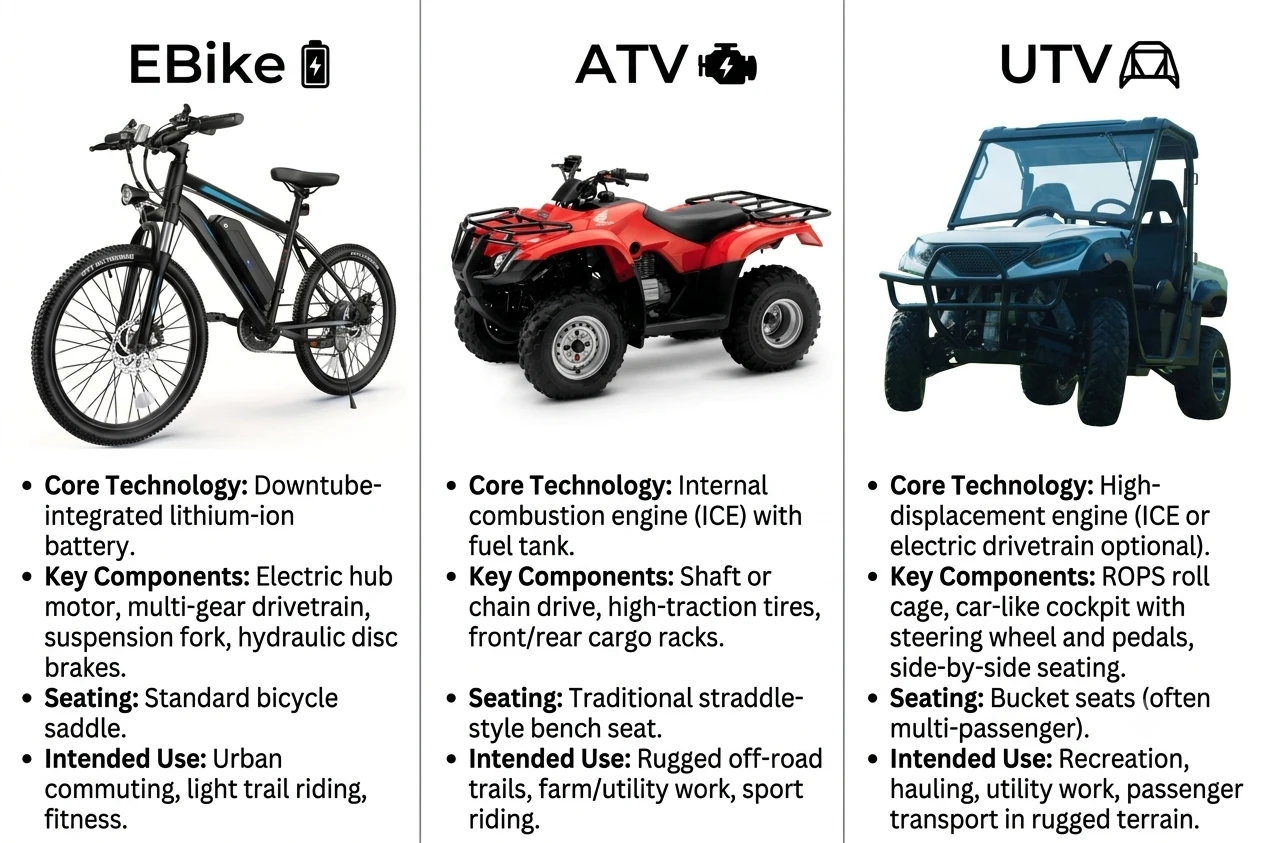
If you want to choose a reasonable vehicle, first of all, you have to clearly distinguish the structure, power form and basic attributes of the three models, which are fundamentally different from each other in terms of driving method, riding form and original design intention.
The eBike is a product of the combination of traditional bicycles and modern lithium-ion battery and motor technology, equipped with rechargeable batteries and power-assisted motors, providing multi-gear power-assisted modes. The rider still needs to pedal actively, and the motor only assists in sharing the physical exertion, which is both fun and energy-saving.
With a weight of 15-30 kilograms, the bike is flexible and lightweight, with a maximum speed of 25-45 kilometers per hour, making it suitable for light outdoor scenarios such as suburban roads and forest trails. The core advantages of ATVs are outstanding: zero emission, low noise, convenient storage, simple maintenance, and the fitness effect can be realized in the process of riding. The threshold is extremely low, which is suitable for outdoor recreation as well as daily commuting, and it is a friendly choice for entry-level outdoor players and middle-aged and old-aged groups.
ATVs, commonly known as four-wheeled motorcycles and beach bikes, are specially designed for unpaved roads, with single/double straddle riding as the main form of transportation. The vehicle is equipped with wide tires with large tread pattern and low pressure, large ground clearance and high power engine, and has a solid cross-country base, which can comfortably cope with extreme terrains such as mud, sand, rocky roads and steep slopes.
It continues the motorcycle’s straddle-type seating position, the control relies on the handlebars, throttle and brakes, and focuses on the sense of speed and handling fun, favored by extreme sports enthusiasts. However, this model has higher requirements for riding skills, body balance and weak body stability, and belongs to the cross-country vehicle model that favors professional fun.
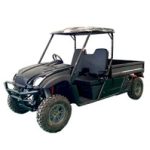
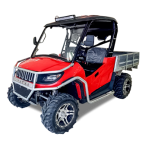
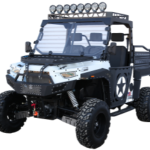
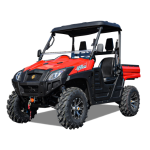
Side-by-side ATVs, also known as side-by-side vehicles, are designed with side-by-side seating similar to that of an automobile, and can accommodate two to six people, with large-capacity cargo space. Equipped with four-wheel drive, independent suspension and a high-strength frame, the vehicle is essentially a compact off-road vehicle with off-road capability, comfort and practicality.
Unlike ATVs, which are designed for single-occupant fun, UTVs focus on multi-occupant travel, long-distance traversing and material transportation, and the body is equipped with a stabilizing protective structure, which makes it safer in complex terrains. Widely used in family trips, wild hunting, farm work, mountain patrol and other scenarios, it is a multifunctional outdoor vehicle that combines entertainment and practicality.
The control feel, learning difficulty and threshold of use directly determine whether the model is suitable for different groups of people, such as novices, the elderly, children, etc., which is also an important part of the outdoor traveling experience.
The control logic of e-bikes is highly consistent with that of ordinary bicycles, relying on the handlebar to steer, pedaling to move forward, and freely switching between power-assisted gears. With its lightweight body and flexible steering, the e-bike can travel freely in narrow forest paths, city parks and other scenarios.
Almost no entry threshold. As long as you master the basic balancing ability and know how to ride a bicycle, you can get started, and you will be able to control it skillfully in a few minutes. The vast majority of areas do not need a special license, low physical requirements, turn on the power mode, the elderly, physical fitness of the general population can also easily ride. The only shortcoming is that the stability of the body will be reduced when traveling at high speed or extreme off-road.
ATV adopts a straddle-type design, similar to motorcycles, relying on the handlebar to control the direction and throttle. With a low center of gravity and strong tire grip, ATVs can bring a strong off-road thrill in scenes such as mud and steep slopes. However, it is necessary to adjust the center of gravity of the body to maintain balance during the riding process, and it is very easy to overturn on sharp turns and bumpy roads.
The entry threshold is high. Drivers need to have motorcycle riding experience, excellent balance, quick reaction ability and upper body strength, and it is very easy for novices to cause safety accidents by misuse. Most regions require drivers to be at least 16 years old, and some regions require drivers to attend professional training and obtain exclusive documents, which results in a long learning cycle and higher safety risks.
UTV adopts car-like steering wheel control and closed cockpit design, the driving experience is similar to that of a small cross-country SUV. With four-wheel drive and professional suspension system, the vehicle can maintain smoothness even on rough roads, and it is easy to communicate with multiple riders and less fatiguing for long-distance riding.
The barrier to entry is medium. The handling logic is consistent with that of a family car, and it is quick to get started, with a high degree of novice friendliness. However, the body size is on the large side and lacks agility in very narrow trails. Most areas require drivers to have a regular motor vehicle license, and when driving at high speeds, you still need to pay attention to road conditions and control your speed.
The road conditions in different outdoor scenarios vary greatly, and the difference in the terrain passing ability of the three models is significant, which is also the core reference basis for choosing a car. This is also the core reference for choosing a vehicle,
The e-bike is suitable for light to medium terrain, and performs well on paved roads, gravel roads, gentle forest paths, and gently sloping roads. Electric power can easily cope with normal climbing, and with off-road coarse tires, light unpaved road passability will be further improved.
However, limited by body weight, tire size and power output, the e-bike is difficult to cope with extreme off-road scenarios: deep mud, loose sand, continuous rocky roads, steep slopes are prone to skidding and getting stuck in the car, and at the same time, high-intensity cross-country will accelerate the power consumption, and the range will be significantly reduced. Overall, it is only suitable for light off-road and leisure exploration, not for hardcore terrain challenges.
ATVs are specially built for hardcore off-roading, and are purely off-road machines. The large tread low pressure tires, ultra-high ground clearance, and high torque engine allow it to flexibly travel through extreme terrain such as mud swamps, sand dunes, rock piles, and steep slopes in dense forests. The single straddle structure allows the driver to quickly adjust the center of gravity to avoid obstacles, and the maneuverability pulls full circle. Some of the higher-end models are equipped with four-wheel drive and differential lock to further strengthen the ability to pass extreme road conditions, making it the first choice for hard-core off-road enthusiasts.
The UTV’s comprehensive terrain adaptability is the strongest of the three. With its professional four-wheel drive system, independent shock absorbers, sturdy chassis and wide wheelbase design, the UTV’s stability far exceeds that of ATVs, and it can safely pass through dangerous roads where ATVs are prone to rollover. With sufficient body size and power, the UTV can carry both people and a large amount of materials, which is suitable for long-distance traversing of complicated terrain such as mountains, deserts and wetlands. The comfort and reliability of UTVs are especially obvious in bad weather and heavy-duty traveling scenarios.
Safety is always the first criterion for outdoor traveling. The body structure and driving characteristics of the three models are different, and the safety coefficients and protective equipment required are also significantly different.
E-bike traveling speed is low, the center of gravity is close to the ground, the overall degree of accidental injury is relatively light. The main risks are concentrated in the loss of control on slippery roads, improper braking on downhill slopes, and road intersection collisions. Vehicles are equipped with front and rear brakes, lights and bells as standard. High-end models are also equipped with anti-lock brakes and traction control systems, so the basic protection configuration is perfect.
Protective equipment: basic helmets, riding gloves, goggles can meet daily needs; advanced with reflective clothing, knee pads, elbow pads, low equipment threshold, daily travel without full armor.
ATV is the one with the highest safety risk among the three models. With its cross-country structure, high speed, and complex road conditions, accidents such as rollover, collision, and vehicle overtopping are frequent. Although some models are equipped with anti-scratch guards and simple safety belts, the stability structure of the whole vehicle is weak, and the probability of losing control is much higher than that of the other two models.
Protective equipment: The requirements are the most stringent and belong to the professional off-road protection standard. You must wear a full-coverage helmet + goggles, with cross-country armor, knee pads, elbow pads, wear-resistant long-sleeved pants and professional cross-country boots. Full protective gear is mandatory in most areas, and new riders must receive systematic safety training before hitting the trails.
UTVs are at the top of the list for safety. The body is equipped with anti-roll bars, standard seat belts, side guard rails, and a cockpit structure that effectively protects the driver and passengers in the event of a rollover or collision. The four-wheel drive system and professional suspension further enhance driving stability, and can guarantee the safety of the whole crew when traveling with many people. The only caveat: the body is large, narrow road meeting, avoiding obstacles need to be careful when operating.
Protective equipment: the basic requirement is helmet + seat belt, gloves, goggles are recommended to be used in conjunction; when carrying children on family trips, children’s safety seats need to be equipped additionally, and the overall protection requirement is lower than that of ATVs.
Safety advice: novice riders and families should give priority to UTVs or e-bikes; ATVs must strictly comply with safety regulations and complete professional training.
Outdoor adventure is more than just fun, many people want to combine exercise and fitness during their trips. There are significant differences in physical exertion and health benefits between the three types of riding.
E-bikes have the strongest fitness attributes of the three. Riders need to keep pedaling, and with the multi-gear power system, the intensity of exercise can be freely adjusted: low power mode is close to regular cycling, which is a medium-intensity aerobic exercise; high power mode greatly reduces the physical energy consumption, which is suitable for leisure and relaxation.
Long-term cycling can effectively exercise cardiopulmonary function, legs and core muscles, burn calories, relieve pressure, and significantly help fat loss, improve endurance, and improve the state of sub-health. It is suitable for middle-aged and elderly people, people recovering from surgery, and outdoor enthusiasts who want to have fun + fitness, and people with different fitness levels can find the right intensity by adjusting the power level.
ATV riding does not require continuous pedaling, and the physical exertion is based on passively adjusting the center of gravity and maneuvering the vehicle, with the overall load ranging from low to medium. Prolonged riding can cause arm and core muscle soreness, but it is not a continuous aerobic exercise.
Its value is more embodied in the exercise of body coordination, balance and field reaction ability, release mental pressure, to get a sense of achievement challenge, but the cardiopulmonary exercise, whole body shaping effect is far less than the e-bike, more suitable for the pursuit of stimulation rather than fitness crowd.
The driving experience of a UTV is the same as that of a family car. The driver sits still for the entire ride and only needs to control the steering wheel and the gas pedal, with almost no active physical exertion, making it the most energy-saving model of the three.
Its value is on the spiritual level: getting out in the fresh air, relaxing the body and mind, and at the same time, multiple passengers can enhance the relationship between friends and relatives. It is suitable for those who are physically weak and have limited mobility, as well as for pure leisure and sightseeing outdoor trips, which can hardly realize the goal of sports and fitness.
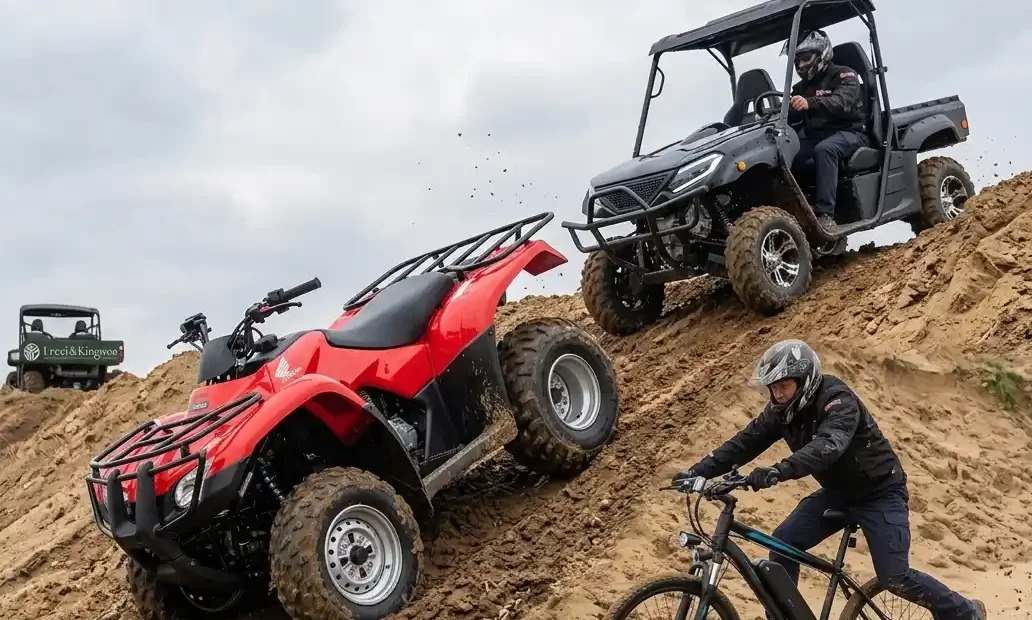
The design style and experience of different models attracts different groups of users, and also creates a differentiated outdoor social atmosphere.
E-bikes have the widest audience coverage and are extremely inclusive. The core group includes outdoor novices, urban residents, fitness enthusiasts, middle-aged and elderly people, parent-child families, and practitioners of environmental protection concepts. E-bikes are lightweight and can be used for weekend suburban riding adventures as well as daily commuting.
Social attributes: the atmosphere is relaxed and friendly, the threshold of team riding and joining a riding club is low, normal communication is possible on the way, and photos can be taken along the way for sharing, which is the mainstream healthy leisure and socializing mode nowadays, representing the green and healthy life trend.
The audience of ATV is inclined to the niche circle, the core is the pursuit of speed and extreme challenge players, 18-45 years old cross-country enthusiasts, hunting and fishing enthusiasts, extreme sports enthusiasts are mainly, on the driving skills, body coordination has certain requirements.
Social Attributes: Personalized and niche socialization. Players mostly participate in off-road events, car enthusiasts’ gatherings and professional clubs’ activities, and their exchanges focus on vehicle modification, off-road skills and extreme experiences. The atmosphere of the circle is warm, but the entry threshold is high, belonging to the niche interest circle.
UTV mainly focuses on multi-people travel, the core audience for parent-child families, groups of friends, outdoor workers (farm workers, mountain patrol personnel, etc.), the crowd age span, the user is more important to travel comfort, safety and sharing experience.
Social attributes: Families and groups have the strongest social attributes. The cabin is spacious, with no obstruction to the communication of fellow travelers, and can carry picnic materials and pets, making it an ideal choice for family trips and long-distance adventures with friends, and easy to create a warm and joyful atmosphere for group travel.
After the purchase of the car maintenance expenses, vehicle handling and storage difficulties, is the daily use of the reality of the problem can not be ignored, especially for urban residents, limited budget users focus on reference.
Maintenance cost: the lowest among the three. Daily maintenance only requires regular charging, checking tire pressure, adjusting brakes and lubricating chains, and most of the basic operations can be done by users themselves. The normal service life of the battery is 3-6 years, and the replacement cost is friendly, with an average annual maintenance cost of only a few hundred dollars.
Portability: outstanding advantages. The weight of the whole vehicle is light, and some models support folding, so it can be easily put into the trunk of a private car, and can also be transferred with the help of public transportation, and it does not take up too much space for home storage, which is very suitable for urban residents.
Maintenance cost: moderately high. As a fuel-mechanical vehicle, it needs regular replacement of oil, filters and spark plugs, and off-road conditions will accelerate the wear and tear of tires, suspension and transmission parts, resulting in high maintenance frequency. Comprehensive fuel, parts, labor costs, the average annual expenses can reach thousands of dollars, complex faults need to be sent to a professional store repair.
Portability: Medium. The volume and weight of the body is large, can not be hand-carried, long-distance transfer needs trailers, pickup trucks with the daily need for independent garages or special sites for storage, is not suitable for frequent transfers.
Maintenance cost: the highest among the three. Vehicle structure is complex, including engine, four-wheel drive system, suspension, vehicle electronics and other precision parts, must rely on professionals to regularly overhaul and maintain. Fuel, spare parts, labor and time costs are superimposed, and the average annual maintenance cost can reach tens of thousands of dollars. Multiple users can share the cost and alleviate the pressure of expenses to a certain extent.
Portability: the worst. The whole vehicle is large in size and heavy in weight, and a special trailer must be used for transportation, and a large area is needed for parking, which is totally unsuitable for temporary transportation and storage in small urban households.
Combining all the above dimensions of comparison, for different travel scenarios, to provide you with a clear direction for the choice of models:
Leisure riding in the suburbs, parks, greenways, gentle forest trails and other light terrain for short-distance exploration;
Daily commuting combined with weekend outdoor fitness, taking into account the practicality and sportiness;
Low-intensity outdoor play for middle-aged and old people, outdoor novices and people with general physical ability;
Short-distance (single trip 20-80 kilometers) slow adventure, outdoor photography, bird watching and other slow-paced activities;
Urban outdoor enthusiasts who pay attention to environmental protection, have limited budget and small living space.
Core positioning: easy and flexible, taking into account the health of the single / small group leisure adventure.
Mud, sand, rocks, steep slopes and other medium to heavy extreme off-road challenges;
Single-person extreme adventure in pursuit of speed and excitement;
Wild hunting, fishing, single person deep crossing, off-road race participation;
Players who have driving experience, specialize in vehicle control and enjoy the fun of extreme driving.
Core positioning: exclusive for senior players, focusing on speed, skill and single-player extreme challenges.
Family trips, group outdoor trips with friends;
Long-distance traversing in complex terrain, outdoor camping, large-volume material transportation;
Functional outdoor work such as farm operation, mountain patrol, field base construction;
Long-duration travel in bad weather and heavy road conditions, prioritizing comfort and safety.
Core positioning: exclusive for families and groups, taking into account comfort, safety and long-distance practical ability.
E-bikes, ATVs and UTVs have no absolute advantages or disadvantages, only whether they are suitable for individual needs. E-bikes represent flexibility, environmental protection and health, and are an all-round choice for leisure outdoor and daily travel; ATV symbolizes wildness and passion, and is an exclusive toy for hardcore off-road enthusiasts; UTV focuses on safety, comfort and practicality, and is a reliable partner for family outdoor and long-distance traversing.
Lastly, we remind you that before you buy, you must consider the six major elements of driving terrain, the number of travelers, personal fitness, budget, storage space, and long-term maintenance capacity. Regardless of which model you choose, you must put safety in the first place, wear protective equipment as required, and strictly abide by local traffic and outdoor management regulations.


-150x150.png)