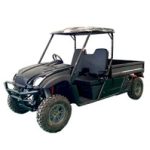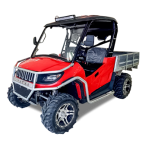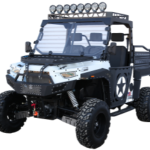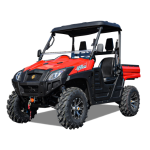
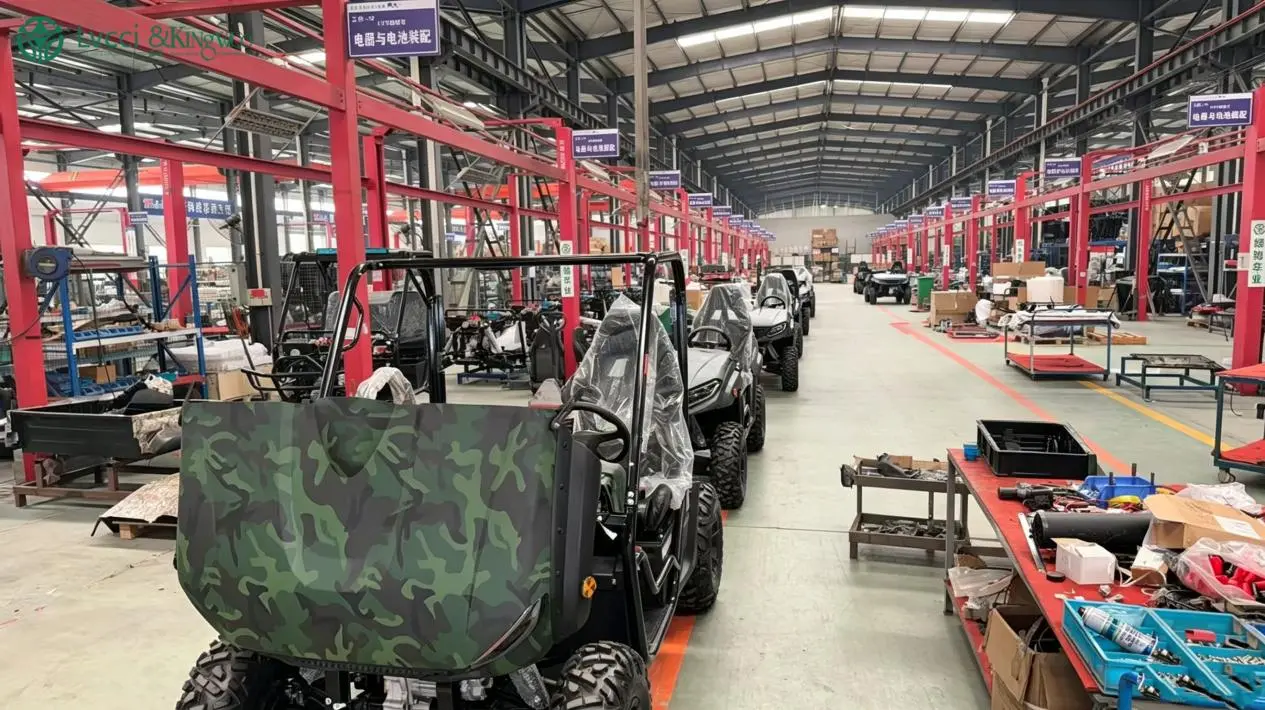
The global all-terrain vehicle market is experiencing a golden age of sustained growth. Thanks to their versatility and exceptional off-road capabilities, UTVs (side-by-side utility vehicles) are widely used in a variety of scenarios—including agricultural production, construction, outdoor tourism and culture, and emergency response operations—and have become a core category in global outdoor work and leisure equipment.
Numerous overseas buyers, farmers, tourism and leisure operators, and outdoor enthusiasts are increasingly choosing Chinese UTVs as their preferred solution. At its core, this trend is driven not merely by price advantages, but by comprehensive breakthroughs in value for money, technological capabilities, customization options, quality control systems, and global supply chains. This article will draw on industry data and product strengths to provide an in-depth analysis of the key reasons behind the global popularity of Chinese UTV brands.
Compared to North America’s mature, trillion-level UTV market, China’s UTV industry got off to a relatively late start but is a steadily growing segment with immense potential. The industry’s core drivers include the modernization of agricultural mechanization, the expansion of infrastructure projects, the rise of outdoor tourism and cultural experiences, the demand for specialized operations, and the continued expansion of policy incentives for electrification. It represents a prime segment for China’s equipment manufacturing sector to “go global.”
The latest industry estimates show that the core market size for four-wheel-drive functional UTVs in China reached $857.7 million in 2024 and is projected to exceed $1.25 billion by 2030, with a steady compound annual growth rate (CAGR) of 5.8% from 2025 to 2030, indicating robust growth.
In terms of sales volume, China’s UTV shipments in 2024 are estimated at approximately 84,000 units. With the continued growth of overseas demand and the expansion of domestic application scenarios, sales are expected to climb to 153,000 units by 2030, representing a compound annual growth rate (CAGR) of 9.8%—far exceeding the market value growth rate—which highlights the trend toward greater affordability and widespread adoption of these products.
When considering the full range of ATVs and UTVs, the overall market size in China reached $1.2 billion in 2023 and is projected to grow to $1.81 billion by 2030, representing a CAGR of 5.1%. Among these, the UTV segment—thanks to its greater versatility and practicality—has become the fastest-growing segment with the greatest market potential.
From a global perspective, the total global ATV/UTV market has surpassed $10 billion and is projected to climb to between $17 billion and $29 billion between 2030 and 2035. While North America has consistently dominated the global market, the Chinese market—leveraging its manufacturing and export advantages—is rapidly capturing global market share, emerging as a core production and consumption hub for the global UTV industry.
The rapid rise of China’s UTV industry is underpinned by multifaceted essential use cases, as well as dual support from policy and the industry itself, ensuring ample and sustainable growth momentum. The mechanization upgrade in agriculture, construction, and industry serves as the foundational support for UTV demand. In remote rural areas, UTVs—with their high off-road capability—are perfectly suited for essential tasks such as material handling, site operations, and terrain inspections, replacing traditional manual labor and inefficient equipment.
The explosive growth of the outdoor tourism, culture, and leisure industries has further expanded the civilian market. As global interest in off-road adventures and camping tourism continues to rise, and off-road facilities and scenic tour routes across the country are constantly being improved, demand for recreational UTVs continues to climb. At the same time, the application of UTVs in specialized scenarios such as border patrols and tactical mobility has also opened up new growth opportunities for the industry.
The transition to electric power is the industry’s most significant growth driver. In 2024, the Chinese electric ATV/UTV market reached $264 million. Thanks to domestic new energy policies, low-carbon and environmental requirements, and iterative upgrades in battery technology, the market is projected to maintain an exceptionally high compound annual growth rate (CAGR) of 16% through 2030, becoming a new engine for industry growth. Furthermore, a well-developed domestic manufacturing supply chain and a mature export system continue to help Chinese UTVs capture global market share.
Currently, China’s UTV industry has formed a competitive landscape characterized by market leaders and a well-structured tiered market, giving rise to a number of globally competitive benchmark export brands. Among them, CFMOTO and Hisun are the two leading companies with the highest global recognition, offering a full range of products spanning high-end recreational, mid-range utility, and entry-level essential models, with overseas dealer networks spanning the globe.
In addition, Linhai and numerous companies specializing in electric UTVs have rapidly emerged. They focus on niche areas to build differentiated advantages, deeply cultivating specialized markets such as customization, lightweight design, and specialized operations. Meanwhile, international giants such as Polaris, John Deere, Honda, and Kawasaki continue to dominate the global high-end market, though most have opted to enter into OEM/ODM partnerships with Chinese factories. By leveraging China’s manufacturing capacity to reduce production costs, they have indirectly attested to the robust capabilities of China’s UTV manufacturing sector.
In the global UTV market competition, the most core advantage of Chinese brands—and the one most recognized by overseas buyers—is their exceptional value for money. Contrary to the traditional stereotype of “low price, low quality,” Chinese UTV manufacturers have significantly reduced prices while fully retaining—and in some cases even upgrading—core functions, perfectly meeting the needs of all scenarios, including farm operations, engineering and maintenance, and outdoor recreation.
With identical configurations and performance, mainstream Chinese UTV products are 20%–40% cheaper than their European, American, and Japanese competitors; for some models, the price difference can reach $3,000 to $5,000. This significantly reduces investment costs for individual users, small and medium-sized enterprises, and bulk purchasers.
Take a benchmark model as an example: the CFMOTO UForce U10 Pro professional-grade UTV has an official MSRP of approximately $17,499. It is equipped with an 88-horsepower powertrain, has a cargo bed capacity of 1,000 pounds, and a towing capacity of 2,500 pounds, and comes standard with high-end features such as an in-vehicle audio-visual system, CarPlay connectivity, and embroidered seats. In contrast, the Polaris Ranger XP 1000, with identical specifications, has a starting price as high as $21,499 but offers fewer standard features, resulting in a significant difference in overall acquisition costs.
The entry-level models in Hengsheng’s Sector and Axis series are priced between just $7,000 and $14,000, meeting the light-duty operational needs of small and medium-sized farms and scenic areas. In contrast, international brands such as Polaris and Bombardier have base prices for their “bare-chassis” models that are already close to those of high-spec domestic models; if optional accessories such as winches, roof racks, and power steering are added, the total price gap will widen even further.
International high-end UTV brands generally adopt a “base model plus paid options” sales model, where practical features such as winches, alloy wheels, power steering, windshields, and hardtops all require additional payment for installation, significantly driving up the actual purchase cost.
Chinese UTV brands emphasize a “all-in-one” high-spec philosophy, with all the aforementioned practical features included as standard equipment right from the factory, requiring no additional payment. Whether it’s the high-end series from Chunfeng, the mid-range work models from Hengsheng, or entry-level general-purpose models, all are delivered fully equipped, perfectly meeting the “ready-to-use” procurement needs.
In terms of core operational performance, domestic UTVs have fully caught up with international competitors. Key features—such as high torque output, four-wheel drive systems, independent suspension, heavy-duty cargo beds, and towing systems—all meet industry standards, enabling them to easily handle complex terrain such as mountains, mud, and steep slopes, while satisfying both daily operational and recreational off-road needs.
At the same time, the warranty systems for domestic models are continuously improving. Leading brands such as Chunfeng offer tiered warranty services ranging from 1 to 5 years, covering the entire vehicle and core components, which has significantly enhanced reliability. While high-end international brands still hold a slight edge in extreme professional off-road and high-intensity, extreme operating conditions, domestic UTVs offer more than sufficient performance for over 90% of commercial, agricultural, and recreational scenarios, and their value for money is unmatched.
Industry field tests and user feedback show that new domestically produced UTVs have long shed the label of “cheap, substandard products.” With proper maintenance, they can reliably operate for thousands of miles without breakdowns, making them the optimal choice that balances cost and practicality.
Leveraging China’s world-leading new energy industry ecosystem, mature lithium-ion battery technology, and a comprehensive smart manufacturing system, the country has achieved a “leapfrog” advancement in the electric UTV sector, becoming a global hub for technological innovation and mass production of electric UTVs. With advantages such as zero emissions, low noise, and low operating and maintenance costs, electric UTVs are widely applicable in scenic areas, farms, industrial parks, and municipal settings, and their market growth far outpaces that of fuel-powered models.
In 2024, the size of China’s electric ATV/UTV market reached $263.8 million. Driven by low-carbon policy support, falling battery costs, and expanding application scenarios, the market is projected to grow to $711 million by 2030, representing a compound annual growth rate (CAGR) of 16% over six years—a growth rate far exceeding the global average.
The Asia-Pacific region’s electric utility vehicle market has maintained double-digit growth overall. Thanks to its well-developed charging infrastructure, large-scale mass production capabilities, and continuous technological innovation, China has firmly established its dominant position in the global market, becoming the preferred source for overseas buyers purchasing electric UTVs.
Core technologies in domestically produced electric UTVs have achieved comprehensive breakthroughs, thoroughly resolving early-stage pain points such as short range, weak power, and poor stability. In the battery sector, the industry widely adopts safe and durable lithium iron phosphate (LFP) batteries, which offer advantages such as long lifespan, high stability, and low-temperature resistance. High-capacity battery packs can achieve a fully loaded range of 80 to 100 kilometers, meeting the demands of all-day operations.
In terms of the powertrain, domestic models are equipped with a three-in-one integrated electric drive system that combines the motor, controller, and reduction gearbox into a single unit. With a peak torque of up to 2,100 N·m, this powerful system can easily handle complex terrain such as 30° inclines and muddy mountainous areas. Additionally, an energy recovery system is included to further improve range efficiency and reduce energy consumption costs.
Intelligent features and safety capabilities have been upgraded simultaneously. The new models come equipped with GPS positioning, smart instrument panels, smartphone connectivity, and rearview cameras, while select high-end models feature an ABS anti-lock braking system. The entire vehicle meets the IP67 dust and water resistance rating, enabling it to operate in extreme conditions such as sub-zero temperatures, high altitudes, and wetlands. It also supports fast charging and battery swapping modes, making it well-suited for high-frequency commercial operations.
Leading domestic brands have completed their full-category lineup of electric UTVs, with products covering all scenarios across both high-end and entry-level segments. The Chunfeng electric UTV series is equipped with a high-power 35kW electric drive system and comprehensive smart connectivity features, offering stable range and robust performance that rivals international high-end electric models.
Entry-level electric models, such as the Hengsheng Sector E1, offer outstanding value for money, with smooth power delivery and easy maintenance, making them suitable for light-duty operations on farms and in scenic areas. In addition, numerous domestic specialized manufacturers have launched customized electric models for specific applications—such as orchard use, polar operations, and municipal patrols—with power outputs ranging from 5 to 35 kW. These models are available in two-, four-, and six-seat configurations and have all obtained international export certifications, including EEC, making them suitable for global markets.
Unlike international brands with limited product lineups, Chinese UTV manufacturers boast the world’s most extensive product portfolio. Leveraging the advantages of large-scale mass production and rapid product iteration, they develop custom models tailored to different industries, operating conditions, and user needs, ensuring precise adaptation to all scenarios.
In agricultural and farm settings, domestic UTVs emphasize high torque and excellent off-road capability. Equipped with hydraulic tipper beds and heavy-duty towing systems, they can transport feed, crops, and farm implements, making them suitable for operations in orchards, farm fields, and mountainous terrain. Electric models feature low noise and zero emissions, ensuring they do not disturb livestock or damage the ecosystem, making them essential equipment for modern farms.
In engineering and mining applications, heavy-duty UTVs feature reinforced frames, large heavy-duty cargo beds, and high-load-capacity suspension systems. They support auxiliary equipment such as snow plows, cranes, and winches, enabling material transport at construction sites, site inspections, and equipment hauling—all while withstanding rugged and harsh working conditions.
In cultural tourism and leisure settings, multi-seat enclosed-cockpit UTVs are equipped with comfortable seating, onboard audio-visual systems, and climate-controlled air conditioning. With their stylish and sophisticated appearance, they are ideal for scenic area sightseeing, campground shuttle services, and off-road adventures, making them a popular choice for cultural tourism projects worldwide.
In addition, domestically produced UTVs are widely used in specialized scenarios such as border patrols, municipal operations and maintenance, forest protection, and outdoor hunting. Tailored models—including lightweight air-transportable variants and models designed for extreme climates—have been developed to address niche market needs.
Domestic brands offer comprehensive product specifications, with seating configurations ranging from 2-seater to 6-seater multi-passenger cabins to accommodate various needs, from single-operator tasks to team travel. Powertrain options include 400cc–1000cc gasoline and diesel engines, 5–35 kW electric motors, and hybrid systems, providing a complete range of power options.
Body configurations offer flexible options such as open cockpits, fully enclosed climate-controlled cabins, hydraulic tipper beds, and extended cargo beds, while practical features like winches, lighting systems, and power steering come standard. This extensive product selection allows global buyers to precisely match their procurement needs without compromise.
After years of technological iteration and process upgrades, China’s UTV industry has completely overcome the early issues of inconsistent quality. Leading brands have fully aligned with international production standards, implementing comprehensive upgrades in manufacturing processes, component material selection, quality inspection systems, and certification qualifications, resulting in significantly improved product quality and stability.
Leading brands have now fully adopted automated production lines and robotic precision assembly equipment, replacing traditional manual assembly and significantly improving product precision and consistency. At the same time, they have established end-to-end quality inspection systems. From component warehousing and vehicle assembly to finished product shipment, products undergo dozens of inspection procedures to ensure no defective products leave the factory.
Leading enterprises such as Chunfeng and Hengsheng strictly adhere to the ISO 9001 quality management system and the IATF 16949 automotive-grade production standards, achieving defect prevention, strict supply chain control, and standardized production processes, thereby reaching the same level as international automakers. All export models undergo rigorous testing, including extreme off-road conditions, high and low temperature endurance, water and dust resistance, and durability under rough terrain, to ensure stability under complex operating conditions.
All new domestically produced UTVs utilize high-quality branded components and feature comprehensive upgrades to core systems—including the suspension, electronic control systems, and powertrain—effectively resolving earlier issues such as excessive noise, severe vibration, and susceptibility to overheating. Body panel assembly techniques, paint finish quality, and interior craftsmanship have been significantly optimized, resulting in a marked improvement in overall refinement.
At the same time, the brand leverages a global user feedback mechanism to continuously iterate on product design, specifically addressing user pain points to adapt the products to the diverse climates, terrains, and usage habits of different regions worldwide, thereby continuously improving durability and adaptability.
All major export models have obtained authoritative international certifications, including EEC (European Union) certification, EPA emissions certification, and DOT safety certification. This enables compliant direct export to most countries and regions worldwide, meeting local road and operational regulations.
Warranty services have also been upgraded: leading brands offer standard 1- to 2-year warranties on the entire vehicle and support extended warranty options; the overseas dealer network is continuously expanding, ensuring global users have no concerns regarding after-sales support. Extensive long-term field data demonstrates that, with proper maintenance, the service life and stability of domestically produced UTVs are now virtually on par with those of leading international brands.
Compared to the shortcomings of international brands—such as standardized mass production, high customization barriers, and long lead times—the flexible customization capabilities of Chinese UTV manufacturers have become a core competitive advantage. Leveraging modular design, flexible production lines, and a mature OEM/ODM service system, they can rapidly respond to global buyers’ personalized, scenario-based, and branded customization needs.
Domestic UTVs feature modular chassis and structural designs, supporting multi-dimensional customization and modification. The powertrain can be switched between gasoline, electric, and hybrid versions as needed, with adjustable power, torque, and range parameters; the body structure allows for customization of seat count, cargo bed style, and cabin type to adapt to different operational scenarios.
Exterior and functional accessories can be freely selected, including body color, brand logos, graphic decals, in-vehicle audio-visual systems, surveillance systems, searchlights, and snow-removal equipment, comprehensively meeting personalized usage and brand display needs. It also supports targeted functional optimizations, such as anti-freeze modifications for cold regions, anti-skid modifications for wet conditions, and noise-reduction modifications for scenic areas.
Domestic factories possess extensive experience in contract manufacturing and have long provided OEM/ODM production services to major international brands, featuring well-established customized production processes. Compared to overseas manufacturers, Chinese manufacturers offer lower minimum order quantities and shorter lead times, with standard custom orders typically delivered within 45 to 60 days.
Whether it’s small-batch brand customization for small and medium-sized dealers or the R&D and production of large-volume exclusive models for large enterprises and overseas brands, all projects can be efficiently executed. This flexible customization model enables overseas buyers to create differentiated products that precisely match local market demands and enhance market competitiveness.
China is the world’s largest UTV production base, boasting a comprehensive full-industry-chain support system. Combined with decades of experience in international trade, this has fostered an efficient, stable, and low-cost global supply capability—a core guarantee that gives overseas buyers confidence in their purchases.
From core components such as batteries, engines, electronic control systems, and chassis to exterior accessories and functional modification parts, China possesses mature domestic supply chains, achieving full autonomy and control across the entire industry chain. With no reliance on imported components, production costs and supply risks are significantly reduced, while the speed of product iteration is ensured.
Leading enterprises have achieved vertically integrated production, exercising full control over the entire process—from R&D, component manufacturing, and final assembly to quality inspection and shipment. With ample production capacity and stable delivery, they can quickly fulfill global orders of any size and confidently adapt to fluctuations in market demand.
Chinese UTV brands have approximately 20 years of experience in overseas expansion. Initially, they primarily served global brands through OEM manufacturing; today, they have independently developed overseas markets, with products exported to more than 100 countries and regions, including North America, Europe, Australia, South America, the Middle East, and Africa.
The manufacturer is well-versed in the import regulations, certification standards, tariff policies, and customs clearance procedures of various countries and can assist buyers in completing the full set of export documentation and compliance certifications, significantly reducing cross-border procurement risks. Leveraging the advantages of key ports such as Shanghai and Ningbo, the company maintains mature logistics channels and ensures stable delivery times.
Mainstream domestic UTV parts are highly compatible and have broad global coverage, allowing overseas buyers to easily procure replacement parts for convenient and cost-effective maintenance. At the same time, leading brands such as Chunfeng and Hengsheng have established overseas distribution centers, authorized dealers, and service outlets, providing localized repair, maintenance, and parts supply services, thereby completely resolving the after-sales challenges associated with cross-border procurement.
Overall, the ability of Chinese UTV brands to rapidly capture the global market and gain recognition from overseas users is the result of multiple core advantages working in tandem. They have long shed the label of “low-cost alternatives” and have become high-quality choices characterized by “high value, high reliability, and high adaptability.”
Unparalleled value for money is a fundamental advantage; with lower prices and higher specifications for equivalent performance, these vehicles significantly reduce users’ total cost of ownership over the vehicle’s lifecycle. Leading electrification technology has enabled domestic UTVs to take the lead in the new energy sector, aligning with global low-carbon development trends and the needs of specific application scenarios.
A comprehensive product portfolio and flexible customization capabilities allow for precise fulfillment of niche demands across various industries—an advantage that internationally standardized brands cannot match. Continuously upgraded quality control systems, internationally recognized certifications, and comprehensive warranty services have completely eliminated users’ concerns about quality.
A mature global supply chain, stable delivery capabilities, and a localized after-sales service system provide comprehensive support for cross-border procurement. At the same time, positive real-world reviews from a large number of overseas users and long-term, stable operational performance have further solidified the brand’s reputation, creating a virtuous market cycle.
For pragmatic buyers such as farmers, cultural and tourism operators, engineering firms, and overseas dealers, Chinese UTVs—which balance cost-effectiveness, practicality, durability, and customization—represent the procurement option with the highest overall value.
In the early stages of procurement, it is essential to comprehensively and meticulously review your procurement standards and usage requirements. Clearly define in advance the product’s actual usage scenarios, suitable powertrain types, core load-bearing parameters, export certification requirements for target markets, customization needs, and overall procurement scale. By clearly defining all requirements, you can precisely match products and manufacturers to your specific order, thereby avoiding issues such as blind selection, ineffective partnerships, and mismatches between procured products and market demand from the outset, significantly improving procurement efficiency.
When screening suppliers, prioritize leading manufacturers with over 10 years of industry experience, proven expertise in global expansion, and a strong reputation in overseas markets. Different brands offer distinct advantages and can be matched based on specific needs: Chunfeng is suitable for high-end customization and high-performance UTV procurement; Hengsheng specializes in cost-effective commercial models, ideal for mass-market commercial procurement scenarios; and various specialized brands can precisely meet the needs of specific niche operational scenarios. Additionally, proactively request case studies of the manufacturer’s overseas clients and overseas market evaluation reports to comprehensively verify the product’s reliability in real-world applications and the brand’s market recognition.
Export compliance and consistent quality are the fundamental safeguards for overseas procurement. It is essential to rigorously verify the manufacturer’s certification system to confirm that the company holds authoritative automotive industry quality system certifications, such as ISO and IATF 16949, to ensure standardized production processes. Additionally, verify whether the products possess the export compliance certifications required by overseas markets, such as EEC and EPA, to ensure they can clear customs smoothly and be sold in compliance with regulations. Furthermore, it is necessary to thoroughly understand the manufacturer’s product warranty policies and end-to-end quality inspection standards. If necessary, request on-site testing of samples or arrange for a dedicated representative to conduct an on-site audit to verify the manufacturer’s production and quality control capabilities.
To address the personalized modifications and customization needs commonly encountered in overseas procurement, it is essential to verify the manufacturer’s modular modification capabilities and experience in implementing bespoke customization solutions; At the same time, clarify the manufacturer’s minimum order quantity (MOQ), customization lead times, and the end-to-end support capabilities of their dedicated engineering team to ensure that your specific customization needs can be efficiently fulfilled. Furthermore, verify the manufacturer’s production line capacity and order scheduling mechanisms to confirm their ability to meet delivery deadlines for bulk orders, thereby avoiding issues such as delayed deliveries and order backlogs.
Prioritize manufacturers with mature and stable supply chain systems and extensive experience in cross-border logistics, focusing on whether they have established overseas warehouses and localized service networks. Simultaneously, verify key service details one by one, including the cross-border supply lead times for product components, overseas remote/on-site technical support, and after-sales maintenance policies for complete units. A well-established supply chain and after-sales system can effectively reduce the overall costs associated with overseas operation and maintenance, repair and replacement of parts, and customer after-sales support, thereby ensuring a positive user experience for end customers.
During the procurement process, proactively mitigate various risks by resolutely avoiding small, unprofessional workshops that offer abnormally low quotes, lack formal industry certifications, have no track record of overseas expansion, or demonstrate unprofessional communication. Prioritize formal cross-border trade platforms and official brand partnership channels to ensure the authenticity and security of the collaboration. Additionally, a standardized formal trade contract must be signed prior to collaboration to clearly define the rights and responsibilities of both parties and specify key details such as product warranty periods, after-sales maintenance standards, dispute resolution mechanisms, and compensation clauses. For large-volume purchase orders, it is advisable to prioritize a small-batch trial order model. After verifying product quality, delivery capabilities, and after-sales service standards, bulk orders can then be placed, thereby minimizing procurement risks to the greatest extent possible.
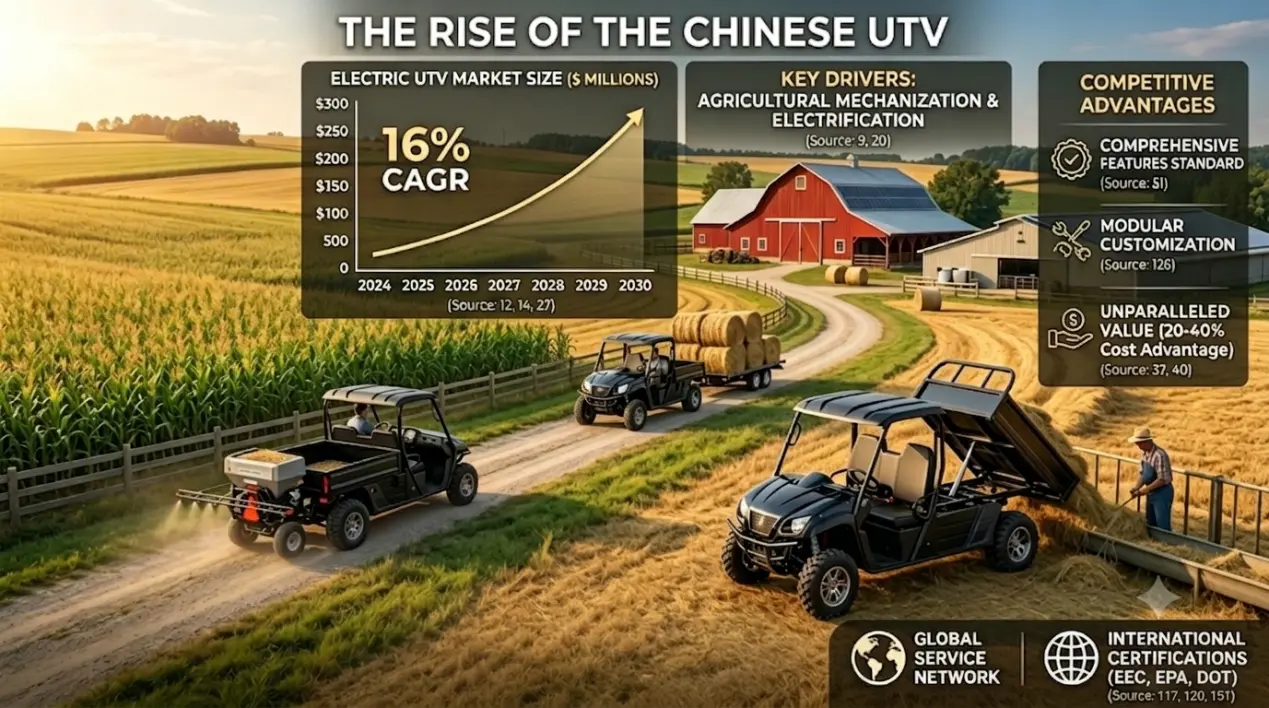
The global popularity of Chinese UTV brands is by no means a coincidence; rather, it is the inevitable result of industry maturity, technological breakthroughs, quality upgrades, and comprehensive service systems. Leveraging exceptional value for money, leading electrification technology, a full-scenario product portfolio, flexible customization capabilities, rigorous quality control systems, and a mature global supply chain, Chinese UTVs have completely reshaped the global market landscape.
As electrification and intelligent technologies continue to evolve and quality control systems are constantly refined, Chinese UTVs will continue to capture the global high-end market in the future, becoming the core benchmark in the global multi-purpose all-terrain vehicle sector. For global buyers, high-value, highly reliable Chinese UTVs have become the optimal choice for global procurement.


-150x150.png)