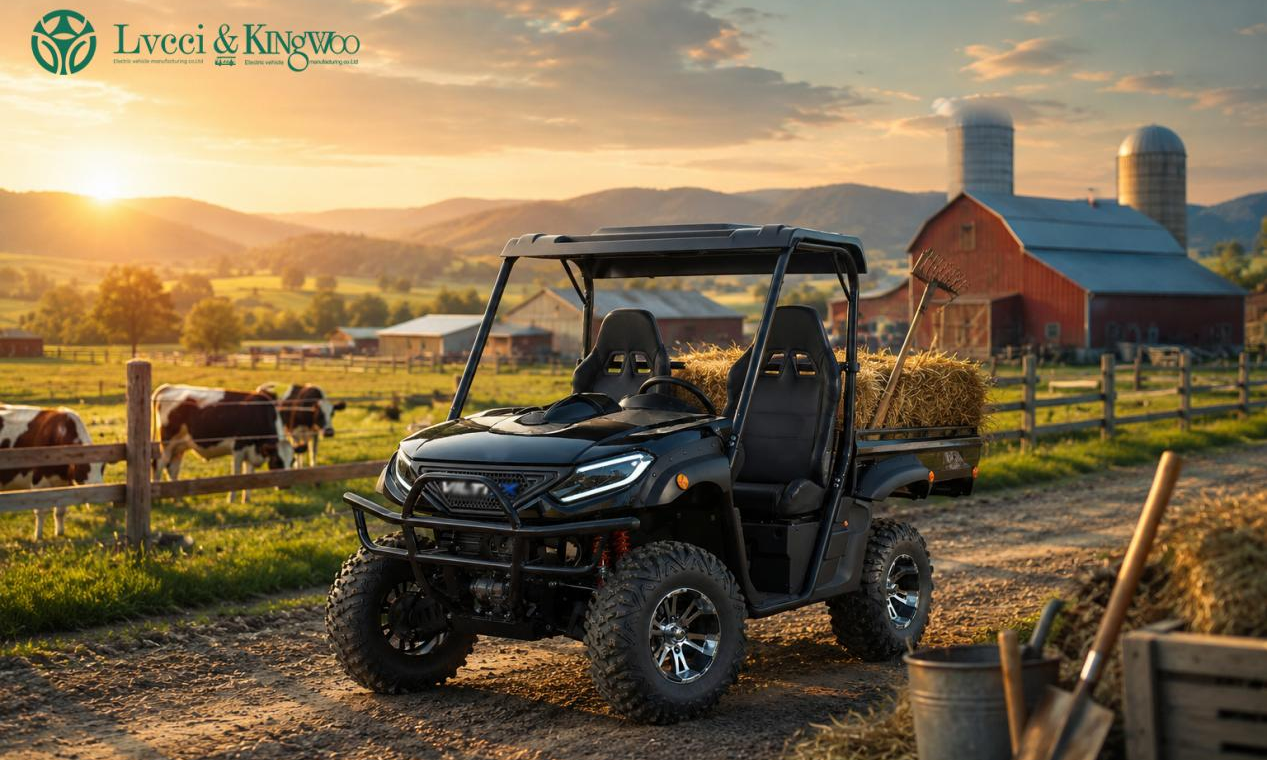
Many UTV (side-by-side all-terrain vehicle) owners and buyers struggle with one central question: which is faster, 2WD or 4WD UTV?
This article combines a large amount of actual test data, the original transmission structure differences and fuel/electric UTV characteristics, all-round dismantling of 2WD and 4WD top speed, acceleration, hill climbing, range performance. Help you accurately determine which drive mode is more suitable for your off-road, commuting, and farming needs.
Core conclusion front: in the level hard ground, paved tracks and other high grip surfaces, 2WD UTV is faster, accelerating more rapidly, lap time is more dominant; in the mud, sand, steep slopes, gravel and other complex off-road terrain, 4WD UTV has a higher average effective speed, and is less prone to skidding and getting stuck in the car.
If you want to distinguish the speed difference between the two, first of all, you have to understand the exclusive transmission structure of the UTV. 2WD and 4WD structure of the UTV is different from that of ordinary off-road vehicles, and most of them adopt the rear-mounted 4WD and the intelligent transmission logic of intervening on demand.
The fuel version of UTV is equipped with CVT system as standard, relying on the belt and master-slave clutch to automatically adjust the transmission ratio, without the need to manually shift gears, and adapting to the power output requirements of off-road conditions.
The core transmission structure of the whole vehicle contains rear differential, front differential, drive shaft, half shaft and other components. Four-wheel drive models will have one more set of front-wheel drive components than two-wheel drive, which is also the core source of the performance difference between the two.
Meanwhile, mainstream UTVs support Locked Differential Mode and Turf Mode, which strengthens off-road grip, and Turf Mode unlocks the differential to avoid tearing up the grass in turns.
The vast majority of 2WD UTVs adopt rear-wheel drive design, where the power from the engine or motor is only transferred to the rear wheels, and the front wheels are in free idling state with no power output.
The biggest advantage of this structure is streamlining and efficiency, eliminating the front wheel drive shafts, front differentials and other components, resulting in lighter weight and less mechanical friction resistance.
Under the factory default state, the 2WD UTV rear differential is locked, and the two rear wheels rotate synchronously, so the traction is stable for straight-line acceleration, which is also the key reason for its fast speed on flat ground.
Modern UTVs have almost no traditional hard-wired time-sharing four-wheel drive, and the mainstream carries on-demand intelligent four-wheel drive systems, representing brands such as Polaris, Bombardier and other mainstream manufacturers.
Polaris RZR, Ranger series equipped with On-Demand intelligent four-wheel drive, daily default two-wheel drive driving, when the rear wheels are detected skidding idling, the electromagnetic mechanism automatically engages the front wheel power to realize four-wheel drive intervention.
The Bombardier Maverick series is equipped with Visco-Lok viscous limited-slip differential and Smart-Lok intelligent locking system, which can automatically adjust the power distribution of the front wheels according to the degree of skidding to suit different off-road scenarios.
In 4WD mode, four-wheel synchronized power distribution significantly reduces the probability of slipping and getting stuck in the car, but it will increase the body weight and transmission resistance, which will slightly slow down the top speed performance on the smooth road.
Power output, 2WD power is concentrated in the rear wheels, transmission loss is very low; 4WD four-wheel power sharing, more power utilization in complex road conditions.
In terms of body resistance, 2WD has fewer parts, lighter weight and less mechanical friction; 4WD has more sets of transmission components, slightly higher resistance and weight.
In terms of maintenance costs, 2WD has a simple structure, fewer wear parts, and cheaper maintenance; 4WD has a complex structure, with a higher frequency of differential and driveshaft maintenance.
In terms of applicable scenarios, 2WD is suitable for high speed and smooth road surface, while 4WD is suitable for complex off-road scenarios on all terrains.
2WD UTV is a two-wheel-drive all-terrain vehicle, and the industry defaults to rear-wheel-drive, which is a common configuration for entry-level, racing-level, and agricultural-level UTVs.
Unlike 4WD models, pure 2WD UTVs do not have a front-wheel drive structure, which has obvious advantages in lightweighting and more flexible handling, and is extremely suitable for high-speed riding scenarios.
Mainstream 2WD models in the market are mostly entry utility versions, including Polaris Ranger basic version, John Deere Gator 2WD version, Landmaster 4×2 series and so on.
Scenarios: level farm inspection, hardened road commuting, hard Trail high-speed riding, sand dune flat area for fun, lightweight short-distance operation.
4WD UTV is a four-wheel drive all-terrain vehicle, supporting four-wheel power output, relying on the intelligent four-wheel drive system, taking into account the smoothness of the paved road and cross-country terrain passability, which is the mainstream configuration of high-end UTVs.
It is not a full mandatory four-wheel drive, and the intelligent on-demand intervention design significantly balances the off-road performance with the energy consumption and speed performance of daily driving.
Mainstream 4WD models on the market include Polaris RZR, Bombardier Maverick X3, Honda Pioneer, Kawasaki, John Deere 4×4 series, and other high-end models.
Applicable scenes: mountain cross-country, muddy sand crossing, steep slope climbing, rain and snow travel, heavy-duty towing, complex terrain farm operations, outdoor adventure.
Many car owners have the misconception that 4WD has stronger grip and higher speed. However, the conclusion of the real test is very clear: 4WD can’t increase the top speed of UTV, instead, it will slightly slow down the top speed performance.
When 4WD mode is turned on, the whole set of transmission components of the front wheels are synchronized, which generates additional mechanical friction and rotational resistance, and consumes the output power of the engine/motor.
At the same time, 4WD models have a higher body weight, and the vehicle needs to consume more power to maintain high speed, so the top speed is naturally lower than that of 2WD versions under the same power parameters.
Professional track test data shows: the same UTV switches between 2WD and 4WD modes, and the 2WD mode is about 0.5 seconds faster on average per lap, which is an intuitively measurable difference.
Maximum speed is the highest instantaneous speed a vehicle can reach, while the average driving speed is what users perceive in their daily life, and they are completely different concepts.
Four-wheel drive will not slip or get stuck in complicated road conditions, and can continuously maintain power output, resulting in a higher average speed; two-wheel drive frequently slips and slows down, resulting in a slower overall driving rhythm.
Smooth and high grip road surface: 2WD top speed > 4WD top speed, 2WD has obvious advantages.
Complex low-grip road surface: the difference between the two instantaneous top speeds is very small, but the average speed of 4WD far exceeds that of 2WD.
Many car owners have found that there is almost no difference between the apparent top speeds of 2WD and 4WD of the same model, which is not a data bias, but a result of the original design mechanism of UTVs.
All Hyundai UTVs are equipped with the ECU electronic speed limiter program, which locks the maximum speed in order to ensure driving safety, fit tire parameters, and protect core components.
Regardless of switching between 2WD and 4WD modes, the ECU will uniformly limit the maximum revolutions and speeds, and the tiny speed gap brought about by the machinery will be completely covered by the electronic speed limit.
The on-demand four-wheel drive of Hyundai UTV is not a hard connection throughout the whole process. When cruising at high speed on a smooth road, the front wheel drive system is in an idle state, and there is almost no additional resistance.
Only when rear wheel slip is detected, the 4WD system will intervene, and the power loss in daily high-speed driving is extremely low, further narrowing the gap between 2WD and 4WD top speed.
The core factors that really determine the top speed of UTVs are engine power, motor parameters, tire specifications, body wind resistance, gear ratio tuning, and the impact of drive mode has a very low weight.
Simply put, tire pressure, body weight, driving technology, than two-wheel drive, four-wheel drive mode switching, can affect the vehicle speed performance.
Acceleration performance is the most obvious difference in user perception, combined with a large number of track tests and feedback from owners, 2WD acceleration on level roads leading the way, complex road 4WD acceleration is more stable and stronger.
The 2WD model has a short transmission chain, low resistance and light weight, and all the power is centrally output to the rear wheels at the start, with no unnecessary power loss.
Track test data confirms that the straight-line start, mid-range speed, and lap performance of the same UTV 2WD mode are better than 4WD mode, and the difference in 100km acceleration is visible to the naked eye.
For racing, high-speed cruising, sand dunes and flat sections of the road for fun, two-wheel drive speed response and driving fun is four-wheel drive can not be replaced.
On sandy, muddy, gravelly and snowy roads, the rear wheels of the 2WD are prone to skidding and idling, and a lot of power is wasted, resulting in a sluggish start and slow pickup.
Four-wheel drive mode four-wheel balanced power output, to eliminate the problem of skidding, power can be efficiently converted into forward power, start more dry, speed more stable.
Especially the high-horsepower turbocharged UTV, four-wheel drive can effectively inhibit slippage, so that the power output is stable, and the acceleration experience in complex road conditions far exceeds the two-wheel drive.
UTV’s usage scenarios cover a wide range of terrains, and a single data cannot determine the speed. We combine the whole scene with the actual test to clearly compare the speed performance of 2WD and 4WD in different road conditions.
Advantageous model: 2WD, sufficient road grip, no risk of skidding, 2WD’s lightweight, low resistance advantage is fully released.
Performance: faster start, higher top speed, better lap time, flexible body handling, driving fun. The 4WD is only more stable, but lags behind in speed.
Advantageous model: 4WD. loose road surface is very easy to get stuck in the car skidding, 2WD rear wheel idling seriously, power waste, speed plummeted.
Performance: 4WD four-wheel grip, continuous power output, no stuck, no stagnation, the average speed far exceeds the 2WD, more efficient passage.
Advantage: 4WD, uneven road adhesion, one wheel is very easy to slip, two-wheel drive is easy to stall in the middle of the road, need to frequently adjust the attitude.
Performance: 4WD power distribution is balanced, the body attitude is stable, no need to frequently decelerate and adjust, the overall speed and throughput rate is higher.
Advantageous model: 2WD (with lawn mode). When 2WD turns on the lawn mode, the rear differential unlocks and turns smoothly without tearing up the ground.
Four-wheel drive locking mode is easy to damage the lawn, farmland ground, and driving resistance is greater, speed and practicality are not as good as two-wheel drive.
Many owners of the actual test data show that the two-wheel drive is faster, but the subjective driving feeling is that the four-wheel drive is more rapid, which is typical of the “perceived speed” and “objective data” bias.
Two-wheel drive is prone to skidding on non-perfect road surfaces, and even if the gas pedal is pressed to the end, it only idles, which makes the body feel weak and the speed drags.
Four-wheel drive grips the ground firmly, the throttle response is linear, and every bit of power can be converted into forward speed, giving people the intuitive feeling of “stronger power and faster speed”.
Two-wheel drive high speed cornering, bumpy road is easy to tail, out of control, the owner instinctively slow down to control the car, the overall average speed is suppressed.
The 4WD body attitude is stable, and there is no need to deliberately slow down when going around corners, climbing slopes, or over bumpy roads, so the vehicle can maintain a higher speed throughout the entire journey.
Two-wheel drive is easy to get stuck, skidding and stagnation in complex road conditions, requiring frequent reversing and body adjustments, interrupting the driving rhythm.
The four-wheel drive passes smoothly throughout the whole process, no stagnation, no stagnation, the whole process of uniform speed, the overall driving efficiency and body speed is far more than the two-wheel drive.
Hill climbing is the core scene of UTV cross-country, and it is also the scene where the gap between 2WD and 4WD is the widest. It can be directly concluded that 4WD completely crushes 2WD in hill-climbing scenarios.
Steep road surface adhesion is extremely low, the center of gravity forward easily lead to the rear wheel grip is insufficient, two-wheel drive is very easy to slip and stall.
Four-wheel drive four-wheel power sharing, front wheel assisted traction, firmly affixed to the slope surface, to eliminate skidding, stuck, stalling problems, continuous and stable hill climbing.
At the same time, four-wheel drive downhill engine braking effect is better, the body is more stable, and the safety and speed of driving back and forth on steep slopes are better.
Only on hardened slopes that are flat, dry and gentle, 2WD can rely on inertia to climb smoothly, and there is little difference in speed between 4WD and 2WD.
Once the slope is soft, rugged, large gradient, two-wheel drive is not only slow, but also very easy to fall into the car, skidding and other safety hazards.
In addition to speed, energy consumption, range, maintenance costs are the core considerations of the user to buy a car, two-wheel drive, four-wheel drive in the economic differences are equally obvious.
2WD has lower weight, less transmission resistance, lower fuel consumption for the fuel version, less electricity consumption for the electric version, and longer range under the same amount of fuel/electricity.
Driving on smooth roads for a long time, the energy consumption advantage of two-wheel drive can significantly reduce the cost of use, simple maintenance, low failure rate, and more cost-effective.
Mud, sand and other scenes, two-wheel drive continues to slip and idle, a lot of fuel/electricity is wasted, the actual energy consumption is extremely high, and easy to damage transmission components.
Four-wheel drive eliminates skidding, power efficient utilization, although it has a small resistance, but the overall energy consumption is lower, vehicle loss is smaller, and the overall economy is better.
The four-wheel drive of traditional fuel UTVs has an obvious speed shortcoming, but the dual-motor four-wheel drive system of electric UTVs has completely changed the logic of speed comparison between two-wheel drive and four-wheel drive.
Electric UTV dual-motor four-wheel drive adopts independent motor drive for front and rear axles, eliminating the need for mechanical structures such as drive shafts and splitter boxes, and virtually eliminating additional transmission resistance.
At the same time, it supports intelligent torque vectoring, which can independently adjust the power of the four wheels, accurately replenish the energy at the moment of skidding, and the response speed is much faster than that of fuel four-wheel drive.
Smooth road: electric four-wheel drive has very low resistance loss, and there is almost no gap between the speed and two-wheel drive, breaking the short board of fuel four-wheel drive speed.
Complex road surface: dual-motor four-wheel drive acceleration, hill climbing, stability of the full range of single-motor two-wheel drive, is a faster choice for all scenes.
Even-speed flat cruising, single-motor two-wheel drive range is slightly dominant; complex cross-country scene, dual-motor four-wheel drive to eliminate power waste, range performance is more stable.
Mainly for high-speed fun, track racing, dune leveling road riding, the pursuit of acceleration pleasure and handling fun.
Daily use for farm leveling road inspection, short-distance commuting, focusing on low energy consumption and low maintenance costs.
Mainly driven on lawn and hardened road, need to protect the ground and pursue flexible handling.
Frequently run on mountainous, muddy, sandy, gravel and other complex off-road conditions, pursuing high passing rate and stability.
Need to climb slopes, heavy load, towing and hauling operations, taking into account the multi-functional use of agriculture, adventure, inspection and so on.
High-frequency traveling in rain, snow and loose road surface, emphasizing driving safety and full-scene versatility.
If the budget allows, give priority to UTVs that can switch between 2WD/4WD intelligent modes, drive 2WD on smooth roads to speed up and save electricity, and drive 4WD on off-road conditions to enhance the passability, taking into account the speed and versatility.
A: No. Influenced by mechanical resistance and body weight, the top speed of 4WD will not exceed that of 2WD, and only the average driving speed of complex road conditions is higher. Under the factory electronic speed limit, the difference between the two top speeds is very small.
Will an electric 4WD UTV consume more electricity and have a shorter range?
A: When driving at a flat speed, the 4WD is slightly more costly; in complex off-road scenarios, the 4WD eliminates the waste of skidding, the range is more stable, and the overall performance of energy consumption is better than that of the 2WD.
A: Hyundai Intelligent 4WD UTV supports switching while driving, and it is recommended to use 2WD on smooth roads, and switch 4WD in advance to avoid skidding before entering complicated road conditions.
A: Choose 2WD for smooth terrain, saving money and electricity, flexible and easy to use; for complex terrain and sloping and muddy land, prioritize 4WD for higher passing rate and practicality.
A: Yes. After lifting the speed limit, the lightweight and low resistance advantage of 2WD will be fully released, and the top speed and acceleration will obviously leave the 4WD version behind.
Comprehensive full-text test data and structural analysis, 2WD and 4WD UTV does not have an absolute difference between fast and slow, the core adapted to different use scenarios.
The pursuit of ultimate speed, acceleration fun, low energy consumption and low cost, the main flat road riding operations, 2WD is the optimal choice, flat speed, lap time, range of the overall advantage.
The pursuit of all-terrain universal, stable through, climbing ability, driving safety, high-frequency cross-country, complex road conditions, 4WD experience wins, the average effective speed is higher.
Especially the new electric dual-motor four-wheel drive UTV, significantly narrowing the speed gap with the two-wheel drive, truly realizing the “high speed does not drag behind, cross-country all-round ability to fight”.
Ordinary users are most recommended to switch between 2WD/4WD intelligent models, on-demand mode switching, taking into account the speed, fun and practicality, the most cost-effective.



-150x150.png)