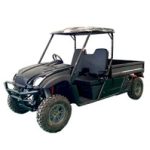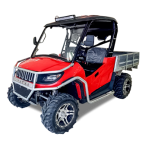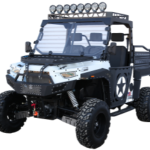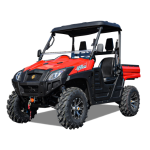
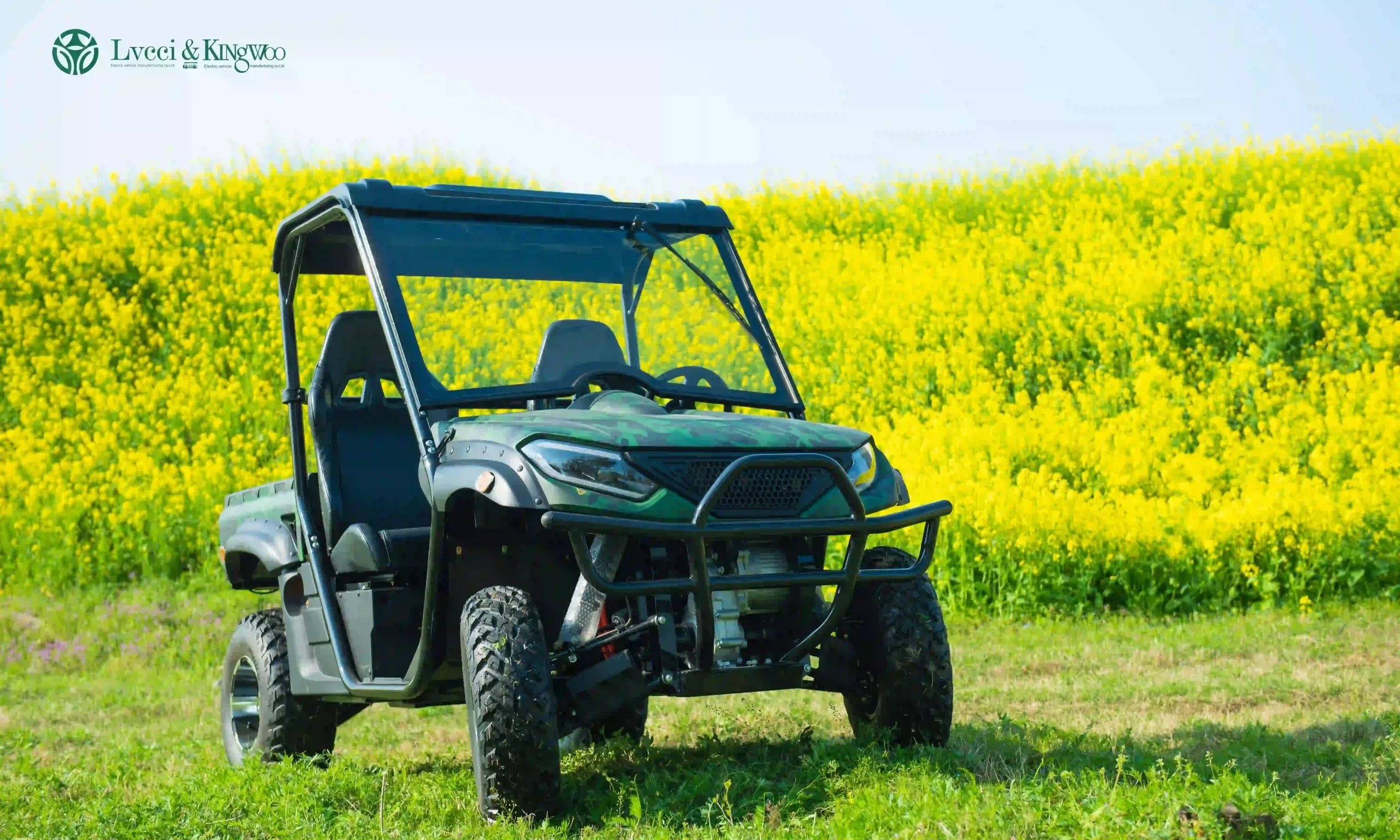
In the modern lightweight, distributed, fast-paced combat system, battlefield mobility has long ceased to rely on the simple firepower and protection advantages of heavy armored vehicles and large tactical trucks. Traditional military vehicles generally have problems such as large size, limited mobility, slow deployment, and high logistical pressure. They cannot adapt to refined tactical scenarios such as special operations, mountain jungle operations, frontier small-scale raids, and field rescue.
This article will comprehensively answer why the military uses UTV, the core characteristics of military UTV, the ten core application advantages, mainstream combat scenarios, the comparison of electric and fuel models, military selection standards and future development trends, and comprehensively dismantle the irreplaceability of military UTV in modern warfare.
UTV full name Utility Task Vehicle, also known as Utility Terrain Vehicle, side-by-side all-terrain vehicle (SxS). Military UTV is a lightweight, highly adaptable, modular tactical vehicle designed for complex battlefield environments, with a core orientation of battlefield support and tactical mobility, rather than frontal heavy fire confrontation.
Many people will confuse military UTV with civilian all-terrain vehicles, but the two are essentially completely different product systems. The military version has been upgraded in an all-round way to meet the demanding battlefield combat requirements.
Body design: Open/semi-closed body, standard anti-roll protection structure (ROPS), ground clearance of more than 10-20 inches, with high-stroke professional suspension system, extreme terrain passability, lightweight body, Flexible steering, far superior to traditional military trucks.
Carrying capacity: It can carry 2-9 fully armed fighters, covering hundreds of pounds to 4000 pounds, and can be adapted to various modification schemes such as personnel transportation, material loading, medical stretcher, weapon base, etc.
Maneuverability: Support four-wheel drive/six-wheel drive configuration, power covers gasoline, diesel, hybrid, and pure electric. The battery life can reach 200-300 miles. It supports explosion-proof tires, night vision infrared lighting, silent driving, and can be adapted to all-weather combat.
Deployment capability: small size, controllable weight, can be lifted by helicopter, cabin loading, small transport aircraft delivery, to achieve rapid battlefield deployment.
Adaptable fuel: military aircraft support JP-8 general military fuel, adapt to the global field logistics system.
Military UTV is not a simple revision of civilian models, but targeted militarization customization: strengthening the frame structure, carrying military-grade electronic equipment, supporting battlefield silence mode, adapting to extreme temperature and humidity and sand and dust environment, and having tactical attributes such as rapid modification, battlefield emergency repair, low detection, etc., fully adapting to the requirements of militarization operations.
At present, UTV models equipped with mainstream military equipment in the world include: Polaris MRZR Alpha series, Can-Am modified defense UTV, John Deere M-Gator/R-Gator, general defense ISV infantry team vehicles, Nikolai Reckless pure electric military UTV, etc., which are widely installed in the U.S. military and multinational regular combat forces.
10 Major Reasons the Military Uses UTVs
The reason why military UTV has become the standard equipment for modern light-armed combat is that it solves many pain points of traditional equipment and improves the combat capability of troops from multiple dimensions such as mobility, deployment, tactics, cost and rescue. It can be divided into ten core advantages:
In complex terrains such as mountains, jungles, muddy deserts, steep slopes, etc., heavy tactical vehicles such as Hummer and JLTV are easily trapped and blocked. However, military UTV can easily cross various extreme terrains and reach combat areas that cannot be covered by heavy vehicles by virtue of ultra-high ground clearance, long-travel suspension and four-wheel drive locking system, which is perfectly suitable for scenes such as border patrol, field reconnaissance and penetration behind enemy lines.
Most military UTV lightweight, modular design, support CH-47, MH-47, Osprey transport aircraft and other aircraft cabin loading or external lifting, can achieve simultaneous airdrop of fighters and equipment, rapid insertion into the battlefield. For special operations, emergency response, and raids behind enemy lines, the ability to deploy quickly is its core tactical advantage.
Military UTV has extremely strong modification and expansion capability, and can quickly switch configurations in the battlefield without complicated tools: personnel transportation mode, ammunition material loading mode, airborne weapon base mode, medical rescue stretcher mode, command and communication equipment carrying mode. One vehicle can take into account multiple tasks of patrol, supply, operation, rescue and command, thus greatly improving equipment utilization rate.
Compared with infantry on foot, UTV can greatly improve the speed of travel and reduce the physical consumption of soldiers. Compared with heavy armored vehicles, UTV is small in size and flexible in steering, and has stronger mobility in street battles, dense forests and narrow positions. It is perfectly suitable for the rapid response, circuitous and mobile ambush tactics of small-scale combat teams.
The military UTV has a maximum load of 4000 pounds, can transport combat materials, ammunition, fuel oil and maintenance tools in batches, and supports light towing operations. It can provide continuous supplies for forward posts, field combat units and temporary positions, and solve the logistics supply problems in remote theaters.
UTV has a low body and small size, and has lower visual recognition than large military vehicles. Especially the electric/hybrid motor type, it can realize silent driving and low infrared heat source signal, effectively avoid UAV reconnaissance, infrared detection and acoustic monitoring, and is perfectly suitable for special tasks such as hidden reconnaissance, silent latency and secret infiltration.
Compared with heavy tactical vehicles and armored vehicles, military UTV has lower purchase price, less fuel consumption, low failure rate of simple structure, and extremely low cost of maintenance and spare parts supply. The army can be installed on a large scale in batches, and the mobility of the grassroots units can be comprehensively improved without increasing huge military expenditures.
In complex terrains such as mountains and wilderness, large ambulances cannot reach and the risk of helicopter landing is extremely high. The modified medical version UTV can carry stretchers and first aid equipment to quickly transfer the wounded, shorten the rescue time in the field and greatly improve the survival rate of the wounded. It is the core equipment for front-line MEDEVAC medical evacuation.
In military bases, shooting ranges and large barracks, UTV can efficiently complete perimeter perimeter patrol, border security, site inspection, equipment handling, daily service support and other work, with flexibility and strong adaptability, greatly reducing the labor cost of base operation and maintenance.
UTV allows small-scale infantry teams to get rid of the limitations of foot operations, and have the comprehensive capabilities of rapid mobility, self-sustaining supplies, simple operations, and emergency rescue. They can independently complete reconnaissance, patrol, raid, security and other tasks without relying on heavy equipment support. Realize the upgrade of the combat power of lightweight troops.
Military UTV does not undertake the task of frontal reloading and confrontation, but focuses on the battlefield support task of lightweight, refined, fast response and high mobility. At present, it has fully covered the ten military core scenes:
Reconnaissance and surveillance mission: relying on low stealth characteristics, equipped with photoelectric and sensing equipment, to complete reconnaissance behind enemy lines, position monitoring, battlefield intelligence collection.
Rapid force delivery provides rapid mobility for special forces, light infantry and airborne troops, suitable for assault, interpenetration and deployment tasks.
Frontier supplies: supplies and ammunition for remote outposts, field training sites and temporary combat positions.
Field medical evacuation: rapid transfer of wounded and on-site medical support in complex terrain.
Mobile command and communication: equipped with communication, GPS, command terminal, build the front of the small mobile command node.
Base security patrol: camp border alert, patrol prevention and control, emergency response.
Special operations raid: after the helicopter is delivered, the task of covert infiltration, precision strike and target attack is completed.
Battlefield search and rescue missions: pilot search and rescue, missing personnel search and rescue, and field emergency rescue.
Field engineering support: transportation and maintenance tools, clearing obstacles, light engineering operation support.
Daily training and combat readiness: basic services such as daily military training, site support and equipment transfer.
Key Features of a Military-Grade UTV
Different from civilian UTV, which focuses on comfort and entertainment, military-grade UTV, from research and development, material selection to structural design, all take battlefield durability, mission adaptability, extreme environmental survival protection, and actual combat tactical value as the core standards. Each exclusive configuration is optimized for modern battlefield pain points, and is fully adapted to high-intensity, high-risk, multi-scenario militarized operations and support tasks, which is the core key to distinguish it from civilian cross-country equipment and become the military’s exclusive tactical equipment. Specific core exclusive performance configuration and actual combat value are as follows:
Extreme All-Terrain Off-Road Performance
Military UTV comes standard with super large approach angle, departure angle and longitudinal passing angle, with thickened anti-skid chassis guard, mechanical differential lock, all-terrain explosion-proof vacuum tires and long-stroke independent suspension system.
Compared with civilian vehicles, its chassis sealing, impact resistance and anti-jamming capability are greatly upgraded. It can calmly cope with various extreme and complex terrains such as steep mountain slopes, muddy swamps, Gobi desert, dense forest gravel, snow and frozen soil, effectively avoid problems such as car sinking, chassis scratching, tire damage, etc., ensure the continuous mobility of troops in field battlefields without paving and roads, and open up combat channels that heavy vehicles cannot cover.
Rapid Modular Modification Design
Using the military’s standardized plug-in modular architecture, front-line soldiers can quickly switch mission modules within minutes without professional tools or returning to the factory for modification.
It can flexibly adapt to various actual combat modes such as fully armed personnel transportation, ammunition and material storage and transfer, field medical stretcher carrying, light weapon mounting, communication command equipment fixing, field rescue equipment loading, etc., completely solve the problems of poor adaptability, complicated scheduling and equipment redundancy of traditional single-function equipment, and greatly improve the utilization rate of battlefield equipment and emergency combat response speed.
High-Carrying Combat-Level Configuration
The whole vehicle adopts a military high-strength reinforced frame and load-bearing structure, and comes standard with impact-resistant military reinforced seats, five-point explosion-proof seat belts, a global heavy-duty binding and fixing structure and a front-rear professional drag system.
It can not only stably carry 2-9 fully armed soldiers and a full set of combat equipment, but also realize thousands to 4 thousand pounds of material loads and light equipment towing.
In a bumpy and high-speed mobile battlefield environment, it can effectively ensure personnel safety and material stability, eliminate potential safety hazards such as equipment falling off and personnel displacement, and is fully suitable for high-intensity actual combat transportation scenarios.
Abandoning the civilian common power assembly, the military UTV is equipped with a military-grade power system. The diesel engine type is fully adapted to the military general JP-8 military fuel, compatible with the field logistics fuel system, and eliminates the risk of fuel adaptation. Hybrid and pure motor types have exclusive optimized mute tactical modes, which can realize silent driving with zero noise and low heat source.
At the same time, the power system has been specially optimized for high and low temperature, sand and dust, and water immersion, and can stably output power in extreme environments such as extreme cold below zero, high temperature desert, high humidity rain forest, dusty Gobi, etc., eliminating problems such as flameout, power attenuation, failure shutdown, etc., and ensuring all-weather uninterrupted combat support capability.
According to the customized design for military air transportation, airdrop and hoisting operations, the whole vehicle is made of lightweight and high-strength aviation-grade materials, with foldable anti-roll protection frame (ROPS), detachable ceiling and modular split structure. The size and weight of the whole vehicle are strictly adapted to the loading standards of mainstream military helicopters and small transport aircraft such as CH-47, MH-47 and V-22 Osprey.
It can not only realize the loading and delivery of the whole machine inside the cabin, but also complete the external rapid lifting, support the long-distance rapid penetration of special forces, emergency deployment behind enemy lines, and rapid deployment of forward positions, thus greatly improving the strategic mobility and emergency response capability of the troops.
According to the survival needs of soldiers in the battlefield, the basic configuration has its own anti-roll protection structure, explosion-proof anti-puncture tires and chassis anti-impact structure, which can effectively resist gravel impact, mild explosion shock wave and road sharp object puncture.
At the same time, it supports the rapid installation of light composite bulletproof armor, window bulletproof module, simple explosion-proof guard plate and other upgrade kits, which can resist light weapon shooting, shell fragments and low-altitude explosion damage, it is perfectly adapted to low-to-moderate intensity confrontation scenarios such as border patrol, reconnaissance behind enemy lines, forward garrison, urban street fighting, etc., and maximizes the survival probability of fighters without sacrificing mobility.
The whole vehicle reserves a military standardized expansion interface, which is originally adapted to the military C4ISR command system and can seamlessly integrate high-precision military GPS, tactical communication radio, battlefield networking terminal, night vision auxiliary system, photoelectric reconnaissance equipment and other professional equipment.
Electric and hybrid vehicles also have high-power external power supply modules, which can be used as field mobile power stations to continuously supply power to unmanned aerial vehicles, electronic countermeasures equipment, directional energy weapons and field medical equipment. A single motor vehicle is upgraded to an intelligent battlefield node integrating mobility, reconnaissance, communication, power supply and support, and is suitable for modern information and systematic combat modes.
The whole vehicle adopts a low-profile body and a low-visibility design with a minimal appearance. It is matched with military mute power adjustment, low-infrared heat source chassis and power cabin optimization, and matte camouflage matching coating to achieve triple stealth effects of low vision, low acoustics and low infrared.
Compared with traditional military vehicles, it can greatly reduce the probability of enemy visual reconnaissance, acoustic monitoring, infrared detection and unmanned aerial vehicle reconnaissance. It is perfectly suitable for secret tactical tasks such as hidden infiltration, silent lurking, reconnaissance behind enemy lines, night raid, fixed-point ambush, etc., helping troops to achieve tactical suddenness and improve the success rate of operations.
At present, military UTV is divided into fuel (gasoline/diesel) and electric/hybrid two categories, each has its own advantages, adapt to different combat scenarios, is the core reference basis for military selection.
The fuel model is the main equipment of the current military, with mature technology and strong stability. Its core advantages are long cruising range (200-300 miles), fast refueling speed, no need to rely on power infrastructure, strong adaptability to extreme high and low temperature environments, and perfect adaptability to long-distance patrols, long-term field training, continuous replenishment in remote areas, and high-intensity continuous combat scenarios.
The motor type is the upgrading direction of the future battlefield. The core highlights are silent stealth, instantaneous high torque, external power supply, low maintenance cost and zero emission.
No engine noise, low infrared heat source, can achieve silent latency, hidden penetration; battery pack can be used as a mobile power supply for unmanned aerial vehicles, sensing equipment, communication terminals, directional energy weapons power supply, perfect adaptation to special operations, hidden reconnaissance, base security, electronic countermeasures mission. The representative model is Nikola Reckless pure electric military UTV.
Long-distance, high-intensity, non-power infrastructure field missions, priority selection of fuel UTV; stealth operations, electronic support, indoor/camp operations, short-range tactical missions, priority selection of electric/hybrid UTV. The hybrid type, which takes into account the advantages of long endurance and mute, is currently the most cost-effective transition solution for the military.
With the comprehensive upgrading of modern battlefield reconnaissance technology and electronic combat system, modern warfare increasingly emphasizes covert assault, distributed combat and field self-sustaining support. Stealth capability and field power support capability have become the core indicators to measure the combat power of light tactical equipment. In this context, the unique tactical value of electric military UTV has been continuously amplified, becoming a new type of tactical equipment that the U.S. military and multinational military focus on testing and iterative installation. Compared with traditional fuel models, its core advantages are concentrated in eight practical dimensions:
Realize the whole silent maneuver and long silent duty, no engine roar and high temperature heat source characteristics, can effectively avoid the enemy acoustic detection, infrared reconnaissance equipment, adapt to hidden penetration tasks.
Superior Cross-Country Mobility
The motor can output instantaneous large torque, fast starting response, strong low-speed traction, and its maneuvering performance on steep slope climbing, muddy dragging, and complex obstacle sections is better than traditional fuel models.
Field Mobile Power Supply
Equipped with a large-capacity power battery system, it can be used as a field mobile power station to continuously supply stable power for drones, reconnaissance sensors, communication equipment, and field medical equipment.
Low Fault And Easy Maintenance
The pure electric structure has no complicated oil circuit and transmission parts, fewer moving parts, and the field failure rate is greatly reduced, effectively reducing the maintenance pressure and spare parts consumption of front-line troops.
Weakening Fuel Dependence
Get rid of the dependence on the traditional fuel supply fleet, greatly reduce the frequency of front-line fuel transportation, avoid the battlefield risk of the fuel fleet being hit, and improve logistical safety.
Ultra-Low Battlefield Detectability
Taking into account the low noise, low infrared, low visual characteristics, perfect adaptation to the current UAV saturation reconnaissance, global sensing detection of the complex modern battlefield environment.
Long-Term Hidden Standby
It supports long-term flameout, silent standby and unattended operation in the field, and is suitable for long-term tactical tasks such as frontier latency and border surveillance.
Global Scene Adaptation
The operation has zero emission and ultra-low noise, which is not only suitable for hidden operations in the field, but also can meet the requirements of daily operation and maintenance of military camps, patrols in ecologically sensitive areas and other compliance operations.
Of course, limited by the current battery technology, electric military UTV still has obvious practical shortcomings: effective battery life is less than fuel models, low temperature environment battery performance attenuation is obvious, the field without special charging infrastructure, difficult to adapt to ultra-long distance, long-cycle field missions. Therefore, in the short term can not completely replace the mature fuel UTV, oil-electric hybrid scheme takes into account the advantages of endurance, mobility and stealth, is the most practical and cost-effective transition choice for the military at this stage.
For national defense agencies and procurement units, military UTV selection is not simply a comparison of paper parameters, but a comprehensive strategic decision that combines military combat positioning, the main battlefield environment, logistics support system and long-term military spending planning. The selection results directly affect the team’s mobility, mission success rate and long-term logistics pressure. Therefore, the military will be from a combat perspective, around the nine core dimensions of scientific screening, to maximize the value of equipment combat, reduce the full cycle of operation and maintenance pressure:
In line with the core combat scenario of the army, around the normal tasks such as reconnaissance latency, rapid assault, material supply and field rescue, the maneuverability, load capacity and modular modification potential of the vehicle are accurately matched to ensure that the equipment meets the actual combat requirements.
Environmental Adaptability
It is preferred to select models that have been tested in extreme environments, which can stably adapt to complex terrain and climate such as desert high temperature, polar cold, rainforest high humidity, plateau hypoxia, etc., to ensure global and all-weather operational stability.
Deployment Capacity
Strict adaptation of military air transport, helicopter lifting, rapid airdrop standards, lightweight, size compliance, can meet the long-range rapid delivery, emergency interspersed deployment of high-intensity tactical needs.
Modular Expansion
It supports quick disassembly and assembly of multi-type task modules without tools, and can flexibly switch operation modes such as combat, supply, rescue and communication. At the same time, interfaces are reserved to facilitate iterative upgrade of later functions.
Power Scheme
Combined with battlefield charging, fuel replenishment and other infrastructure conditions, flexible selection of fuel, pure electric or hybrid power combination, balance mileage, tactical stealth effect and field logistics adaptability.
Battlefield Survivability
Standard anti-roll, explosion-proof, anti-puncture and other basic protection configurations, support light bulletproof armor, protection kit upgrade, can effectively adapt to low, moderate intensity against the battlefield environment.
Reliability and Maintenance
The equipment is required to have low failure rate, durable structure, convenient field repair, sufficient supply of general spare parts, adapt to the front-line simple maintenance conditions, and reduce the risk of operational stagnation.
Intelligent Integration
It can seamlessly connect military C4ISR command system, sensing equipment and unmanned combat system, realize data intercommunication and cooperative operation, and adapt to modern information and intelligent cooperative combat mode.
Full Life Cycle Costs
Comprehensive consideration of the initial procurement costs, long-term energy consumption costs, maintenance costs and equipment service life, comprehensive control of military investment, to achieve cost-effective installation.
Relying on its core advantages of high mobility, high adaptability and low cost, UTV has long been out of the military industry and has been popularized on a large scale in the civil industry. Its main application scenarios include: agriculture, agriculture and forestry, construction and infrastructure, oil and gas mines, forest fire fighting, public security emergency rescue, outdoor travel, park operation and maintenance, power communication inspection, etc. It is a common and efficient operation equipment for many industries.
With the acceleration of modern warfare to intelligent, unmanned, stealth, distributed combat transformation, the traditional heavy equipment system is gradually difficult to adapt to the fast-paced, high concealment, low logistics of the frontier combat needs.
As the core carrier of light tactical mobility, military UTV is ushering in all-round technical iteration. It is no longer just a simple cross-country transportation tool, but is upgrading towards a new battlefield terminal with multi-domain coordination, autonomous combat and intelligent support. The future military UTV industry will present seven core development trends:
Power electrification:
Hybrid and pure electric power systems are rapidly iterating and popularizing, gradually replacing traditional pure fuel models as mainstream configurations. Electrification not only brings the tactical advantages of silent stealth and low infrared heat source, but also provides field external power supply capability, which perfectly adapts to the requirements of modern concealed operations and distributed self-sustaining support. Hybrid vehicles can better take into account the dual advantages of long endurance and silent operations.
Operation unmanned:
The new generation of military UTV will be deeply equipped with functions such as automatic driving, AI intelligent obstacle avoidance, formation following, autonomous path planning, etc. It can realize tasks such as unmanned material supply, full-automatic battlefield reconnaissance, fixed-point patrol on duty, and auxiliary transportation of wounded, effectively reducing the exposure risks of front-line soldiers and reducing the combat load of personnel.
Module standardization:
In the future, military UTV will fully popularize universal plug-in standardized task modules, unified interface, fast disassembly and assembly, without the need for professional tools to quickly switch transportation, combat, medical, communication, replenishment and other functional scenarios, to achieve second-level task conversion, adapt to the global, multi-type emergency combat needs.
Protection lightweight:
Relying on new lightweight composite armor, anti-impact chassis, active protection system (APS) and other new technologies, without sacrificing vehicle mobility, lightweight advantages, greatly improve explosion-proof, anti-fragmentation, impact resistance, balance the battlefield contradiction between high mobility and high survivability.
Battlefield intelligence:
The vehicle terminal is deeply integrated into the military C4ISR command system, supporting real-time battlefield networking, cloud data intercommunication, and multi-equipment cooperative operations. It can cooperate with unmanned aerial vehicles, unmanned combat vehicles, and individual soldier terminals to build a man-machine cooperative intelligent combat system and improve the overall tactical decision-making efficiency.
Operation and maintenance intelligence:
The whole vehicle is equipped with an intelligent sensor monitoring system, which can collect data of core components such as power, chassis and battery in real time to realize fault prediction, early warning and predictive maintenance, effectively reduce sudden failures in the field, reduce the consumption of logistics spare parts, and greatly improve the continuous combat capability of the battlefield.
Scene specialization:
Develop an exclusive customized version for extremely complex battlefield environments such as extreme cold in polar regions, high temperature in deserts, high humidity in rainforests, and lack of oxygen in plateau. Through targeted adjustment of power, sealing, suspension and protection systems, the normalized combat guarantee for the whole region and the whole climate is realized.
Military UTV is not a simple cross-country transportation equipment, but an indispensable tactical mobile combat power multiplier in modern light combat system. It perfectly fills the mobile gap between infantry walking and heavy vehicles. With its core advantages of all-terrain passability, rapid deployment capability, multi-scene modular adaptation, low detectability and low-cost operation and maintenance, it covers all-dimensional military tasks such as reconnaissance, assault, supply, rescue and security.
In the future battlefield, with the continuous landing of electric, intelligent and unmanned technology, military UTV will be upgraded from a single mobile equipment to an intelligent battlefield node integrating mobility, power supply, reconnaissance, operation and support, and become the core standard equipment of light combat forces and special operations forces of various countries.
Military UTV through military reinforcement, military electronic adaptation, battlefield stealth modification, extreme environment adaptation, support air transport, modular combat, military fuel, fully adapt to the battlefield needs, the overall performance, reliability, expansion is much higher than civilian models.
There are no absolute merits. Electric models are better than stealth, power supply and low maintenance, and are suitable for special stealth tasks. Fuel is better than endurance and environmental adaptability, suitable for long-term field missions. Hybrid operation is the best compromise.
3.Which military units primarily use UTV?
The U.S. Special Operations Command, airborne troops, Marine Corps, light infantry units, and light combat, border defense, and emergency combat units of various countries are the main use units.
You can. Most military UTV support the installation of machine guns, grenade launchers and other light weapons base, can perform light fire suppression and assault missions.
Mainstream military UTV can be quickly lifted by helicopter and loaded in the cabin, which can realize synchronous airdrop with combat troops, so as to achieve immediate deployment and immediate combat.


-150x150.png)