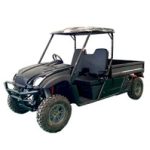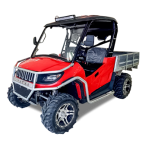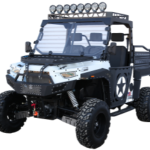
For landowners with 100-acre farms, large ranches, private estates, woodlands and recreational parcels, land management is no longer simply a matter of mowing, inspection and maintenance. As land sizes increase, labor costs rise, and environmental compliance requirements escalate, the traditional land operation model is facing multiple challenges.
Fuel trucks, old tractors, fuel UTVs and other traditional equipment have long been characterized by high fuel consumption, frequent maintenance, noise nuisance, ecological damage and many other problems. These small problems accumulate over time and will continue to drive up operating costs, reduce work efficiency, and constrain the refined management of land.
Under the trend of intelligent and green land management in 2026, the electric UTV (Electric Side-by-Side Multi-Purpose Work Vehicle) is becoming the standard equipment for large land holders. It perfectly solves the core pain points of traditional equipment and reshapes the modern large-area land management mode with the advantages of low cost, zero emission, quiet operation and high adaptability.
This article will deeply analyze the core problems of large-scale land management, the core advantages of electric UTVs, the comparison of oil and electric models, practical application scenarios, and professional purchasing skills to help land owners make accurate judgments, realize cost reduction and efficiency, and green operation.
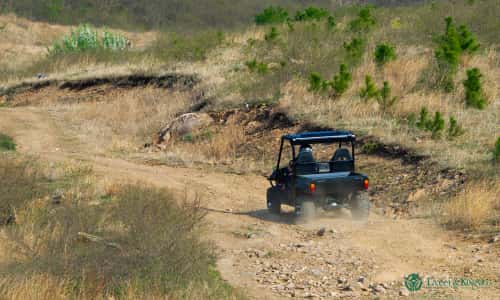
Whether it is large-scale agricultural land, livestock ranch, private 10,000-acre manor, or commercial green land, the difficulty of operating and managing large-scale land is increasing year by year. Inflation, labor shortages, tightened environmental policies, and escalating equipment operation and maintenance costs have become the four core challenges plaguing many land operators.
The traditional mode of relying on manual inspection and fuel vehicle operation can no longer meet the needs of modern land management, and the specific pain points are concentrated in five dimensions.
In recent years, the prices of materials, labor, and fuel continue to rise, significantly increasing the basic expenses of daily operation and maintenance of land. Fence overhaul, green plant maintenance, material transportation, site cleaning and other work in large land areas require high-frequency vehicle operations.
Fuel vehicles not only have high fuel consumption cost per kilometer, but also need regular replacement of oil, filter elements, spark plugs and other accessories, and the annual maintenance cost is a fixed and expensive expenditure. Under long-term high-frequency use, frequent vehicle breakdowns and downtime for maintenance are common, further increasing the hidden operating costs.
At the same time, the cumulative wear and tear of old equipment will lead to more problems, forming a vicious cycle of “the more maintenance is delayed, the higher the cost is accumulated”, which seriously affects the normal operation of the land.
At present, there is a labor shortage in agriculture, site operation and maintenance, animal husbandry management and other industries, and skilled site maintenance and equipment operation personnel are extremely scarce. Young laborers have a low willingness to work, and existing staff members generally suffer from fatigue and inefficiency.
Traditional operating equipment is cumbersome, vibrating and noisy, with high labor intensity, and long-term use can easily lead to physical and mental fatigue of the staff. For repetitive work such as daily inspections, material handling, and hidden danger investigation of large areas of land, traditional equipment cannot reduce the burden of labor, but will slow down the overall work progress.
Nowadays, green agriculture and ecological land management have become the mainstream trend in the industry, and stricter regulations have been introduced for agricultural production and site operation in terms of emissions, soil and water protection, and noise control.
Whether it is a large-scale farm, cultural tourism estate or ecological forest land, all need to meet ESG green assessment standards. Problems such as exhaust emissions, oil leakage and noise pollution from fuel vehicles not only damage the ecology of the land, but may also lead to compliance demerit points and fines, affecting the qualification and value-added space of the land.
More and more investors and partners are beginning to value the green operation capability of land, and the traditional operation mode of high pollution and high energy consumption is no longer in line with the demand for long-term development of modernized land.
Fuel-fired UTVs and tractors are extremely noisy when operating, commonly reaching 75-100 dB, which can cause serious alarm to livestock and wildlife. Sensitive livestock such as cattle, sheep and young animals are easily irritated by noise, and are prone to agitation, loss of appetite and stress reaction, which directly affects the farming income.
At the same time, high-frequency noise operations will disrupt the ecological balance within the plots, disturb wildlife and affect the ecological diversity of the land. Plots near residential areas will also cause neighborhood disputes due to operation noise, limiting normal operation in the morning and evening hours.
Many landowners still rely on private cars, large trucks, traditional tractors or ordinary ATVs to complete their daily operations, and each of these tools has its own shortcomings and cannot be adapted to the fine management of large areas of land.
Domestic vehicles have poor off-road performance, easy to get stuck, low chassis, and can’t be adapted to mud, steep slopes, and complex terrain in the forest; large trucks have high fuel consumption, large size, and poor flexibility, and are not suitable for short-distance, high-frequency operations; tractors are slow, noisy, and are only suitable for heavy farming; and ATVs are weak in cargo-carrying capacity and low in safety, and can’t satisfy the demand for material transportation and multi-people operations.
The limitations of these tools lead to a large number of daily simple work time-consuming and laborious, seriously lowering the overall efficiency of land management.
Electric UTV, also known as electric utility vehicle, is also known as electric side-by-side off-road vehicle (Electric Side-by-Side), is a new energy vehicle designed for farms, ranches, large estates, woodlands and other large areas.
It abandons the traditional fuel engine and carries a lithium battery power system, taking into account the advantages of off-road performance, cargo capacity, silence and environmental protection. It is a modernized tool to replace the traditional fuel operating equipment, perfectly adapted to the daily operation and maintenance of large areas of land in a full range of scenarios.
Electric UTV is a four-wheel-drive off-road vehicle powered by lithium batteries, focusing on short-distance and high-frequency operation, refined site management, and green operation with low energy consumption. Different from recreational off-road vehicles, it focuses more on practicality, stability and durability, and is a real productivity tool suitable for daily land operation and maintenance.
The vehicle adopts side-by-side seating design, which can carry 2-6 people, and is equipped with a special cargo bucket and towing interface, taking into account the multiple functions of personnel transportation, material handling, equipment towing and site inspection.
Electric UTV is equipped with lithium-ion power system, which has the advantage of instantaneous torque that fuel models do not have, and it can output peak power from zero rotation speed, which makes it more capable of climbing slopes, getting out of trouble, and starting under heavy load.
The mechanical structure of the whole vehicle is extremely simple, without complex fuel supply, air intake and exhaust systems, greatly reducing the number of wear parts, and the failure rate is extremely low. At the same time, the noise level is extremely low and zero exhaust emission, which is suitable for all kinds of sensitive operation scenarios.
Standard four-wheel drive system, high ground clearance, independent suspension structure, can easily cope with mud, steep slopes, gravel, grass and other complex terrain, all-terrain adaptability pull full.
In terms of range, mainstream electric UTVs can travel 25-80 miles on a single charge, fully covering the daily inspection and short-distance operation needs of 100 acres and 1,000 acres of land.
Strong cargo and towing capacity, rated payload up to 700-1250 pounds, towing weight up to 2500 pounds, can easily carry feed, tools, building materials, crops and other materials.
The noise level is only 45-65 decibels, which is close to the volume of daily conversations and does not generate noise pollution, and is perfectly suited for animal husbandry, ecological conservation, and near-residential operations.
For farm owners, ranch operators, ten thousand acres of manor holders and other large land operators, replacing electric UTVs is not a simple iteration of old and new equipment, but a strategic upgrade for modern land management. Unlike fuel UTVs that can only meet basic operational needs, electric UTVs can solve the long-term pain points of traditional equipment in terms of cost control, operational efficiency, ecological compliance, operational safety, scene adaptation and other core dimensions.
It is not only an operation tool, but also the core productivity equipment for large-scale land to realize fine management, green operation and long-term profitability. Next, we will combine the real field operation scene, actual measurement data and long-term operation logic to comprehensively dismantle the core landing value of electric UTV.
In the long-term operation of large land areas, the comprehensive cost of equipment is a key factor in determining profitability. Many land operators only focus on the purchase price of the equipment bare vehicle, but ignore the hidden costs of energy consumption, maintenance, and breakdown downtime accumulated over several years.
The biggest core advantage of electric UTVs is that they have extremely low TCO (Total Life Cycle Cost of Ownership), and the economy of long-term use far exceeds that of traditional fuel UTVs, which is perfectly suited to the high-frequency and long-term operation mode of farms, ranches, and estates.
Energy consumption cost is a fixed and large expense for daily operation and maintenance of land. According to the measured data of outdoor operation vehicles, the fuel cost per mile of fuel UTV is about $0.15, while the electric cost per mile of electric UTV is only $0.09, so the difference in energy consumption is very obvious.
For large sites of 1,000 acres, the average daily operating mileage of the vehicle can reach 30-50 miles, covering inspection, operation and maintenance, material transfer and other basic work. The savings in energy consumption alone can be a steady $2,000-$3,500 per year, and the longer the operating life, the more significant the savings.
In addition to energy savings, the maintenance cost gap is the core of the cost-effectiveness of fuel-electric models. Traditional fuel UTVs have a complex structure, including a large number of wear parts such as engine, oil circuit, exhaust system, spark plugs, etc..
Fuel models need to regularly replace the oil, filter, air filter, but also a regular check of oil carbon, exhaust failure, engine wear, annual maintenance process is cumbersome and expensive.
Electric UTVs are purely motor-driven, with no fuel combustion system, so there are virtually no wear-and-tear parts. Daily only need to check tires, brakes, battery status can be, the overall maintenance costs than fuel models reduced by 50% -70%. The overall maintenance cost is 50%-70% lower than that of fuel models, and it can easily save tens of thousands of dollars in maintenance cost under the high-frequency use for a long time.
In terms of comprehensive energy consumption, maintenance, downtime, parts replacement and all other costs, the ten-year full-cycle cost of electric UTVs saves $7,000-11,000 compared to fuel UTVs of the same class.
Most of the venues can erase the difference in purchase price of electric vehicles in 2-5 years, and realize “low-cost pure profit” operation in the following years, which greatly improves the overall profitability of land operation.
In animal husbandry and ecological land management, noise pollution is an invisible pain point that is easy to be ignored. The noise of traditional fuel UTVs and tractor operations is as high as 75-100 decibels, and the ear-splitting mechanical roar will continue to damage the ecological and breeding environment.
Relying on the pure electric drive structure, electric UTVs have no engine roar, no exhaust vibration, and the operating noise is only 45-65 dB, close to the volume of daily human voice conversations, which solves the problem of noise nuisance and livestock disturbance at the root, and meets the demand for fine management and care.
In cattle and sheep farms and poultry breeding bases, livestock are extremely sensitive to noise. High decibel noise of fuel machinery can easily lead to abortion of pregnant animals, restlessness of young animals, decreased appetite of livestock and poultry, which directly reduces the farm rate and farm income.
Electric UTV’s quiet operation is perfectly suited for daily inspection, feed transfer, equipment overhaul, site disinfection and other work in the breeding area. The whole process is free of noise interference, livestock will not produce stress reaction, growth state is more stable, and effectively improve the quality of breeding and economic benefits.
For ecological woodlands, nature conservation areas, hunting grounds and other ecological plots, the value of quiet operation is also outstanding. Traditional fuel vehicles can disturb wildlife in the forest, causing birds and animals to migrate, destroying habitats and affecting the ecological diversity of the land.
Electric UTVs can realize silent close-range operation, and staff can smoothly carry out ecological monitoring, pest inspection, vegetation maintenance, wildlife observation and other work. On the premise of not destroying the natural ecology, it can complete a full range of site management work.
In addition, the silent feature greatly broadens the flexibility of the operating hours. The land near residential areas and cultural resorts can be operated in the early morning, at night, and on holidays in a staggered manner.
There is no noise nuisance in the whole process, which completely avoids neighborhood disputes, restricted operation hours and other troubles, so that the site operation and maintenance work is not restricted by time and scene, and the degree of freedom of operation is greatly enhanced.
Nowadays, green agriculture, low-carbon operation and ESG compliance have become the hard standards and core competitiveness of large-scale land operation. Whether it is a large-scale farm, high-end cultural tourism estate or ecological forest land, green certification, carbon credit assessment and ESG rating are required to enhance land valuation and cooperation qualification.
Problems such as tailpipe emissions, oil leakage and exhaust gas pollution of traditional fuel-fired operating equipment can easily lead to compliance demerit points, project rectification and substandard qualification, restricting the long-term development of land. Electric UTVs are the core equipment for realizing green upgrading of sites at low cost and high efficiency.
Electric UTV adopts purely electric operation mode, with no exhaust, carbon dioxide, particulate matter or harmful emissions throughout the whole process, which can continuously reduce the carbon footprint of the land parcel.
Long-term batch use of electric UTVs can help the site successfully complete green agriculture certification, LEED green building rating, rural eco-project declaration and carbon credit reserve, providing strong support for land appreciation, project cooperation and policy subsidy declaration.
In high-standard scenarios such as organic agriculture, high-end horticulture and ecological planting, the requirements for land pollution control are extremely strict. Fuel vehicles are prone to oil leakage and fuel dripping problems, which can directly pollute soil, water and crops, affecting the quality of agricultural products and organic certification results.
Electric UTVs have no fuel or oil storage and consumption structure, eliminating the risk of leakage and pollution from the root, protecting soil and water resources and the planting environment in all aspects, and adapting to the production standards of high-end green agriculture.
For large-scale sites equipped with solar power supply systems, the whole process of zero-carbon closed-loop operation mode of photovoltaic charging and pure electric operation can be realized.
This green operation system can not only greatly enhance the ecological value and market competitiveness of the land, but also set up a standardized green management benchmark, which is suitable for the development trend of modern agriculture and ecological culture and tourism.
Many land operators have the misconception that electric operation equipment is weak and cannot meet heavy-duty cross-country demand. As a matter of fact, electric UTVs designed for professional field operations have better power response and maneuverability than fuel models of the same class, and are more suitable for the complex operating environment of large land areas.
Fuel engines need to increase speed to output peak power, and there is a delay in power response; while the power output characteristics of electric motors are more suitable for heavy-duty and off-road operation.
The electric UTV can realize zero-speed instantaneous output of peak torque and release strong power at the start. In the face of steep slopes, muddy puddles, soft grass, heavy-duty towing and other high-intensity scenarios, the power output is smoother and more explosive, and there will be no problems of insufficient power, lack of climbing strength and start-up problems of fuel vehicles.
Whether it is towing agricultural equipment, climbing slopes with a full load of materials, or getting out of trouble in muddy terrain after rain, electric UTVs can handle it with ease, and the stability of operation far exceeds that of traditional fuel models.
The stability of the equipment is the key to ensure the efficiency of field operation. The mechanical structure of electric UTVs is extremely simple, with no complex oil, gas and exhaust systems, so the number of failure points is greatly reduced, and the failure rate of the whole machine is extremely low.
In the critical period of agricultural work such as sowing, harvesting, flood control, snow removal, pest control, etc., the equipment can be continuously and stably operated, and there will be almost no breakdowns and stoppages, and maintenance misses. Completely avoided the traditional fuel equipment frequent failures, delays in the work schedule, affecting the progress of agricultural affairs.
At the same time, the electric UTV has a very low operating threshold, adopts infinitely variable speed, lightweight steering design, smooth control and sensitive response. Novice operators can be skilled after simple training, without the need for professional equipment operation qualifications.
Vehicle operation without violent vibration, no ear-piercing noise, significantly reduce the operator’s physical fatigue, effectively alleviate the industry labor shortage, labor inefficiency problems, the overall team operating efficiency significantly improved.
The operation scenarios of large land areas are very seasonal and diverse, and the operation and maintenance needs of different seasons and sites vary greatly. Traditional operation equipment has single function and poor scene adaptability, which makes it impossible to realize year-round universal operation.
With its high functionality and all-terrain adaptability, the electric UTV can be perfectly adapted to the operation and maintenance work of different sites in four seasons, realizing the year-round non-stop normal operation and greatly improving the utilization rate of the equipment.
Spring, summer and autumn are the core cycles of land management, and electric UTVs can undertake high-frequency work such as green plant maintenance, pesticide spraying, fence inspection, seed and fertilizer transportation, crop harvesting and transfer, and site debris cleaning.
After entering winter, with special snow shovels, bulldozers, anti-skid tires and other accessories, it can quickly complete the site snow removal, road leveling, winter material transfer, facility frost inspection and other winter operations that are just needed, with strong adaptability.
The ability to adapt to the terrain determines the coverage of site operations. The electric UTV is equipped with professional four-wheel drive system, high ground clearance and independent shock-absorbing suspension structure as standard, so the off-road performance is full.
In the face of rainy muddy ground, winter snowy road, high and low undulating slopes, gravel woodland, soft pasture and other complex terrain, can pass smoothly, there will be no private cars, ordinary ATVs, old tractors stuck in the car, lying down, the passage of the problem of obstruction, to achieve the whole area of work without dead ends.
In addition, the electric UTV supports the expansion of multiple types of functional accessories, with cargo bucket, hydraulic winch, intelligent sprayer, sunshade, closed cab, lighting system and other accessories, according to the need to expand the transportation, rescue, plant protection, lighting and other functions.
A single device can replace multiple types of traditional operating tools, one-stop coverage of all operation and maintenance scenarios of large land, cost-effective and practical far exceeds the single-function fuel equipment.
Site operation safety is the core bottom line of land operation, and it is also the key concern of many operators. Traditional fuel operation vehicles are subject to multiple safety hazards such as rollover, exhaust gas poisoning, obstructed vision and noise obscuring risks.
Electric UTVs optimize the safety design from three dimensions: body structure, operating environment and operating experience, significantly reducing the risk of site operation and providing double protection for personnel and site facilities.
In terms of body structure, the electric UTV adopts a low-center-of-gravity integrated body design, with balanced weight distribution and professional off-road suspension and stable chassis.
When traveling on steep slopes, patrolling at high speeds, and working off-road in concave and convex terrains, the body stability is extremely strong, and it is not easy for safety accidents such as rollover and loss of control to occur, so the overall safety coefficient is much higher than that of traditional ATVs and light-duty fuel operation vehicles.
In terms of operating environment, the zero-emission feature of pure electric power solves the safety problem of confined space operation. When traditional fuel equipment works in confined spaces such as barns, greenhouses, closed warehouses, breeding sheds, etc., a large amount of exhaust gases will accumulate, which can easily lead to carbon monoxide poisoning, lack of oxygen, dizziness and other safety accidents.
Electric UTVs do not emit any exhaust gases, and can be safely adapted to all kinds of indoor and closed site operations, completely eliminating the potential safety hazards caused by the accumulation of exhaust gases.
At the level of operation safety, silent operation is the core safety advantage. The loud noise of traditional fuel vehicles will completely obscure the sound of the surrounding environment, and the staff can’t hear the shouts of teammates, equipment rattles, livestock movement, wind and rain rattles and other key sounds, which makes it very easy to miss the danger warning.
With electric UTVs running silently, staff can clearly perceive changes in the surrounding environment and avoid potential risks such as personnel falling, equipment failure, livestock rushing, site collapse, etc., which greatly improves the safety factor of field and site operations.
Fuel UTVs and electric UTVs have their own advantages and disadvantages, there is no absolute good or bad, only whether they are suitable for the scene. For large land owners, they can precisely choose the suitable model according to the operating distance, usage scenarios and budget requirements, or they can adopt the combination mode of oil and electricity.
In terms of purchase cost, fuel UTVs are sold at a lower price in the early stage, while electric UTVs have a high initial purchase price, but are more cost-effective in the long term.
In terms of operating costs, electric models have a significant advantage in energy consumption and maintenance costs, and the total cost is much lower than that of fuel models in ten years; fuel models continue to consume fuel, and the annual operation and maintenance expenses are stable and expensive.
In terms of experience, electric models are quiet, odorless and easy to operate; fuel models are noisy, vibration, pungent exhaust and have poor long-term operating experience.
In terms of performance and range, fuel models have longer range and faster refueling, which is suitable for ultra-long-distance continuous operation; electric models have moderate range, which is perfect for daily short-distance high-frequency operation and maintenance.
In terms of compliance ecology, electric models have zero emission and no pollution, which is suitable for green compliance requirements; fuel models have emission, noise and leakage pollution risks.
The sites of daily high-frequency short-distance inspection, fence overhaul, and short-distance transfer of materials in the field are prioritized for electric UTVs.
Electric UTVs are the optimal solution for scenarios with high requirements for noise and environmental protection, such as animal husbandry, ecological conservation, near-residential areas, and cultural and tourism estates.
Scale land operations pursuing long-term cost reduction, green certification, intelligent management, and fixed charging conditions are suitable for full replacement of electric models.
Fuel UTVs can be retained in remote woodlands and desert pastures where there are no fixed charging facilities, ultra-long-distance field operations, and all-day uninterrupted heavy-duty construction is required.
In special scenarios of long-term extreme heavy-duty, high-speed cross-country, and uninterrupted high-intensity operation, the range advantage of fuel models is more obvious.
For large sites over 1,000 acres, the most cost-effective program is the combination of oil and electricity. Use electric UTVs to undertake 90% of daily short-distance fine O&M work, and use fuel UTVs to cope with long-distance, heavy-duty, no-charging scenarios of special operations, taking into account cost, efficiency and practicality.
The multi-functional attributes of electric UTVs can cover the full range of operational needs of large farms, ranches, estates, and woodlands, and is an all-round productivity tool with strong adaptability.
It can be used for daily livestock inspection, feed transportation, drinking water equipment overhaul, and disinfection of the breeding area. Silent operation will not disturb the livestock, and zero emission is suitable for confined operation in the shed, which effectively improves the breeding efficiency and survival rate of livestock.
The fences, borders and facilities of large areas of land need to be inspected daily. Electric UTVs are flexible, lightweight and have sufficient range, which can quickly complete the inspection of the whole area, and timely detect hidden dangers such as broken fences, equipment failures and foreign invasion.
With strong loading and towing capacity, it can easily transport seeds, fertilizers, agricultural tools, harvested crops, construction supplies and other materials, replacing manual handling and large trucks for short-distance operations, significantly saving labor and time costs.
In hunting grounds, ecological woodlands and natural conservation areas, the quiet and non-disturbing characteristics can realize covert inspection, wildlife monitoring and habitat maintenance without damaging the natural ecology and animal habits.
Suitable for lawn mowing, green plant maintenance, weed cleaning, waste removal, winter snow removal and other all-season work, suitable for high-end private estates, cultural and tourism farms, parks and green fine management.
The multi-seat model can be used for staff commuting and visitor transportation, and its quiet and environmentally friendly features can enhance the high-end texture of the site, which is suitable for the operation needs of agricultural tourism projects and high-end estates.
Selection of electric UTV can not only look at the price, need to be combined with the land area, terrain conditions, operational needs, charging conditions to make a comprehensive judgment, the following is a professional land purchase standards.
According to the average daily operating mileage to determine the range requirements, 100 acres of land can choose 40-50 miles range models, more than 1,000 acres of land priority 60-80 miles long range version.
Select load and towing specifications based on job content, with priority given to models with 1,250 lb. load and 2,000 lb. or more towing capacity for frequent cargo and equipment towing.
Mud, steep slopes, complex terrain must choose four-wheel drive version and high ground clearance models, to ensure all-terrain accessibility.
Prioritize lithium iron phosphate/lithium batteries for longer life, slower decay, and better cold resistance, avoiding the short life and low range defects of lead-acid batteries.
Focus on the instantaneous torque, four-wheel drive system, suspension configuration, waterproof grade, these parameters directly determine the operational performance and durability of the vehicle.
Prioritize brands with multi-year warranties for batteries and motors to reduce the risk of late maintenance and replacement costs.
Don’t just compare the bare vehicle price, focus on accounting for ten years of full-cycle cost of use. The cost reduction advantage of high-priced high-quality models can completely cover the price difference in 3-5 years.
Attention can be paid to local agricultural new energy equipment subsidies and green project tax incentives to further reduce the cost of purchasing a car.
Field test drive to test the vehicle starting, climbing, quiet, handling performance, suitable for their own site terrain before starting.
Prioritize brands with local after-sales outlets to ensure timely replacement of parts and maintenance.
According to the seasonal demand in advance with snow shovels, cargo buckets, sprayers, closed cab and other core accessories, to enhance the practicality of the whole year.
Electric UTV is not a perfect device, there are some objective short boards, but they can be avoided through reasonable planning, without affecting the regular site operations, but also its real and credible product value.
The first one is the range and low-temperature degradation problem. Cold weather will lead to a small decline in battery life, which can be solved by battery warm-up, staggered charging, avoiding heavy load full load operation, fully meet the daily use.
The second is the problem of charging time. Compared with the fuel refueling speed, electric models charge for a longer time, you can use the night idle time overnight charging, daytime full operation, does not affect the daily work progress.
The third is the high cost of purchasing a car in the early stage. But the huge savings in long-term energy consumption and maintenance can quickly erase the difference in the early stage, and the long-term cost-effective far more than fuel models.
Under the industry trend of escalating large-scale land management costs, environmental compliance upgrades, and labor shortages, it has become difficult to adapt traditional fuel-fired operating equipment to modern operational needs. Electric UTV is no longer an optional upgrade configuration, but a tool just needed to improve quality, reduce cost and increase efficiency of large land areas.
It solves the management pain points of farms, ranches, estates and forests by virtue of lower full-cycle operation costs, quiet and non-disturbing operation experience, zero-carbon and environmental protection, and strong and stable operational performance.
For landowners pursuing long-term stable operation, green and sustainable development, and fine management and care, replacing electric UTVs is the optimal investment to enhance land value, optimize operation mode, and strengthen competitiveness in the industry.
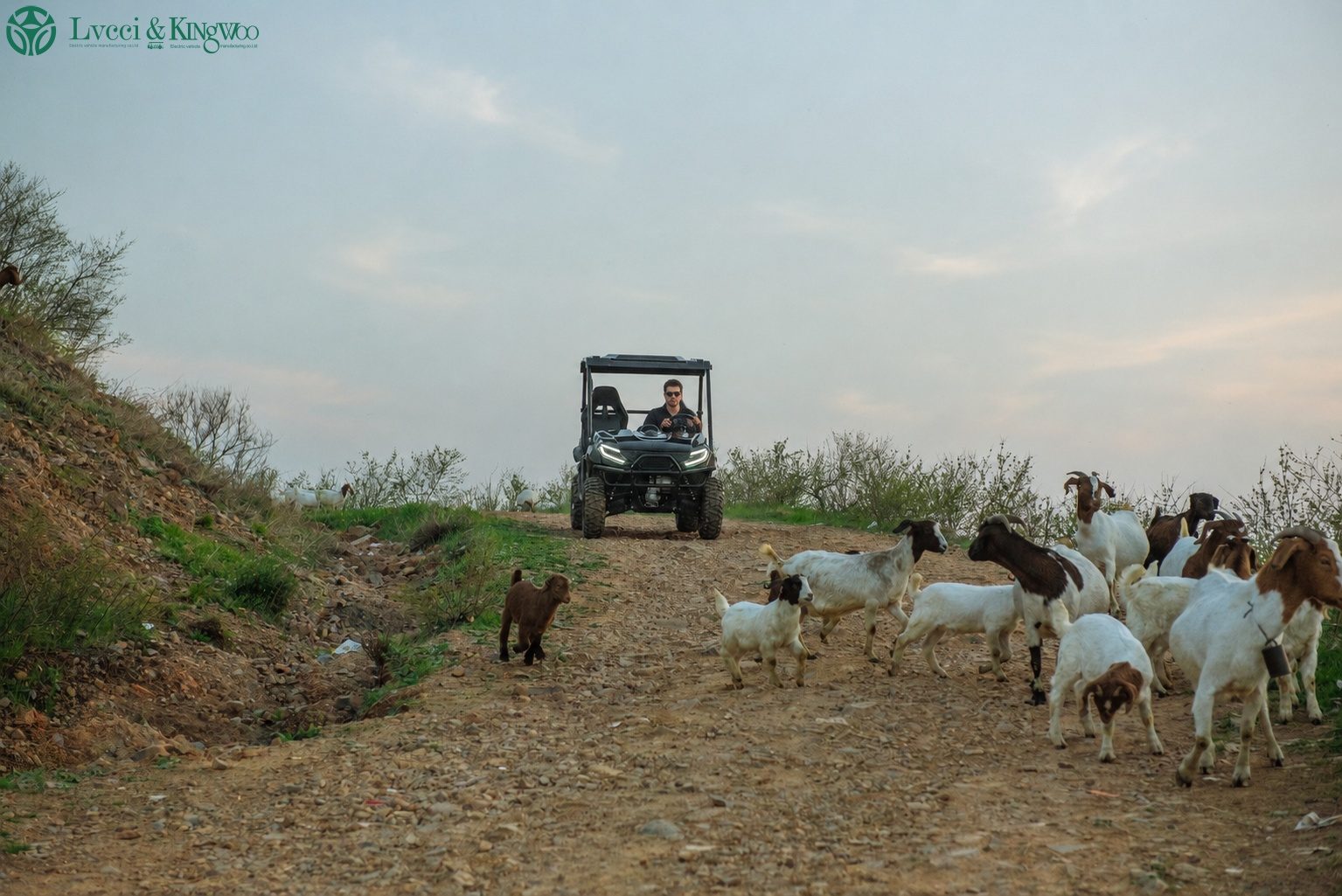
Q1: Are electric UTVs suitable for daily operation of farms and ranches?
Very suitable. With the characteristics of quietness, low consumption and high torque, electric UTVs are perfectly suited for high-frequency daily work such as livestock inspection, feed transportation, site maintenance and crop care, and they are the mainstream operating equipment for modern agriculture and ranching.
Q2: How long is the battery life of electric UTV?
The mainstream lithium version can be cycled for more than 10 years for normal use. With reasonable daily charging and avoiding over-discharge, the battery degradation is extremely low, which fully matches the long-term operation demand of the land.
Q3:Does electric UTV really save money compared with fuel vehicles?
Yes. Even if the initial purchase price is higher, the difference can be recovered in about 5 years, and the ten-year usage cycle can save more than ten thousand dollars in energy consumption and maintenance costs, with significant long-term economic benefits.
Q4: Can electric UTVs be used in snowy and cold environments?
Yes. The new model is equipped with battery preheating function, which can effectively improve the problem of low-temperature range degradation, and with four-wheel drive and snow accessories, it can stably complete winter snow removal and inspection operations.
Q5: What size electric UTV is needed for land over 100 acres?
Priority is given to the version with a range of 50 miles or more, 4WD configuration, and a load capacity of 800 pounds or more for plots of land over 100 acres, which can fully cover all scenarios of daily inspections, operation and maintenance, and material transfer.


-150x150.png)