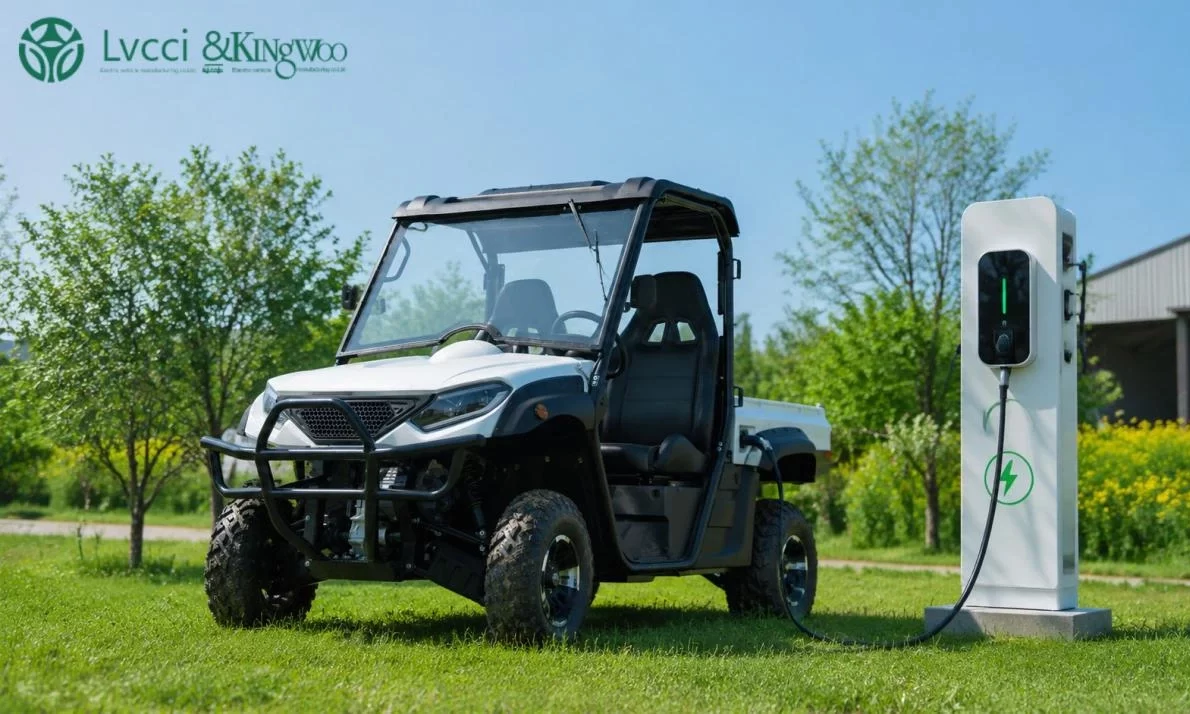
Electric UTV (multi-function off-road mission vehicle) is widely used in farm operations, outdoor off-road, field commuting and other scenes due to its advantages of quiet operation, low maintenance cost and zero exhaust emission. Compared with the fuel version of UTV, the electric model has a more comfortable experience and simpler operation and maintenance, and has become the first choice for more and more outdoor work and leisure enthusiasts.
However, in actual use, the Electric of UTV charging problems (electric UTV charging failure) is the most common core problem encountered by users. Faults such as unresponsive charging, too slow charging speed, intermittent charging disconnection, overheated charging, and battery failure will directly delay the operation progress, interrupt the outdoor travel plan, and greatly reduce the car use experience.
When many users encounter abnormal charging, they are often unable to accurately determine the cause of the failure and can only blindly replace the charger or shelve the vehicle. In fact, the vast majority of electric UTV charging problems are not hardware scrap, but repairable problems caused by environment, operation, line or system protection.
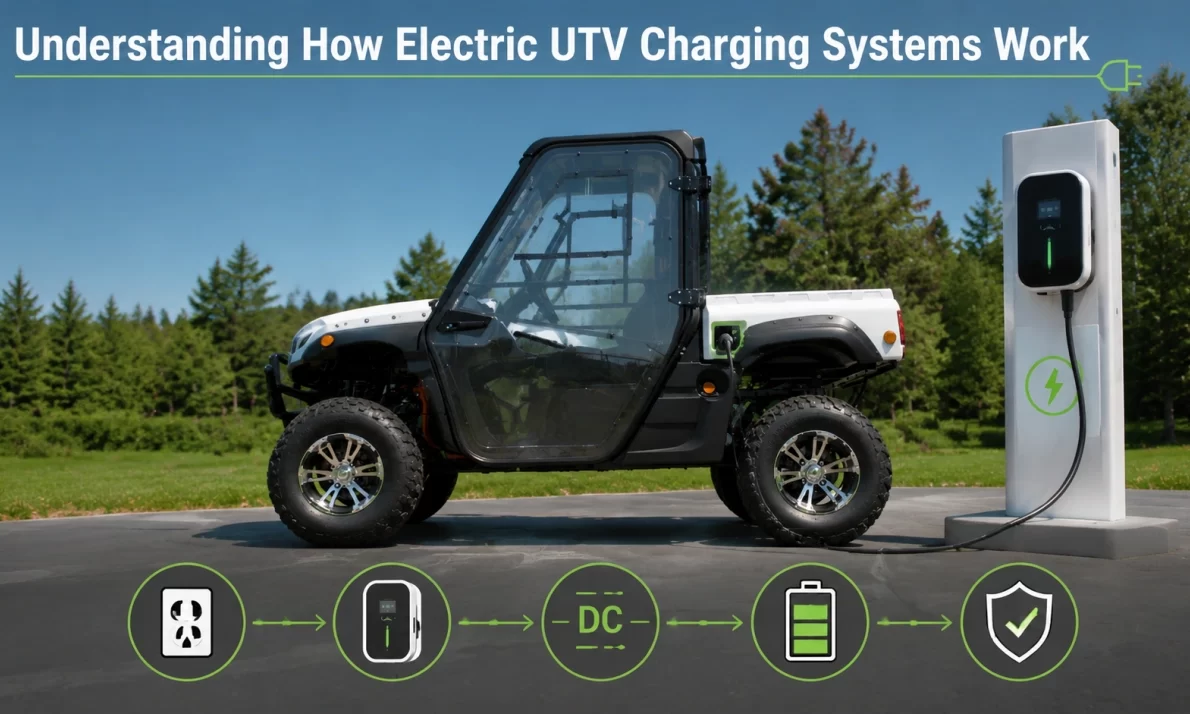
To completely solve the charging failure of electric UTV, we first need to understand the operation logic of its exclusive charging system. The electric UTV charging system is similar in principle to the EV of a domestic passenger car, but it has made durability adaptation for complex scenes of off-road and outdoor operations, and is more suitable for special use environments with dust, bumps and great temperature differences.
The entire charging system consists of 5 major core components working together, and any abnormality of any component will cause charging failure. The specific composition is as follows:
High-voltage battery pack: The current new electric UTV (such as the Polaris Ranger XP Kinetic) are equipped with lithium-ion battery packs. The common capacity is divided into 14.7kWh basic version and 29.8kWh high-end version. It is the core energy storage device of vehicle power and replaces the old lead-acid battery. The battery life and stability are greatly improved.
On-board charger (OBC): The core conversion component is responsible for converting the alternating current (AC) output from the wall socket and charging pile into direct current (DC) that the battery can store. The power of the on-board charger is divided into 3kW, 6kW and other specifications. The higher the power, the faster the charging speed when matched with the adaptive power supply.
Battery Management System (BMS): The “intelligent brain” of the battery pack, which monitors the battery voltage, current, temperature, remaining power (SOC) and cell balance status in real time throughout the process. It can not only optimize the charging efficiency, but also start overcharge, overdischarge, overheating, and overcurrent protection. It can also start the battery heating function in a low temperature environment. It is the core protection system to avoid battery damage.
Power supply equipment (EVSE): our commonly used charging cable and portable charging pile, using J1772 universal interface. It is mainly responsible for signal docking, grounding protection and power transmission between vehicles and power supply. It comes with leakage and overload safety protection. Most electric UTV are equipped with primary and secondary portable charging equipment.
The charging interface is mostly arranged in the driver’s side compartment of the vehicle and is equipped with a special dustproof and waterproof cover plate. It is specially designed for off-road scenes and can resist the invasion of daily dust and water stains. However, long-term use in harsh environments will still cause fouling and corrosion problems, which are high-frequency failure points.
99% of the electric UTV on the market only supports AC charging (primary/secondary charging). It relies on the on-board charger to complete AC/DC conversion, and is suitable for household sockets and conventional charging piles. It is safer and more suitable for outdoor daily use.
DC fast charging (three-stage charging) is basically not suitable for electric UTV. This kind of fast charging voltage is as high as 400-1000V and power is above 50kW, far exceeding the adaptation range of UTV vehicle system. Blind use of DC fast charging, will directly burn the car charger, breakdown battery management system, resulting in irreversible hardware damage.
The speed, cost and usage scenarios of different charging modes vary greatly. Users can choose according to their own needs. Take Polaris Ranger XP Kinetic models as an example:
Level 1 charging (120V AC, 1-2kW): It is suitable for ordinary household sockets, and the charging speed is the slowest. It takes more than 10-20 hours to fill the whole vehicle. It is only suitable for long-term parking and low-speed power supply, and can supplement 2-5 miles of endurance per hour.
Secondary charging (240V AC, 3-19kW): special charging pile/industrial socket power supply, is the best charging method for electric UTV. The standard 6kW on-board charger can be fully charged in about 5 hours, and can supplement more than 10-30 miles of endurance per hour, which is suitable for daily high-frequency use and fast power replenishment scenes.
DC fast charge: no adaptability, the vast majority of electric UTV does not support, prohibit the use, to avoid hardware failure.
Regular charging is divided into 5 major steps, and the abnormality of each step will lead to charging failure. The complete process is as follows:
The first is to connect and energize, connect the charging cable to a leak-proof socket with qualified grounding, and then insert the interface into the charging port of the vehicle. The connection is successful when you hear the sound of the buckle locking, and the vehicle will automatically wake up and light up the charging indicator.
The second is safety self-check. EVSE equipment completes signal handshake with vehicle BMS and on-board charger. The system detects line grounding, battery temperature, voltage and fault code, and starts charging only after confirming that there is no abnormality.
Then there is power conversion and transmission. AC power is transmitted to the on-board charger and converted into stable DC power. The battery is charged in a constant current and constant voltage dual mode. BMS balances the cell voltage in the whole process and automatically limits current and suspends charging at abnormal temperature.
During the charging process, the dashboard or exclusive APP will display the remaining power, charging duration and estimated full time in real time, and the charging pile indicator will also synchronously feed back the charging status, which is convenient for users to monitor in real time.
Finally, the charging is completed. When the battery is close to full charge, the system automatically reduces the charging current to protect the battery core. After full charge, it will automatically power off and stop power supply. Some models will enter the standby maintenance mode to keep the battery active.
Combined with user feedback Polaris mainstream models such as Ranger EV and XP Kinetic, electric UTV charging problems are mainly divided into six categories, each with obvious identifiable symptoms, and users can quickly check and diagnose themselves.
This is the most common electric UTV charging problem. After the vehicle is connected to the charger, there is no response, the charging pile indicator light is not on, the instrument panel has no charging identification, and the charging process cannot be started at all.
This fault mostly occurs after off-road driving and long-term idle storage of the vehicle. The high probability is caused by poor line contact, port damage or deep battery power loss protection, not direct scrapping of the battery.
The vehicle can be charged normally, but it exceeds the official standard when fully charged. The battery that can be fully charged in 5 hours actually takes 8-10 hours or even longer, which seriously affects the efficiency of the car.
This kind of fault is especially high in extreme weather in winter and summer. At the same time, low voltage power supply, battery aging and vehicle load not turned off will continue to slow down the charging speed, which is a high frequency prone problem.
Frequent automatic disconnection and restart during charging, and the charging state is extremely unstable. Touch the charging interface will have a sense of looseness, and some scenes will have slight ignition and arc phenomena.
It is mainly due to the loosening of the interface and the fouling and corrosion of the port caused by off-road turbulence. It is an exclusive high-frequency fault in outdoor use scenarios, and the charging port will be burned if it is not handled for a long time.
After charging for a period of time, the temperature of the charger, charging port or battery pack rises sharply, and the temperature is obvious. Subsequently, the vehicle BMS starts the overheat protection, automatically stops the charging, and cannot continue the power supply.
This problem not only affects charging, but also has potential safety hazards. Long-term overheating charging will accelerate battery aging, and in severe cases, it will cause circuit failures.
The vehicle shows that the power is full, but the power drops rapidly after starting driving, and the power will be lost inexplicably when it is no-load static. Under heavy load driving and complex off-road conditions, the power-off speed will be further accelerated, and the endurance will be far lower than the new car standard.
Most of them are caused by cell imbalance, battery aging and parasitic power consumption of on-board electrical appliances, which are the core manifestations of battery performance attenuation and require timely maintenance and repair.
When charging, a fault warning light and an error code will pop up on the instrument panel, and the vehicle BMS will trigger the over-discharge, over-voltage, and over-current protection mechanism to directly lock the charging function, resulting in failure of normal charging.
Most of these faults are system self-check protection, some of which can be solved by restarting and resetting, while others need to check the line and upgrade the system firmware to be completely repaired.
The charging problem of electric UTV is not caused by a single reason, but the result of the four dimensions of hardware, environment, operation and system. Different from ordinary household electric vehicles, the special working conditions of off-road scenes are the core causes of high failure.
Most users of the charging failure, the root cause is that the charging peripherals are not up to standard or damaged. For convenience, many people randomly replace third-party low-cost chargers and lengthen extension cords to bury hidden troubles.
The voltage and current parameters of the non-original inferior charger do not match, and the output power is unstable, which will directly lead to slow charging, failure to charge, and triggering the system to report an error. Long-term use can also damage the BMS system and battery cells.
After off-road use, the charging cable is prone to skin wear and internal copper wire breakage. The charging port will accumulate dirt, dust and water stains, resulting in interface corrosion, poor pin contact, charging failure, overheating and other problems.
In addition, the use of plug-in and ultra-long extension cord charging will cause line voltage loss and unstable power supply, which is also a common artificial cause of abnormal charging.
Lithium-ion batteries have a natural aging cycle. After long-term use, the internal resistance of the battery increases, the capacity decreases, the charging efficiency will continue to decline, and the problems of slow charging and non-storage of electricity will occur.
If the vehicle is idle for a long time without charging, the battery will enter a deep power loss state, triggering the BMS low-voltage protection lock, which directly leads to the inability to start charging, which is the most common failure cause of idle vehicles.
At the same time, the long-term operation of BMS system may lead to battery cell equalization failure, sensor failure, firmware vulnerability and other problems, which cannot accurately control the charging state, and will lead to battery cell imbalance, charging error reporting, protective shutdown and other faults.
Electric UTV focuses on complex scenes such as off-road, farmland, and construction sites. It is exposed to high temperature, cold, dusty, and muddy environments all year round, which greatly consumes the charging system.
In high temperature weather, the heat dissipation of the battery is blocked and the temperature exceeds the standard, BMS will automatically limit the current and suspend charging. In severe cold winter, the activity of the battery electrolyte decreases, the ion transmission slows down, the charging speed will drop significantly, and even the battery cannot be charged.
After cross-country wading and muddy driving, water stains and sediment will invade the charging port and the inside of the battery compartment, corrode the lines and sensors, and cause various charging failures such as short circuits, poor contact, and system errors.
The power supply voltage of outdoor construction sites and farms is generally unstable, and there are problems such as voltage fluctuation, insufficient power, and poor grounding, which cannot meet the charging standards of electric UTV, which directly leads to abnormal charging.
Bad car charging habits are the key to accelerating failure. Frequent exhaustion and recharging of the battery, long-term exposure to the sun, and overcharging will damage the battery cell and reduce the charging stability and battery life.
Some users modify the vehicle circuit, install high-power lights, and modify equipment without permission, which will destroy the balance of the original vehicle circuit, increase the vehicle load, interfere with the normal operation of the charging system, and cause charging failure.
Vehicle charging system fuse burned, controller parameters disorder, will directly cut off the charging circuit, resulting in completely unable to charge. This kind of fault is mostly caused by voltage surge, line short circuit and overload use.
If the vehicle on-board system is not upgraded for a long time, there will be software vulnerabilities, resulting in failure of signal communication between EVSE equipment and vehicle BMS, and soft faults without hardware damage such as abnormal charging start and stop, error reporting and shutdown.
This article sorts out the DIY troubleshooting and repair scheme that can be operated on a zero basis. Ordinary users can complete most basic fault repair without professional tools. High-voltage circuit faults are recommended to be handled by professional technicians to avoid safety risks.
In case of abnormal charging, three basic inspections shall be completed first, and 80% of minor faults can be directly solved. First of all, check the power supply, replace the special socket with normal grounding, prohibit the use of row plug, inferior extension cord, to ensure voltage stability.
Secondly, clean and check the charging port, clean the soil, dust and water stains in the port with dry cloth or special electronic cleaner, check whether the pins are bent or corroded, and ensure that the interface connection is tight and not loose.
Finally, restart the vehicle system, unplug the charging cable and power supply, and let it stand for 5-10 minutes. After resetting the vehicle power supply system, reconnect the charging system to solve the problems of temporary system jam and abnormal signal.
For the fault of no charging at all and repeated start and stop of charging, first check the charging cable and charger comprehensively. If the outer skin is damaged, the pins are deformed and the indicator light is abnormal, replace the original matching charging equipment immediately.
Refer to the vehicle manual and check the special fuse for the charging system. If it is burnt or blown, replace the fuse of the same specification to restore the charging function.
In view of the deep power loss and locking of the battery caused by long-term idle, use a low-power charger to make trickle charge, slowly activate the battery cell, unlock the BMS protection mode, and resume normal charging.
Avoid charging in extreme temperature environments, choose a cool and ventilated place in summer, preheat the vehicle in advance in winter, and start charging after the battery temperature returns to the optimal range of 50-104 °F.
Give priority to the use of the original matching high-power charger, eliminate the third-party equipment with mismatched parameters, and avoid the problems of slow charging and incomplete charging caused by insufficient power.
Before charging, turn off all auxiliary electrical appliances of the vehicle, including lights, modified lights, on-board fans, etc., to reduce the on-board power consumption load, so that all power is used for battery replenishment, and charging efficiency is improved.
If the charger and battery are found to be abnormally hot during charging, immediately disconnect the power supply and stop charging. Park the vehicle in a ventilated and cool place, and then continue to use it after natural cooling. Forced charging under high temperature is prohibited.
When charging, keep the cabin of the vehicle ventilated, do not block the heat dissipation area of the battery and charger, the closed exposure environment will continue to accumulate heat, triggering overheating protection.
If overheating protection occurs frequently, the BMS cell equalization function can be activated manually, or the system parameters can be calibrated through professional equipment to solve the local overheating problem caused by cell imbalance.
In view of the problems of battery cell damage and serious capacity attenuation, professional equipment is needed to detect the state of the battery cell, replace the faulty battery cell or battery module, and restore the overall performance of the battery.
When BMS system frequently reports errors and equalization fails, professionals need to upgrade firmware, calibrate system parameters, and repair software vulnerabilities and sensor failures.
For hardware problems such as circuit short circuit, controller failure and circuit aging, professional technicians are required to detect the circuit, troubleshoot the fault points, complete maintenance and replacement, and users are prohibited from disassembling the high-voltage circuit by themselves.
How to Prevent Electric UTV Charging Problems
The vast majority of electric UTV charging problems can be circumvented through routine maintenance. Develop standardized car charging habits and do a good job in equipment maintenance, which can greatly reduce the probability of failure and extend the service life of the battery and charging system.
Lithium batteries have no memory effect and do not need deep discharge to recharge. It is best to keep 20%-80% of the power in daily use, avoid power depletion or long-term full power storage, and reduce battery core loss.
During high-frequency use, charge as you use it, and regularly replenish electricity when it is idle for a long time to keep the battery active and avoid the problems of power loss locking and capacity attenuation caused by low-voltage static.
Use the original factory or brand certified adapter charger and charging cable in the whole process, and do not replace low-cost third-party equipment at will, so as to avoid power mismatch and compatibility failure from the source.
After each cross-country, muddy and wading drive, clean up the sediment and water stains in the charging port and battery compartment in time, dry them and then store them, and close the protective cover of the port in the whole process to prevent the invasion of impurities.
Priority should be given to dry, ventilated, and suitable temperature for charging and parking, avoiding exposure to the sun, severe cold, and humid environments, and reducing the loss of the environment to the charging system.
Regularly visually check the status of the charging cable, port, and fuse, check the temperature changes of the battery and charger during charging, and deal with abnormalities in time to avoid minor faults from becoming major problems.
According to official requirements, regularly go to stores to upgrade vehicle systems and BMS firmware, repair system vulnerabilities, optimize charging logic, and improve system stability.
Every 6-12 months to do a professional battery and circuit maintenance, detection of battery cell balance, battery capacity, line status, advance troubleshooting potential faults.
The charging stability of an electric UTV essentially depends on the hardware configuration of the vehicle. High-quality original hardware is specially designed for off-road complex scenes, avoiding all kinds of charging problems from the root, which is also the core reason why the failure rate of regular brand models is far lower than that of modified and miscellaneous models.
The intelligent BMS battery management system is the core guarantee. It has the functions of active cell equalization, overheat protection, overvoltage and overcurrent protection, and low temperature preheating. It can control the charging state in real time and prevent various faults such as cell imbalance, overheating, and power loss.
High-end models are equipped with industrial-grade waterproof and dustproof charging interfaces with excellent sealing performance, which can resist sand, water stains, bumps and vibrations in off-road scenarios, and greatly reduce the failure probability of interface corrosion and poor contact.
The original factory is equipped with a constant temperature charging system, which can adapt to high and low temperature environments, automatically adjust the charging power and battery temperature, avoid slow charging and error reporting problems caused by extreme weather, and ensure stable charging all day long.
The original factory comes standard with a high-durability charger. The parameters are perfectly adapted to the vehicle circuit and battery. There is no compatibility problem. There will be no various charging failures caused by power mismatch and voltage instability, and the long-term use stability is stronger.
Low temperature in winter will greatly reduce the activity of lithium battery electrolyte, the internal resistance of the battery will increase, and the ion transmission speed will slow down. At the same time, in order to protect the battery, the BMS system will automatically reduce the charging power to avoid low-temperature charging damage to the battery core, which is a normal protection mechanism. After the temperature rises, the charging speed will automatically return to normal.
Long-term use is not recommended. The parameters of the miscellaneous third-party charger are inaccurate and there is no suitable protection mechanism, which is prone to the problem of unstable voltage and current, which may lead to slow charging and error reporting, or burn the BMS system and damage the battery cell. The original certified charging equipment is preferred.
After the vehicle is locked with deep power loss due to long-term idleness, a low-power trickle charger can be used to replenish power at low speed and slowly activate the dormant battery core. If self-repair is invalid, you need to go to a professional store to unlock the BMS protection mode through the equipment, and do not force high-power charging.
Slight warmth is a normal physical phenomenon. If the charger is hot, hot, emits burnt smell, or triggers an error report to stop, it is abnormal overheating, and it is necessary to stop using it immediately, and check the cable failure, unstable power supply, equipment aging and other problems.
Under the condition of normal use and maintenance, lithium battery can be used for 5-10 years and cycle more than 1000-3000 times. If the long-term extreme temperature charging, deep power loss, the use of poor quality charger, 1-2 years will appear obvious capacity attenuation, abnormal charging.
On the whole, the core causes of electric UTV charging problems are mainly divided into 4 categories: hardware equipment mismatch, outdoor complex environmental loss, improper daily charging and maintenance, and abnormal vehicle circuit system.
The vast majority of electric UTV charging faults are not hardware scrapped. They can be quickly repaired and solved through basic line checking, port cleaning, standardized charging operation and environmental adaptation adjustment without high maintenance cost.
In the long run, the key to avoiding charging problems lies in prevention. Adhering to the use of original equipment, developing scientific charging habits, and regular vehicle maintenance can reduce the failure rate from the root cause and greatly extend the service life of the battery and the entire vehicle.
High-quality hardware configuration and standardized vehicle maintenance can maximize the attendance time of electric UTV, reduce downtime and maintenance costs, and make cross-country and operational vehicles more stable and efficient.


-150x150.png)