Nowadays, UTVs have become the core equipment for farm operation, ranch maintenance, site construction, outdoor hunting, mountain traversing and yard maintenance. Currently, there are three main types of UTVs on the market: electric UTVs, fuel oil (gasoline) UTVs, and diesel UTVs, which differ greatly in terms of their power characteristics, application scenarios, cost, and maintenance difficulty.
In this article, we will compare the three types of UTVs from the basic definition, core features, advantages and disadvantages, popular models, applicable scenarios, long-term cost, industry trends and other dimensions, to help you accurately match your own needs, and select the most cost-effective model that best fits the usage scenarios.
UTV is known as Utility Task Vehicle, which can also be translated as Utility Terrain Vehicle, and is unified as Multi-functional All Terrain Vehicle (MATV), which is commonly known as “Side-by-Side Beach Vehicle/Side-by-Side Off-Road Vehicle” in the industry. It is a multifunctional vehicle designed for complex unpaved roads, focusing on operational utility and outdoor off-road compatibility.
Different from ordinary off-road vehicles, UTVs do not need to rely on hardened road surfaces, and can be easily adapted to grass, mud, mountains, gravel roads, farmland gullies and other complex terrains, and is a special equipment for outdoor work, short-distance transportation and outdoor recreation.
Currently 2026 UTV market, electric, fuel, diesel three power models have their core advantages, there is no absolute “best model”, only “the most suitable for the scene of the model”. In this section, we will disassemble the three types of UTVs in depth from the five dimensions of power principle, core characteristics, advantages and disadvantages, market models, and suitable people.

Electric UTV is a new type of all-terrain vehicle under the trend of new energy, with the core power structure of power battery + high-power motor, completely abandoning the traditional internal combustion engine structure, relying on charging and energy storage, motor-driven driving, and it is the fastest-growing UTV subcategory at present.
It completely retains the body structure, load capacity, four-wheel drive system and off-road performance of traditional UTVs, and only replaces the powertrain, taking into account the multifunctional utility and the core advantages of green, low-carbon, quiet and energy-saving, and is perfectly adapted to the use of fine-tuned, low-interference, and low operation and maintenance scenarios.
Fuel UTV (gasoline UTV) is a classic mainstream vehicle in the industry, and is also the UTV category with the highest market share and the most mature technology. Relying on the gasoline internal combustion engine, they are equipped with single-cylinder or twin-cylinder gasoline engines with a displacement of 500cc-1000cc+, which perfectly balances the operational performance, leisure attributes, and the cost of purchasing a vehicle.
After decades of technology iteration, the powertrain, chassis structure, and handling logic of fuel UTVs have fully matured, with popularized spare parts and convenient maintenance, making them a versatile vehicle for domestic, agricultural, recreational, and light commercial use, as well as the first choice of most ordinary users.
Diesel UTV is a professional model specially designed for continuous heavy-duty and high-intensity commercial operations. Equipped with a three-cylinder diesel engine, it adopts the principle of compression-ignition power, abandons the logic of high-revolution output, and focuses on low-revolution and high-torque, high durability, and high fuel economy, which makes it a real “industrial-grade work tool vehicle”.
Unlike the all-round attributes of fuel UTVs and the lightweight attributes of electric UTVs, diesel UTVs are positioned in the ultimate vertical position, giving up high-speed cross-country performance, and strengthening the heavy-duty towing and continuous operation ability, which is specially designed for high-intensity commercial scenarios such as farms, ranches, construction sites and so on.
Diesel UTVs are preferred for heavy-duty commercial operations (large farms, construction sites, ranches, etc.), as they are the best solution for heavy-duty commercial scenarios due to their ultra-low torque, high durability, and low fuel consumption, and their ability to cope with heavy-duty dragging and hauling, full-load transporting, and continuous hill climbing over a long period of time, with a low downtime rate and high operational efficiency.
The alternative solution is high-end large-displacement fuel UTV, which can satisfy medium and high intensity operation, but the endurance and stability of long-term continuous heavy-duty are not as good as diesel models. Electric UTVs are only suitable for short-distance light-duty auxiliary operations, and are not able to meet all-day high-intensity heavy-duty needs.
Fuel UTVs are the most cost-effective, with low purchase cost, convenient replenishment, and common scenarios, which can be used for daily maintenance, short-distance transportation, and light cross-country, and perfectly match the mixed-use needs of ordinary families.
If there are stable charging conditions at home, and the pursuit of low noise, low operation and maintenance costs, you can choose electric UTVs. diesel UTVs are overfunctional, high cost, and completely unsuitable for this kind of lightweight scenarios.
Electric UTVs are preferred for quiet operation, zero exhaust emission, no disturbance to wildlife, no damage to the ecological environment, and instantaneous torque that can easily cope with the complex terrain of mountains and forests, making them the exclusive models for hunting and ecological area operations.
Fuel UTVs are relatively controllable in terms of noise and exhaust gas, and can be used as a temporary replacement. Diesel UTV is noisy, strong vibration and obvious exhaust gas, absolutely not suitable for such scenes.
Fuel UTVs are preferred, with excellent high-speed performance, flexible power response, unlimited range, support for long-distance traversing and high-speed cross-country, and playful attributes, making them the first choice for leisure users.
Electric UTVs have limited range and cannot support long-distance traversing; diesel UTVs have too low speed and no sports attributes, and both models are not suitable for pure leisure off-road scenarios.
Electric UTVs are preferred: zero exhaust, no exhaust pollution, low noise, safe for continuous operation in closed spaces, no indoor air pollution, suitable for all kinds of indoor transportation and factory inspection scenarios. Fuel and diesel UTVs are prohibited to be used in confined spaces due to exhaust gas problems.
Fuel or diesel UTVs are preferred; they can carry spare fuel for quick replenishment at any time, with no upper limit of range, and can realize uninterrupted operation throughout the day. Electric UTVs have no charging conditions to replenish energy, and the short range will seriously affect the operational efficiency.
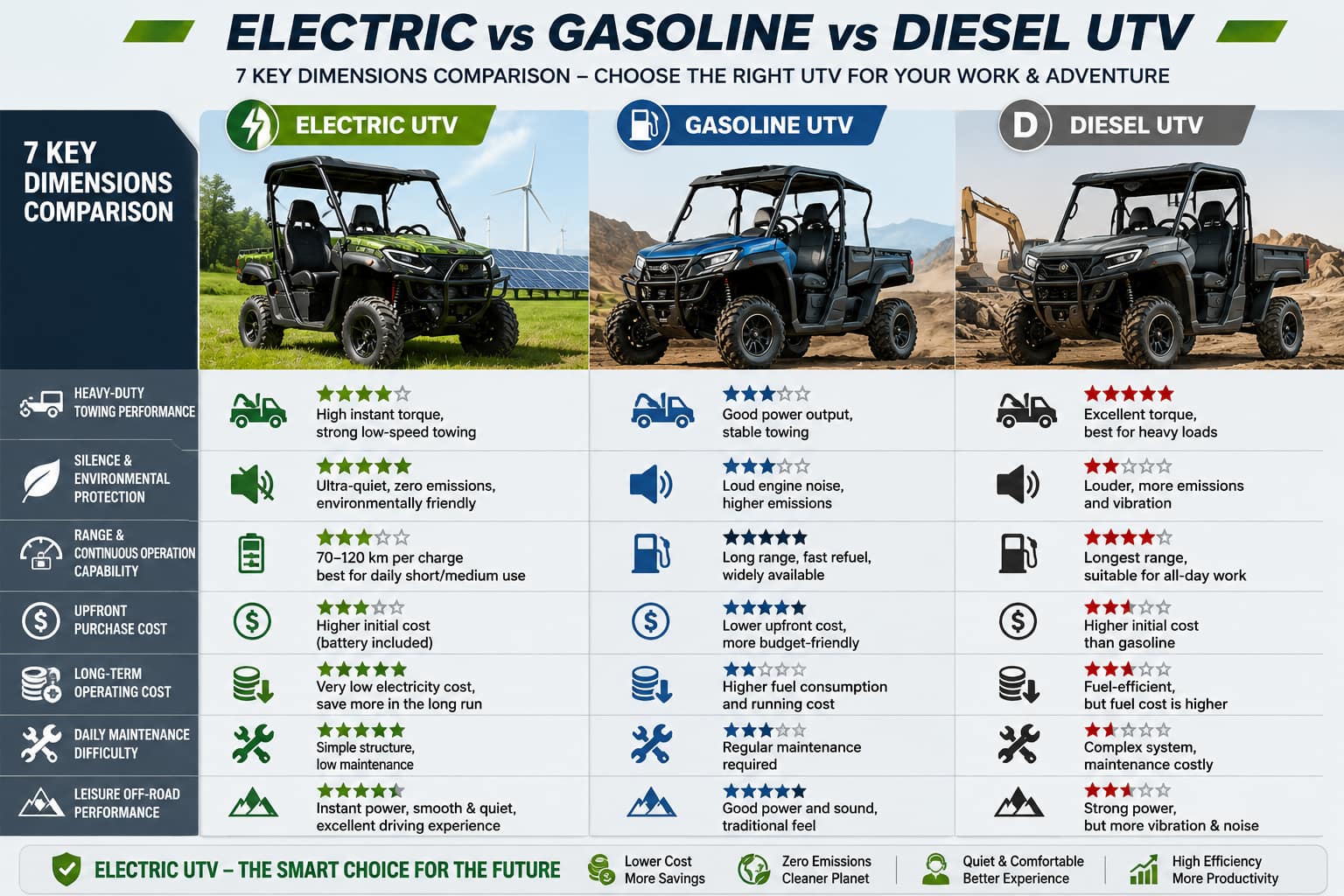
In order to let you more intuitively and clearly distinguish the core differences between electric UTVs, fuel UTVs and diesel UTVs, we discard the table form below, and compare the seven core dimensions text-by-text, so that you can quickly capture the key differences and accurately select the type.
Electric UTVs have excellent instantaneous torque, good starting towing and climbing performance, and can meet daily light to medium heavy-duty needs. However, its shortcoming lies in the lack of sustained heavy-duty capability, which makes it easy to experience performance degradation in long-time full-load operation and unsuitable for high-intensity continuous towing conditions.
Fuel UTVs have balanced and universal performance, and their towing and loading capacity can be adapted to most of the small and medium-sized operation scenarios, taking into account the needs of daily work and light heavy-duty, with no obvious shortcomings, but with limited endurance under extreme continuous heavy-duty working conditions.
Diesel UTV is the heavy-duty king of the three, with outstanding low-speed and high-torque advantages, and strong endurance for continuous heavy-duty, fully loaded climbing, and prolonged towing, making it the only model that can stably cope with high-intensity commercial heavy-duty operations for a long period of time.
Electric UTVs have the best performance in terms of silence and environmental protection, with zero exhaust emission, extremely low noise, no exhaust odor and no obvious vibration, which can be adapted to various demanding scenarios such as silence, ecology and confined space.
Fuel UTV performance is medium, the operation process will produce a certain amount of noise and exhaust emissions, daily outdoor general-purpose scenarios are fully applicable, but can not meet the needs of the special scenarios of the ultimate quiet, zero-emission.
Diesel UTVs perform poorly, with obvious engine vibration, loud operating noise, prominent exhaust odor, far less environmental protection and quietness than electric and fuel models, and completely unsuitable for noise-sensitive, ecological protection scenarios.
The range of electric UTVs has an obvious upper limit, with mainstream models having a full battery range of 30-80 miles, which is further reduced by the influence of load and terrain, and is only suitable for short-distance and intermittent operations, and can’t support all-day uninterrupted work.
Fuel UTVs have the best continuous operation capability, relying on the readily available gas stations and matching with spare fuel to realize unlimited range, and replenishment only takes a few minutes, which is perfectly suited for remote areas and all-day continuous operation scenarios.
Diesel UTVs have excellent range performance, with fuel consumption 20%-35% lower than that of fuel UTVs, longer single-tank fuel range, and less frequent replenishment between operations, making them ideal for long, uninterrupted commercial operations.
The pre-purchase cost of electric UTV is on the high side, and the price of the same-class models is higher than that of fuel and diesel versions, and the premium of high-end high-performance models is even more obvious, so the pre-investment threshold is the highest.
Fuel UTVs have the lowest pre-purchase cost, wide model coverage, many entry-level versions, high cost performance, and are the first choice for users with limited budgets, and the entry threshold is friendly.
Diesel UTV purchase cost is moderately high, the pricing is generally higher than fuel models, mainly commercial professional configuration, only suitable for commercial heavy-duty users, home purchase cost-effective low.
Electric UTVs have the lowest long-term cost, almost no fuel consumption, very few maintenance items, very low average annual operation and maintenance expenses, long-term holding more than 5 years can save a lot of money, the best overall economy.
Fuel UTVs have medium long-term cost, cheap to buy, but fuel consumption and routine maintenance expenses accumulate over the years, and long-term ownership will generate continuous and stable operating costs.
Diesel UTVs have a medium long-term cost, with the core advantage of low fuel consumption and good fuel economy, but the single professional maintenance cost is high, and the overall cost is between electric and fuel UTVs.
Electric UTVs are the least difficult to maintain, without the complex structure of internal combustion engines, oil, spark plugs, oil circuit and other wear parts are all eliminated, and you only need to check the status of the tires, brakes, and batteries, so it is easy to maintain with no basic knowledge.
Fuel UTVs have medium difficulty in maintenance, and need to complete the replacement of oil, filter, belt, spark plugs and other accessories in accordance with the cycle, with high maintenance frequency, but the process is mature, the accessories are popularized, and the maintenance is convenient.
Diesel UTVs are less difficult to maintain, with durable engine structure, low failure rate, long maintenance cycle, no need for frequent overhaul, and although the single maintenance process is complicated, the overall operation and maintenance workload is extremely small.
Electric UTVs have good off-road performance, smooth power output, linear acceleration, strong low-speed extrication ability, and high ride comfort, but the speed is limited, making it unsuitable for high-speed off-road and long-distance traveling.
Fuel UTV has the best leisure off-road performance, strong high-revolution power, high speed limit, supporting high-speed cross-country, mountain traversing, long-distance play, playability and versatility, and it is the only model that takes both work and play into account.
Diesel UTV has poorer leisure performance, the whole vehicle is tuned for heavy-duty operation, with low top speed and no sports attributes, totally unsuitable for high-speed off-road, leisure traversing and other recreational scenarios.
When choosing a UTV, you should not only look at the purchase price, but also focus on the long-term total cost of ownership (TCO) over 5-10 years. The up-front investment and later expenses vary greatly between powertrains, and the cost/performance ratio over the long term can be completely reversed.
In a side-by-side comparison of models in the same class, fuel UTVs have the lowest entry price, with mainstream models priced at $15,000-$25,000, making the threshold approachable and suitable for all types of budget users. Diesel UTVs are priced in the middle, at $18,000-$28,000, focusing on commercial quality.
Electric UTVs have the highest upfront investment, with high-end models priced at $25,000-$37,000, but the high purchase price will be offset by O&M and energy savings in the long term.
Electric UTVs have an energy advantage over conventional vehicles. The average annual electricity cost for home charging is only $100-600, and the total energy expense over 10 years is only $1,000-3,500, which is almost negligible.
Fuel UTVs have the highest energy costs, consuming gasoline year-round, with average annual fuel expenses far exceeding the cost of electricity, and total 10-year fuel costs can reach tens of thousands of dollars, several times that of electric models.
Diesel UTV fuel consumption is 20%-35% lower than fuel models, and energy costs are better than fuel, but still much higher than electric UTVs, and only suitable for heavy-duty scenarios to balance costs.
Electric UTVs have the lowest maintenance cost, no oil, spark plugs, fuel line maintenance, only need to check tires, brakes, batteries, average annual maintenance cost of $100-600, 10-year total maintenance cost of only $4,000-5,000.
Fuel UTVs have the highest maintenance frequency and need regular replacement of oil, filter, belts, spark plugs and other accessories, with a total maintenance cost of $8,000-9,000 over 10 years, which puts a lot of pressure on long-term expenditures.
Diesel UTVs have a low maintenance frequency, but the single maintenance cost is on the high side, and the overall maintenance cost is between electric and fuel models, which is more cost-effective in commercial scenarios.
Although electric UTVs are expensive upfront, with ultra-low energy consumption and maintenance costs, the price difference can be recovered in 3-5 years of normal use, and the total cost of holding the vehicle for more than 5 years is much lower than that of fuel and diesel models.
Fuel UTVs are suitable for short-term ownership (less than 3 years), saving money in the early stage and consuming money in the later stage; diesel UTVs are suitable for long-term commercial and heavy-duty operations, with the best overall cost performance.
In recent years, the wave of new energy has swept the all-terrain vehicle industry, and electric UTVs have become the fastest-growing segment. Industry data shows that the compound annual growth rate of the electric UTV market in 2025-2035 will be as high as 13%-22%, which is much higher than the 7%-8% growth rate of traditional UTVs.
However, from the actual scene and technical bottlenecks, electric UTVs will not completely replace fuel and diesel UTVs, and the industry will maintain the pattern of coexistence of three types of models for a long time in the future.
The short boards of electric UTVs are still obvious, with the upper limit of range, charging dependence, and lack of heavy-duty continuity, which can’t be adapted to the remote and non-supply, all-day high-intensity heavy-duty operation scenarios. The all-round versatility of fuel UTVs and the commercial heavy-duty advantages of diesel UTVs cannot be replaced in the short term.
In the future, the industry pattern will be clearly differentiated: electric UTVs will dominate the lightweight, quiet, environmental protection, and short-distance scenes; fuel UTVs will dominate the general-purpose, leisure, and mixed-use scenes; and diesel UTVs will monopolize the high-strength commercial heavy-duty scenes, with each of the three types of vehicles playing its own role in the long-term coexistence.
The core principle of choosing UTVs is: don’t blindly pursue the high quality, don’t follow the wind and choose the popular ones, and the model that fits your own usage scenario, budget and operation environment is the best model.
Prioritize diesel UTVs for heavy-duty operations, construction sites, and large farms; prioritize fuel UTVs for family maintenance, recreational off-roading, and mixed use in multiple scenarios; and prioritize electric UTVs for quiet hunting, indoor operations, and short-distance high-frequency maintenance.
Select power specifications according to load and towing needs, choose small and medium displacement/conventional electric models for daily light load, and choose large displacement fuel or professional diesel models for long-term heavy load. At the same time, choose ground clearance and 4WD system according to the terrain, and prioritize the 4WD high end version for mountainous and muddy terrain.
Choose 2-seat version for single person operation and short-distance shuttle, with compact body and stronger passability; choose 4-6-seat crew version for multi-person operation, family traveling and team construction, taking into account the needs of carrying people and goods.
For short-term use and limited budget, choose fuel UTVs for the lowest upfront investment; for long-term ownership and high-frequency short-distance operation, choose electric UTVs for long-term savings; for commercial and heavy-duty, long-term operation, choose diesel UTVs for the highest overall efficiency.
If you live in the suburbs, have stable charging conditions and pay attention to quietness and environmental protection, give priority to electric; if there is no charging in remote areas and no fixed supply conditions, give priority to fuel/diesel; if you live in very cold areas in winter, give priority to fuel models; if you live in high-temperature and heavy-duty working conditions, give priority to diesel models.
There are no absolute advantages and disadvantages of electric, fuel and diesel UTVs, only the differences in the adaptability of the scene. Electric UTV focuses on silent and low consumption, lightweight and intelligent operation, which is the first choice for household and refined operation under the trend of new energy; fuel UTV is all-round and balanced, with outstanding cost-effectiveness, which is the universal choice for popular general-purpose scenarios; and diesel UTV specializes in heavy-duty and durability, which is the exclusive tool for commercial high-intensity operation.
When choosing a UTV, you only need to match the model with your own operation scenario, budget, usage environment and holding period, so that you can avoid the premium price, eliminate the waste of functions, and choose the UTV model that best fits your needs and has the highest cost-effectiveness.
It is worthwhile. If the holding cycle is more than 3-5 years, daily high-frequency short-distance use, the energy consumption and maintenance savings of electric UTVs can completely cover the difference in price upfront, and the experience of using them is better and more worry-free. For short-term use and heavy-duty high-frequency operation, it is not recommended to get one.
For large farms, all-day heavy-duty towing and continuous operation, choose diesel UTVs; for small and medium-sized farms, mixed operation and occasional leisure, choose fuel UTVs, which are more cost-effective and more versatile.
Mainstream models have an official range of 30-80 miles, and the nominal range can be achieved on unloaded smooth roads, while the actual range will be slightly reduced for heavy loads, climbing slopes, and muddy terrains, which fully meets the needs of daily short-distance operations.
Yes. The diesel engine has a strong structure, fatigue resistance, heavy load resistance, and can run stably for thousands of hours with normal maintenance. The service life is much longer than that of the fuel engine, which is more suitable for long-term commercial operation.
Very suitable. Quiet operation will not disturb the prey, zero exhaust and no odor, strong ability to get out of trouble in mountainous areas, it is the optimal choice of UTV for hunting scenarios.


-150x150.png)