Many UTV all-terrain vehicle players will encounter these bad problems: the battery loses power and stalls during off-road, the winch pulling force is getting weaker and weaker, it is difficult to start at low temperature in autumn and winter, the battery needs to be replaced frequently in two or three years, and the original car battery is too heavy to affect the control. For players who often cross-country, refit multi-accessories and store vehicles for a long time, the UTV battery selection directly determines the reliability and experience of the vehicle.
At present, the mainstream UTV batteries in the market are divided into three types: traditional water-added lead-acid batteries, maintenance-free AGM batteries, and LiFePO4 lithium iron phosphate batteries. Many owners tangle: Is UTV lithium battery better?
UTV battery is the core of the electrical system of the whole vehicle, which can be called the “power heart” of the vehicle. It cooperates with the stator, rectifier voltage stabilizer and the whole vehicle line to adapt to the harsh working conditions of cross-country turbulence, large temperature difference and dusty mud. The core function is divided into two parts, and it also undertakes the key function of voltage stabilization and protection.
The displacement of UTV engine is generally larger than that of ATV and motorcycle, and it needs instantaneous high current support to start. The battery relies on the CCA cold start current to release high voltage current to drive the starting motor and ignite the engine. Conventional UTV requires 200-400 + CCA current. If the CCA parameters of the battery are insufficient, the problems of starting weakness and ignition difficulty will easily occur after the low temperature weather in autumn and winter and the high load of accessories are used. After the engine is running, the vehicle charging system will take over the work, replenishing the battery and supplying electricity to the entire vehicle.
Modern modified UTV is generally equipped with winches, LED spotlights, audio, heaters, GPS and other accessories. When idling or flameout, the generator power supply is insufficient, and the battery will be used as a stable energy storage compartment to continuously output power to avoid dimming of lights caused by unstable voltage. Problems such as weak winch and electrical stuck. High-quality UTV batteries need to have good deep cycle capability, can be used repeatedly, will not quickly decay damage, different from ordinary car starter batteries.
The battery can balance the fluctuation of generator power supply, stabilize the vehicle voltage, and protect the precision electrical accessories. At the same time, the special UTV battery has been strengthened and designed to resist high-frequency vibration, sediment erosion, high and low temperature extreme environment during off-road, and is suitable for all-terrain high-intensity use scenarios.
The general UTV battery standard in the industry is a 12V power special battery with a capacity of 12-35 + Ah. The mainstream specifications include YTX20, YTX24HL and other models. The original parameters of the vehicle must be matched during selection.
Explore our high-performance electric utility vehicles designed for tough terrains, off-road adventures, and sustainable utility tasks. Direct factory pricing.

At present, UTV universal batteries are divided into three categories: water-added lead-acid, AGM glass fiber and LiFePO4 lithium battery. The three are very different in structure, performance, maintenance cost and adaptation scene, and the suitable player groups are completely different.
This is the most basic traditional battery, the internal lead plate soaked in liquid sulfuric acid electrolyte, mature technology, low price.
Core advantages: the lowest entry cost, offline stores can be purchased everywhere, the basic start-up performance is stable, fully meet the needs of the basic transportation of the car.
Obvious short board: regular inspection and supplement of distilled water are required, and maintenance is complicated; non-sealed structure, easy leakage and corrosion of car body during off-road bumps; poor resistance to vibration and high and low temperature; high self-discharge rate, long-term parking is easy to lose power; service life Only 2-3 years, frequent use decays faster.
Adaptation crowd: light leisure players with limited budget, no modification of plain vehicles, low frequency of use and regular maintenance.
It is a sealed lead-acid battery. The electrolyte is adsorbed in glass fiber cotton and has no free liquid. It is currently the most standard battery type in the UTV factory on the market.
Core advantages: maintenance-free in the whole process, no need to add water to replenish fluid; fully sealed and leak-proof, can be installed at multiple angles; excellent anti-vibration and impact resistance, perfect adaptation to off-road conditions; low self-discharge rate, long-term storage is not easy to lose electricity; deep cycle capacity It is superior to traditional lead acid and can stably support conventional lights and light winches.
Obvious shortcomings: the weight is too large to be lightweight and refitted; the voltage attenuation is obvious during the discharge process, and the power of the electrical appliance is greatly reduced when the power is low; the price is higher than that of traditional lead-acid, and the service life is 3-5 years, and it still needs to be replaced regularly.
Adapt to the crowd: the vast majority of ordinary off-road players, moderate modification of the user, is to take into account the cost and durability of the balanced choice.
A new generation of dedicated power battery, fully sealed structure, built-in BMS battery management system, is the current UTV performance upgrade of the mainstream preferred, designed for high-intensity cross-country, high-frequency use of the scene.
Core advantages: lightweight, long life, stable voltage, fast charging, zero maintenance, comprehensive performance rolling traditional lead-acid and AGM batteries.
Obvious short board: the highest cost of purchase in the early stage, some old models have charging system compatibility problems.
Suitable crowd: senior players with heavy modification, high-frequency cross-country, race competition, long-distance crossing and long-term storage of vehicles.
Under the scenes of UTV high-intensity cross-country, load-bearing operation and long-distance crossing, the performance short board of ordinary lead-acid and AGM batteries will be infinitely enlarged. LiFePO4 lithium iron phosphate battery is not a simple parameter upgrade, but for UTV cross-country vibration, high and low temperature, multi-electrical load, long-term idle and other core pain points targeted optimization.
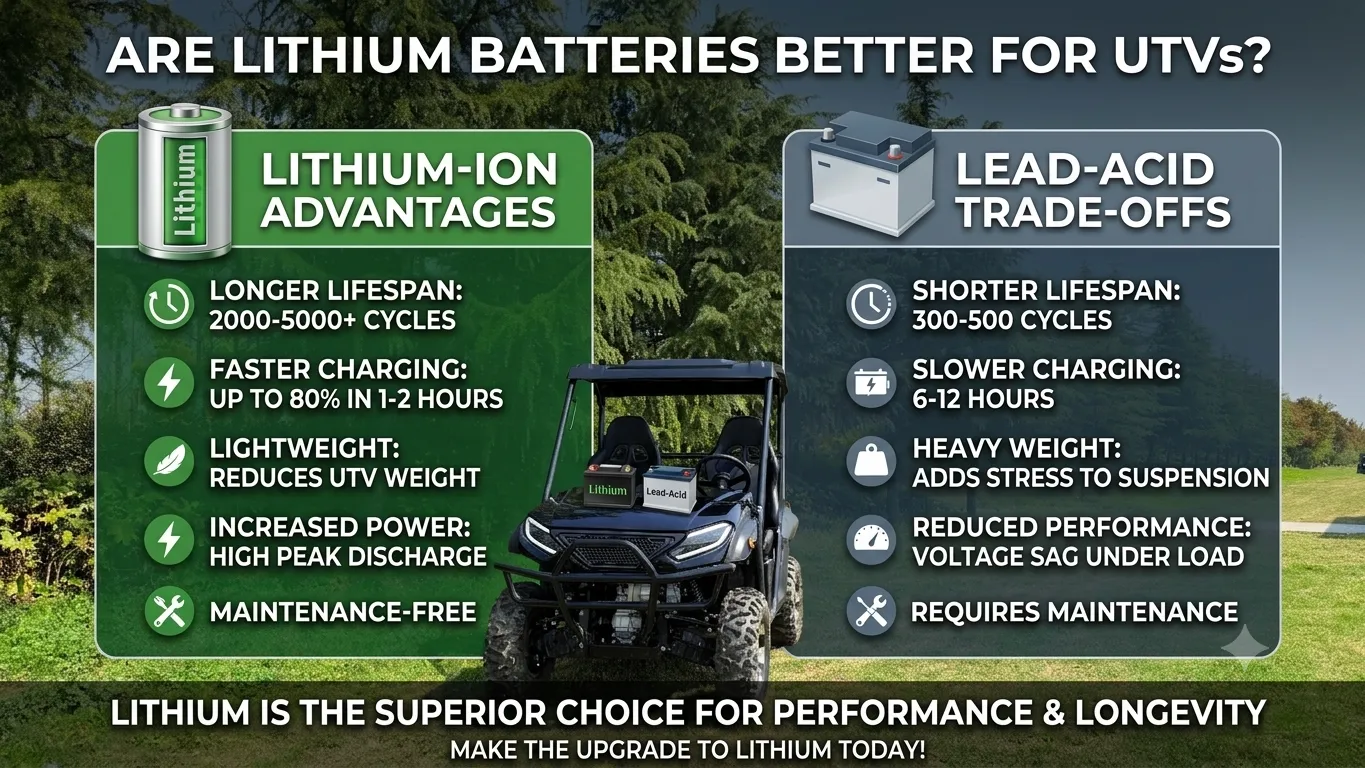
Weight is one of the key factors affecting the off-road performance of UTV. Under the same specification parameters, LiFePO4 lithium battery is 60%-70% lighter than traditional lead-acid battery and AGM battery, and conventional UTV battery can directly reduce the weight by 10-20 pounds. This lightweight effect is of great significance to UTV. UTV is mostly rear-mounted or side-mounted battery layout, which can effectively optimize the weight ratio of the whole vehicle and reduce the deviation of the body’s center of gravity after weight reduction. In daily off-road, the lighter body can greatly improve the starting acceleration response speed and get rid of the heavy and procrastinating driving texture; under complex road conditions such as climbing, cross-axle, and stuck cars, the body load is reduced, the tire grip is more balanced, and the off-road Passability is greatly improved. For competitive vehicles, lightweight is the core means to improve lap speed and control sensitivity. Lithium battery can achieve weight reduction comparable to titanium alloy modified parts at very low cost. At the same time, the lighter body can reduce the load on the chassis, suspension, and tires, indirectly reduce vehicle losses, and extend the service life of vehicle accessories.
Frequent battery replacement is the core pain point of most UTV owners. The cycle life of traditional water-added lead-acid batteries is only 200-400 times. Normal high-frequency use for 1-2 years will cause problems of capacity attenuation and starting weakness, which must be replaced in 2-3 years; mainstream AGM maintenance-free batteries have more stable performance, but The cycle life is only 400-800 times, and the service life is only 3-5 years. The high-quality UTV special LiFePO4 lithium battery has a cycle life of 2000-5000 times, which is 4-6 times that of AGM batteries and more than 10 times that of lead-acid batteries. Under the premise of standardized use and normal maintenance, lithium batteries can serve stably for 5-10 years, basically realizing “one installation, many years free of replacement”. Although the early purchase cost of lithium batteries is higher, the average annual use cost is much lower than that of traditional batteries. At the same time, the time cost of frequent purchase and replacement of batteries is saved, which perfectly adapts to the needs of players with high-frequency off-road and long-term vehicles.
This is the core advantage of lithium battery compared with traditional battery, which is the most suitable for UTV modification. Lead-acid and AGM batteries have obvious voltage attenuation characteristics. With the consumption of electricity, the voltage will continue to drop. This is also the core reason why many car owners encounter “the battery has electricity, but the winch is weak and the lights are dimmed. Especially when using electrical appliances at idle speed and low-speed off-road rescue, the generator power supply is insufficient, and the traditional battery voltage drop problem will be more serious, which not only affects the use of electrical appliances, but also easily damages precision accessories such as audio, GPS, and spotlights. However, LiFePO4 lithium batteries have a flat voltage curve recognized by the industry. In the remaining 20%-100% power range, the voltage always remains stable and there will be no obvious attenuation. Whether it is in a full-power state or a low-power state, it can ensure the full-load traction of the winch, the LED spotlight is highlighted without flicker, the sound quality of the car audio is clear without noise, and the navigation equipment runs stably, thus thoroughly solving the hidden dangers of electricity consumption in cross-country rescue, night riding and outdoor camping.
Many car owners will misunderstand that: “with Ah capacity of the battery, the power is the same”. In fact, traditional batteries have serious capacity waste problems. Water-added lead-acid batteries and AGM batteries are only recommended to use 50%-70% of the rated capacity in order to avoid plate vulcanization and battery scrapping. Once deeply discharged, the battery life will be greatly halved. For heavily modified UTV with modified high-power winches, multiple sets of spotlights, on-board refrigerators, heaters, and subwoofers, the available power is seriously insufficient, and the problems of power overdraft and frequent power loss are prone to occur. However, LiFePO4 lithium batteries have no vulcanization risk and can safely release 98% of the rated capacity. Under the same volume and specification, the actual available power is nearly 1 times higher than that of AGM and lead-acid batteries. Without replacing large-size batteries and modifying the battery compartment, it can easily carry high-intensity and long-term electricity demand, fully meeting the continuous electricity consumption scenarios of off-road camping, field rescue and site operation.
Most UTV has the characteristics of seasonal use and intermittent parking. Idle in autumn and winter and cross-country in spring and summer are the normal use of most players. Long-term parking and power loss of batteries are high-frequency common problems. Traditional lead-acid and AGM batteries have high self-discharge rate. If they are idle for 1-2 months, they will suffer from serious power loss and polar plate vulcanization. If they are not operated for a long time, they will be directly scrapped and need frequent power replenishment and maintenance every year. However, the self-discharge rate of LiFePO4 lithium battery is extremely low, and the monthly self-consumption power is less than 2%. It can be stored stably for 3-6 months under full power state without frequent power replenishment. It is perfectly adapted to seasonal parked UTV and completely solves the problem of idle battery scrapping. At the same time, the charging efficiency of lithium batteries is far higher than that of traditional batteries, and the charging acceptance is higher. The charging speed of vehicles and external chargers is faster. Short-distance off-road vehicles can quickly replenish the power, and there will be no “running for half a day and not being filled with electricity”. There is no need to worry about the power supply problem for high-frequency vehicles and long-distance crossing.
The off-road scene is bumpy, muddy, dusty, and has a great temperature difference, which requires extremely high battery sealing, manufacturing resistance, and safety. UTV special LiFePO4 lithium battery adopts fully sealed integrated molding process, no liquid electrolyte, completely eliminate the risk of leakage and corrosion, can be installed at any angle, and is suitable for various modification layouts. At the same time, the battery shell has a reinforced anti-collision design and a built-in anti-seismic structure, which can resist cross-country high-frequency bumps, sediment erosion and gravel impact. Excellent high temperature resistance and low temperature resistance, no fear of summer exposure and severe cold in winter, no need of water, inspection and maintenance in the whole process, thus truly realizing “maintenance-free, ready-to-use and long-term stable work”.
Outdoor cross-country can not avoid extreme temperature environment, low temperature start difficult, high temperature battery aging is the main short board of traditional battery. The high-quality LiFePO4 lithium battery is matched with a professional BMS battery management system, which has a large temperature working range and can work stably in an environment of -20 ℃ to 60 ℃. Under conventional low temperature and high temperature scenarios, the cold start performance and power supply stability are better than traditional batteries. Some high-end UTV lithium batteries are also equipped with an exclusive emergency start reserve function. Even if the battery power is extremely low, it can retain the emergency ignition power, completely solve the risk of cross-country and no man’s land crossing in the field, and greatly improve the safety and reliability of outdoor vehicles.
Traditional batteries do not have any intelligent protection and monitoring functions, and there is no early warning of battery power loss, aging and failure. It is often found that the battery is damaged only after ignition failure and electrical failure, which is very easy to delay the off-road trip. However, regular UTV lithium batteries are equipped with a full-function intelligent BMS battery management system, which can monitor battery voltage, current, temperature and single cell state in real time, and automatically realize overcharge protection, overdischarge protection, overcurrent protection, short circuit protection and high and low temperature protection, thus avoiding battery damage, line failure and potential safety hazards from the root. At the same time, the high-end model supports Bluetooth interconnection of mobile phones. The mobile phone APP can view the remaining power, working temperature, health status, charge and discharge data in real time without disassembling the mobile phone or testing equipment. It can accurately predict the battery life, avoid failure risks in advance, and make cross-country power consumption more secure and controllable.
Although the comprehensive performance of LiFePO4 lithium battery far exceeds that of traditional batteries, it is a high-quality choice for UTV upgrade, but it is not a universal fit for all players and all models.
Price is the core of lithium battery, the most intuitive short board. Under the same specification, CCA and Ah parameters, the selling price of UTV special LiFePO4 lithium battery is 3-4 times that of ordinary water-added lead-acid battery and about 2 times that of AGM maintenance-free battery, and the one-time upfront investment is higher. For players who use high-frequency vehicles, heavily refitted vehicles and hold vehicles for a long time, the advantages of ultra-long life and zero maintenance can smooth the price difference, and the long-term cost performance is higher. However, for leisure players who use less than 10 cars a year, use plain cars instead of walking, plan to change cars for a short period of time, and have a strictly limited budget, the high upfront investment is totally uneconomical. AGM battery is sufficient to meet the demand for basic car.
The stator and voltage-stabilizing rectifier of the new UTV (factory model in the past 5 years) are all adapted to lithium-ion charging logic, which can be directly replaced and installed without any modification. However, the charging system of the old and low-end UTV is specially designed for lead-acid batteries, and the charging voltage, charging curve, and voltage stabilization logic do not match lithium battery. Old rectifiers are prone to problems such as high charging voltage, continuous floating charge, unstable pulse voltage, etc. In the light of triggering lithium battery BMS protection, causing the battery to be cut off and unable to use, in the heavy case, causing battery core damage, greatly shortening battery life, and even causing safety Risks. For this type of vehicle, it is necessary to install an additional DC-DC charger for lithium battery or replace a voltage regulator rectifier compatible with lithium battery, which will increase the modification cost and construction cost by hundreds of yuan. For old and low-priced vehicles, the upgrade cost performance is extremely low.
In the daily routine low temperature environment, the starting performance of lithium batteries is better than that of lead-acid and AGM batteries, but in extreme extreme cold scene below minus 20 ℃ the cell activity of the ordinary entry-level LiFePO4 lithium battery will decrease slightly, and the cold start CCA current will decrease slightly. Compared with the new lead-acid battery, the starting explosive power is slightly insufficient. However, this problem only exists in the entry-level lithium battery model without low temperature protection. The high-end UTV special lithium battery is equipped with low temperature enhanced battery core and BMS low temperature preheating protection, which can perfectly avoid this problem. Players in extremely cold regions only need to select high-end models, and players in ordinary regions do not need to worry about this problem.
This is the biggest difference between lithium battery and traditional battery, and it is also the mistake that novice players are most likely to step on. When the lead-acid and AGM batteries are insufficient and the voltage is too low, the power will slowly decay, the lights will gradually dim, and the starting will gradually become weak. There is an obvious early warning process. The car owner can detect the problem in advance and replenish the electricity in time. The lithium battery relies on the BMS management system to protect the safety of the battery core. Once abnormal conditions such as over-discharge, over-temperature, short circuit, low voltage, etc. are detected, it will be instantly and directly powered off for protection without any buffer warning, and it is easy to cause the electrical appliance to suddenly stop during driving and fail to start again after flameout. Many novices will mistakenly think that the battery is damaged, but it is actually a normal protection mechanism. At present, high-end lithium batteries are equipped with emergency start reserve power, can manually unlock the emergency fire, effectively solve the pain point.
AGM and lead-acid batteries have extremely high fault tolerance rate. Occasionally, they are deeply deficient in electricity, exposed to high temperature and overcharged, and will not be directly scrapped. They can be restored to use after simple electricity replenishment and maintenance. However, LiFePO4 lithium batteries have higher requirements for use, storage, and charging specifications, and lower fault tolerance. Long-term deep power loss storage, long-term high-temperature exposure, random charging with non-special chargers, and frequent high-current overload discharge will cause irreversible damage to the lithium battery core, resulting in permanent capacity attenuation, shortened service life, and irreparable. At the same time, the professional recycling and offline emergency replacement channels of lithium batteries in remote outdoor areas are not as popular as those of traditional lead-acid batteries. If there is sudden failure in the field, temporary replacement and maintenance are more difficult, which is suitable for maintenance and backup plans in advance.
The advantages of lightweight and miniaturization of lithium batteries are also small short boards for installation and adaptation. The original car battery compartment, fixed bracket, and pressure strip are all designed according to the size of the large-volume and heavy-weight lead-acid/AGM battery. After replacing the smaller-volume and lighter-weight lithium battery, the battery will be loose, suspended, and the gap is too large. problem. Under off-road high-frequency bumpy road conditions, if it is not fixed, the battery will shake and shift in the warehouse, wear the wiring, and cause poor contact. Therefore, lithium battery installation needs to be fine-tuned and fixed with special foam gaskets, fixing brackets, cable ties and other auxiliary accessories. Some special models need to slightly modify the battery compartment fixing structure. Compared with traditional battery direct installation, the installation process is more complicated and requires professional construction.
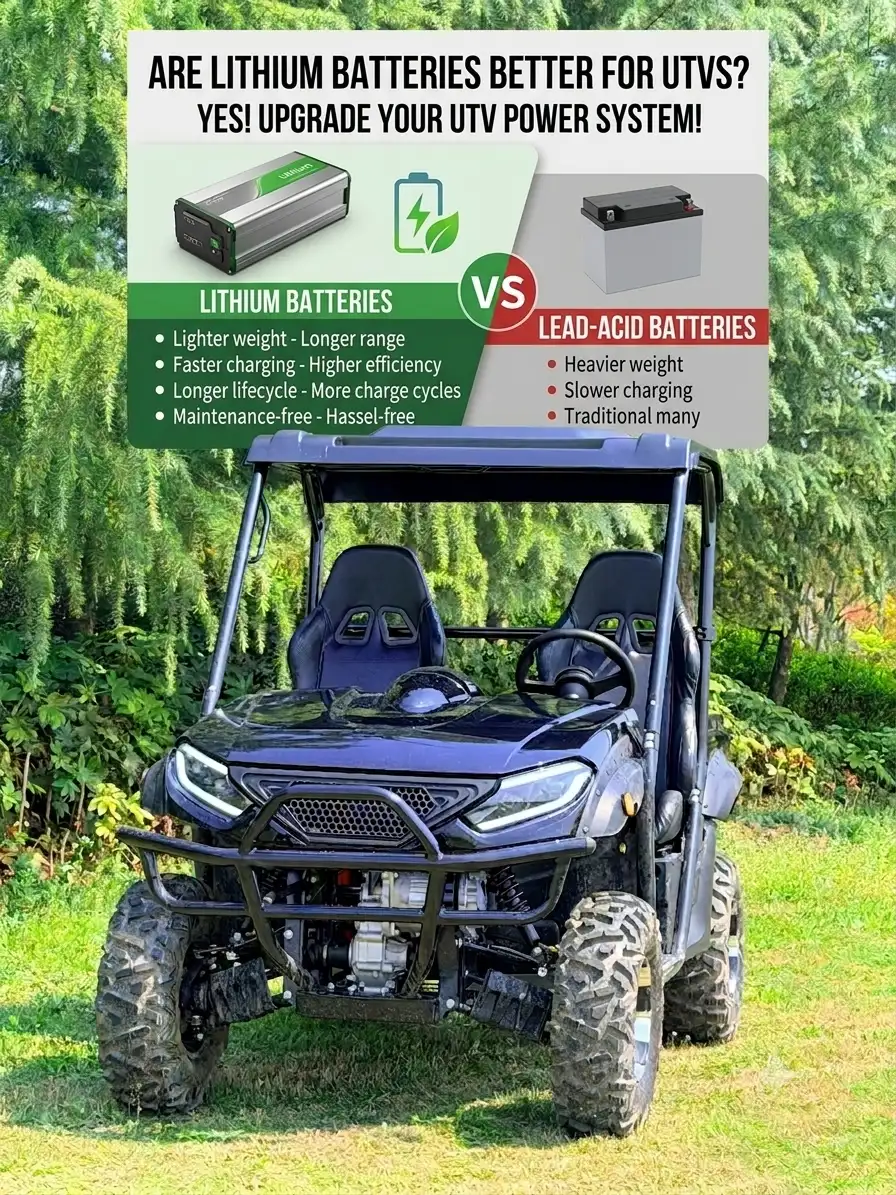
The three mainstream UTV batteries on the market are water-added lead-acid batteries, AGM maintenance-free batteries and LiFePO4 lithium batteries. The three are significantly different in cost, performance, maintenance and adaptation scenarios, which can accurately match the car needs of different players.
Water-added lead-acid batteries have the lowest price and high cost performance. AGM batteries are moderately priced and have the widest audience. Lithium batteries have the highest cost, about 2-4 times that of lead-acid batteries and 2 times that of AGM batteries. In terms of weight, lead-acid batteries are the heaviest and drag down vehicle handling. AGM batteries are heavier, while lithium batteries can reduce weight by 70%, effectively optimizing body weight and improving off-road performance.
Traditional lead-acid batteries need to be supplemented with distilled water regularly, which is complicated to maintain, and the open structure is easy to leak and has poor resistance to manufacturing. AGM battery is maintenance-free in the whole process, sealed and leak-proof, has excellent seismic performance, and is suitable for conventional off-road. Lithium batteries are also zero-maintenance and adopt a fully sealed integrated process, which is dustproof, moisture-proof, earthquake-proof and leak-proof, and can cope with high-proof and complex off cross-road conditions. The service life gap is particularly obvious. Lead-acid batteries can only be used for 2-3 years and have a cycle life of 200-400 times; AGM batteries can be used for 3-5 years and have a cycle life of 400-800 times; lithium batteries can have a service life of 5-10 years, The cycle life is as high as 2000-5000 times, and the long-term loss is extremely low.
Lead-acid batteries have weak deep cycle capability and obvious voltage attenuation. They can only use about 50% of rated capacity, slow charging, high self-discharge rate and easy to lose power when parked for a long time. AGM battery has medium performance, slight voltage attenuation, usable capacity 50%-70%, and satisfactory charging and self-discharging performance. Lithium battery has outstanding advantages, excellent deep cycle performance, stable voltage in the whole process, and usable capacity of 98%, charging speed, low self-discharge, long-term idle without frequent replenishment.
Lead-acid batteries are suitable for players with limited budget and low-frequency transportation. AGM battery is the first choice for ordinary off-road and moderately modified users. Lithium battery is suitable for senior off-road players who are heavily modified, race crossing, high-frequency operation and long-term car storage.
Priority should be given to the vehicle manual to confirm the original battery voltage (universal 12V), minimum CCA cold start current, Ah capacity, and battery size code (YTX20, YTX24HL, etc.). Priority should be given to the direct-mounted lithium battery of the same specification to avoid size and parameter mismatch. At the same time, the length, width and height of the battery compartment are measured, and the installation and fixing space is reserved.
Give priority to the model with full-function BMS protection (overcharge, overdischarge, overtemperature, short circuit protection), emergency start-up and Bluetooth monitoring support. Pay attention to the peak discharge parameters and adapt to the instantaneous high current demand of the winch. Priority should be given to reliable brands with a warranty of 3-5 years, and no low-priced products should be 3.
Players who often have extreme temperature and high intensity off-road need to confirm the high and low temperature working range and anti-vibration level of the battery. Old models must check the compatibility of the charging system in advance, and install a special DC-DC charger for lithium battery if necessary.
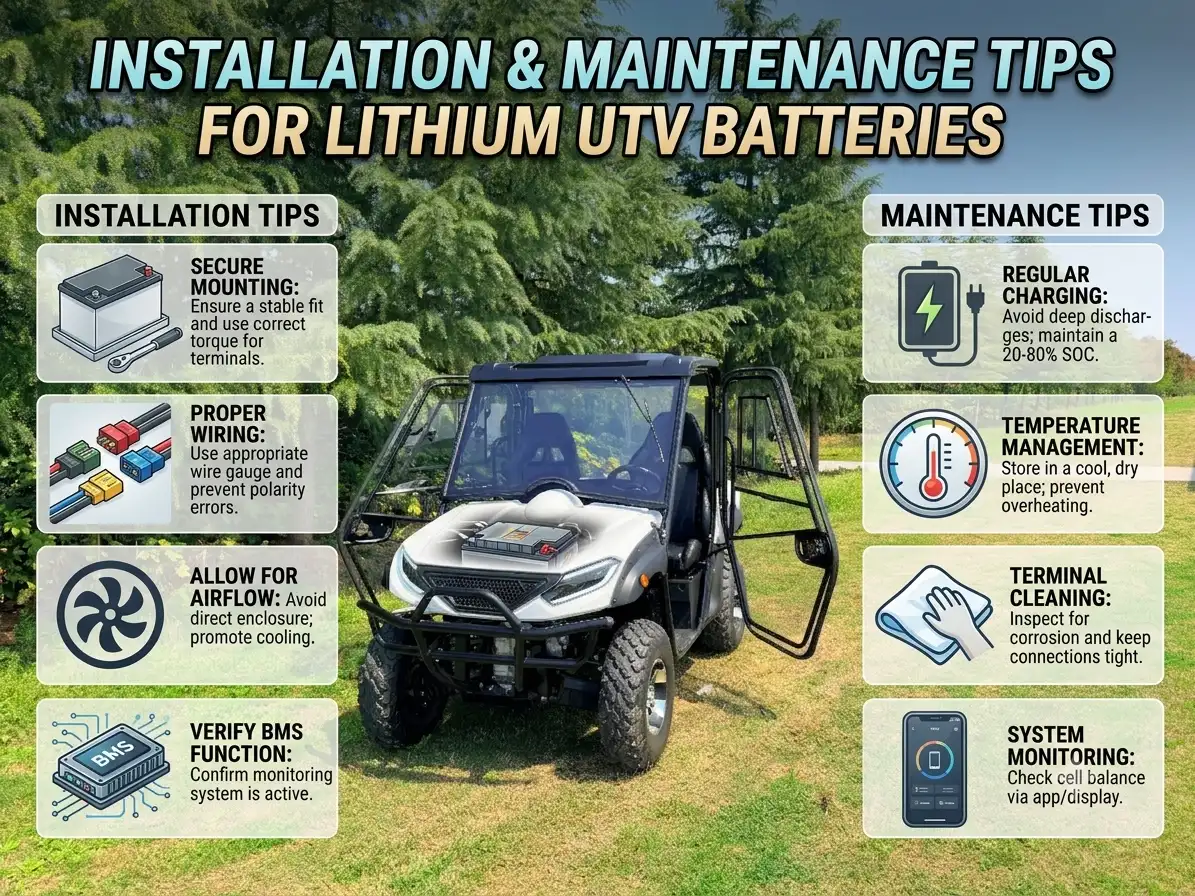
Before installation, disconnect the negative electrode of the battery, thoroughly clean the battery compartment and connection terminals to avoid poor contact caused by impurities; Check the compatibility of the charging system, and upgrade accessories for old models as required; The lithium battery is smaller in size and needs to be firmly fixed with bracket and foam to prevent off-road turbulence and loosening. Strictly distinguish between positive and negative poles, and apply insulating grease to prevent corrosion after wiring fastening. Test the vehicle voltage after installation. The normal idle voltage should be 14.2-14.6V, bluetooth APP can be connected to confirm the battery working status.
Lithium battery is maintenance-free in the whole process, does not need to replenish water and liquid, and only needs to check the tightness of the wiring regularly. Use a special charger for lithium battery to replenish electricity to avoid long-term deep power loss storage; When idle for a long time, keep 50%-80% of the electricity stored and replenish the electricity every 3-6 months. Daily try to keep the electricity above 20%, greatly prolong the battery life; If BMS power failure protection occurs, after checking the temperature, short circuit and power loss problems, it can be reset and restored.
For the vast majority of UTV players who use high frequency, modify and upgrade, outdoor off-road, and long-term storage, lithium batteries are definitely better and more worthy of upgrading. Although the high price of lithium batteries is the only short board, with the core advantages of 70% light weight, 5-10 years long life, full voltage stabilization output, zero maintenance and low self-discharge, it can completely solve the pain points of traditional batteries such as weak start-up, unstable power supply, frequent replacement and complicated maintenance. The cost of long-term vehicles is lower, and the off-road reliability is greatly improved. It is a cost-effective solution for UTV performance upgrades.



-150x150.png)