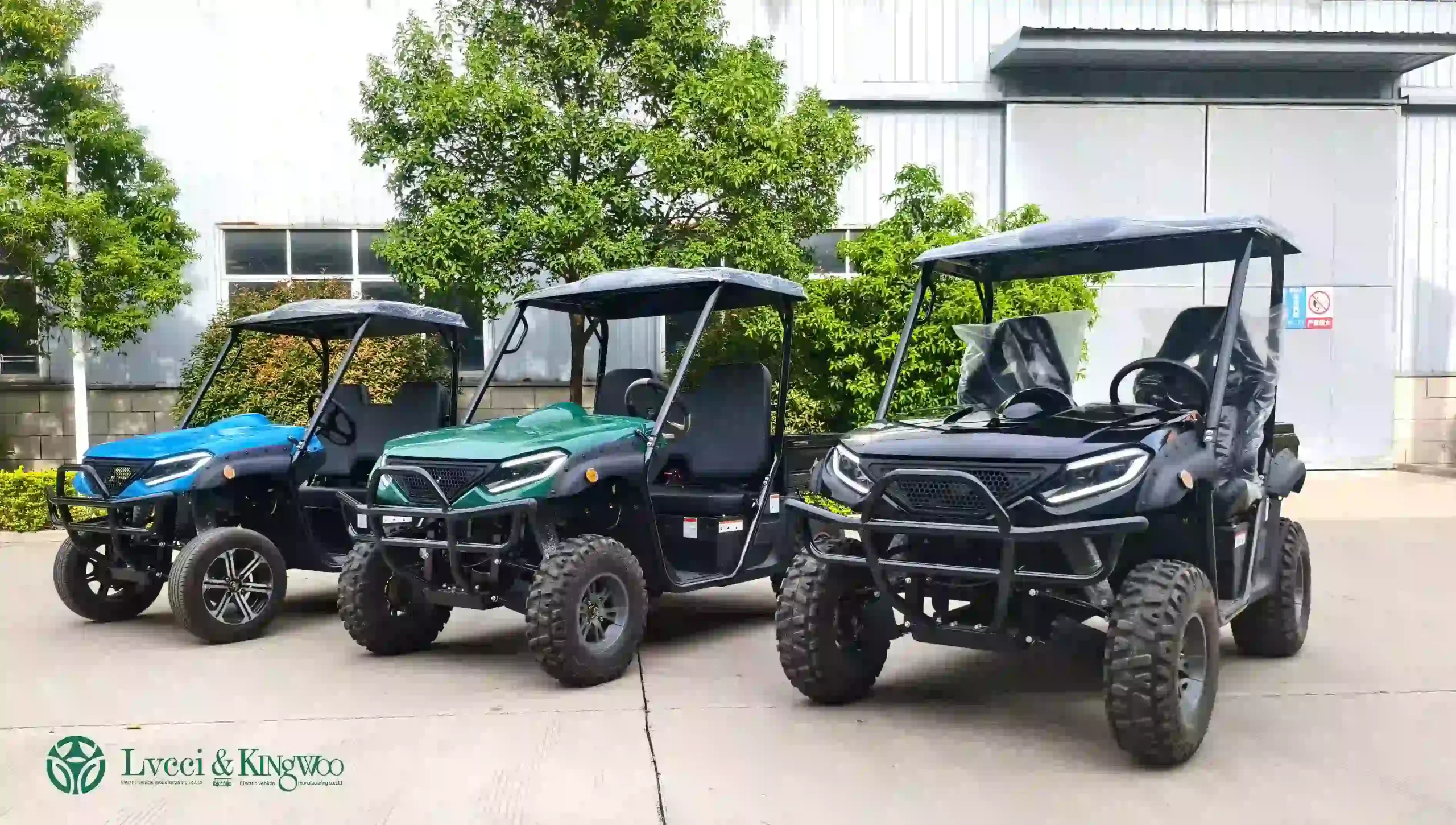
With its excellent off-road performance, load capacity and adaptability, UTV (side-by-side all-terrain vehicle) has become the core tool for outdoor work, snow cross-country and snow clearing in winter. Whether it is farm winter operation and maintenance, outdoor snow exploration, or snow cleaning in private courtyards and factories, UTV can give full play to its advantages over ordinary vehicles.
However, the ice and snow, low temperature and low light environment in winter will completely change the driving state and mechanical performance of UTV. Mature driving habits and maintenance methods in summer can easily cause skidding, vehicle failure, trapping and even safety accidents in winter.
Especially at present, more and more users choose electric UTV, lithium battery low-temperature attenuation, electronic control system antifreeze, power output characteristics and other exclusive issues, further raising the threshold of winter vehicles.
This guide for safe use of UTV in winter integrates a full set of dry goods such as professional driving skills, winter maintenance of the whole car, exclusive maintenance of electric vehicles, necessary safety equipment, high-frequency misunderstanding and pit avoidance, and usage of winter operation scenes. Novices can get started quickly, and old players can standardize operations, extend the service life of vehicles, and fully guarantee the safety and stability of winter vehicles.
The core reason why UTV driving is more risky in winter is that the road grip is greatly reduced, the hidden hidden dangers of road conditions increase, the mechanical performance of vehicles is suppressed by low temperature, and drivers and passengers face the risk of low temperature frostbite and temperature loss. The superposition of multiple factors can easily cause safety accidents.
Ice and snow road is the biggest safety hazard of UTV driving in winter. Road ice is divided into three forms: open ice, ice under snow and black ice. Among them, black ice has high transparency and extremely low identification, which is difficult to predict in advance.
On pure ice roads, the braking distance of UTV will be greatly extended, in extreme cases up to 10 times the normal road. Conventional steering and braking operations will completely fail, and it is easy to slip, flick or even lose control of the car.
The grip on snow-covered roads is equally unstable. Compacted snow has only a weak grip, while floating snow and slush roads will completely break the tire bite rhythm. At the same time, the snow in the shade and low-lying areas is not easy to melt, and the road conditions are extremely random.
It is worth noting that the body structure and dynamic characteristics of UTV are completely different from those of family cars. It is more sensitive to subtle slippage on the road, and a slight operation error will cause loss of control.
Thick snow will completely cover the topographic details of the original road surface and completely block the road obstacles. During driving, the driver cannot quickly identify potholes, rocks, stumps, ditches and steep slopes on the road.
In the wild snow scene, the frozen lake, river is a high-risk area. Warm winter weather will lead to uneven thickness of the ice layer. The surface layer looks like a solid ice layer. There may be holes and thin ice below. The carrying capacity is completely unpredictable. It is easy to break the ice and be trapped if you rush through.
The extremely low ambient temperature will affect the driving state of the UTV in all directions. The cold air will reduce the tire pressure, directly weaken the tire contact area and grip performance, and greatly reduce the driving stability of the vehicle.
Various liquids such as engine oil, gear oil, brake oil, etc. will become viscous at low temperatures and have poor fluidity. This will lead to difficult cold start of the vehicle, delayed braking response, stuck transmission system operation, and a significant reduction in overall mechanical sensitivity.
At the same time, snow is easy to accumulate in the gaps of vehicle air inlets, vents and transmission components. Long-term icing will block the pipeline, wear the transmission structure, and increase the probability of vehicle failure and nest.
UTV is mostly open or semi-open cockpit, high-speed wind resistance in winter will accelerate the loss of body heat. Even if the ambient temperature is not very low, long time riding will appear stiff hands and feet, body temperature drop.
If the vehicle is accidentally trapped or trapped, the driver needs to manually shovel snow and drag rescue. After strenuous exercise and sweating, wet clothes will quickly take away the body temperature, which may cause temperature loss and frostbite in a short time, endangering personal safety.
In winter, the days are short and the nights are long. Snow reflection, heavy fog, and snowy weather will continue to interfere with the driver’s sight, and it is impossible to observe the road conditions ahead and the surrounding environment in time.
In a low temperature environment for a long time, the reaction speed of the human body will slow down, the attention will be easily distracted, and the body will feel tired. Combined with the slow response speed of the vehicle, the driver’s fault tolerance rate is greatly reduced, and human error has become one of the main causes of winter accidents.
In winter, 80% of UTV failures, out of control, car traps and other problems stem from insufficient preparation before going on the road. The loss of vehicles caused by low temperature, snow and freezing is far greater than that of normal temperature environment. A complete set of pre-competition pre-inspection process is the basis for safe riding and stable operation.
Before the first use in winter, UTV needs to be thoroughly cleaned, focusing on cleaning the chassis, frame gaps, wheel arches, transmission parts of the soil, sand and debris. These residues, when wet and frozen in winter, can crush body parts, causing rust, jamming and component damage.
After cleaning, it must be completely dried, carefully check the body shell, screws, suspension, transmission system for looseness, cracking, wear and other problems, repair damaged parts in time, and prevent diseases on the road.
In view of the low temperature characteristics in winter, it is necessary to replace the suitable low viscosity winter engine oil, such as 5W-30 synthetic engine oil. This type of engine oil has better low-temperature fluidity, can quickly complete cold start lubrication, and reduce engine wear.
Check the ratio of antifreeze, it is recommended to maintain a standard ratio of 50:50 to ensure that the antifreeze can withstand the local minimum temperature, and completely eliminate the problem of freezing and cracking of water tanks and pipelines.
Check the level and status of brake fluid, transmission oil, and differential oil one by one. Turbid and damp oil needs to be replaced in time to avoid oil failure at low temperatures affecting control.
Fully lubricate the suspension fulcrums, steering joints, and transmission grease nozzles of the whole vehicle to prevent stiffness, abnormal noise and even jamming of components caused by low-temperature freezing.
Fuel models need to add fuel stabilizer, start the engine to run for a while, so that the stabilizer covers the entire oil circuit, to avoid winter fuel deterioration, oil circuit icing blockage.
Low temperature will greatly reduce the battery capacity and discharge performance, whether it is fuel vehicle battery or electric vehicle lithium battery, before the winter need to be fully charged, and check the health status.
Clean the positive and negative terminals of the battery, remove the oxide layer and snow and frost, ensure the wiring is firm, and avoid power failure and startup failure caused by poor contact.
Comprehensively test the working status of car lights, turn signals, brake lights, defogger, and car accessories. In winter, the light is insufficient. A sound lighting system is an important guarantee for driving safety.
In extremely cold areas, battery heaters and battery insulation sleeves can be installed, and long-term voltage stabilization and maintenance with chargers can effectively avoid low-temperature power loss and scrapping of batteries.
Winter temperature drop will lead to a natural drop in tire pressure, tire pressure must be calibrated before the road, in strict accordance with the manufacturer’s standard value adjustment. Appropriately reducing the tire pressure of 2-4PSI can increase the tire contact area and improve snow floatability and grip.
Carefully check the tire tread depth, whether the sidewall is cracked or bulged, and the severely worn tires must be replaced in time. Snow tires and anti-skid nail tires can be replaced in ice and snow road conditions. It is recommended to install anti-skid chains or track kits in deep snow areas.
Comprehensively check the wear of brake pads and brake discs, clean up the snow and ice between the brake pads and the disc surface, and test the brake sensitivity to ensure that the brake system can work normally at any time.
Check the wear and aging of the transmission belt. The cracked and slack belt should be replaced immediately. At the same time, a new belt should be reserved with the car to deal with sudden outdoor failures. Clean up the dust, ice and snow on the clutch sheaves to ensure smooth transmission.
Test the four-wheel drive and two-wheel drive switching functions and the working status of the differential lock. For high-frequency use in winter skidding scenes, it is necessary to ensure that the system is switched sensitively and without jam.
For operating vehicles equipped with winch and snow plough, the state of winch cable, hydraulic system, snow plough support and blade shall be checked separately, and lubrication and debugging shall be performed in advance to ensure the stable operation of snow clearing and rescue operations in winter.
Comfort modification can greatly improve the experience of using a car in winter. It is recommended to install full/half windshield, closed cabin door, heated handle, heated seat and cabin heater to resist cold wind and low temperature.
Safety and rescue accessories are essential. Prepare snow shovel, trailer belt, anti-skid plate, emergency tools and spare fuel in advance to deal with sudden situations such as car sinking and skidding.
It is equipped with winter emergency kit, including thermal insulation blanket, warm clothing, food and water source, first aid kit and satellite communication equipment, so as to eliminate the risk of being trapped in the wild without rescue.
After starting the vehicle, fully warm up the vehicle and wait for the engine and electronic control system to reach normal operating temperature to avoid damage to the vehicle at low temperature and high speed.
Clean the snow and ice attached to the air intake, air vent, tire and chassis to prevent the parts from sticking and falling off during driving.
Before a short ride, quickly check the tire pressure, power/fuel level again to ensure that the vehicle is stable and meets the driving needs.
Compared with fuel models, electric UTV has the advantages of silence, low maintenance and sufficient instantaneous torque. It is very suitable for winter snow removal, courtyard work and short-distance off-road. However, the low temperature characteristics of lithium batteries make electric vehicles have exclusive rules for winter vehicles, and only by mastering skills can they avoid faults and improve battery life.
Lithium, lithium iron phosphate battery is extremely sensitive to low temperature environment, the temperature will slow down the internal chemical reaction of the battery, increase the internal resistance, directly lead to battery capacity shrinkage.
Under the conventional low temperature environment, the endurance of electric UTV will shrink by 20%-50%. In the extremely cold weather of minus 18 ℃, the vehicle power, climbing speed and extreme speed will be limited by the system, resulting in obvious power shortage.
In the low temperature state, the vehicle energy recovery system will automatically weaken or shut down to protect the battery pack, and cannot supplement the power through recharging, which further aggravates the endurance attenuation.
In addition to the reduced efficiency of the battery itself, winter snow driving resistance is greater, deep snow, soft snow will continue to consume electricity. At the same time, the high-frequency use of electrical equipment such as warm air, lights, and heated seats will also increase power consumption.
When the battery temperature is not up to standard, the electronic control system will actively limit the power, even if it is fully charged, it will not be able to output full power, which is also the key reason for the battery life and power drop of electric UTV in winter.
For models equipped with battery preheating and battery temperature control systems, it is recommended to plug in the pre-temperature before going on the road to increase the battery temperature to 10-15°C, which can greatly restore battery capacity and power performance.
At the beginning of the start, drive smoothly at low speed, and autonomously heat the battery through the heat generated by the vehicle. After the power output returns to normal, drive normally.
When not in use for a long time, park the vehicle in a garage or indoor heat preservation environment with a battery heat preservation cover to prevent the battery from being left standing at low temperature for a long time to damage the battery core.
Core taboo: it is strictly forbidden to charge the battery directly in the state of freezing and low temperature, which will cause lithium precipitation, cause permanent damage to the battery and greatly shorten the service life of the battery.
The zero-speed and full-torque characteristics of the electric motor allow the vehicle to start smoothly and the power is controllable. It is easier to control than fuel models during low-speed crawling and snow clearing operations in the snow, and it is not easy to cause abrupt power slippage.
The battery pack is mostly arranged at the bottom of the vehicle body, which lowers the center of gravity of the vehicle and has stronger driving stability on snow. With intelligent four-wheel drive and torque vector control, the grip performance on ice and snow roads is better than that of ordinary fuel UTV.
During driving, it is necessary to keep the throttle output smooth, avoid instantaneous full power output, activate the vehicle’s snow and traction exclusive mode, increase the following distance, and adapt to the winter braking characteristics.
Keep the battery connection port dry and clean, clean up snow, frost and water vapor in time, and avoid short circuit and leakage fault caused by moisture.
Frequently check the battery management system data, pay attention to the battery temperature, monomer pressure difference, abnormal alarm immediately stop using.
Compared with fuel vehicles, electric UTV does not need to change the oil, spark plug, no oil circuit icing, carburetor failure problems, winter maintenance is simpler, only need to focus on battery and electronic control system protection.
The road grip, braking distance and vehicle response speed in winter are completely different from those in normal temperature environment. The driving habit in summer is the core reason for the high incidence of accidents. Only by mastering exclusive driving skills can we effectively avoid risks such as skidding, overturning and car sinking.
Snow driving must be greatly reduced, the speed of compacted snow road surface should be reduced by 50%, and the speed of pure ice road surface should be reduced by 75%, so as to prevent high-speed driving and violent operation.
All operations must be smooth and gentle, and sudden switching of accelerator, brake and steering shall be avoided. The electric UTV has a large instantaneous torque, and it is necessary to prevent the accelerator from being stepped on to prevent the wheels from idling and slipping.
Significantly lengthen the following distance. In winter, the safe following distance should be kept for more than 8-10 seconds, and sufficient braking and reaction space should be reserved to deal with sudden road conditions.
It is forbidden to brake suddenly or lock brakes on icy and snowy roads. It is necessary to use gentle and continuous point brakes to slow down to maximize the tire grip and avoid losing control of the body.
Slow down in advance before entering the corner, complete the steering at low speed, and prohibit braking and acceleration in the corner. Snow centrifugal force is more likely to cause rollover, smooth speed control is the key.
When there is a tail-flick slip during driving, do not panic the brakes, release the throttle, fine-tune the steering wheel along the direction of the slip, keep the body stable, and then slowly return to the positive direction after correction.
The deep snow section shall be kept straight at a constant speed, relying on inertia to pass smoothly, avoiding midway stops and sharp turns. If there is a stuck car or a stuck car, reverse the original road and exit, and change the driving route.
The slope must be straight up and down, and oblique climbing and lateral sliding are prohibited. Maintain a stable throttle uphill, lean forward, put in low gear downhill, lightly brake to control speed, and lean backward to prevent rolling and overturning.
It is strictly forbidden to blindly pass through frozen lakes and rivers. The blue pure ice structure is the most stable, and the snow-covered ice surface and the gray ice surface have extremely low intensity. Conventional UTV traffic needs to ensure that the thickness of the ice layer is not less than 5-7 inches, manned cargo needs to be further thickened, and the thickness of the ice layer is not sure.
Give priority to familiar marked routes, unfamiliar snowy road conditions hidden pits, ditches, obstacles, do not blindly explore.
Turn on all lights in day and night, foggy weather and snowy weather to improve self-identification and avoid snowmobiles, pedestrians and other road users in time.
Insist on team riding and working together, never go deep into remote snow alone, plan routes in advance, synchronize round-trip time, and reserve emergency space.
The outdoor environment in winter is complex and changeable, and vehicle traps, faults and sudden weather changes are high-frequency situations. Perfect personal protection, vehicle rescue and emergency survival equipment are the core keys to ensure personal safety and get out of trouble quickly.
The three-layer dressing rule is adopted to create professional cold-proof wear. The bottom layer chooses quick-drying thermal underwear to quickly perspire without moisture accumulation. The middle layer is matched with fleece and down warm-keeping layer to lock the body temperature. The outer layer is wearing waterproof and windproof assault clothes and snow pants to isolate wind, snow and water vapor.
Complete with waterproof warm snow boots, thickened non-slip gloves, face scarf, cold cap, all-round protection of hands and feet, face and other parts prone to frostbite.
Wear professional snow helmet and anti-fog goggles to avoid wind and snow, strong light reflection blocking the line of sight, and prevent impact and branch scratch injury. Carry spare warm clothes and warm baby with the car to deal with sudden low temperature and damp.
Install the winch that can work normally in advance, and match it with tree protection belt, pulley and soft shackle to meet the rescue needs of severely trapped vehicles.
Standing strong tow rope, folding metal snow shovel, anti-skid plate, deep in the snow can be quickly shoveled snow, help out.
Carry portable air pump, tire pressure gauge and tire repair tools to adjust tire pressure and repair tire faults at any time to meet the needs of snow driving.
Equipped with basic multi-function tool sets, adhesive tapes, cable ties, spare belts, fuses, spark plugs and other vulnerable accessories to quickly deal with small faults.
Prepare emergency starting power supply and wiring, and deal with problems such as battery power loss and low temperature starting failure.
Prepare headlights, flashlights and spare batteries. It gets dark earlier in winter. Adequate lighting can ensure emergency maintenance and rescue operations at night.
Standard professional first aid kit, including frostbite treatment drugs, hemostatic dressings, disinfection supplies, to deal with trauma, low temperature frostbite and other emergencies.
Carry thermal insulation blankets, emergency survival tents, waterproof matches and fire tools to maintain body temperature and wait for rescue in extreme trapped scenes.
Reserve high-calorie snacks, insulated drinking water, and replenish physical strength in time to deal with long-term outdoor detention.
Necessary satellite communication equipment, walkie-talkie, offline map and compass, remote mountainous areas without mobile phone signal area, can stabilize the external distress, accurate positioning route.
Snow removal operation users can install special snow plough, salt spreader, snow removal accessories, improve the winter site snow removal, deicing operation efficiency.
Upgrade LED auxiliary spotlights and atmosphere warning lights to enhance the visibility and safety of driving in low-light environments.
Install the chassis guard to resist the impact of hidden stones and branches in the snow, and protect the chassis, oil circuit and transmission system.
Most winter UTV safety accidents and vehicle damage are due to habitual misunderstandings and negligence of details. Many users follow the habit of using cars in summer, ignoring the special attributes of low temperature and ice and snow in winter, which eventually leads to out of control and failure. The following high-frequency errors must be avoided.
Some users are used to driving at high speed in summer and still maintain a faster speed in winter, while frequently accelerating, braking and hitting the direction. The grip on icy and snowy roads is extremely poor, and any abrupt operation will directly break the balance of the body, causing sideslip and rollover.
Remember that the snow is slow rather than fast. Smooth and uniform speed and gentle operation are the core principles of safe riding in winter.
Many car owners directly ignore winter special maintenance, do not replace winter oil, do not check tire pressure, do not maintain batteries, do not clean snow and frost. Low temperature will amplify the minor faults of the vehicle, which will eventually lead to half-way nesting, oil circuit freezing and battery scrapping.
Regardless of the length of the riding distance, the basic inspection before using the car in winter cannot be omitted to prevent the car from taking the road with disease.
The most dangerous mistake is to “look at the strong dare to open”. The thickness of the snow-covered ice layer cannot be judged. In warm winter weather, the thickness of the ice layer is uneven, the interior is hollow, and the bearing capacity is completely unpredictable.
The thickness of ice layer must be measured. When there is no detection condition and no local experience reference, the ice surface of lake and river is strictly prohibited.
Winter continue to use summer ordinary pattern tires, tire pressure is too high, is an important reason for snow skidding. Hard summer tires will harden at low temperatures, the pattern bite capacity will be greatly reduced, and it is easy to spin and slip.
Timely replacement of snow tires, installation of chains and adjustment of tire pressure according to the depth of snow is the most cost-effective winter safety upgrade.
Many owners only pay attention to vehicle protection in winter, ignoring personal warmth and emergency equipment. Wearing thin, no spare clothes, no rescue tools and no communication equipment, once the car is trapped, it is very easy to lose temperature quickly, and minor faults turn into great danger.
Winter snow will completely change the landform, the electronic map can not update the snow, ice, road conditions closed information in real time. Simply rely on GPS navigation, easy to stray into deep pits, dangerous slopes, open circuit area.
Give priority to the familiar route, carry paper maps and compasses with you, judge the road conditions on the spot, and do not blindly follow the navigation.
In winter, the field rescue is difficult and the response speed is slow. If you ride alone and do not report the round-trip route and time, once you are trapped or lost, it will greatly increase the difficulty of rescue and endanger your life.
Insisting on organizing a team to travel, reporting the trip in advance, and keeping smooth communication throughout the whole process are the basic safety guidelines for outdoor riding in winter.
Winter low temperature, snow, snow melting salt is very easy to corrode the body, loss of parts, fine daily maintenance and storage management, not only to ensure riding safety, but also can greatly extend the service life of UTV, reduce maintenance costs.
After each ride and operation, the snow, ice mud and snow melting salt on the body, chassis and tires must be cleaned in time. Snow melting salt is extremely corrosive, and long-term residues will rust the frame, metal parts and pipelines.
After cleaning, thoroughly dry the vehicle, focusing on the electrical interface, transmission gap and chassis dead angle to prevent residual moisture from freezing, rusting and causing circuit failure.
Frequently check the tire pressure, battery voltage, and oil status. The parameters fluctuate greatly in a low temperature environment. Adjust and supplement in time to ensure the stability of the vehicle.
Regularly check the transmission belt, clutch, and suspension parts, and timely repair if wear, jam, and abnormal noise are found, so as to prevent minor problems from becoming major failures.
When the vehicle is not used for a long time in winter, the whole vehicle shall be thoroughly cleaned and dried to completely remove corrosive impurities.
Fill the fuel tank of the fuel model, add fuel stabilizer, and run the engine to cover the entire oil circuit with chemicals to prevent fuel deterioration and oil circuit blockage.
The battery is removed and placed in a dry environment at room temperature for storage, or connected to an intelligent charger for voltage stabilization and maintenance to avoid low-temperature self-discharge and power loss.
The tire is inflated to the standard tire pressure, and the bracket can be used to suspend the body when conditions permit to avoid flat spots and deformation of the tire caused by long-term heavy pressure.
Apply protective agent to exposed metal parts, cables and joints to prevent oxidation and corrosion in winter. Cover the whole car with a breathable dust cover and store it in a dry and ventilated indoor garage.
Strictly follow the original vehicle maintenance manual, combined with the local winter temperature, adapt to the oil, maintenance cycle and accessories specifications.
The original high-quality accessories are preferred. In winter, the vehicle load is large, and the inferior accessories are prone to failure, which affects the safety of the vehicle.
After changing seasons and high-frequency operations, a professional overhaul can be done, focusing on the inspection of clutch, belt, chassis protection and other easily worn parts.
UTV is the core equipment for outdoor operations in winter, widely used in courtyards, factories, farms, scenic spots of snow and ice removal, material transportation, site operation and maintenance. Master the professional operation skills, can take into account the operation efficiency and construction safety.
Snow cleaning is the most commonly used function, which can quickly clean the snow on the driveway, trail, parking lot and park road, and the efficiency is far more than manual cleaning.
It can be equipped with salt and sand spreading equipment to complete road deicing and anti-skid operations, and is suitable for auxiliary operation and maintenance scenarios in factory areas, residential areas and highways.
The short-distance transportation of firewood, feed and tools and materials in winter is completed by using cargo bucket and trailer device, which is suitable for the operation and maintenance needs of farms and field sites.
Can be used for winter field inspection, fence maintenance, livestock inspection, easy to reach the winter vehicles can not pass through the complex snow terrain.
According to the width of the site, it is suitable for 60-72 inch special snow plows, hydraulic and electric lifting styles are selected, the adjustment angle is flexible, and it is suitable for various snow removal scenes.
Change snow tires and non-slip crawlers to greatly improve the grip of complex snow and avoid slipping and trapping during operations.
The installation of closed cockpit, heating equipment, heating accessories, improve the comfort of long-term outdoor work. With LED spotlights, to meet the cloudy, early morning, night operation lighting needs.
The working vehicle can be appropriately increased with counterweight to improve the stability of the vehicle body, but strictly follow the manufacturer’s load standard and do not exceed the standard.
The snow clearing operation shall give priority to the low-speed gear, keep the throttle stable, and clean the thick snow in layers to avoid excessive snow pushing at one time and overload damage to the vehicle.
Raise the snow plow in advance when turning or reversing to prevent the blade from scratching the ground and damaging the equipment and road surface. The use of reciprocating regular route operations to improve the efficiency of snow removal.
Open the four-wheel drive and differential lock throughout the process to keep the body stable and prevent dangerous operations such as high-speed operations, sharp turns, and sudden braking.
Prejudge the road conditions of the site before operation, avoid dark pits, steep slopes, thin ice areas, and reduce the operation speed in complex terrain, and give priority to safety.
After the daily operation, thoroughly wash the snow and snow melting salt from the body, snow plow and chassis to prevent equipment corrosion and component icing.
Check the fastening status of the snow plow hydraulic system, winch and fixed bracket, lubricate and maintain in time to ensure long-term stable operation of the equipment.
Compared with traditional fuel UTV, electric UTV by virtue of structural advantages, more suitable for winter low temperature, silent operation, lightweight operation and maintenance scene, become the family, farm, small site winter car selection.
The electric motor can output full torque from zero speed, with abundant power at low speed and smooth output. It is extremely controllable when pushing snow, climbing, and dragging. It is not prone to sudden power slippage, and it can be easily operated by novices.
Electric UTV has extremely low operating noise and is suitable for noise-sensitive scenes such as residential areas, residential accommodation and scenic spots. Snow clearing operations in the morning and evening will not cause noise nuisance.
Zero exhaust emissions, no exhaust gas accumulation in closed cockpit operations in winter, no hidden dangers of smoke and poisoning of fuel vehicle exhaust, and higher operation safety.
There is no engine oil, spark plug, carburetor, and oil circuit system, which completely avoids high-frequency problems such as fuel wax deposition, oil circuit icing, and carb failure in winter, and has stronger stability in low temperature environment.
Simple structure, few wearing parts, no need to change oil products frequently in winter, maintain oil roads, greatly reduce operation and maintenance time and cost.
The battery power supply system of the whole vehicle can stably drive the warm air, heated seats, spotlights, salt spreader and other accessories without idling energy supplement, and the accessories are more stable in use and suitable for long-term winter operation.
For high-frequency and short-distance operations such as daily snow removal, short-distance inspection, site operation and maintenance, the electric UTV has sufficient endurance, the use cost is far lower than that of fuel vehicles, and it is more cost-effective to use for a long time.
The core of the safe use of UTV in winter lies in full pre-inspection, smooth operation, professional maintenance and perfect protection. Ice and snow low temperature environment will completely change the vehicle performance and road conditions, abandon the summer car habits, adapt to the winter exclusive rules, in order to completely avoid safety risks.
Whether it is entertainment off-road or professional operation, the whole vehicle inspection before going on the road, smooth control during driving, and fine maintenance after the end are indispensable. Electric UTV users need to focus on battery temperature control, low-temperature endurance management, to play the advantages of the model.
Equipped with a full set of safety emergency equipment, avoiding the misunderstanding of high-frequency vehicles, and standardizing the winter operation process, it can not only maximize the safety of drivers and passengers, but also effectively extend the service life of UTV, so that the vehicle can play the maximum value stably, efficiently and safely in winter.


-150x150.png)