With excellent off-road performance, carrying capacity and scene adaptability, UTV is widely used in industrial operation and maintenance, agriculture, forestry and animal husbandry, field exploration, engineering operations and other scenes, can meet the needs of manned, cargo, complex terrain traffic, is the core equipment of field operations. However, most operators have cognitive misunderstandings, regard UTV as an ordinary scooter, ignore its high-risk equipment attributes, operate illegally based on experience alone, omit standardized processes, and easily lead to safety accidents such as rollover, collision, personnel fall, equipment damage, etc.
In this paper, the professional UTV training system is comprehensively dismantled from nine dimensions: training value, equipment structure cognition, pre-operation specification, practical driving skills, risk prevention and control, safety protection, equipment maintenance, enterprise training system and organization selection, so as to provide complete guidance for enterprise compliance operation, personal safety practice, and reduction of accident and operation risks.
Why UTV Operator Training Matters
Most enterprises and operators mistakenly believe that UTV has a low operating threshold and does not need special training. In fact, UTV is a high-risk special operation equipment, with a high center of gravity structure, complex field conditions and heavy-duty operation modes hiding a large number of potential safety hazards. Systematic special training is the core measure to ensure human-machine safety, meet industry compliance requirements, and reduce enterprise operating costs. Its importance is reflected in the three dimensions of risk prevention and control, compliance requirements, and practical value.
UTV’s Inherent High Security Risks
The core safety hazard of UTV stems from the high center of gravity structure design. In order to meet the requirements of off-road and heavy load, the center of gravity of the vehicle body is on the high side, and the stability is greatly reduced under the condition of full load and cargo. Rollover and overturning accidents are extremely easy to occur when driving on slopes, turning at high speed and bumpy roads, which is also the primary cause of death and disability of UTV. Statistics from the US Consumer Product Safety Commission show that rollover accidents account for the highest proportion of UTV serious safety accidents, and occupants who do not wear seat belts are easy to be thrown out of the car and suffer from body crushing and impact, resulting in a great risk of casualties.
In addition, problems such as collision of obstacles in the field, partial loading of goods, errors in towing operations, illegal roads, and idle safety protection equipment will all overlap safety risks. Operators without professional training cannot accurately identify hidden dangers, deal with emergencies, and greatly increase the probability of accidents.
Industry Regulations And Compliance Requirements
In industrial, municipal, agricultural and forestry and other workplace work scenarios, UTV certification, special training is a statutory compliance requirements. The British HSE and PUWER equipment specifications, the US OSHA, USDA and the Forest Service all clearly stipulate that special operation equipment operators must complete special training, hold certificates, and regularly retrain. Many states in the United States have made it clear that the use of UTV in public field areas must hold an official certification training certificate.
For enterprises, failure to implement training and work without a license are illegal operations. Once an accident occurs, they will face administrative penalties, accountability and huge economic compensation. Even if the leisure scene is not mandatory, the industry and equipment manufacturers also clearly recommend full participation, amateur operation experience can not cope with complex field high-risk conditions.
Practical Operation and Commercial Value of Professional Training
UTV special training is not a simple theoretical science popularization, but focuses on the ability improvement courses of practical operation landing, risk prevention and control, cost reduction and efficiency enhancement, covering the core contents of pre-class inspection, basic maintenance, terrain judgment, load drag and drop, emergency disposal, etc., and makes up for the short board of operator’s ability in an all-round way.
The landing value is very significant: the 1 is to reduce the accident rate of casualties and equipment damage from the source; The 2 is to reduce equipment failure and shutdown losses caused by improper operation and lack of maintenance, and to reduce operation and maintenance costs. The 3 is to standardize the operation process of enterprises and avoid compliance risks and accident compensation responsibilities. The 4 is to cultivate standardized operation habits, improve the professionalism and efficiency of team operation, and build a safe operation culture for all employees.
In summary, UTV is a high-risk professional operating equipment, not a leisure toy. Systematic training can help operators abandon fluke psychology and blind self-confidence, realize the transformation from “experience operation” to “compliance professional operation”, and ensure the safety of personnel and equipment in an all-round way.
Understanding UTV Components and Functions
Most of the hidden dangers of operation are due to the fact that the operators do not understand the structure of the equipment and do not understand the limits of the equipment. The structure, performance and control logic of UTV are very different from those of ordinary private cars and ATV all-terrain vehicles. It is easy to make mistakes in judgment and illegal operations only based on ordinary driving experience. Mastering the core structure and function of the equipment is the basis of risk prediction, standardized operation and fault identification, and is also the core content required by the operator.
Infrastructure: Body, Frame And Travel Mechanism
The frame and chassis are the core load-bearing structure of UTV, supporting the engine, suspension, seat and cargo hopper, and are suitable for high-intensity field operations. The body guard plate can resist the impact and wear of gravel and branches and protect the core components. The rear cargo hopper is the core operation configuration, which supports material loading. Some models are equipped with hydraulic dump function, which is suitable for engineering and agricultural and forestry operations. Overload, partial load is the body center of gravity lift, rollover risk surge of the core incentives, must strictly follow the equipment rated load standards.
Large-size tires for off-road use have deep tread and strong bearing capacity. The tire pressure and tread state directly determine the grip and stability of the body. Compared with ATV,UTV has a wider track and better basic stability, but abnormal tire pressure, tire damage, and tread wear will directly break the balance, causing skidding and rollover, which are key items for daily inspection.
Core Safety Protection System: ROPS And Occupant Protection Device
ROPS anti-roll frame and seat belt are the core life-saving configuration of UTV, and they are also the most easily overlooked safety devices. Many operators believe that low-speed, short-distance operations without protection, is a typical fatal misunderstanding. The ROPS rigid frame can support the body and reserve the living space of the occupants when the vehicle overturns, but it must be used in conjunction with the seat belt to be effective. The standard wearing of seat belts can fix the occupants in the safe cockpit, and prevent the risk of car dumping and rolling. The cooperation of the two can reduce more than 90% of severe casualties.
In addition, protective doors, protective nets, handrails and other devices can effectively prevent people from getting out of the body with their limbs, avoid scratching and impact injuries, and improve operation safety in all directions.
Powertrain, Suspension Braking and Electrical Systems
UTV power is divided into three categories: fuel, diesel, and electric. Industrial-grade models are equipped with high-torque engines, which are suitable for long-term and heavy-duty operations. With CVT continuously variable gearbox, the power output is stable, the control is convenient, and it can be adapted to complex terrain power adjustment. The transmission system includes core components such as differentials, half shafts, and universal joints. It supports two-wheel drive/four-wheel drive switching and differential locking to improve off-road traffic capacity. The universal joint dust cover is a vulnerable part, which is easily damaged. It causes component wear and power failure, which requires key inspection.
The equipment adopts an independent off-road suspension system, which has excellent shock absorption and stability, and can be adapted to bumpy terrain operations; high-end models are equipped with EPS electric power steering, which has precise control and light strength; four-wheel hydraulic disc brakes respond quickly, brake balance, and parking The brake ensures the safe fixation of the vehicle on steep slopes and at rest.
UTV adopts a car-type control layout. The digital instrument can display core data such as vehicle speed, water temperature and fault code in real time. The electrical system covers functions such as lighting, alarm and external equipment. Some models are equipped with expansion accessories such as winches and hydraulic lifts. Operators need to master various configuration specifications to prevent misoperation.
The Safety Significance of Structure Cognition
Familiarity with the equipment structure can help operators to accurately complete pre-shift inspection and quickly identify hidden dangers such as oil leakage, loose parts, tire damage, etc. Clearly grasp the load, climbing and drag limits of the equipment, and prevent operations beyond working conditions. Standardize the use of safety protection and power modes, maximize the safety performance of the equipment, and avoid safety accidents from the hardware level.
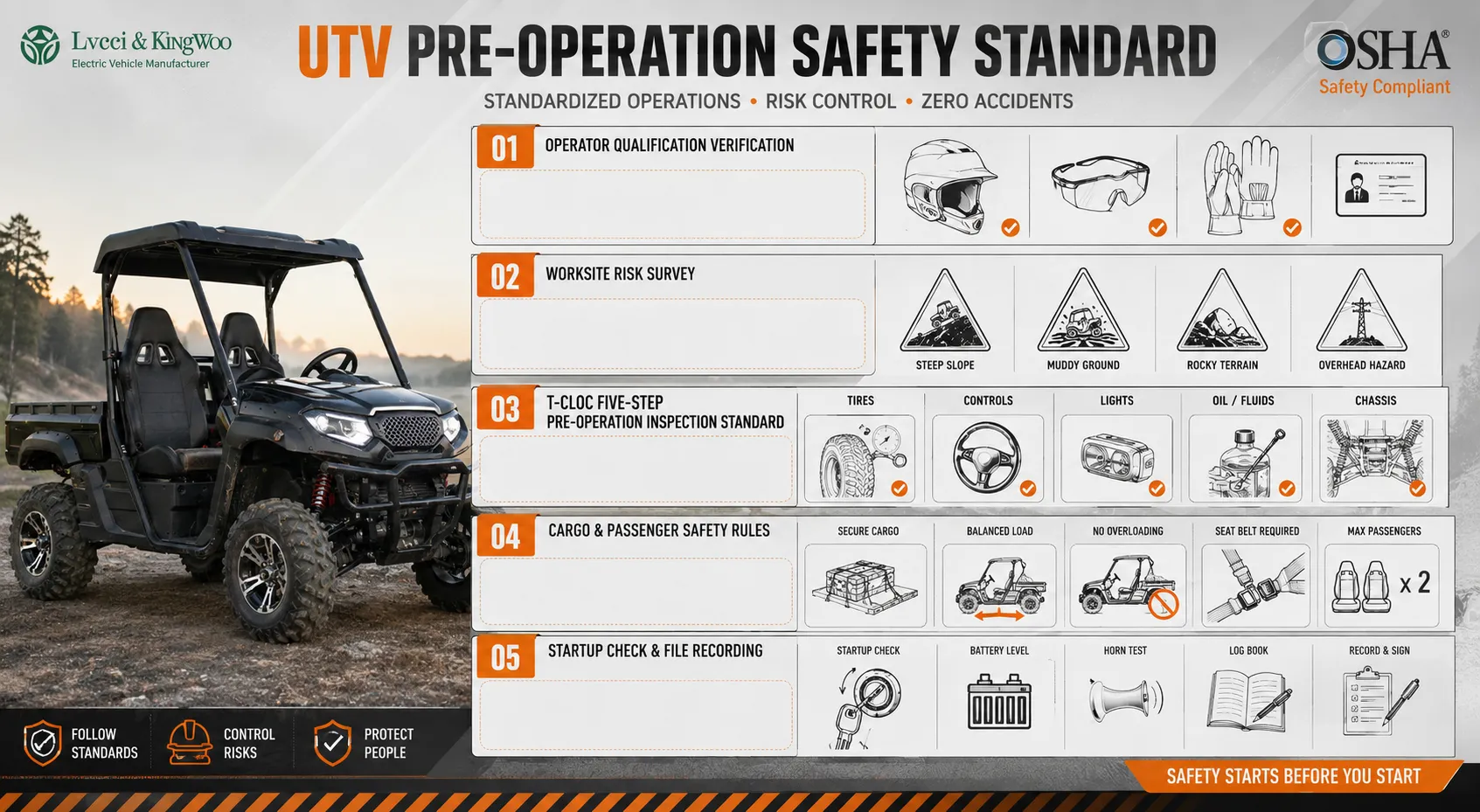
The vast majority of UTV accidents and equipment failures can be avoided through standardized pre-operation procedures. The pre-specification is carried out around the 5 dimensions of personnel status, site risk, equipment inspection, cargo carrying, startup verification, which is the basic criterion that licensed operators must strictly abide by, and can eliminate all kinds of controllable safety hazards from the source.
Pre-job Status Verification Of Operators
Operators must hold the corresponding model qualification, familiar with equipment parameters and operating specifications, unqualified personnel are strictly prohibited. Before operation, it is necessary to read the operation manual and make clear the contraindicated working conditions of the equipment. In terms of personal protection, wear-resistant tooling, closed shoes and socks, anti-goggles and non-slip gloves must be worn. Professional helmets and high-visual warning clothing must be worn in complex scenes to prevent nudity and loose clothing operations. At the same time, it is strictly prohibited to work in the state of drunkenness, fatigue and medication, to prevent distraction from work, to complete safety disclosure before work, and to clarify the work tasks and emergency plans.
Work Site and Task Risk Assessment
The terrain, weather and obstacles of field operation are highly uncertain. Before operation, it is necessary to conduct a comprehensive survey of the site, investigate hidden dangers such as steep slopes, mud, deep pits, accumulated water and falling objects from high altitude, mark high-risk areas and plan avoidance routes. Check the matching degree of operation task and equipment performance, and prohibit overloading, over-climbing and over-dragging limit operations. For remote field operations, it is necessary to plan communication and emergency channels in advance, report the operation route, and prevent a single person from blindly going into unknown areas.
Pre-shift Core Inspection: T-CLOC Standardization System
T-CLOC is an OSHA-certified general pre-shift inspection standard, covering large modules 5 tires, controls, lighting and electrical, oil, chassis and body, and each shift must be checked item by item. The tires need to confirm the tire pressure standard, the tread is intact, and the screws are fastened; the control system needs to test the accelerator, brake, steering, and parking brake to ensure that there is no jam and no virtual position.
The wiring of lights, alarms, instruments and batteries shall be in good condition; the liquid level of oil, coolant, brake oil and fuel shall be sufficient without leakage, and the air filter element shall be clean and free from blockage. The chassis, ROPS frame, protective device and safety belt shall be in good condition, without deformation and cracking, entanglement of sundries, and the fire extinguisher, first aid kit and other emergency equipment shall be complete. If any fault is found in the patrol inspection, it must be stopped immediately and reported, and the equipment is strictly prohibited from operating with disease.
Cargo Loading and Occupant Riding Specification
Overload, partial load, cargo fixed is not firm, cargo hopper manned is a high-frequency high-risk operation. The loading of goods shall follow the principle of “low center of gravity, centering and uniformity”, reduce the placement height, evenly distribute the weight, and firmly fix it with straps and cargo nets to avoid shifting of goods and breaking the balance of the body during driving. The occupants must take exclusive seats, wear seat belts throughout the whole process, and place their limbs inside the vehicle body. It is strictly prohibited to carry people in the cargo hopper, probe to the body and ride sideways. The expansion operation accessories shall be verified and installed firmly in advance.
Startup Verification And Operation File Records
Before starting up, adjust the seat and rearview mirror, lock the seat belt, and test the steering, braking, and four-wheel drive switching functions for the second time to confirm that there are no people or obstacles around the body. After starting up, observe the instrument data, listen to the sound of engine operation, and confirm that there is no fault alarm and normal operation before starting. Enterprise operations need to complete the inspection ledger, equipment status records, and retain operation files to meet the requirements of compliance supervision and accident traceability.
UTV’s high center of gravity and adaptability to off-road conditions make its driving logic very different from ordinary vehicles. Rough operation and improper terrain adaptation can easily cause rollover, skidding, and loss of control. Combined with industry safety standards, standardizing full-scene driving and operation is the core of avoiding driving accidents and dealing with sudden risks.
Common Core Operating Guidelines
In the whole operation, the sitting posture is correct, the seat belt is locked, the limbs are not leaned out of the body, the steering wheel is controlled by both hands, and the SIPDE law is used to dynamically scan the environment, identify hidden dangers and predict risks. Eliminate distractions from playing with mobile phones and chatting, adapt the speed to the terrain, load and visibility, and adhere to the principle of “low speed and steady operation. Before entering high-risk terrain such as steep slopes, muddy, and wading, switch four-wheel drive and low-speed gears in advance, and prohibit temporary switching of power modes during driving to avoid sudden power mutations and loss of control.
Basic Driving Operation Standard
Gently supply oil at the start, prevent rapid acceleration and sudden rush, and avoid body shaking and sudden change of center of gravity. Daily braking adopts gradual deceleration, and full braking in a straight line under emergency conditions. It is strictly forbidden to slam the brakes at the same time to prevent rollover and tail flick. High-speed sharp turns are the primary cause of UTV rollover. All turns must be decelerated in advance and hit the direction slowly at low speed. Under full load and slope conditions, the vehicle speed and turning angle should be further reduced.
Specification for Operation on High-risk Terrain with Steep Slope
Slope operation is the highest risk scenario for UTV. The core principle is to give priority to straight up and down slopes, and to avoid horizontal cross-slopes as much as possible. Switch to low-speed four-wheel drive before going uphill, straighten the body, tilt the center of gravity forward, give oil at a constant speed, and prevent tire slippage; when the power is insufficient, reverse straight back to the bottom of the slope, and it is strictly forbidden to turn around in the slope. Cut into the low-speed gear downhill, use the engine to hold the brake, move the center of gravity back, and slow down at a constant speed to prevent extreme rushing and brake lock. Only in emergency scenarios, you can drive across the slope at a low speed, with the center of gravity shifting to the slope, avoiding potholes and raised terrain, and cross-slope operations are strictly prohibited under full load conditions.
Complex Terrain Traffic Skills
Drive at a low speed and at a constant speed on gravel and potholes to reduce body bounce and avoid loss of control; when encountering obstacles, pass straight and low speed, and high-speed oblique collision is strictly prohibited. Switch to the four-wheel drive low-speed mode on muddy and sandy ground, drive at a constant speed, prevent sudden acceleration and deceleration, and adjust the power of the slightly trapped car smoothly, and do not continue to blow oil to aggravate the trapped car. Keep away from ditches, embankments and steep slope edges during operation to avoid slope collapse and wheel hanging out of control.
Code For Load Towing And Emergency Disposal
For heavy load and towing operation, the rated limit value of the equipment shall be strictly observed. The goods shall be fixed in the middle position, and the whole process shall be driven at low speed and the braking distance shall be increased. The towing operation must use the original special accessories, stable and uniform operation, prevent rapid acceleration, emergency stop and sharp turn, and prevent the breakage of accessories and the loss of control of the body.
For wading operations, it is necessary to confirm that the water depth does not exceed the limit and pass in a straight line at low speed. For low visibility operations at night, the speed shall be greatly reduced and all lighting equipment shall be turned on to avoid complex terrain as much as possible. UTV has no qualification for public roads, and can only stop for observation and cross the road quickly. When there is a sudden rollover trend, it is strictly forbidden to jump, lock the seat belt to fit the body, and rely on the ROPS frame for protection; lock the parking brake immediately when the slope is turned off, and withdraw smoothly; when the body slips, fine-tune the direction and control the oil smoothly. Quickly restore stability.
The standardized process can only deal with the risk of fixed scenarios, while the field operation conditions, terrain and weather change dynamically. Professional operators need to jump out of the curing process, establish dynamic risk perception and prediction capabilities, upgrade from “passive compliance” to “active avoidance”, and avoid unconventional safety accidents from the root cause.
Scene Perception and SIPDE Wind Control Landing
Professional operators should have three levels of risk perception ability: actively scan environmental anomalies, accurately identify hidden dangers and risks, and predict hidden dangers in subsequent working conditions. The whole process uses SIPDE wind control rules to continuously scan the working environment, identify risks, predict consequences, formulate plans, implement and review them on the ground. Long-term training can make risk prediction instinct and effectively avoid unexpected accidents.
Human Factors: The Biggest Core Cause Of Accidents
Over 80% of UTV severe accidents are due to human error, mainly including fluke psychology, self-conceited operation, job fatigue, rush for work, and risk paralysis. Senior operators are easy to relax their vigilance without accidents for a long time, simplify inspection, omit protection and take risks. Overconfidence overestimates equipment performance and underestimates terrain risks. Fatigue and distraction, rush to work and pressure will greatly reduce risk judgment. Long-term violation without accidents will form the illusion of risk normalization and eventually lead to major accidents. One of the core purposes of the training is to help operators maintain safety awe and eliminate subjective violations.
Dynamic Risk Assessment and High-risk Scenario Identification
The operation risk changes dynamically in real time, and the operator needs to re-judge the working conditions in the whole process: pay attention to the subtle changes such as the center of gravity of the goods, terrain and soil quality, weather and road conditions, personnel status, equipment abnormal noise and jitter, etc., continuously self-check the safety of the working conditions, and avoid gradual hidden dangers in advance. It is necessary to focus on identifying risk multiplication scenarios: full-load cross-slope, partial load of goods, soft road surface after rain, blind area of operation, steep slope, long-term operation at high temperature and cold, and low visibility operation at night. In such scenarios, take the initiative to reduce speed, avoid risks and terminate high-risk operations.
Team Risk Prevention And Control System
Enterprises need to implement the shutdown authorization mechanism, the operator found unsafe working conditions can immediately stop to avoid danger, no need to worry about the duration. In view of dangerous situations, attempted accidents and illegal operations, all staff will review and summarize, share experience, carry out risk training on a regular basis, reasonably arrange shifts to avoid fatigue work, and build an all-round safety prevention and control system with individual self-discipline and team control.
UTV safety system is divided into vehicle equipment protection and personal PPE protection, the two complement each other, is the last line of defense after the accident, standardized use can minimize casualties and equipment losses.
On-Board Safety System Specification Use
ROPS anti-roll frame + seat belt is the core life-saving combination, which is indispensable. It can be used in the whole process in a standardized way, eliminating short-distance and low-speed fluke omission. Protective doors, protective nets and handrails can prevent limbs from hitting and scratching. Lighting, alarm and reversing prompt ensure the safety of operation in low visibility and crowded scenes. Fire extinguishers, first aid kits, warning signs and other emergency equipment shall be complete and in good condition and readily accessible. All safety equipment shall be included in pre-shift inspection and replaced immediately if damaged or invalid.
Standardized Personal Protection (PPE) Requirements
For basic protection, wear safety belts, long-sleeved tooling, closed wear-resistant shoes and socks, and anti-goggles to prevent skin exposure. For complex cross-country and multi-obstacle scenes, professionally certified helmets and anti-skid protective gloves must be worn; for densely populated areas on the construction site, high visual warning clothing must be worn. Dust, cold and high decibel scenes shall be equipped with dust-proof, cold-proof and sound-proof protective equipment as required, and the protective equipment after wear and impact shall be replaced in time.
Protection Guidelines and Compliance Requirements
All protective equipment is fully activated and worn in a standardized manner. Disassembly, blocking and misappropriation of safety devices are strictly prohibited, and high-risk behaviors such as cargo hopper manned and limb exploration are eliminated. Enterprises need to combine job risks, formulate exclusive PPE wear standards and equipment maintenance systems, clarify inspection and replacement cycles, strictly implement compliance protection requirements, and avoid safety and regulatory risks.
A large number of UTV accidents are caused by equipment operation with disease and lack of basic maintenance. Operators do not need to master professional overhaul skills, but they must be proficient in daily inspection, basic maintenance, fault identification, and problem reporting capabilities, and investigate hidden dangers in advance to prevent safety accidents caused by equipment failures.
Daily Maintenance Core Value
Basic hidden dangers such as abnormal tire pressure, clogged filter element, insufficient oil, aging belt, and damaged dust cover will evolve into major risks such as brake failure, power failure, and body loss for a long time. Normalized basic maintenance can avoid failure accidents from the source, reduce equipment repair and shutdown losses, meet enterprise compliance ledger management requirements, and extend equipment service life.
Daily and Periodic Maintenance
Before and after each shift, check the tire status, oil, filter element, control and electrical system of the whole vehicle, check that the protective device, transmission belt and dust cover are intact, and clean up the body sediment, radiator and chassis debris after operation. Periodic maintenance requires replacing the oil and filter element according to the working hours, cleaning the battery wiring, lubricating the transmission and suspension points, focusing on monitoring the three vulnerable and high-risk components of the CVT belt, universal joint, and brake system, and predicting the risk of component failure in advance. In field operations, spare belts can be prepared to deal with sudden failures.
Fault Early Warning Identification And Maintenance Rights And Responsibilities
The operator shall accurately identify the warning signals such as abnormal noise, jitter, oil leakage, weak braking, steering deviation, fault light on, power attenuation, etc., and immediately stop and report any abnormality. Forced operation is strictly prohibited. The maintenance work shall be carried out after the parking and cooling equipment are leveled on the ground, and the wearing of protective equipment shall be standardized to prevent the risk of squeezing and scalding. Operators are only responsible for daily inspection and foundation maintenance, equipment dismantling, overhaul, circuit maintenance and other professional work, completed by certified technicians, all maintenance and failure conditions need to be recorded and archived.
Scattered training cannot achieve long-term safety control. Enterprises need to build a standardized, iterative and assessable complete training system, train compliance operators in batches, and realize closed-loop management of safe operations.
Training Objectives And Access Criteria
The core goal of the training is to enable all employees to master the skills of equipment operation, risk prevention and control, basic maintenance and emergency disposal, and meet the requirements of industry compliance and enterprise safety system. Participants should be physically and mentally healthy and have basic vehicle operation knowledge, focusing on new employees, transferred employees and new equipment personnel. Independent operation is strictly prohibited for unqualified personnel.
Curriculum System and Teaching Mode
The hierarchical teaching mode of “theory + practical operation” is adopted, and the theoretical course covers the contents of equipment structure, compliance specification, inspection process, risk control, maintenance knowledge, emergency system, etc. The practical operation course focuses on real-life training such as pre-class inspection, standard control, complex terrain operation, load drag and drop, danger drill, etc. to prevent disconnection of theoretical and practical operation. The mixed mode of online theoretical assessment and offline small class practical operation guidance is adopted, combined with real accident cases, to fit the actual working conditions of the enterprise and improve the practicability of training.
Assessment And Retraining Mechanism
The implementation of the theory + practical operation double assessment system, theoretical assessment 80 points qualified, practical operation item by item verification operation standardization, fatal violations directly determine unqualified. Pass the assessment and issue the qualification certificate for the post, and keep the training and assessment files completely. Establish an annual retraining and qualification review mechanism, carry out special reinforcement training in case of danger, equipment renewal and working condition adjustment, and continuously consolidate safety skills and awareness through pre-shift short training and monthly regular meetings.
Long-Term Training Guarantee
Improve the enterprise safety management system, clarify the rules of operation authorization, protective wear, inspection records, shutdown reporting, etc., set up a team of professional lecturers, regularly review hidden dangers and accident data, dynamically optimize the training content, and realize the closed-loop management of training, operation, wind control and review.
The quality of UTV training in the market is uneven, and ineffective quick training cannot meet compliance and safety needs. Enterprises need to master professional selection standards, avoid training traps, and screen high-quality training resources.
Quality Training Selection Criteria
High-quality training requires a complete curriculum system, covering the whole module of equipment structure, practical operation skills, wind control and maintenance, and emergency compliance, which is suitable for enterprise models and operating conditions. The proportion of practical operation is sufficient, equipped with standardized skills assessment, and pure online quick teaching is eliminated; Teachers have professional qualifications and rich practical training experience; Can provide complete assessment ledger and compliance certificate; Support customized and on-site practical training to meet the personalized needs of enterprises.
Selection Process and Key Points of Pit Avoidance
The selection of enterprises should first sort out their own operational needs, compare the curriculum outline, teacher qualifications and case assessment standards of the organization, give priority to the pilot observation of practical courses, comprehensively evaluate the quality rather than simply compare prices, and confirm that the training qualifications can meet the requirements of compliance. Resolutely avoid quick training without practical operation, assessment and ledger, and stay away from inferior training such as unqualified teachers, false packages and templated general courses.
Internal And External Training Scenario Adaptation
Enterprises with venues, teachers and equipment can set up an internal normal retraining system with lower cost and stronger adaptability. Enterprises without professional resources and requiring standardized compliance certification will give priority to professional external institutions. The best model in the industry is “external initial training and evidence collection and internal normalization of retraining”, taking into account professionalism and long-term effectiveness.
Conclusion
UTV safety operation does not rely on a single operation skill, but a complete system of standardized operation specification + active risk prediction + full-dimensional protection guarantee + normalized maintenance training. Standard process is the bottom line of safety, risk awareness is the core of safety, protection and maintenance is the bottom line of safety, and systematic training is the fundamental support for long-term safety. For operators, professional training can abandon the bad habits of empiricism and develop standardized and safe working habits. For enterprises, a perfect UTV training system is the key to reduce the accident rate, control operational risks, realize compliance operation and build a strong safety culture. Only by adhering to safety standards, adhering to regular training and strengthening active wind control can we truly realize the safe, stable and long-term operation of UTV operations.


-150x150.png)