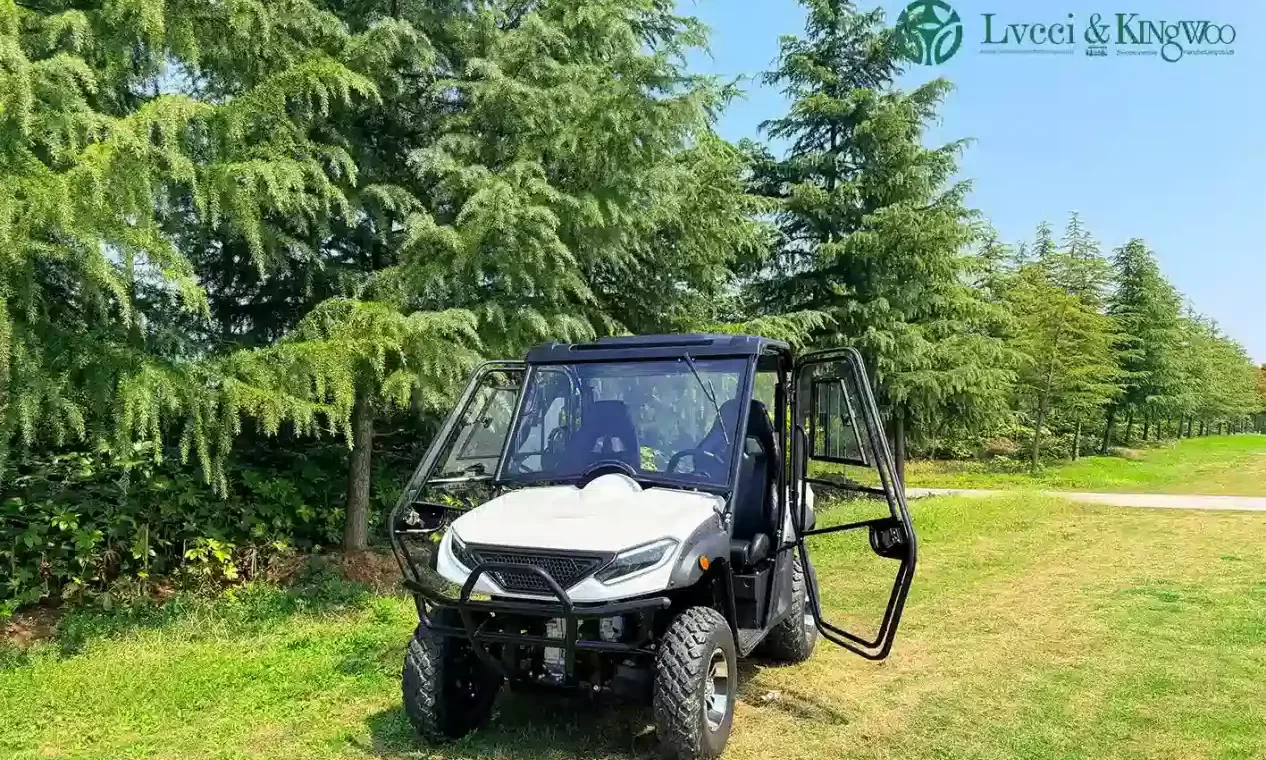
With the popularity of electric UTV (electric all-terrain side-by-side) in outdoor off-road, farm operations, leisure and entertainment scenes, more and more car owners are facing the same problem: how to properly maintain long-term parking in winter? Different from traditional fuel UTV, electric UTV has no problems such as oil circuit, carbon deposit and oil aging, but it has more delicate core components.
The lithium battery pack, electronic control system, motor, and circuit assembly are extremely sensitive to low temperature, humidity, and temperature fluctuations. Many car owners encounter problems such as plummeting battery life, circuit corrosion, brake jam, tire deformation and so on after starting up in spring. Most of the root causes are improper storage in winter.
The wrong winter storage method will not only incur high maintenance costs, but also directly shorten the service life of the vehicle, and even cause the battery warranty to expire. This article will bring you a complete set of winter storage steps for electric UTV that can be landed, from battery maintenance, vehicle cleaning, mechanical protection to regular inspection and restart in spring, with full coverage and explanation, so that your equipment can survive the winter safely and be ready for use in spring.
This is the core reason for the exclusive maintenance of electric UTV in winter, and it is also the most common mistake of using cars. Fuel UTV is mainly mechanical and fuel structure, and winter maintenance focuses on mechanical antifreeze. The core value of electric UTV is concentrated in electrical systems such as lithium battery, motor, ECU controller, high-voltage circuit, etc. The maintenance core is changed to cold, moisture and static loss. The maintenance method of fuel vehicle cannot protect the core components of electric UTV.
Electric UTV precision electrical components have weak low temperature resistance and moisture resistance. Low temperature in winter, temperature difference changes and long-term standing will continue to damage the core components, which is the main cause of idle failure:
Lithium battery damage: Low temperature will greatly increase the internal resistance of the battery, and long-term standing of the vehicle will accelerate the attenuation of battery activity, which will directly lead to capacity decline and endurance shrinkage.
Circuit electronic control erosion: The temperature difference between day and night in winter is easy to produce condensed water inside the car body, which will continuously corrode the line interface, high-voltage circuit, ECU controller and other precision components, causing oxidation and hidden trouble.
Mechanical parts stuck and aging: the vehicle transmission and braking structure is left standing for a long time in a low temperature environment, and the lubrication effect is reduced, and problems such as stuck, rust, and moving parts stuck are prone to occur.
Electric UTV idle in winter is not a simple ash static, neglect of maintenance will cause multiple irreversible damage, directly affect the car experience, equipment performance and vehicle residual value:
Mild appearance and mechanical failure: long-term parking is easy to cause tire flat spots, driving jitter, brake jam; Body plastic, rubber parts low temperature embrittlement, cracking and aging.
Severe core irreversible damage: permanent capacity attenuation of the battery cannot be repaired; short circuit and leakage caused by circuit corrosion; abnormal operation and damage of the motor due to moisture and water inflow.
Maintenance costs and residual value loss: The high cost of repair and replacement of electrical core components and the loss of vehicle performance result in a significant reduction in the second-hand preservation rate, resulting in additional asset loss.
Lithium battery is the most expensive and sensitive core component of electric UTV, and it is also a high-risk part of storage failure in winter. The low temperature environment will directly change the chemical activity of the lithium battery, and the wrong storage capacity and environment will cause irreversible battery damage.
First of all, the best storage capacity needs to be controlled. Electric UTV lithium batteries are stored for a long time in winter. It is strictly prohibited to stand at 100 full power or 0% power loss. The full power state will continuously compress the battery core and accelerate the aging of the battery. The static state of power loss will cause deep self-discharge, resulting in undervoltage scrapping of the battery core.
The industry’s general optimal storage capacity is 40%-70%, and most original manuals recommend a 50%-60% range. This power range has the lowest core pressure and the slowest self-discharge speed, which can retain the battery capacity to the greatest extent and avoid the collapse of battery life in the coming year.
Followed by the battery cleaning and anti-corrosion protection. Before storage, carefully clean the battery shell and terminals of dust, dirt and water stains. After cleaning, a small amount of insulating grease can be applied to the metal terminals to isolate humid air and prevent terminal oxidation and corrosion caused by condensed water in winter.
Regarding the use of power-up equipment, it is recommended to match lithium battery-specific intelligent power-up appliances for long-term storage in winter. Ordinary charger is not suitable for long-term standby power, easy to cause overcharge damage. Intelligent electrical appliances can stabilize the flow, automatically maintain a healthy power range.
Finally, control the storage temperature. The best storage environment temperature of lithium battery is 10 ℃-25 ℃, try to avoid long-term storage at low temperature below 0 ℃. It is recommended to use battery insulation pads in severe cold areas, or directly remove the battery and store it at a constant temperature indoors to prevent the problems of low-temperature lithium precipitation and battery core damage.
Many car owners believe that there is no need to wash the car before storage in winter, and then clean it in the spring of the coming year. In fact, the residual sediment, snow melting salt, oil is the main culprit of corrosion of the body and parts in winter, long-term attachment will continue to damage the equipment.
First, clean the vehicle with low pressure flushing. Neutral special vehicle cleaner shall be selected, and high-pressure water gun shall not be directed at precise electrical parts such as battery compartment, charging port, electric control box, line interface, etc. to avoid hidden danger of short circuit caused by moisture infiltration.
Focus on cleaning up the silt and snow residue in the chassis, suspension gap and wheel hub gap. Snow melting salt on the road in winter is extremely corrosive, and long-term adhesion will rust the metal chassis, screws and suspension parts, causing irreversible metal corrosion.
The vehicle must be thoroughly dried after cleaning. Use hair dryer and air drying equipment to blow dry the residual moisture in the body gap, electrical interface and chassis dead angle to ensure that the whole vehicle is completely dry and then put into storage to prevent the problems of moisture, mildew and corrosion of components.
Finally, do a full range of vehicle condition investigation. Check one by one whether the circuit is worn and broken, whether the water pipe is cracked, whether the screw is loose, and whether the brake pad is excessively worn. Check minor faults in advance to avoid aggravation of faults during static storage in winter.
The weight of the electric UTV is much higher than that of the fuel model, mainly because of the built-in large-capacity lithium battery. In the long-term static state, the weight of the body continues to press the same position of the tire, and the rubber hardens at low temperature in winter, which easily forms permanent flat spots.
Calibrate the tire pressure before storage. The tire pressure can be inflated to the original standard value or slightly higher than the standard value of 5-10PSI. Sufficient pressure can reduce the pressure on the tire contact surface and effectively alleviate the occurrence of flat spots.
When conditions permit, it is most recommended to use the jack bracket overhead vehicle. Let the tire completely out of the stress state, completely eliminate the problems of flat spots, rubber aging and deformation, and release the pressure of the suspension system to protect the spring and shock absorber structure.
For the suspension system, lubrication and maintenance should be done in advance. Clean up the mud and sand impurities at the swing arm, ball joint and hinge point, and apply special waterproof grease to prevent the components from rusting and jamming due to wet environment in winter, and avoid abnormal noise and sticking problems in driving in the coming year.
At the same time, check whether the suspension rubber sleeve and dust cover are aging and cracking, and the damaged rubber sleeve needs to be replaced in time. Low temperature in winter will make aging rubber brittle cracking, loss of protective effect, water vapor and impurities will directly invade the interior of precision parts.
The brake system is the most easily overlooked in winter storage and the most prone to failure in spring. Wet, low temperature, and long-term standing can easily cause the brake disc to rust, the brake pad to stick, and the caliper piston to jam, which affects driving safety.
Long-term winter storage is strictly prohibited to tighten the handbrake. Whether it is a mechanical handbrake or an electronic handbrake, in the long-term locked state, the brake pads and the brake disc are closely attached, and it is easy to stick and jam after being affected with moisture. Forced activation in spring will cause damage to the brake components.
The correct approach is to release the handbrake and use wheel blocks to fix the vehicle to prevent it from slipping. It can not only fix the body position, but also make the brake system in a slack state to avoid adhesion failure.
Then clean and maintain the brake system. Clean the dust and rust impurities on the surface of the brake disc and caliper, and apply special brake grease to the brake guide pin and movable point to ensure the smooth movement of the components.
Check the state of the brake oil. The brake oil has water absorption and will be mixed with water after long-term use. If the brake oil has been used for more than 2 years or is turbid and black, it is recommended to replace the new oil before storage to avoid freezing and brake failure caused by low temperature in winter.
In addition, the mechanical parts such as living hinges, shafts, bearings, etc. of the whole vehicle are uniformly coated with grease to prevent long-term static rust and Caton and maintain the mechanical flexibility of the whole vehicle.
The seats, plastic shells, rubber sealing strips, instrument panels and other interior and exterior trim components of electric UTVs are prone to mold, embrittlement, fading, and cracking in low temperature and humid environments in winter, and require targeted protection.
First, clean up the sundries in the interior, and take out the garbage and water in the foot pad and storage tank. Wipe the seat, instrument panel and interior panel with a clean microfiber towel to thoroughly dry the moisture to avoid mold and odor in the airtight storage environment.
For plastic and rubber parts, spray special maintenance and protection agent. Low temperature in winter will make rubber, plastic lose toughness, easy to crack aging, curing agent can form a protective film, anti-freezing, anti-aging, anti-ultraviolet fading.
Check whether the sealing rubber strip of the whole vehicle is in good condition, and repair the aging and loose rubber strip in time. Good sealing can effectively isolate the outside moisture, rain, snow and dust, and protect the precision electronic accessories in the car.
The advantages and disadvantages of the storage environment directly determine the wintering state of the electric UTV, and it is also the key to reduce the failure in winter. A lot of maintenance work done in place, but due to improper environment fall short.
The closed garage with dry, ventilated and stable temperature difference can avoid the problems of rain, snow, frost, strong light exposure, large temperature difference between day and night, and protect the battery and electrical system to the greatest extent.
In the open air, rain and snow infiltration, frost wrapping, and severe temperature difference between day and night will accelerate battery attenuation, circuit corrosion, and body aging, greatly increasing the probability of failure. If it can only be stored in the open air, it must be matched with professional protective measures.
Moisture is the number one killer of electrical components, and condensed water will corrode the line interface, electronic control module and charging port. Desiccant can be placed in the compartment and storage space to absorb water vapor in the air.
In winter, rats are easy to get into the vehicle interior to bite the line and build nests, causing line damage and short circuit failure. It can block the body vent and exhaust port, place rodent repellent supplies, and regularly check the traces of insect pests.
Reject airtight plastic film, airtight airtight material will lock moisture, breeding mold, accelerate corrosion. Breathable clothes can prevent dust and frost, and can be ventilated and wet, suitable for long-term winter storage.
Electric UTV winter storage can not be left alone for a long time. When the vehicle is parked for a long time, the power, environment and vehicle condition will continue to change, which is easy to cause failure. Regular monthly inspection can check hidden dangers in advance, avoid most static faults, and ensure the integrity of the vehicle. The specific inspection items are as follows:
The battery is the core of winter storage inspection, and the remaining power shall be checked monthly. When the power is less than 40%, the power will be replenished to the standard range in time to prevent long-term standing of low power from damaging the battery core and causing battery aging. At the same time, check the working condition of the power supply device to ensure that the equipment operates normally and the power supply function is in good condition.
Inspect the damp and rust problems of the whole vehicle regularly, focusing on the line interface, battery terminal, brake system and chassis metal parts. Check whether the components have accumulated water, damp, oxidation, rust, etc., and timely dry and remove rust if any abnormality is found to avoid the expansion of hidden dangers.
For vehicles not stored overhead, slightly move the body every 1-2 months to replace the tire stress points to avoid permanent flat spots and deformation caused by long-term single-point pressure on the tire, and effectively protect the tire Working condition.
Do not start the vehicle directly on the road after unsealing and restarting the vehicle in spring. After the electric UTV has been 1 for a long time throughout the winter, hidden problems are easily occurred in parts, batteries, lines, etc. It is necessary to verify the vehicle condition in strict accordance with the complete restart inspection process, and then put it into normal use after confirming that all the conditions are correct, so as to effectively avoid equipment failure and potential safety hazards caused by sick driving. Specific inspection items are as follows:
Remove the protective accessories such as desiccant, rodent repellent products and battery thermal insulation pad installed during the storage of the vehicle completely, and remove the whole vehicle clothing. Clean up the dust, sundries and attachments on the surface of the vehicle body to ensure that the vehicle body is clean and tidy, restore the complete state of the original factory of the vehicle, and make basic preparations for subsequent vehicle condition inspection.
Connect the original charger of the vehicle at normal temperature, carry out full charging operation on the battery, observe the charging state throughout the process, and confirm that the charging process is normal and the equipment does not have any error notification. After charging is completed, carefully check the battery voltage and battery core operating status, and focus on verifying that the battery has no performance degradation, no fault alarm, no bulge leakage and other problems to ensure stable battery power supply.
Test all kinds of electronic equipment of the vehicle one by one, including the entire vehicle’s lights, instrument panel display, function buttons, on-board charging system, four-wheel drive control system, etc., to ensure that all equipment start, stop and run normally. At the same time, check the whole vehicle lines and wiring interfaces to confirm that there is no oxidation, rust, looseness, falling off, damage, etc., to ensure the safety and stability of the circuit system.
Supplement the four-wheel tire pressure according to the vehicle standard parameters, and ensure that the tire pressure value is compliant and balanced. Comprehensively check the appearance of the tire and check whether there are problems such as flat spots, tread cracking, sidewall bulge, abnormal wear, etc. Press and test the suspension shock absorber for many times to confirm that the shock absorber has smooth rebound, no jam, no abnormal noise, and the suspension structure is in good condition.
Step on the brake pedal repeatedly to completely discharge the air accumulated in the brake oil circuit and improve the braking sensitivity. Careful inspection of brake discs and brake pads for wear and corrosion, and cleaning of slight rust on the surface of brake discs in winter. Test the braking effect of the brake, and confirm that the brake response is timely, no jam, no biased braking, and stable and reliable braking.
Low-speed road test to verify the overall performance of the vehicle. Select an open, flat and safe site for low-speed test, and test the core performance of the vehicle such as power output, steering control, braking response, shock absorption and filter. At the same time, monitor the running state of the whole vehicle, check whether there are abnormal noise, jitter and other problems in the chassis, motor and transmission structure, and confirm that the whole vehicle is in stable condition without abnormality before it can be used normally on the road.
Many car owners of vehicle damage, are derived from the inconspicuous storage errors. The following high-frequency errors are the main causes of battery scrap, circuit failure, and mechanical damage, and must be avoided in advance.
Full-charge storage accelerates the aging of the battery core, and deep discharge scrapping caused by power loss storage is the number one cause of lithium battery damage, which can be avoided by strictly maintaining 40%-70% of the stored power.
The brake parts are blocked by moisture, which is the most common problem that the brakes are stuck in the spring and cannot be driven. For long-term storage, the handbrake must be released and the vehicle must be fixed with a stopper.
The airtight material locks moisture, causing the whole vehicle to be affected with damp, line corrosion and moldy interior trim. Special breathable UTV protective clothing must be used.
Residual snow melting salt and sediment continue to corrode metal and rubber parts, resulting in irreversible corrosion and aging over time. Cleaning is the basic premise of storage.
Winter temperature difference, self-discharge and insect pests will quietly damage the vehicle. Monthly inspection is a low-cost and high-guarantee maintenance method, which must not be omitted.
Long-term open storage is not recommended. Low temperature, rain and snow, and temperature difference between day and night in the open air will seriously damage lithium batteries and electrical systems. If there is no indoor condition, thickened breathable car clothes must be used, battery insulation pads must be installed, moisture-proof and snow-proof measures must be taken, and inspection frequency must be increased.
The optimal interval is 40%-70%, and 50%-60% of the middle power is recommended. In this state, the cell pressure is the smallest and the self-discharge is the slowest, which can effectively avoid capacity attenuation and cell scrap. It is the original factory and industry general wintering standard.
Can be connected to the lithium battery special intelligent electrical supplement, prohibit the use of ordinary charger. Intelligent equipment will automatically stabilize voltage and supplement electricity, maintain healthy electricity, prevent self-discharge and power loss, and is a high-quality auxiliary tool for long-term winter storage.
Under the premise of standard storage environment and power compliance, it can be safely placed for 3-6 months. However, it is recommended to check the power and vehicle condition every 1-2 months to avoid hidden damage caused by environmental changes and self-discharge.
Simple low temperature will not directly damage the motor, but low temperature with damp condensate water, will cause the motor internal moisture, coil corrosion, insulation performance decline. Long-term open storage at low temperature can easily lead to short circuit and abnormal noise of the motor, so the motor must be moisture-proof and antifreeze in winter.
The core of electric UTV storage in winter is not “simple parking”, but the four core points of battery constant temperature protection, moisture prevention and corrosion prevention, mechanical pressure relief and regular inspection. Compared with fuel models, the mechanical structure of electric UTV is simpler, but the electrical and battery systems are more precise and delicate.
A scientific and standardized winter storage can effectively protect the life of lithium batteries, electrical systems and mechanical components, greatly reduce maintenance costs, and retain the peak performance and second-hand residual value of the vehicle. On the contrary, perfunctory storage will only exchange for various failures and high expenses in the coming year.
According to the complete set of steps in this article to complete the overwintering maintenance, your electric UTV can safely survive the cold winter, realize one-button start-up in spring and return to full blood performance, and put it into use directly without complicated maintenance.


-150x150.png)