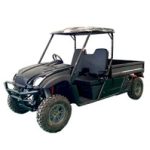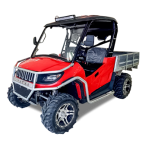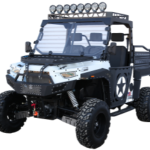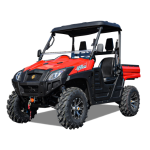
UTV is divided into basic operations, all-round commuting, professional competition three categories, different models of design standards, hardware configuration, production process and applicable scenarios are very different, affordable practical models and high-end off-road models of the core structure, material performance gap. To this end, this paper combines the latest market data from 2025-2026, comprehensively dismantle UTV all kinds of price factors, sort out the precise price range and purchase scheme, to help all kinds of users to avoid the purchase trap, precise control of budget, to choose to adapt to their own needs of cost-effective models.
Combined with the 2025-2026 overseas trading platform, brand official guidance price and industry authoritative data, the current global mainstream transaction price of the new UTV is 13,000-17,000 US dollars, and the mainstream high-end consumer market transaction price is concentrated at 15,000-22,000 US dollars. New cars on the market are clearly divided into four price echelons according to their positioning: 8,000-13,000 US dollars for entry-level operation, focusing on basic agricultural and short-distance operation and maintenance, with simple structure and high cost performance. The US $13,000-20,000 mid-range all-round model, which takes into account daily operations and light cross-country operations, is the mainstream choice for ordinary users. US $20,000-30,000 high-end multi-function model, equipped with comfortable configurations such as high frequency commercial operations, equipped with turbo power, professional competitive suspension, the main extreme terrain crossing and event use. However, the mainstream transaction price of second-hand UTV is concentrated at US $5,000-15,000. The mid-range operating models with excellent vehicle conditions have the highest value preservation rate and the largest circulation volume. The old low-cost models have high failure rate, scarce accessories, and higher long-term use cost. It is not recommended for ordinary users to purchase.
Most new car buyers are easy to confuse the official MSRP guiding price with the actual landing price. The final cost of a new car needs to add up to US $500-1200 in transportation fees, dealer service fees and various local taxes and fees. At the same time, the roof, windshield, winch and other just-needed accessories are mostly optional, and the full set of installation will add an additional US $3000-8000. According to the market situation, the landing budget of fully equipped brand-new conventional UTV is generally US $15,000-25,000, the budget of high-quality second-hand models is US $10,000-15,000, and the landing of flagship top-equipped models is more than US $30000. The end-of-year brand clearance and inventory promotion stage is the best price window period for starting UTV.
The core price gap of UTV is essentially the gap between hardware configuration and engineering design. Core hardware such as model positioning, power system, suspension chassis, load capacity, drive form, etc., directly determine the production cost and performance ceiling of the vehicle, which is the first echelon factor affecting pricing and the core basis for price stratification of different models.
Vehicle positioning and usage scenario
UTV’s product positioning is the core index with the highest weight among all price factors. Different models with different usage scenarios have completely different design standards, production processes and accessory costs, directly opening up the price gap of tens of thousands of dollars. At present, the industry divides UTV into three categories, and the pricing logic is clearly distinguished:
Operational UTV: The main load, traction, durability, the core of the design is to simplify the redundant structure, reduce production costs, suitable for farmland, pasture, factory and other flat site operations. The model is equipped with a low-power engine, a basic suspension system, and a simple body structure. It does not need to be adapted to extreme off-road scenarios. The production cost is the lowest, and the price is also the lowest in the entire category. It is stable within $15000 all year round.
Crossover all-purpose UTV: Balancing the practicability of operation and off-road entertainment is the mainstream category in the market. On the basis of retaining cargo and traction capacity, the suspension shock absorption, power output and control system are upgraded, which can take into account daily operations and driving on light mountain and rugged roads. The configuration is moderately rich, and the pricing is in the middle range, with the widest audience.
Professional competitive UTV: The design core is extreme cross-country, high-speed crossing and field racing, abandoning part of the load capacity and focusing on strengthening power, suspension, chassis and stability. Equipped with turbocharged engine, ultra-long stroke competitive suspension, high-strength alloy chassis, professional off-road tires, the full set of hardware are high-end customized accessories, the production cost is extremely high, is the core category of UTV price ceiling.
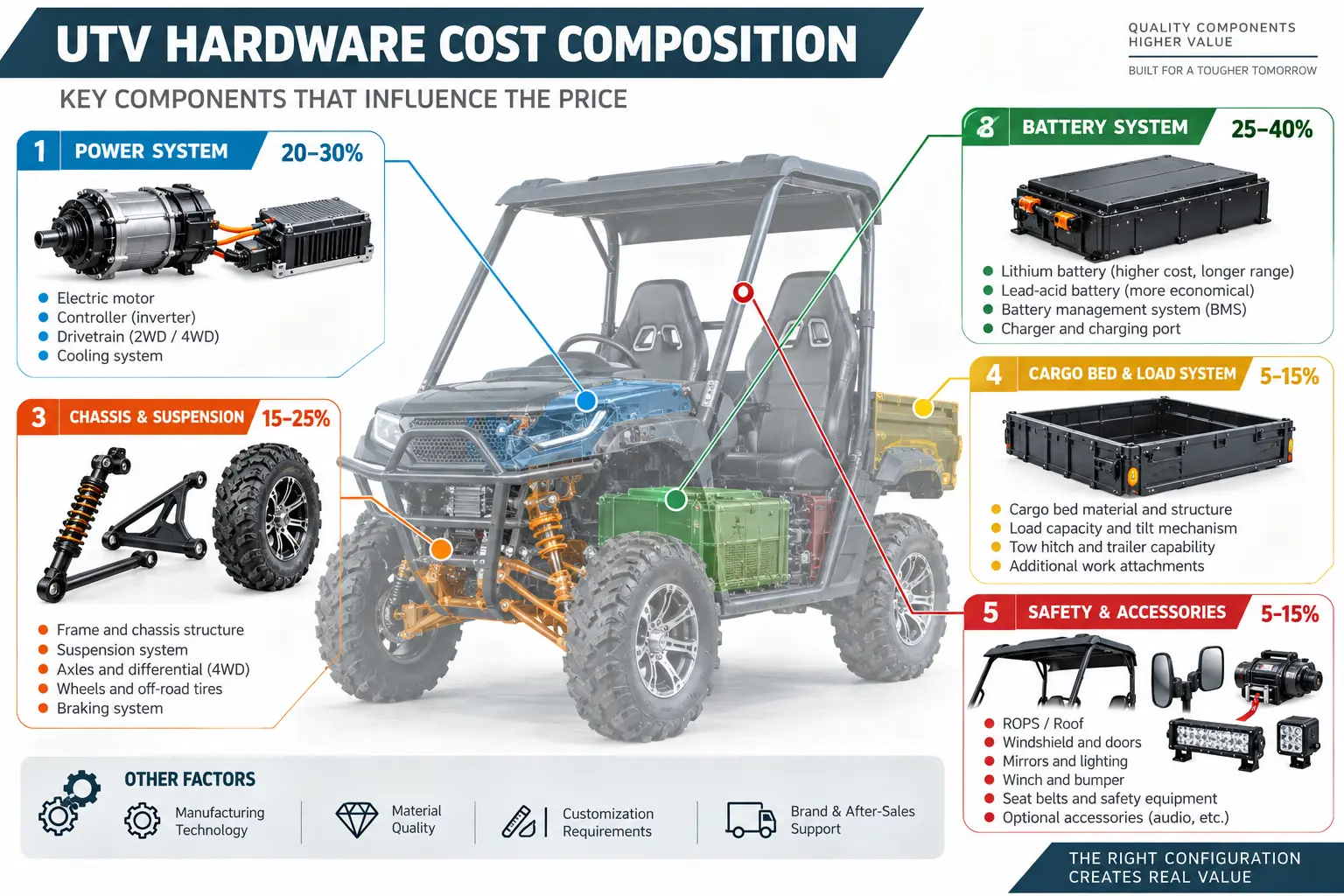
The power system is the core heart of UTV. The upgrade of power parameters is not a simple power increase, but a comprehensive iteration of the entire hardware, heat dissipation, transmission, and chassis system. It is also the core reason for the sharp increase in prices. The power pricing logic of fuel and electric UTV has its own focus.
The fuel UTV is divided into four echelons according to horsepower: 16-50 horsepower entry model, suitable for basic light-weight operation, priced at 8,000-14,000 US dollars, representing Kawasaki Mule SX; The 50-100 horsepower mid-range model, which takes into account operation and cross-country, costs 14,000-22,000 US dollars and covers mainstream models in the market. 100-180 horsepower high-performance models, suitable for high-intensity cross-country, priced at 20,000-intensity cross-country, priced at $35,000, such as Bombardier Maverick R, Polaris RZR Pro R and other top models.
Turbocharged power is the core premium point of high-end models. Compared with naturally aspirated engines with the same displacement, turbocharged models need to be equipped with exclusive cooling systems, reinforced clutches, high-strength drive shafts, and high-pressure resistant cylinders. The production cost of the entire set of accessories has increased significantly, which is also the core reason why the same series of turbo versions are thousands of dollars more expensive than the ordinary version. At the same time, the high-end models are equipped with dual-clutch gearbox and refined CVT gearbox. Compared with the basic transmission structure, the control accuracy, durability, and power conversion rate are fully upgraded, further increasing the price.
Electric UTV takes power (kW) as the core parameter, and 5-15kW low-power motors are suitable for entry-level light-duty vehicles, with lower prices. 20-80kW medium-power motor is standard for mainstream electric UTV, with sufficient power to cope with full-scene operation and off-road operation. The selling price is concentrated at US $20,000-35,000. High-power motors above 100kW, with exclusive electronic control systems and heat dissipation systems, are only used for high-end electric flagship models. At the same time, the motor power upgrade will support the strengthening of the controller, transmission structure, battery system, the formation of a full set of hardware premium.
The complexity of off-road scenes requires extremely high suspension and chassis of UTV. It is also the core standard to distinguish ordinary models from high-end models. The weight of the impact on price is second only to the power system. Suspension stroke, shock absorption brand, chassis material, tire and wheel configuration, each upgrade will bring thousands of dollars in price fluctuations.
UTV is equipped with 8-12 inch basic suspension stroke and ordinary dual-speed shock absorber, which can only filter slight bumps, has low production cost and is suitable for leveling the ground. The suspension stroke of the mid-range all-round model is increased to 10-14 inches, and the independent double A- arm suspension is upgraded, thus greatly improving the shock absorption effect and passability. The high-end off-road vehicle is equipped with 14-20 inch ultra-long travel suspension and equipped with FOX, Walker Evans and other top international professional shock absorption, some flagship models are equipped with an electronic adaptive damping system, which can automatically adjust the softness and hardness according to the terrain. The cost of a single set of damping equipment is far higher than that of ordinary vehicle suspension, and the premium is extremely obvious.
In terms of chassis materials, entry-level models use ordinary thin-walled steel with simple structure and low cost; mid-to-high-end models use high-strength alloy steel and lightweight alloy materials. After precision welding and reinforcement, they have stronger impact resistance, distortion resistance, and corrosion resistance., Can cope with extreme off-road impact and heavy load pressure for a long time. At the same time, high-end models are equipped with a full set of chassis guards, reinforced arms, and thickened drive shafts to further increase hardware costs.
Tires and wheel hubs also affect pricing. Entry-level models are equipped with 25-30 inch ordinary four-season tires and basic compression rating. High-end models are equipped with 32-35 inch large-size professional off-road tires, 6-10-level high-pressure explosion-proof structure, suitable for extreme terrain such as mud, rock and sand, and with anti-ring competitive wheel hubs, the cost of a single set of tire hubs can be increased by 1,000-3,000 US dollars, which is the iconic premium configuration of high -3,000.
Payload, Cargo Bed Capacity and Towing Capacity
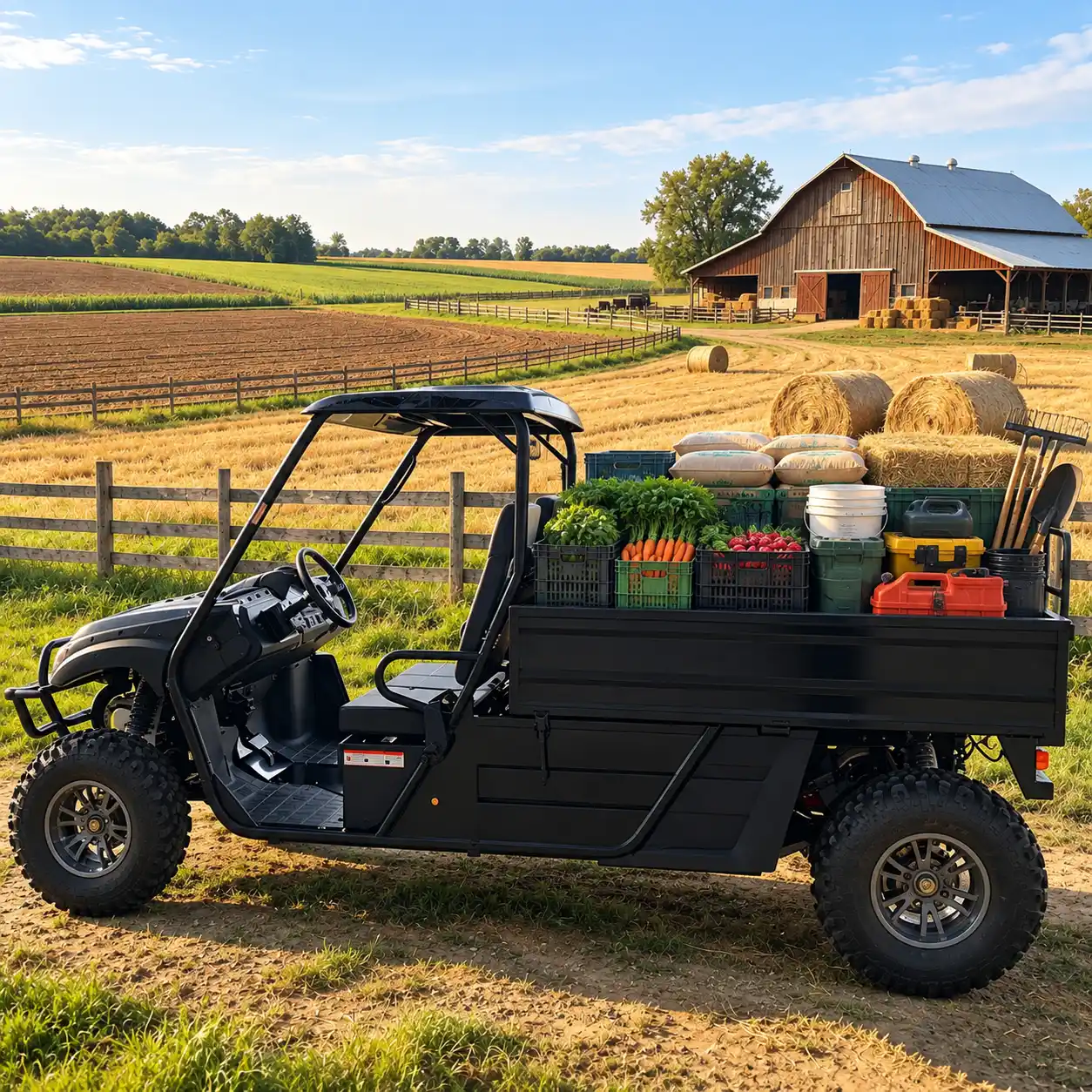
This factor is the core pricing criterion for operational UTV, and the higher the load and towing capacity, the higher the cost of structural strengthening of the vehicle and the higher the pricing. The load parameters of UTV are divided into two core indicators: the load of the cargo bucket and the total load of the whole vehicle. At the same time, the traction capacity determines the upper limit of the vehicle.
The entry-level compact UTV cargo bucket has a load of only 400-600 pounds, the total load of the whole vehicle is 800-1200 pounds, the cargo bucket is narrow in size, simple in structure, no reinforced design, and the lowest cost. The cargo bucket of the middle-end medium-sized operation vehicle carries 600-1000 pounds and the whole vehicle carries 1200-1500 pounds. The cargo bucket of high-end full-size heavy-duty vehicles can carry 1000-1500-1500-1500 pounds and 2000 pounds, no manual handling is required, and the operation efficiency is greatly improved.
In terms of traction capacity, the traction weight of entry-level leisure vehicles is only 1,000-1,500 pounds, and only small equipment can be towed. The traction weight of mainstream full-size operating vehicles is 2,000-2,500 pounds, which is suitable for most agricultural and engineering traction requirements. The traction weight of high-end heavy-duty flagship models can reach 3000-4000 pounds. It is equipped with enhanced traction chassis, special heat dissipation system and low-speed high-torque gear set.
It should be noted that competitive off-road UTV will deliberately weaken the load and traction capacity and give priority to lightweight design. Therefore, the high price of such models comes from off-road hardware rather than load configuration, which is completely opposite to the pricing logic of operational UTV.
The configuration difference between two-wheel drive and four-wheel drive is the most intuitive price watershed between entry and mid-range UTV. The four-wheel drive version of the same model is 500-2000 US dollars more expensive than the two-wheel drive version, and the four-wheel drive upgrade premium of high-end models is higher. The core reason for the price gap is that the four-wheel drive system needs to add a full set of front differentials, drive shafts, transfer cases, strengthened half shafts, and anti-skid locking structures. The number of parts has increased significantly and the assembly process is more complicated.
The 2WD two-wheel drive model has simple structure, lighter weight, lower energy consumption, and low maintenance cost. It is suitable for simple scenes such as leveling farmland and courtyards. It is the first choice for users with limited budget and light use. It is also the mainstream configuration of entry-level models. However, the two-wheel drive model has limited grip, and it is easy to slip and sink in complex terrain such as mud, steep slopes, sand, and snow, and its passability is extremely poor.
4WD four-wheel drive models are divided into time-sharing four-wheel drive, timely four-wheel drive, and full-time four-wheel drive. High-end models are equipped with differential locks and terrain adaptive systems, which can automatically distribute four-wheel power according to road conditions. Extreme terrain passability and stability, Traction is fully upgraded, suitable for full scene use. At the same time, the chassis, half-axle, and brake systems of the four-wheel drive model have been strengthened, and the overall durability is stronger, and the value retention rate is much higher than that of the two-wheel drive version.
For the vast majority of users, the premium of four-wheel drive is extremely cost-effective and is also standard for UTV above the middle end. For users who only use the two-wheel drive version for a long time, they can save their budget by choosing the two-wheel drive version without blindly upgrading the four-wheel drive.
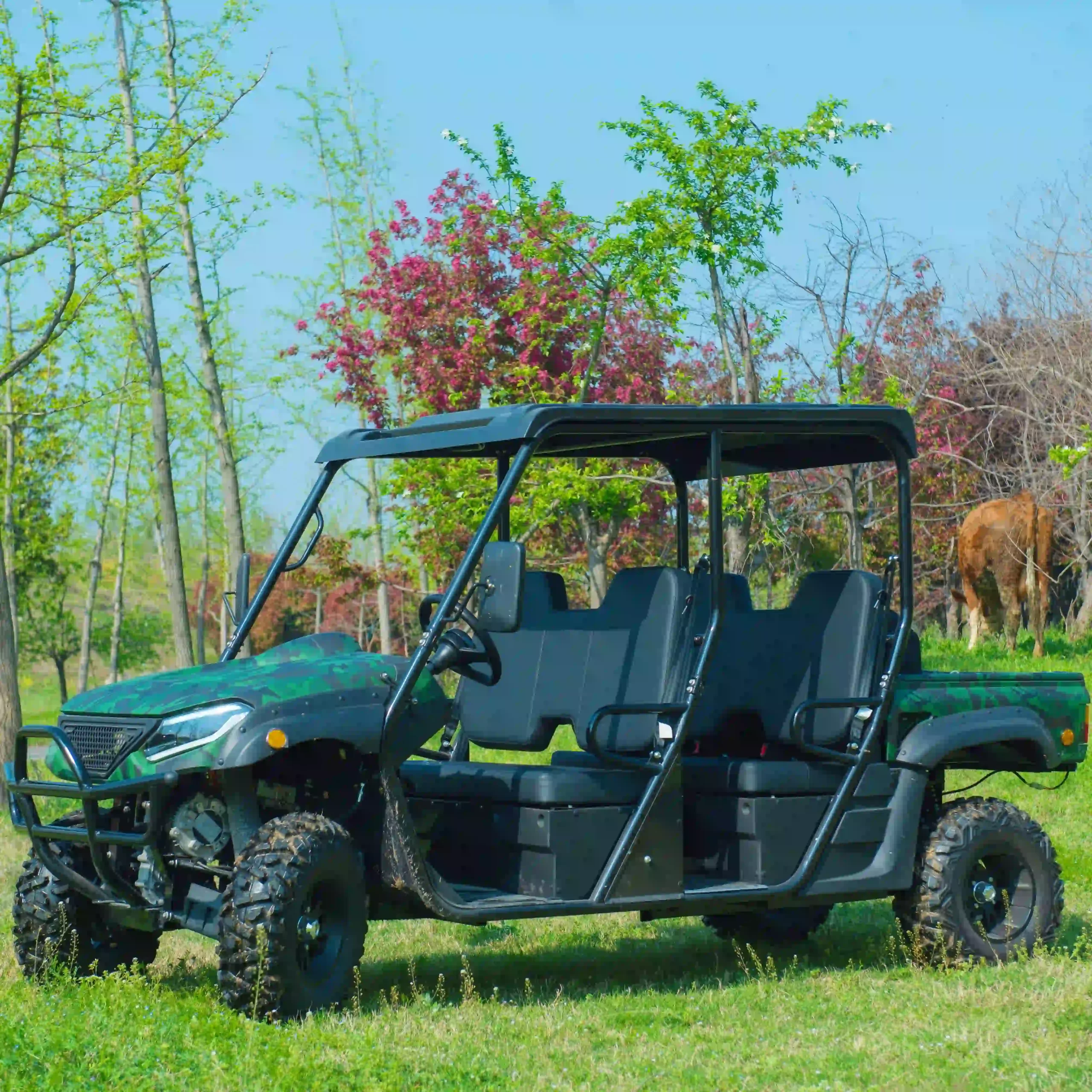
The body size and the number of passengers directly determine the amount of materials used in the vehicle. At the same time, it needs to be matched with different lengths of chassis, drive shafts, protective structures and safety configurations. The more seats and the larger the body size, the more obvious the price premium. Industry mainstream data show that the four-seat passenger version is 2,000-4,500 US dollars more expensive than the two-seat basic version, and the premium for the six-seat flagship version can reach 3,000-8,000 US dollars.
The two-seater UTV has compact body, shorter wheelbase, stronger flexibility, and the least materials. It is the lowest-priced basic version. It is suitable for single-person, double-person operations or off-road operations, and is more convenient to store and transport; the 3-seater model takes into account both passenger and cargo space. It is a popular choice for agricultural operations with a moderate premium; the four-seat and six-seat passenger models need to lengthen the chassis, add body panels, install a full set of seat belts, and ROPS protective structure. The overall weight is greatly increased, and the production cost is significantly increased.
At the same time, wide-body full-size models have stronger chassis stability, upper load limit, protection capability, higher material and process standards than narrow-body compact models, and pricing will rise simultaneously. However, large-size models have the disadvantages of large turning radius, poor flexibility, and large storage space. Users do not need to blindly pursue multi-seat and large-size models, and choose on-demand models to avoid budget waste.
Safety configuration and control system are the core upgrade items of mid-range models. Although the weight of the impact on the price is lower than that of the power and suspension system, it directly determines the control safety and comfort of the vehicle. It is also an important distinction between high and low models. The upgrade can bring a price premium of 1,000-3,000 US dollars.
In terms of steering system, the entry-level low-profile car has no electronic power assistance, and the steering is heavy, and the control fatigue is extremely strong in off-road and heavy-duty scenarios. EPS electronic power steering is standard for medium and high-end models, and some high-end models are equipped with multi-mode power adjustment, which can automatically adjust the steering force according to the vehicle speed and terrain, greatly reducing the control difficulty and improving the driving stability. It is a premium configuration with high practicability.
In terms of brake system, entry-level models use single-piston calipers and ordinary brake discs, which have long braking distance, poor heat resistance, and are prone to thermal attenuation under heavy load and high-speed scenarios. High-end models are equipped with multi-piston calipers and enlarged perforated brake discs, with EBS engine braking, steep slope descent and brake assist system. Some flagship models are equipped with ABS anti-lock braking system, which greatly improves the braking safety of complex terrain.
Safety protection configuration is the basic standard of all UTV, but there is a great gap between high and low quality. All models are equipped with ROPS anti-roll protection frame. High-end models use thick high-strength steel, with more precise welding process and stronger impact resistance. At the same time, high-end models are equipped with four-point and five-point professional seat belts, fully enclosed doors and protective nets. Compared with basic three-point seat belts, the safety protection level is greatly improved and the corresponding production cost is also higher. At the same time, models need to pass a number of industry safety certification, compliance testing costs will also be allocated to the vehicle pricing.
The pricing logic of electric UTV(eUTV) is obviously different from that of fuel vehicles. The battery system is the core cost module of electric UTV, accounting for 30%-40% of the cost of the vehicle power system. The material type, capacity size and technical standard of the battery directly determine the selling price, endurance, service life and performance of electric UTV, and are the core price influencing factors of electric vehicles.
Price and performance differences of battery material types
Electric UTV mainstream batteries are divided into 4 types, material differences directly open the model price and performance gradient. Entry-level low-end models are generally equipped with lead-acid batteries, which are low in cost, but have short life, bulky, slow charging, and unstable working conditions. They are only suitable for short-term light use. Mid-range models mostly use ordinary lithium batteries, which are lighter and have better power performance than lead-acid batteries, but their heat resistance and durability are average, which is a transitional configuration. At present, the new electric UTV mainstream standard in 2025-2026 lithium iron phosphate battery, With the highest proportion of installed capacity, it has the advantages of safety and stability, high and low temperature resistance, and long cycle life. The cost is controllable and the comprehensive cost performance is outstanding, covering most of the high-end models. The top flagship electric UTV is equipped with a high-nickel ternary lithium battery, which has high energy density, stronger battery life, and good lightweight effect, but it is expensive and has weak thermal stability. It is the main source of battery premium for high-end models.
The direct impact of battery capacity on pricing
Battery capacity is the core indicator that determines the battery life, power and price of electric UTV. The larger the capacity, the stronger the battery life and power reserve, but the cost of building the car and the weight of the body also increase, forming a clear market price gradient. Small-capacity batteries below 10kWh are mostly used in entry-level models, priced at US $12,000-18,000, with limited endurance and only suitable for short-distance light operations. The 10-25kWh medium-capacity battery is the mainstream configuration in the market, suitable for most operations and off-road scenarios, with the highest comprehensive cost performance. The selling price of the models is generally 20,000-35,000 US dollars. Large-capacity batteries above 25kWh are only used in high-end flagship models, which can support long and can support long-high-high-intensity off-road operations, the top-of-the-line version can reach more than $45000.
Battery cost iteration and long-term use value
With the iteration of power battery technology, the unit price of batteries has been greatly reduced, driving the price of electric UTV to gradually move closer to fuel models. Although the premium for electric UTV purchases is generally between US $3,000 and US $15,000, the advantages of long-term use are outstanding. The life of the mainstream lithium iron phosphate battery can reach 5-10 years, the cost of electricity is low, and the electric vehicle does not need to replace the oil, spark plugs and other wearing parts, and the maintenance is very simple. From the 5-10 year full-cycle cost point of view, electric UTV can significantly save energy consumption and maintenance costs, completely offset the pre-purchase price difference, the overall cost-effective.
Secondary Price Factors Affecting UTV: Brand, Manufacturer, and After-Sales Support
In addition to the core hardware, secondary factors such as model configuration, production process, brand reputation, after-sales system, market policy and customized service will also greatly affect the final selling price of UTV, which is also the core reason for the price gap between models with the same hardware parameters, and is the key to pricing that consumers easily ignore.
Configuration Grade And Original Optional Accessories
The basic version of UTV only retains the core driving and operating functions, the lowest price, medium and high-end models by adding various types of original optional accessories to pull up the price, a full set of original optional configuration can bring a price premium of $3000-8000.
Common premium configurations are divided into three categories: roof, windshield, closed door and other protective accessories, which are just needed in daily life and cost 1,000-4,000 US dollars. Comfortable configurations such as air conditioning, heated seats and car audio are exclusive to high-end models. Functional accessories such as electric winch, competitive lighting and expanded cargo hopper greatly improve the practicability of operation and cross-country. At present, most of the optional functions are gradually converted to standard, and the quality and adaptability of the original accessories are far better than those of third-party products, further pushing up the basic selling price of medium and high-end models.
UTV is a niche special vehicle, mass production scale is much lower than the family car, research and development, mold, production line commissioning and other fixed costs can not be shared on a large scale, directly raise the price of bicycles.
There is a significant gap between the process and materials of high and low models: high-end models adopt high-precision molds, robot welding and strict factory inspection, and are matched with high-strength alloys and thickened customized parts, with high structural strength and low failure rate; entry-level models adopt common technology And conventional materials, lower cost but weak quality control and durability. At the same time, high-end flagship models need to invest a lot of money for limit testing, event research and development and technology iteration, the related research and development costs are ultimately reflected in the terminal price, forming a significant process premium.
Ordinary off-road UTV only needs to meet basic safety standards, and the certification cost is relatively low. UTV with legal on-road qualification needs to pass a full set of safety, emission, lighting and braking compliance certification, and is equipped with supporting devices such as turn signals, instrument panels and speed limit systems. The overall compliance upgrade cost can reach hundreds to thousands of US dollars, directly raising the terminal price.
In addition, the continuous updating of industry safety and environmental protection standards, forcing manufacturers to iterate production processes and optimize vehicle configuration, is also an important indirect reason for the steady increase in model prices.
Standardized mass production UTV has the lowest cost, while various custom modifications will break the pace of mass production and significantly increase production costs. The original factory’s exclusive color matching, customized interior decoration, event-level hardware upgrade and other personalized modifications will produce a significant premium, and the price of heavily modified models will even double.
On the contrary, bulk procurement has significant price advantages: there is no discount for individual single procurement, 5%-15% ladder discount for 2-5 small-batch procurement, manufacturer’s exclusive policy for more than 6 commercial fleet procurement, up to US $1750 for single procurement, 20%-40% price difference for large-batch dealer procurement, and high cost for small-batch ODM customized models.
The difference in landing prices in different regions of the same UTV comes mainly from various hidden costs. Among them, the logistics landing fee of 400-1200 US dollars, regional differentiated purchase tax and service fee are the basic floating items. Fluctuations in import tariff policies for complete vehicles and parts will directly affect the manufacturer’s production costs and transmit them to the terminal selling price, with regional differences up to thousands of US dollars. At the same time, dealer inventory pressure, seasonal supply and demand changes, will also cause UTV terminal prices short-term rise and fall, affecting the final cost of car purchase.
The purchase of UTV can not only look at the unit price of the car, long-term maintenance, repair, energy consumption, depreciation and other full-cycle car costs, is the key to affect the overall cost performance. The data shows that the average user’s annual UTV car cost is 500-2,500 US dollars, and the cost is higher under high-intensity use scenarios. The 5-year comprehensive car cost can reach 3,000-10,000 US dollars.
Routine maintenance costs include oil filter replacement, air filter element cleaning, whole vehicle oil detection, chassis fastening, etc. The single basic maintenance cost is US $50-150, and the annual basic maintenance cost is US $200-800. Energy consumption costs fluctuate according to the length of use. The average annual fuel cost for fuel models is US $200-1,000, while that for electric vehicles is less than half of that for fuel models. In terms of replacing wearing parts, tires, brakes, belts, belts and batteries are high-high-high-high-high-high-high-high, faster loss in high-intensity off-road scenarios. In addition, the cost of insurance, annual inspection, storage and maintenance, etc., is also a fixed annual expenditure.
The long-term cost gap between fuel and electric UTV is significant: electric UTV has no oil, belt, and clutch loss, daily maintenance is extremely simple, and long-term maintenance costs are extremely low. Only the problem of battery aging and replacement needs to be considered; fuel UTV has a complex power structure and many vulnerable parts. High maintenance frequency and higher maintenance cost. At the same time, the first-line brand model accessories have strong versatility, convenient maintenance, slower depreciation speed, and the later maintenance cost of niche brand models is higher and the value preservation rate is lower.
On the whole, although the purchase cost of low-priced and low-end models is low, the failure rate is high, the maintenance is frequent, and the depreciation is fast, and the long-term comprehensive cost is often higher; the mainstream models with medium and high-end models have strong stability, high durability, and balanced maintenance costs, and the whole cycle The cost performance is the best.
Combined with various price influencing factors of UTV, the following standardized purchase scheme is organized according to different budgets and usage scenarios, and the selection criteria, adaptation crowd and pit avoidance points are clearly displayed in tabular form, so as to facilitate users to accurately match models, avoid premium waste, and maximize budget and practicality.
| Budget interval | Adapt to the scene and crowd | Core purchase recommendations | Principles of purchasing and avoiding pits |
| Within $12000 | Family courtyard operation and maintenance, small farm light operation, short-distance low-speed use, almost no complex cross-country needs. | The first-line brand entry-level two-seat two-drive UTV is preferred, which focuses on basic load and short-distance traction, simplifies redundant off-road and comfortable configuration, and focuses on ensuring the stability and durability of the whole vehicle to meet the basic daily use. | Resolutely avoid niche miscellaneous brand high-end models, such models with false parameters, poor quality control, scarce accessories, high maintenance costs and high failure rate in the later period. |
| US $12,000-18,000 (price/performance gold range) | Ordinary individual users, small and medium-sized farms, taking into account daily operations and light mountain, rugged road crossing, the most comprehensive use of the scene. | Select the standard model of the mid-end all-round four-wheel drive, with basic assistance, full-vehicle protection and other just-needed configurations, balance practicality and passability, give priority to the original finished product configuration, no additional accessories, one-step adaptation to the whole scene mild use | No need to blindly install redundant off-road accessories, comfortable configuration, to avoid additional budget waste, the standard version is sufficient to meet the needs of the vast majority of users |
| $18000-28000 | High-frequency commercial operation and maintenance, moderate off-road enthusiasts, long-term operation of large-scale farms, higher requirements for vehicle performance, comfort and durability | Choose first-line brand mid-to-high-end models, equipped with upgraded suspension, four-wheel drive lock, smart instruments, and a full set of professional protective accessories, taking into account work efficiency, off-road passability and driving comfort, and suitable for high-intensity normal use | Focus on checking the landing price of the whole vehicle, do not only refer to the official guide price, and calculate the hidden costs such as taxes and transportation fees in advance to avoid budget overruns. |
| More than $28000 | Professional extreme off-road, heavy commercial operation, long-term outdoor use, the pursuit of top performance and car experience | Optional flagship high-end models, equipped with closed cockpit, cold and warm air conditioning, top competitive suspension, high-power power system, can cope with extreme terrain, long-term high-intensity operations and professional off-road scenes | Select exclusive events and commercial customized configurations on demand, eliminate blind top matching, match performance according to working conditions, and avoid functional redundancy premium. |
General Core Selection Guidelines: Agricultural operations give priority to load, traction capacity and vehicle durability; Off-road entertainment gives priority to power, suspension and terrain passability. Just need to configure the mandatory, redundant high configuration abandoned; Priority should be given to mainstream brands to ensure the after-sales system and vehicle preservation rate; With limited budget and vehicle condition screening ability, priority can be given to high-quality second-hand UTV, with higher cost performance.
FAQ
Vehicle positioning and core use are the first influencing factors. The design standards and hardware configuration gaps of operational, all-round and competitive vehicles directly determine the price difference of tens of thousands of US dollars, far exceeding secondary factors such as brands and accessories.
For ordinary household and light operation users, the mid-range model with the highest cost performance of US $12,000 to US $18,000 is available. With limited budget, you can choose 8,000-12,000 USD entry-level models, which fully meet the basic requirements.
Long-term high-frequency use scenario is worth starting with, although the early premium is high, but the energy consumption, maintenance costs are extremely low, more than 5 years of use cycle can recover the difference.
The vast majority of scenes are worth it. The passability, stability and safety brought by the four-wheel drive are greatly improved, and the price difference is extremely cost-effective. Only for the fixed operation of the pure leveling site, the two-wheel drive version can meet the demand.
The four-seater and six-seater passenger version has a wider demand for commercial and household use, and has better market liquidity. The value preservation rate is slightly higher than that of the two-seater version, but the premium is too high, so you can choose on demand.
The flagship off-road UTV is equipped with turbocharged high-power power, professional competitive suspension, high-strength customized chassis, a full set of off-road hardware, research and development and production costs are extremely high, and the audience is small, mass production scale is small, the cost can not be shared, so the pricing remains high.
Summary
On the whole, the price gap of UTV is not caused by a single brand premium, but is the result of the joint decision of product positioning, core hardware, production process, battery configuration, brand after-sales and various hidden costs. The usage, power, suspension, driving and load capacity of different models constitute the core pricing gradient. Electric UTV takes battery system as the key price difference factor, and consumers do not need to blindly pursue top-end or low-price entry models when purchasing, combining its own usage scenario, terrain conditions, usage frequency and budget requirements to match the corresponding models, abandoning redundant configuration, and taking into account the cost of full-cycle vehicles, it can effectively avoid the purchase trap and maximize the cost-effectiveness of car purchase.
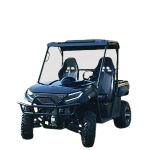
Explore our high-performance electric utility vehicles designed for tough terrains, off-road adventures, and sustainable utility tasks. Direct factory pricing.


-150x150.png)