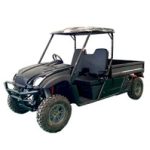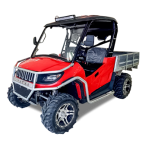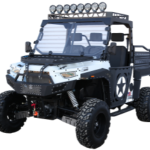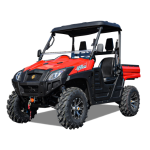
Mud is one of the most severe working conditions in UTV cross-country and field operations. Ordinary leisure UTV is difficult to adapt to complex scenes such as deep mud pits, muddy swamps, and soft mud after rain. Problems such as tire slippage, chassis bottom support, water inflow failure, and vehicle sinking are extremely easy to occur, which not only affects traffic efficiency, but also causes parts loss and increases maintenance costs.
Most novice buyers have serious misunderstandings. They blindly value engine horsepower, but ignore the core configurations such as ground clearance, special mud tires, four-wheel drive lock, and waterproof protection of the whole vehicle, which leads to the actual mud performance of the vehicle. Discount. The truly professional mud UTV is based on the all-round matching of passability, grip, stable power, body protection and escape ability, rather than relying solely on high horsepower.
What is a UTV?
UTV’s full name Utility Task Vehicle, also known as Utility Terrain Vehicle. Its Chinese common name is multi-function task vehicle and all-terrain side-by-side off-road vehicle. It is often referred to as SxS(Side-by-Side) in the industry. As a multi-functional off-road vehicle specially designed for complex non-paved roads, UTV takes into account multiple scenes such as outdoor entertainment, engineering operations, site operation and maintenance, agricultural and forestry labor, and is currently one of the all-terrain vehicles with the highest utilization rate in off-road circles, agricultural and forestry pastures and outdoor construction fields.
The biggest difference from the traditional ATV ATV, UTV adopts a car-style driving design, which completely gets rid of the ATV straddle control mode, and has stronger riding comfort, higher safety and better carrying capacity. It is also the core advantage of being able to adapt to long-term mud operations and multi-person teams on mud off-road.
Ordinary original UTV can deal with simple muddy roads such as dry dirt roads and mild wet and soft grasslands, but if you want to gallop deep mud pits, sticky swamps, concrete and other severe scenes, you must have exclusive mud performance configuration. The core difficulty of mud driving is not high-speed driving, prevent the chassis from bottoming the car, ensure the continuous grip of the tires, stable escape at low speed, and avoid muddy water from invading the core components the following is the core configuration and auxiliary configuration necessary for professional mud UTV, which is also the core basis for purchase and modification.
Ground clearance is the most basic and important parameter of mud UTV, which directly determines whether the vehicle can smoothly pass through deep mud pits and bumpy muddy roads. The clearance of ordinary leisure UTV from the ground is only 8-11 inches, and it is easy to have the chassis sticking mud and sticking to the bottom in deep mud. However, the clearance of professional mud UTV generally reaches 12-15 inches, and some high-end models and modified models can exceed 16 inches. The ultra-high ground clearance can allow the body to suspend on the mud surface, prevent the chassis, differential, and suspension parts from falling into mud, and reduce the probability of car trapping from the root. The arch A- arm design is matched to further improve the angle of the chassis and adapt to the ups and downs. Muddy terrain.
It is recognized in the industry that tires are the first modification configuration that determines UTV’s mud performance, and it is also the most cost-effective upgrade scheme. Ordinary all-terrain tires have shallow tread patterns and small grain spacing. When driving in sticky mud, they will quickly fill up mud blocks and lose their grip and become “light tires”. However, professional mud tires are specially designed for mud scenes and have ultra-high deep tooth lines of 1.5-2.5 inches with wide and loose grain spacing. During driving, the attached mud can be automatically thrown off to achieve self-cleaning effect and continuously maintain the grip ability.
At the same time, high-quality mud tires adopt a 6-8-layer thickened carcass structure, which has stronger puncture resistance and tear resistance, and can resist scratches of tree roots, gravel and hard objects hidden in the mud. The mainstream adaptation size is 28-32 inches, and the heavy mud cross-country can be upgraded with 33-37 inches of large-size tires. Mud tires with excellent reputation on the market include System 3 XM310, ITP Cryptid, Margis Mudzilla, High Lifter Outlaw, Bailuo Chi KM3, etc. In addition, mud driving needs to reduce the tire pressure to 6-12PSI, expand the tire contact area, improve the body buoyancy, and further reduce the risk of car trapping.
The friction of the mud terrain is extremely uneven, and the tires on one side are extremely easy to hang and slip. Ordinary two-wheel drive and ordinary four-wheel drive models cannot distribute power and will continue to idling and dig pits, causing the vehicle to sink deeper and deeper. Professional mud UTV is equipped with a switchable four-wheel drive/full-time four-wheel drive system, equipped with front and rear locking differentials, and some high-end models are equipped with intelligent mud mode (such as Bombardier Smart-Lok intelligent differential), which can automatically identify slipping wheels and power Accurately distribute to tires with grip to prevent ineffective idling.
At the same time, the exclusive low-speed climbing gear is the key to getting out of the mud. The low-speed gear can amplify the engine torque, allowing the vehicle to crawl smoothly at a low speed and high torque. It can easily break through the heavy mud resistance without increasing the speed and avoid high speed. Tire idling and body pit problems caused by speed.
Many users mistakenly think that “the higher the horsepower, the stronger the mud performance”, but in fact, mud driving is more important low speed torque output rather than peak horsepower. The mud has high resistance and strong viscosity. It requires the vehicle to output continuous and stable traction at low speeds to drive the body to slowly get out of trouble and pass at a constant speed. Professional mud fuel UTV is generally equipped with 800-1000cc and above large displacement engines, with specially adjusted CVT gearbox and clutches to meet the load demand of large mud tires. Electric UTV, with its natural advantage of zero speed peak torque, performs particularly well in low-speed mud crawling and relief scenes.
Mud and stagnant water on muddy roads are most likely to cause vehicle core failures: mud and stagnant water can easily invade the fuselage through the engine air intake and CVT air intake, causing fatal problems such as engine water ingress, cylinder holding, and belt damage. The professional mud version UTV comes standard with high wading pipe (snorkel), which raises the air inlets of the engine, clutch and CVT to the roof position to effectively avoid deep water and deep mud intrusion. At the same time, the electronic components, bearings and differential of the whole vehicle are sealed, and the radiator is arranged at a high position or exclusively protected to avoid high temperature failure caused by mud wrapping heat dissipation components and greatly improve the driving stability on mud.
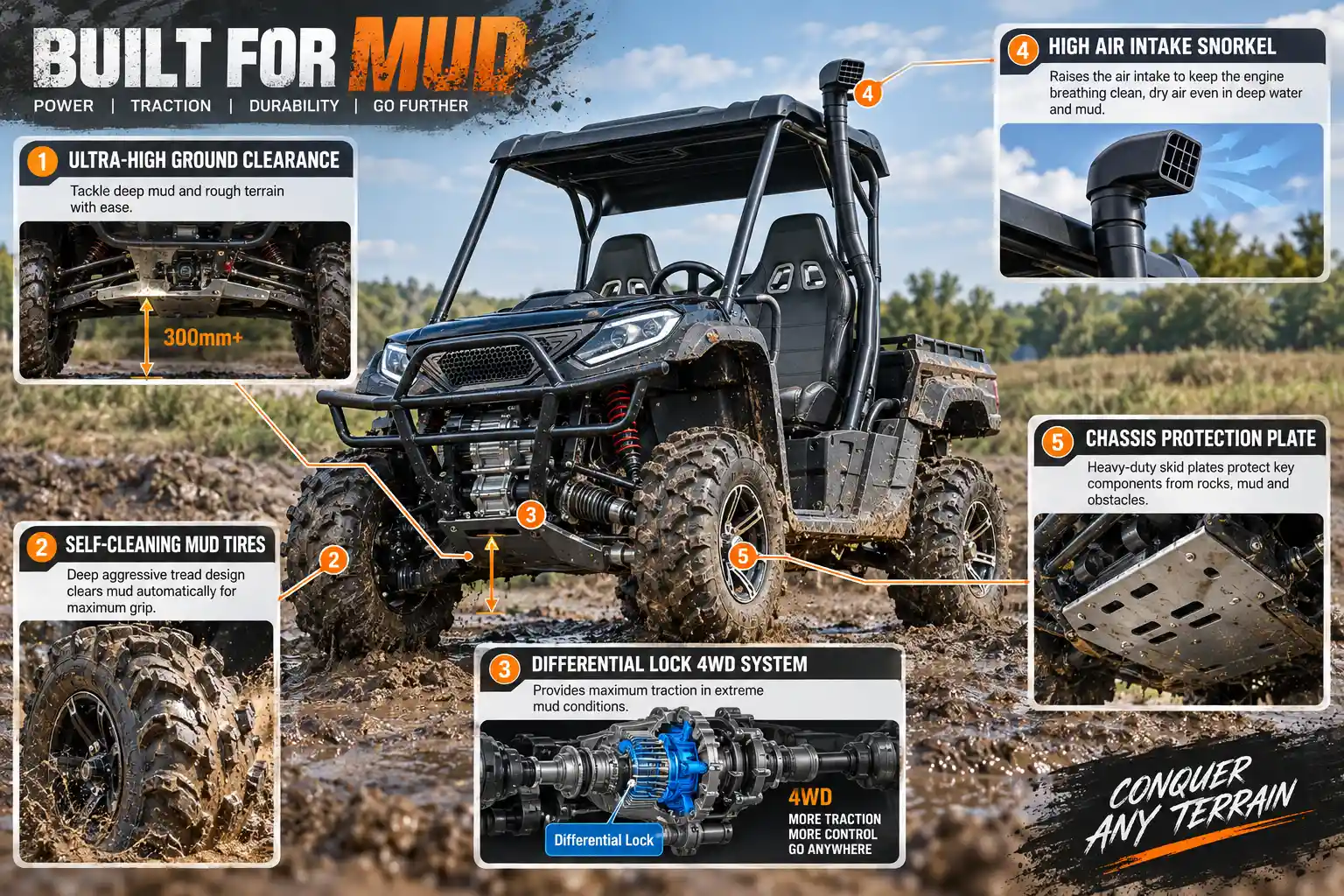
In addition to the 5 large core configuration, the high-quality mud UTV is also equipped with a number of auxiliary configurations to adapt to heavy mud conditions in all directions: long-stroke independent suspension with high-strength arch A- arm to ensure that the tire fits the uneven muddy ground throughout the process and reduce the probability of suspension skidding; Full-size heavy-duty chassis guard plate, fully covering the chassis, suspension and transmission components, and resisting mud impact and hard objects; Professional winches of 4500 pounds and above are standard, it is the core equipment for self-rescue of trapped cars, which can be completed without external force; strengthen the transmission shaft, thicken the clutch belt, and adjust the exclusive mud program to optimize for high-load conditions in the mud, reduce the wear of parts, and extend the service life of the vehicle.
Ordinary original factory commuting and off-road UTV can only cope with shallow and dry muddy roads, and cannot adapt to severe scenes such as deep mud pits, swamps and concrete floors. If you want professional mud traffic capacity, you should give priority to the exclusive version of the brand’s original mud. Compared with the later full modification, the original model configuration has higher matching degree, stronger stability, lower cost, and more guaranteed vehicle warranty.
With the popularization of new energy technology, electric UTV has gradually entered the public view with the advantages of low maintenance, zero emission and silent operation. Many users struggle with whether to choose electric UTV or fuel UTV for mud scenes. There is no absolute difference between the two. The core adaptation scenes are different: electric UTV has low-speed controllability and better low-torque performance, and is suitable for light mud operations and short-distance crossing. Fuel UTV has longer endurance, larger modification space and stronger stability under extreme working conditions. It is suitable for cross-country, long-distance crossing and all-day operation in heavy mud. The following is a full depth comparison.
Electric UTV has the advantage of natural torque. The motor can output peak torque at 0 speed. The power is linear and smooth. The throttle control is accurate. When crawling on mud at low speed and getting out of trouble, the traction force can be output smoothly without deliberately controlling the speed. There will be no problems of speed delay and abrupt power of fuel vehicles. Novice can easily control it. It is suitable for fine mud operation and mild relief. The representative model Polaris Ranger XP Kinetic electric UTV, which can output 110 equivalent horsepower and 140 pound feet of peak torque, with excellent performance in mud climbing and dragging.
Fuel UTV torque is gradually released with the increase of speed, and low-speed torque is weak, requiring skilled throttle control skills to avoid skidding. However, the high-speed peak horsepower is stronger and the continuous power output capability is outstanding. It is suitable for heavy mud rolling, deep pit high-speed crossing and long-term high-intensity mud operation. The explosive power under extreme working conditions is better than that of electric vehicles.
Because the electric UTV is equipped with a large-capacity battery, the weight of the whole vehicle is larger. Compared with the fuel UTV, the vehicle of the same grade weighs about 200-300 pounds, and the grounding pressure is greater. It is easier to sink in the extremely soft swamp and deep mud, and the probability of car sinking is slightly higher. Fuel UTV body lighter, better mud buoyancy, more light driving posture, is the first choice for heavy mud off-road. Users can effectively make up for the short weight of the electric UTV by replacing large-size mud tires and lowering the tire pressure.
Mud driving is a high-load condition, which will greatly increase energy consumption and fuel consumption. The official endurance of the electric UTV is 45-80 miles. Under mud conditions, the actual endurance will shrink by 40%-60%, and it will take several hours to fully charge, which cannot realize fast energy replenishment. It is not suitable for long-distance, all-day, field mud operations and cross-country operations without charging conditions. The fuel UTV 1 tank can travel more than 100 miles, takes only a few minutes to refuel, and can also carry spare fuel. It is the best choice for remote muddy sites with continuous operation and long-distance cross-country capability over electric vehicles.
Fuel UTV has a mature mud modification system. The original factory comes with professional mud versions such as High Lifter and X MR. The modification accessories are rich and the technology is mature. It can easily upgrade suspension, tires, wading and protective kits. Electric UTV is currently dominated by utility versions, with very few original exclusive mud versions, relatively few modified accessories, and more difficult to upgrade heavy mud.
In terms of maintenance cost, electric UTV has significant advantages. There are no vulnerable parts such as oil, spark plugs, air filter elements, CVT belts, etc. There is no need to replace consumables frequently after mud use, and the long-term use cost is lower; fuel UTV filter elements, belts, and oil under mud conditions The loss is great, and the maintenance frequency and maintenance cost are higher. In terms of use experience, electric UTV is silent and has zero emission, which is suitable for hunting, animal husbandry and muddy operations around residential areas. Fuel UTV has more noise and exhaust emissions, but the working conditions are more suitable. In low temperature environment, the endurance of electric UTV will be greatly reduced, and the performance of fuel UTV will be more stable.
priority selection electric Mud UTV: Users who daily farm, manor muddy site operation and maintenance, short-distance mud crossing, hunting silent operation, fixed charging conditions, pursuit of low maintenance cost and delicate control.
priority selection fuel mud UTV: Users who cross-country in deep pits in heavy mud, long-distance crossing in the wild, all-day high-intensity muddy work, no charging conditions, pursuit of extreme mud performance and modification potential.
You can’t just look at the appearance and horsepower when choosing mud UTV. The following core parameters directly determine the vehicle’s mud traffic capacity and are organized into accurate purchase standards to help users avoid IQ tax and choose models that are truly suitable for mud scenes.
The basic threshold is 12 inches, preferably 13-15 inches of ultra-high ground clearance, effectively avoiding the bottom of the chassis; the front and rear suspension stroke is recommended to be more than 10 inches, with arched A- arms and elevated connecting rods to ensure that the tires on the bumpy and muddy roads fit the ground and improve Grasping stability is the basic guarantee for mud traffic.
28-32 inch mud special tires are preferred for conventional mud scenes, and 33-37 inches can be upgraded for severe deep pit scenes. The tread depth is 1.5-2.5 inches, and it must have self-cleaning function. The carcass 6-8-layer thickened structure is anti-puncture. For long-term low tire pressure driving, it is recommended to match the anti-ring hub. The tire pressure can be stably controlled at 6-10PSI to maximize the buoyancy and grip of mud.
Abandon “horsepower only theory” and focus on low-speed torque output; Fuel vehicles give priority to the configuration with low-speed climbing gear, lockable four-wheel drive and intelligent mud mode, and are equipped with enhanced CVT clutch to avoid high-load slip damage on mud. Electric vehicles give priority to vehicles with peak torque above 100 pounds and feet and support multi-mode power adjustment.
The weight of UTV on conventional fuel mud land is 1500-1700 pounds, taking into account stability and buoyancy. Electric vehicles generally weigh 1800-2000 pounds, and large-size tires are required to make up for sinking short boards. The 60-64 inch body width and long wheelbase can improve the driving stability on mud and reduce the risk of sideslip and rollover.
Necessary high-position wading hose (engine CVT dual intake lift), fully wrapped chassis guard, sealed electronic components; give priority to models with a winch of more than 3500 pounds and original anchor points to save later modification costs and meet Mud self-rescue needs.
Fuel models preferably 9-12 gallons of large fuel tanks, suitable for all-day field operations; electric models give priority to large-capacity batteries, reserved for endurance redundancy. The load and towing parameters are selected according to the operation requirements, and the container load of more than 1000 pounds and the towing capacity of more than 2000 pounds are recommended for conventional site operations.
The original mud UTV can meet the daily needs of most users. Heavy mud players can further improve the extreme performance of vehicles through graded modification. The modification follows the principle of “core first, auxiliary later”. Tires, relief and protection are the highest priority modification items, and power modification is the final upgrade item.
Original standard version: suitable for ordinary users, to meet the daily needs of light and moderate mud driving and operation; Lightly modified version: suitable for senior enthusiasts, suitable for most outdoor deep pit mud crossing; Hard core modified version: suitable for professional competitive players and extreme mud scenes, taking into account extreme performance and ability to escape difficulties.
No matter how good the hardware configuration is, it also requires professional driving skills. The core logic of mud driving is maintain uniform inertia, prevent in-situ skidding, and predict road conditions in advance, the wrong way of driving will make the top mud UTV also frequently stuck in the car, the following is a full set of professional driving process.
Vehicle inspection must be completed before driving: reduce the tire pressure to 6-10PSI to increase the tire buoyancy; turn on the four-wheel drive mode, low-speed gear, and mud mode in advance on hard roads, and lock the differential; check the winch and escape equipment Whether it is intact, the chassis and air intake system are not damaged. In terms of personal protection, wear helmets and goggles, fasten seat belts and wear waterproof equipment to prevent single people from going to remote and heavy mud scenes.
Before entering the unfamiliar mud ground, get off the bus to investigate the road conditions, judge the mud depth and bottom hardness, and avoid unknown deep pits, stagnant swamps and dense hidden obstacles. Priority should be given to solid ruts crushed by vehicles, and try to ride over deep ruts to prevent one side of tires from falling into deep pits. In case of unavoidable ravines, pass diagonally at a constant speed to ensure that one side of the tire always has grip and prohibit vertical hard running. If the road condition is unknown, the mud is too deep and there is no safety exit, the traffic shall be abandoned decisively.
Keep driving at a constant speed throughout the whole process, pass through the core area of the mud at a low speed and stably, and avoid stopping, accelerating and braking in the middle of the road. Lightly step on and release the accelerator to maintain continuous and stable power and avoid tire idling at high speed. Tire idling will not only fail to get out of trouble, but also quickly dig holes to make the body sink deeper and deeper. Steering adopts small angle fine adjustment to avoid large steering and reduce body resistance and side slip risk. Electric vehicles use precise torque control, finely adjust the throttle, stabilize the speed of the fuel model, and output power at a constant speed.
Once the car is stuck, stop the tire idling for the first time, which is the core key to self-rescue. First of all, try to swing the car body lightly back and forth and use inertia to get out of the mud pit. If it is invalid, get off the car and clean up the tires and chassis to accumulate mud to reduce the resistance of the car body. Lay hard objects such as anti-skid plates, stones, branches and other hard objects under the tires to increase grip. Mild trapped cars can drive out slowly at low speed. Severe trapped cars can directly use winch to save themselves. Choose strong anchor points such as trees and rocks, avoid damage to vehicles and equipment.
Put an end to the four major misunderstandings of high-speed pit flushing, in-situ throttle blasting, midway parking and violent steering. Don’t use all-terrain tires and high-pressure tire pressure to drive in mud; Don’t bring relief equipment into heavy mud; Don’t cross remote muddy sites for long distances by single person.
Mud is extremely corrosive and adsorptive. The residual mud after driving will wrap the chassis, heat dissipation system, suspension, and electronic components. Long-term unconsciousness will cause rust and corrosion, poor heat dissipation, component jamming, and circuit failure, which will greatly shorten the vehicle. Service life. After each muddy driving, a full set of cleaning and maintenance procedures must be completed.
Let the vehicle stand for cooling for 15-45 minutes after flameout. Direct cold water washing under high temperature is prohibited to avoid damage of components due to thermal expansion and contraction. First, fully soak the mud of the body and chassis with low-pressure water gun to soften the dry mud and manually clean the large accumulated mud. Use car washing liquid and soft brush to carefully clean the dead corners such as tires, suspension, chassis guard plate, radiator and wheel hub gap; after the cleaning is completed, blow dry the moisture in the gap of the whole car with a blower to eliminate the residual water.
Check whether the CVT dust cover and the half shaft dust cover are damaged to prevent sediment from entering the transmission system; check whether the oil and differential oil are emulsified and whitish, and replace them immediately once they enter the water; check whether the air filter element and wading pipe enter the mud and water, and clean or replace them in time; check whether the electronic plug, circuit and battery assembly are damp and corroded, and do a good job of drying protection; Check whether the tires, wheel hub, winch, winch, loose, tighten and repair.
Refill the grease nipple, suspension hinge point and transmission parts of the whole vehicle with waterproof butter to squeeze out the residual moisture inside; apply insulating grease to the electronic plug and battery terminal to prevent oxidation and corrosion; spray anti-corrosion coating on the exposed metal parts to avoid long-term muddy water erosion and rust.
Fuel models focus on checking CVT belt wear, air filter blockage, engine oil emulsification problems, and shorten the maintenance cycle; electric models focus on checking battery pack tightness, heat dissipation channel patency, and motor line dryness to prevent muddy water from invading the circuit system. Before long-term parking, the whole vehicle should be dry and clean, and moisture-proof protection should be done.
Integrated measured data and user real feedback, electric UTV is fully competent for mud scenes, and is better than fuel vehicles under specific working conditions, but not suitable for extreme heavy mud off-road.. Its core advantages and limitations are very clear, and users can accurately judge according to their own needs.
Zero-speed peak torque, low-speed crawling, more delicate control of trapped cars, and extremely high novice friendliness; There are no wearing parts such as CVT belts, spark plugs, engine oil, etc., the failure rate is lower under harsh mud conditions, and the maintenance cost is greatly reduced. Mute zero emission, suitable for hunting, breeding, and muddy operations around residential areas; The whole vehicle has excellent sealing performance, good waterproof and dustproof effect, and strong traffic stability with slight cement accumulation.
The self-weight of the battery leads to a higher risk of sinking of the car body, and the traffic capacity of extreme mud and swamp scenes is weaker than that of fuel vehicles. Under high load conditions in mud, the endurance is greatly reduced, and the energy supplement speed is slow. It is not suitable for long-distance and all-day field operations. The original mud has few exclusive models and limited space for heavy modification. Battery performance decays in low temperature environment and driving stability in mud.
If your usage scenario is short-distance muddy site operation, manor inspection, silent hunting, with fixed charging conditions, electric mud UTV is an excellent choice, cost-effective and use experience far exceeds fuel models; if the main cross-country, long-distance field crossing, all-day high-intensity operation without supply, give priority to fuel mud UTV, performance and stability are more guaranteed. At present, Polaris Ranger XP Kinetic is the mass-produced electric mud UTV with the best comprehensive strength, which is suitable for most civil mud scenes.
FAQ
Q1: What is the best UTV model for deep mud pit off-road?
Bombardier Maverick X3 X MR Turbo RR and Polaris RZR XP 1000 High Lifter are preferred for severe deep mud pits. The two models are original professional mud versions. The ground clearance, mud tires, locking four-wheel drive and protective configuration are all full. After long-term market measurement, the deep pit is at the top of the industry in terms of relief and continuous mud capacity.
Q2: Which is more suitable for mud land, electric UTV or fuel UTV?
There is no absolute merit, the scene determines the choice. Short-distance operation, mute demand, electric charging conditions, heavy cross-country, long-distance crossing, no supply of field scenes to choose fuel.
Q3: How much ground clearance does mud UTV need to be sufficient?
Daily light mud land can be satisfied by 12 inches, moderate mud land is preferably 13-14 inches, and heavy deep mud pit and swamp scenes are recommended to be 15 inches or more, so as to completely eliminate the problem of undercarriage sinking.
Q4: Mud UTV must replace professional mud tires?
Yes, tires are the core of mud performance. Ordinary all-terrain tires cannot be self-cleaning and are extremely easy to slip and sink. As long as they run in the mud frequently, deep-tooth self-cleaning mud tires must be replaced, which is the most cost-effective and the most obvious improvement effect.
Q5: Must a winch be installed for mud driving?
Heavy mud scenes are necessary equipment. The probability of mud sinking vehicles is extremely high. Self-built winches can realize autonomous relief without waiting for rescue. Daily use of light mud can be installed as required, but long-term outdoor mud driving is strongly recommended.
Q6: How to avoid UTV muddy car to the greatest extent?
The core four points: reduce tire pressure and increase buoyancy, turn on the four-wheel drive low-speed mode in advance, drive at a constant speed to eliminate midway parking, choose a solid route to avoid deep pits, and cooperate with professional mud tires and ultra-high ground clearance to greatly reduce the probability of car trapping.
Summary
When choosing a special UTV for mud, the core depends on 5 key configurations: ultra-high ground clearance, self-cleaning mud tires, locking four-wheel drive low-speed system, high-level waterproof protection and escape equipment. The selection of working conditions has its own emphasis. The fuel UTV has strong stability and is suitable for cross-country and long-distance crossing in heavy mud. Electric UTV has smooth control, low maintenance cost and good quietness. It is more suitable for light scenes such as daily muddy field operation and short-distance shuttle. Users can flexibly choose according to their own use requirements and charging conditions.
Ordinary users can choose the original mud UTV to meet most of the use requirements, and senior players can improve the extreme performance of vehicles through graded modification. At the same time, standardized mud driving methods and refined cleaning and maintenance after the game can effectively reduce vehicle failures and extend the service life. With scientific car use and modification plans, UTV can be stably adapted to various complex muddy terrain.


-150x150.png)