Today, electric UTV with low noise, zero exhaust, low maintenance costs, widely used in farm operations, outdoor off-road, field operations and other scenarios, and gradually replace the traditional fuel UTV. However, under complex muddy, bumpy, heavy-duty, high and low temperature outdoor conditions, electric UTV is prone to problems such as limited motor power, overheat and power reduction, starting frustration, abnormal noise and vibration, intermittent inability to start, etc., which not only affect operation and travel experience, but also often make car owners blindly repair, cost, and even cause secondary damage to equipment due to improper operation.
This article systematically explains the working principle of the electric UTV motor, the causes of high-frequency faults, the practical operation investigation methods, the maintenance trade-off skills and the long-term maintenance scheme, so as to help zero-based car owners to accurately identify faults, conduct safe self-inspection and maintenance, avoid vehicle risks, effectively reduce the failure rate of the motor, and prolong the overall service life of the equipment.
Basic Working Principle
The electric UTV motor relies on the principle of electromagnetic induction to directly convert electrical energy into driving mechanical power, abandoning the complex structure of fuel engine combustion work. Compared with fuel models that need to increase the speed to output power, the motor can output peak torque at zero speed. The power is linear and smooth, without knocking and shifting. It is extremely suitable for outdoor climbing, heavy-duty dragging, and muddy escape. In high-intensity scenes, the comprehensive driving experience and working condition adaptability are better.
Electric UTV Mainstream Motor Types and Adaptation Scenarios
At present, the mainstream electric UTV motors are divided into 4 categories, which are suitable for different price points and usage scenarios. The performance, durability and failure rate are obviously different:
Brushless/permanent magnet synchronous motor (BLDC/PMSM) is the mainstream configuration of medium and high-end models, with high operating efficiency, strong low-speed torque, low vibration, bump resistance, excellent dustproof and waterproof performance, suitable for off-road, heavy load, high-frequency start-stop Complex outdoor conditions.
AC induction motor: high temperature resistance, overload resistance, strong durability, suitable for industrial-grade continuous heavy-duty operations, short board is weak low-speed starting torque, mostly used in commercial engineering UTV.
Brush DC motor: entry-level low-cost models dedicated, simple structure, low price, but the brush is easy to wear, poor protection, need regular maintenance, not suitable for high-intensity outdoor operations.
Wheel hub motor: niche special configuration, four-wheel independent torque control, strong escape ability, but difficult heat dissipation and sealing, inconvenient maintenance, only used for modification and special operations UTV.
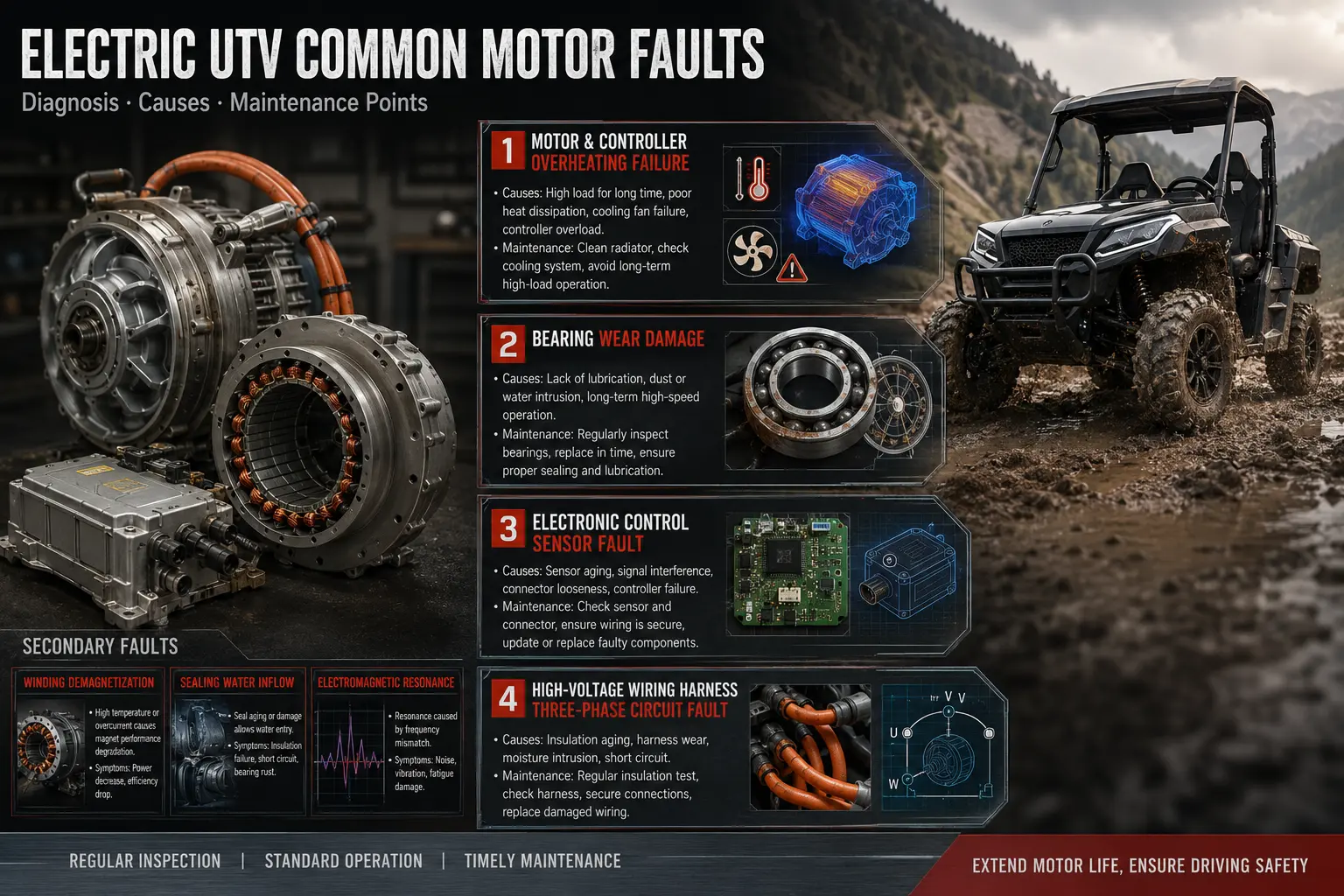
Judging from the vehicle owner’s actual measurement and industry maintenance data, the electric UTV motor itself has reliable structure and rarely has structural damage to its body. More than 95% of the faults are caused by harsh outdoor conditions and improper maintenance, mainly including overheating, bearing wear, electronic control and Several categories of sensor abnormalities, high-voltage line faults, etc. The following is a simplified introduction to the causes, hazards and prevention and repair points of various high-incidence faults to help car owners avoid motor problems from the root causes.
Motor And Controller Overheating Fault
Overheating of motor and controller is the most frequent fault problem of electric UTV, which occurs in heavy drag, continuous climbing, muddy low speed driving and high temperature operation in summer. The main causes include long-term full-load operation, blockage of cooling fins and air ducts by sediment, insufficient coolant in liquid-cooled models, failure of cooling fans or pipelines, etc., resulting in equipment heat not being released in time and rapid temperature surge.
Long-term overheating will bring irreversible damage, trigger vehicle power limit protection, cause power attenuation, power consumption increase, accelerate the aging of the motor winding insulation layer and permanent magnet demagnetization, greatly shorten the overall service life of the motor. It is necessary to clean the heat dissipation system regularly on a daily basis to avoid long-term heavy-duty continuous operation, intermittent shutdown and heat dissipation in high-temperature environment, and regularly check the working conditions of coolant and heat dissipation equipment to effectively avoid hidden dangers of overheating.
Bearing Damage Fault
Bearing damage is the most common mechanical failure of electric UTV, accounting for about half of the motor mechanical failure. After the vehicle is driven in a bumpy, muddy and dusty environment for a long time, and the motor sealing rubber ring is aging and invalid, sediment and water vapor are easy to penetrate into the interior, damaging the bearing grease and causing lubrication failure. At the same time, motor installation offset, abnormal belt tension, body bump dislocation and current erosion will accelerate bearing wear and aging.
If the bearing wear is not handled in time, it will cause friction damage to the rotor and stator, and burn the motor windings in serious cases, resulting in high maintenance costs. In daily life, it is necessary to focus on maintaining the sealing structure of the motor, regularly replace the aging oil seal, standardize and adjust the transmission structure, avoid violent off-road and long-term overload, check the sealing state in time after muddy wading conditions, and replace the bearing in time if it is damaged to prevent secondary faults.
Fault Of Controller, Inverter And Position Sensor
As the core of electric UTV power control, the controller and inverter are subjected to high voltage, high temperature and high frequency current impact for a long time. They are components with high incidence of electrical faults. Common problems include power tube burning, capacitor bulge, driver chip damage, frequent overcurrent protection, etc. At the same time, motor Hall sensors and angle sensors are easily caused by dirt, damaged lines, and loose joints, which can easily cause power frustration and stall problems, which are also common problems of many mainstream electric UTV models.
Daily maintenance needs to keep the controller and sensor joints dry and clean, avoid long-term deep water wading operations, and prevent water vapor from corroding circuits and electronic control components. Regularly read the vehicle fault code to investigate hidden dangers, sensor faults can be repaired by replacing accessories separately, and the cost is lower; if the controller hardware is damaged, professional equipment is required to detect and repair or replace the assembly to avoid the expansion of the fault causing the vehicle to lie down.
Line Connection, High-Voltage Wire Harness And Motor Phase Failure
The three-phase phase line of the high-voltage wiring harness, battery connector and motor is the key to power transmission. Outdoor muddy, dusty, and humid conditions, coupled with long-term body bumps, can easily cause loosening of the connector, oxidation corrosion, and damage to the line insulation layer, which in turn causes the line Virtual connection, leakage, phase loss and overcurrent faults. In addition, maintenance wiring errors, motor windings damp, will also exacerbate the electrical system failure.
This kind of line fault has strong concealment and high repeatability. It is necessary to regularly cut off the power to check the high-voltage connector, clean up the oxidation and corrosion impurities and tighten the standard, comprehensively check the wiring harness wear and damage problems and repair them in time. After wading and muddy operations, it is necessary to dry the line joints, do insulation and anti-corrosion treatment, regularly test the three-phase resistance and winding insulation performance, and prevent electrical faults such as leakage and phase loss from the source.
Other Minor Common Faults
Absolute Safety Guidelines for High Voltage Operation
Electric UTV is generally equipped with 48V-400V high-voltage battery system. High-voltage current has the risk of fatal electric shock. All DIY investigation and maintenance operations must strictly abide by safety regulations. Before operation, the vehicle power must be completely turned off, the vehicle key must be pulled out, and the battery main switch or high-voltage service plug must be disconnected; after power failure, it must be allowed to stand for 5-10 minutes and wait for the controller and capacitor to be completely discharged to avoid electric shock by residual voltage; it is strictly prohibited to disassemble and detect high-voltage lines and core components with electric tools in the whole process; insulating gloves and protective glasses must be worn to operate in a dry, ventilated, standing beside the electric special fire extinguisher. If you are not sure about the high-pressure operation, stop DIY immediately and hand it over to a professional technician to eliminate potential safety hazards.
Nine-Step Systematic Troubleshooting Process
Step 1: Basic visual inspection and symptom recording investigation: record the specific performance of the fault in detail, including no power, limited power, starting setback, abnormal noise, overheating, intermittent fault, etc., and specify the fault occurrence scenarios (heavy load, wading, climbing, after standing still). Fully visually inspect the motor, controller, and high-voltage wire harness to check whether there are obvious problems such as wire harness extrusion damage, insulation layer melting, scorch marks, muddy water accumulation, component deformation, etc., and at the same time, clean up the surface debris of the heat dissipation air outlet and heat dissipation fins, and check whether the emergency stop switch, seat sensor switch, and brake interlock switch work normally.
Step 2: Battery and low-voltage system detection: insufficient battery voltage, cell imbalance, and BMS protection are the most easily misjudged as motor failures. Use a multimeter to detect the total voltage of the battery pack, and compare the full power and minimum working voltage standards marked by the manufacturer; If conditions permit, the voltage of a single battery cell can be detected to check the excessive voltage difference and imbalance of the battery cell. Check whether the positive and negative main connectors of the battery are loose and corroded, and tighten to standard torque; Check the working state of 12V auxiliary battery and DC-DC converter, and check the abnormal low voltage power supply. Observe whether there is too fast self-discharge when the vehicle, record BMS fault codes during charging to eliminate battery system fault interference.
Step 3: Fault code and controller status reading: After safe power-on, read all fault codes stored in the instrument panel, special diagnostic APP and diagnostic interface, focus on recording over-temperature, over-current, phase loss, sensor abnormality, insulation fault and other codes, and lock the fault range against the equipment manual. Observe whether the contactor is normally closed and the system enters the ready state after the vehicle is powered on, and check the communication abnormality and hardware failure of the controller.
Step 4: Detection of high-voltage lines and three-phase lines: After complete power failure and capacitor discharge, check all high-voltage connectors between batteries, contactors, controllers and motors one by one, clean up oxidation and corrosion impurities, and retighten them. Visually check whether the wiring harness has high temperature discoloration, extrusion damage and virtual connection traces; Use multimeter to detect the on-off and resistance of the three-phase line of the motor. Under normal condition, the three-phase resistance values are basically consistent, the deviation is extremely small; the insulation between the test phase line and the motor housing to the ground is normally infinite. If conduction occurs, there will be leakage and winding damage.
Step 5: Comprehensive inspection of the heat dissipation system: thoroughly clean up the sediment, dust and sundries in the motor, controller heat dissipation fins and heat dissipation air duct to ensure smooth heat dissipation channel; For liquid-cooled vehicles, check the coolant level and state, and check the leakage and blockage of pipelines. Power on to test whether the start and stop of the cooling fan and pump are normal, and whether the heat dissipation can be started in time under high temperature conditions; After short distance low speed, touch the motor and controller temperature, compare the standard working temperature of the manufacturer to check the problem of poor heat dissipation.
Step 6: Sensor and accelerator signal detection: Focus on checking the lines and connectors of the motor Hall sensor and angle sensor, and check the problems of line wear, connector looseness and water corrosion; Check the signal voltage of the accelerator pedal sensor and confirm that the signal output is within the manufacturer’s standard range without signal interruption or signal deviation. Test the working state of brake switch and energy recovery brake switch, and check the dynamic abnormality caused by signal disorder. The vehicle starts to fall and move at low speed, with 90% probability caused by abnormal sensor signal.
Step 7: Motor mechanical structure inspection: After the power is completely off, manually rotate the wheel or motor shaft to feel the rotation feel. The normal state should be smooth, uniform resistance, no jam, and no abnormal noise; if there is grinding sound, jam feeling, obvious resistance, and too large left and right shaking clearance during rotation, it can be judged as bearing wear, shaft misalignment, and internal parts damage; at the same time, check the motor fixing screws, transmission chains, belts and couplings to check looseness, misalignment and wear.
Step 8: Safety functional road test: After all investigation and repair work is completed, rearrange and connect all lines to ensure that the connectors are fastened and the wiring harness is arranged in a standard manner; Power on the open safety area, observe the vehicle’s ready state, listen to the contactor’s closing sound, and lightly step on the accelerator to drive at low speed after no abnormality; Test the vehicle’s starting, acceleration and constant speed driving states, and observe whether the power is smooth, abnormal noise, and fault code is triggered; after driving for a short distance, monitor the temperature of the motor and controller, test whether the energy recovery braking function is normal, and confirm whether the fault is completely eliminated.
Step 9: Advanced Fault Determination (DIY Termination Node): If the fault still exists after the above full set of investigation, and there are problems such as imbalance of three-phase resistance, poor insulation to ground, abnormal sensor signal, repeated overcurrent fault of controller, etc., it is not necessary to continue DIY investigation. Such faults need to be detected by oscilloscope, special detector, motor dynamometer and other professional equipment, and need to be directly handed over to professional technicians for maintenance, avoid secondary damage caused by blind disassembly.
Quick Corresponding Troubleshooting Table of 4.3 Symptoms
In order to facilitate car owners to quickly locate faults and efficiently complete self-examination, common faults and corresponding priority troubleshooting items are now sorted into the following table, which is intuitive, clear and convenient for comparative maintenance:
| Common fault phenomenon | Priority Check Items |
| Vehicle completely unpowered, not ready | Battery voltage, main contactor, fuse, vehicle interlock switch |
| Vehicle power is limited and enters limp home mode | Equipment high temperature fault, battery power and temperature, system fault code |
| Slow start, low speed movement | Position sensor, throttle signal, motor three-phase line |
| Driving abnormal noise and body vibration | Bearing wear state, motor fixation and transmission structure alignment |
| Frequent overheating power reduction | Smooth degree of heat dissipation system, long-term heavy-duty operation condition, operation status of heat dissipation equipment |
| Intermittent power interruption | Tightening of line connector, sealing and waterproof performance of vehicle, and corrosion of grounding line |
Self-Diy Low-Risk Projects
With the help of basic manual tools and multimeter, car owners can safely complete all kinds of low-risk maintenance and simple maintenance, effectively solving most minor faults and hidden dangers. It mainly includes: cleaning sundries of the body and heat dissipation system and visual troubleshooting of faults; Cleaning, derusting and fastening of high and low voltage connectors; Battery voltage, 12V auxiliary system detection and routine maintenance; Vehicle fault code reading, reset and function detection; Coolant supplement, cooling equipment working condition inspection; Routine inspection and adjustment of motor shaft, transmission chain, belt and fixing screw, on-off inspection of basic circuit, etc. This type of operation has no high pressure risk and is simple to use, which can greatly reduce daily maintenance costs.
High-Pressure/Complex Projects Where The Must Be Handed Over To Professionals
Projects involving high-voltage disassembly, internal maintenance of motors and precision electrical testing have extremely high risks of safety and equipment damage. Self-maintenance is prohibited and must be handled by certified professional technicians. Mainly includes: disassembly and maintenance of battery pack, controller, inverter and motor body; Motor winding leakage, insulation failure, demagnetization and internal structure damage repair; Replacement of controller hardware, high-voltage wire harness and contactor assembly; Complex faults such as vehicle water corrosion, system leakage, repeated overcurrent and phase loss, abnormal sensor signal, etc. Multi-motor system calibration and vehicle warranty period fault maintenance, unauthorized disassembly and maintenance will directly void the vehicle warranty.
Maintenance Rapid Decision-Making Criteria
Car owners can quickly choose maintenance methods according to simple judgment principles: cleaning, fastening, basic testing, and replacement of external parts can all be DIY independently. Failures involving disassembly of high-voltage components, motor cover opening and precision calibration shall be directly sent to professional maintenance. When it is not sure whether the high-voltage equipment is completely powered off and discharged, immediately stop self-operation. Carrying fault phenomena, fault codes and other recorded data during repair can effectively shorten the maintenance time, reduce maintenance costs, adhere to safety priority throughout the process, and do not blindly try and error maintenance.
The core advantages of electric UTV motors are low maintenance costs and high stability. Most motor failures can be completely avoided through standardized maintenance. Different from the replacement of high-frequency consumables for fuel engines, the core of electric UTV motor maintenance focuses on the four dimensions of heat dissipation, sealing, wiring and working condition control. Adhering to standardized maintenance can make the motor run stably for life and greatly extend the service life of the whole vehicle.
Before Each Ride: 3 Minutes Of Basic Pre-Check
Take 3 minutes to quickly check before each departure to avoid most sudden faults in advance: visually check the motor, controller and high-voltage wiring harness for damage, extrusion and looseness; Clean up the fallen leaves, sediment and sundries on the surface of the heat dissipation air outlet and heat dissipation fins to ensure smooth heat dissipation; Check the instrument panel for no fault lights and fault codes, and the battery has sufficient power; Start at low speed to listen to the running sound of the motor, without abnormal noise or vibration; confirm that the cooling fan and cooling pump can be started normally after power-on without abnormal function.
Special Maintenance After Muddy/Wading/Dusty Working Conditions
Complicated and severe working conditions are the main causes of motor failure. Timely maintenance must be carried out after use to eliminate hidden dangers: low-pressure clean water is used to flush the vehicle body, and high-pressure water cannons are strictly prohibited from directly punching the motor, controller, line joints and sealing rubber ring positions to prevent high-pressure water flow from breaking through the sealing layer and penetrating into the equipment; Dry the vehicle body thoroughly after flushing to ensure that there is no water and moisture in the line joints and water in the equipment. Check the high pressure and sensor line joints, clean up sediment and corrosive impurities, and apply insulating grease to prevent moisture and corrosion if necessary; check whether the motor, controller sealing rubber ring and oil seal are displaced or damaged, and repair and replace them in time.
Periodic Maintenance
Under normal use conditions, complete in-depth maintenance every 25-50 hours or once a month. For high-frequency off-road, heavy-load, and wading conditions, the maintenance cycle needs to be shortened: comprehensively clean the heat dissipation system, clean up the heat dissipation fins, air ducts, and radiator dust and sundries. For liquid-cooled vehicles, check the state of the coolant, supplement and replace it regularly as required; comprehensively check all high-pressure connectors, tighten the standard torque, clean the standard torque, clean the oxidation corrosion layer, and prevent false heat; maintain the battery and BMS system, avoid long-term full power and power loss storage, and update the official system firmware in time; Check the motor fixing bracket and screws, adjust the tension of the transmission belt and chain to ensure accurate transmission alignment; Turn off the power and manually rotate the motor shaft, check the smoothness of the bearing, and predict the hidden danger of wear in advance; Check the sensor wiring and low-voltage wiring harness, repair the worn and broken wiring, and eliminate the wiring faults.
Quarterly/Annual In-Depth Maintenance
Complete in-depth overhaul of the whole vehicle every quarter or year, and comprehensively investigate hidden faults: carefully inspect all sealing rubber rings, oil seals and waterproof gaskets, and replace aging failure accessories; If conditions permit, the insulation performance of motor winding can be tested by insulation tester, and the hidden dangers of aging and moisture can be checked in advance. Read the historical fault code of the whole vehicle, check hidden faults, and completely eliminate the root cause of the fault; Lubricate and maintain the maintainable bearings and replace the aging sealed bearings; comprehensively investigate the wear and aging of the high-voltage and low-voltage wiring harnesses of the whole vehicle, focus on checking the bending and friction position lines of the frame, and do a good job of protection.
Core Usage Habits To Extend Motor Life
Standardized usage habits are the key to reduce failures and prolong equipment life: prevent long-term full throttle heavy load and continuous climbing, avoid long-term high-temperature overload operation of motors and controllers, and timely shut down and dissipate heat under high-temperature conditions; Strictly abide by the official wading depth standard of vehicles, do not forcibly cross rivers in deep water, and avoid water vapor intrusion into electrical equipment; Reduce frequent violent acceleration and braking, and reduce system heat accumulation and line impact; When the vehicle is parked for a long time, place it in a dry and constant temperature environment to avoid sun exposure and low temperature freezing to prevent battery aging and seal hardening. Don’t ignore minor fault signals. In case of limp mode, abnormal noise and abnormal power, stop the machine immediately for investigation to avoid major damage caused by minor faults.
Essential Maintenance Tools And Consumables
Car owners always stock basic tool consumables, which can meet the needs of daily maintenance and simple troubleshooting: high-precision multimeter, line contact cleaner, insulating grease, soft brush, compressed air gun, torque wrench, electrical special fire extinguisher, equipment official maintenance manual and fault diagnosis tools, realize long-term maintenance at low cost, and greatly reduce maintenance cost.
Many car owners are difficult to distinguish the failure rate, maintenance cost and reliability of electric UTV and fuel UTV when purchasing. The following table compares the core differences between the two models in an all-round way, visually showing their respective advantages and disadvantages and adaptation scenarios:
| Contrast dimension | Electric UTV | Fuel UTV |
| Core failure characteristics | Faults are mostly induced by improper environment and maintenance. The faults are mainly caused by overheating of motor/controller, bearing wear, abnormal sensor, virtual connection of high-voltage lines, wading corrosion and battery BMS protection. There is no wear of conventional consumables and the fault frequency is lower. | There are many mechanical consumables and high frequency of failures. Common CVT belt wear, radiator blockage, oil circuit failure, fuel deterioration, spark plug damage, air filter blockage, carbon deposits, valve wear and other continuous loss problems. |
| Core advantages | No need to frequently change oil, filter elements, spark plugs and other consumables, simple maintenance; no carbon deposit oil circuit problem, strong power stability; low-speed torque, linear power, good off-road heavy load experience; silent zero emission, wide adaptation scene, long-term maintenance cost Lower. | The structure is popular, the accessories network is large, and the maintenance is convenient and cheap. No high-voltage safety hazard, DIY maintenance space is large; Refueling is convenient, endurance is free of anxiety, and it is suitable for remote areas and continuous high-intensity operations for a long time. |
| Core short board | High-voltage core assemblies such as motors and controllers have high maintenance costs and rely on professional equipment and technology; batteries have attenuation problems, which affect power life; electrical components have extremely high requirements for waterproofing, sealing, and heat dissipation maintenance. | The maintenance process is cumbersome, and various consumables need to be replaced regularly; there are many moving mechanical parts, and the long-term use and wear are serious; common problems such as carbon deposits and oil circuit blockage are prone to occur, and the CVT belt is easily damaged under muddy and heavy-duty conditions. |
| Long-term reliability & cost of use | Early failure rate is extremely low, maintenance cost worry, do a good job of heat dissipation, waterproof, line maintenance can be long-term stable use, rarely appear core assembly damage, long-term use of more cost-effective. | Single minor maintenance is cheap, but high-frequency consumables replacement, frequent minor failures will continue to stack costs, long-term mechanical wear and tear is easy to cause engine overhaul, the overall long-term cost is higher. |
| Adapt scene | Farm daily operation and maintenance, short-distance cross-country, mute environmental protection operations, park site normalization use scene. | Remote non-charging area, long-distance crossing, high-intensity continuous heavy-duty operation, long-term outdoor working conditions. |
High-End Off-Road Vehicle Models
Polaris Ranger XP Kinetic/Pro XD Kinetic: The mainstream high-end electric UTV in the market, 2023-2024 models have the problems of loose high-voltage connectors and insufficient sealing, which are easy to cause overheating, abnormal power, wading short circuit, and easy to report electric control faults in humid environment. It is necessary to focus on waterproof and heat dissipation cleaning of connectors in daily life.
Volcon Stag XR is a high-performance off-road model with high heat dissipation and sealing requirements. Due to low ownership and few after-sales accessories, the heat dissipation system should be checked in time after high-strength off-road to prevent deep water wading to avoid water vapor intrusion and damage to electronic control components.
Mid-Range Main Utility Model
Hisun Sector E1 has a very high retention capacity. The core problem is that the controller is prone to overcurrent and the line is falsely connected to report errors. Most power abnormalities are not motor body faults. Regular tightening and cleaning of the lines and ensuring heat dissipation can greatly reduce the failure rate.
Landmaster AMP series :48V low-power model, only suitable for mild operation, easy to overheat and torque limit for long-term heavy-duty climbing, general waterproof and anti-corrosion performance of high-voltage connectors, and regular maintenance of line connectors.
Greenworks U series is a special model for commercial gardens, with strong system stability and no obvious common diseases. Conventional heat dissipation, battery and line maintenance can be used stably for a long time.
Entry Niche
John Deere Gator, Tracker EV, Club Car and other niche models focus on low-speed stable operation, with few faults in the motor body. Common problems focus on line corrosion, seal aging and battery BMS protection, which can be used normally after routine maintenance.
General Failure Law Of Brand
The vast majority of electric UTV failures are not caused by damage to the motor body, but by loose high-voltage connectors, blocked heat dissipation, abnormal sensors and damp water. The power limit triggered by high temperature and heavy load is the normal protection mechanism of the equipment, not a fault. Most suspected motor failures are actually abnormal batteries and BMS systems. Small models rely more on daily preventive maintenance to avoid failures.
Summary
On the whole, the electric UTV motor has simple structure, few wear parts and extremely high reliability. Most of the daily failures are caused by bad outdoor working conditions, improper operation and inadequate maintenance. They are not the quality problems of the motor body. Overheating, bearing wear, abnormal sensors, poor line contact and sealing failure are the most common 5 major failures, which can be effectively prevented through standardized use and regular maintenance.
During maintenance and investigation, car owners need to distinguish the boundary between DIY maintenance and professional maintenance, strictly abide by the safety standards for high-pressure operation, simple faults can be investigated and repaired independently, and complex high-pressure faults can be handled by professional technicians in time, which can not only save maintenance costs, but also avoid secondary damage to equipment. Compared with fuel UTV, electric UTV maintenance process is simpler, long-term failure rate and lower use cost, adhere to scientific maintenance can be long-term stable operation, give full play to the advantages of electric vehicles.
FAQ
Q1: What is the reason for frequent overheating of electric UTV motors?
A1: The core reasons include long-term heavy-duty climbing, low-speed and high-load driving on muddy roads, blockage of cooling fins/air channels by sediment, insufficient cooling liquid or failure of cooling fan, and continuous operation in high-temperature environment in summer. Slight overheating is the normal protection of the system. Frequent overheating is mostly caused by lack of maintenance and overload of working conditions. It can be improved by cleaning the heat dissipation system and standardizing the use.
Q2: What is the fault of the electric UTV?
A2: More than 90% is caused by dirty motor Hall sensor/position sensor, loose circuit, abnormal signal, or signal offset of accelerator pedal sensor and poor contact of three-phase circuit. Check the sensor circuit and connector first, and it can be basically solved after cleaning and fastening, and there is no need to replace the motor.
Q3: How long is the normal service life of electric UTV motors?
A3: Under the premise of standardized maintenance and normal use, the electric UTV motor has no vulnerable parts, and its service life far exceeds that of the fuel engine, which can realize the lifelong use of the whole vehicle. When most vehicles are eliminated, the motor can still work normally. The only thing that limits the life of the motor is long-term overheating, water corrosion, bearing aging and other preventable problems.
Q4: electric UTV motor failure can repair their own?
A4: Basic cleaning, fastening, line detection, heat dissipation maintenance and fault code reading can be DIY independently. However, the disassembly of high-voltage components, internal maintenance of motors, winding failures and controller hardware failures must be handed over to professional technicians to eliminate high-voltage safety risks.
Q5: Electric UTV and fuel UTV which is more durable, lower failure rate?
A5: Under the same maintenance conditions, the failure rate of the core power system of electric UTV is far lower than that of fuel UTV, and there is no wear of consumables, no carbon deposit and no oil circuit failure. Fuel UTV wins in convenient maintenance and no anxiety in life, but there are more high-frequency minor faults and higher maintenance costs. Short-distance, normal operation selection electric, long-distance, no charging scene selection fuel.


-150x150.png)