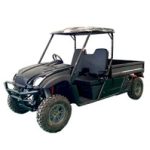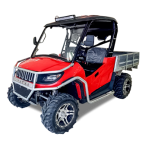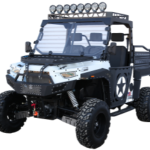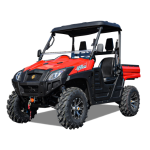
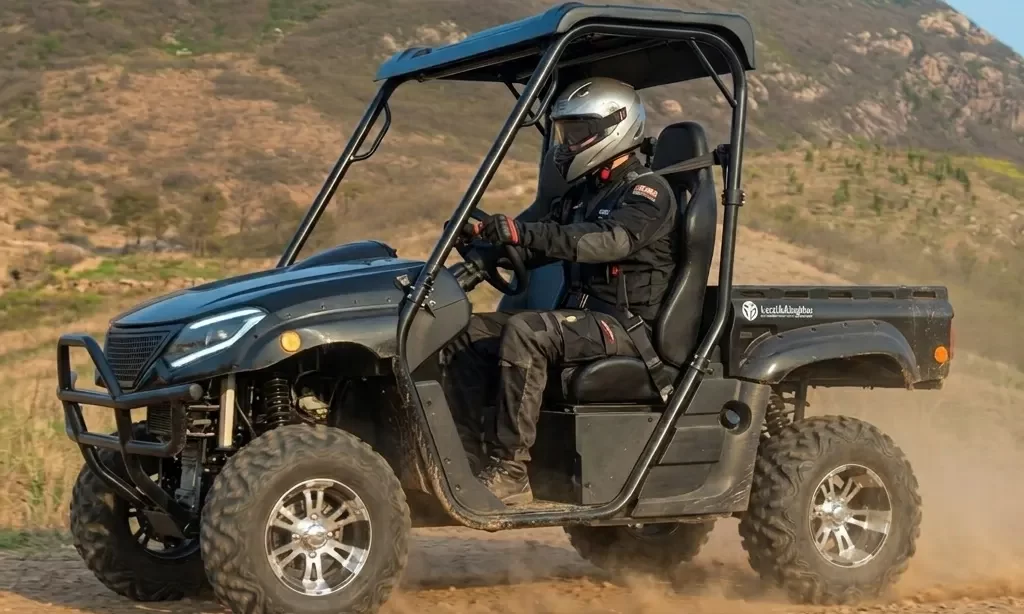
UTV is a multifunctional utility all-terrain vehicle, which is widely used in outdoor recreational cross-country, agricultural production, construction site operation, forest inspection, outdoor rescue and other scenarios. Unlike ordinary highway vehicles, UTVs travel on unpaved roads such as dirt, gravel, steep slopes and mud puddles for a long time, and the center of gravity and driving characteristics of the body are special, so accidents such as rollover, failure of mechanical parts, and falling of personnel occur frequently.
According to statistics from foreign safety organizations, tens of thousands of UTV-related accidents occur globally every year, with over 30% of the accidents stemming from man-made problems such as lack of protective equipment and negligence in vehicle inspection, and most of the casualties can be avoided in advance through standardized operation. If you want to safely enjoy the off-road fun brought by UTVs and safeguard operational efficiency, you need to know some safety precautions for UTVs.
Personal protective equipment (PPE) is the last safety barrier for UTV drivers and passengers. In the engineering safety system, protective equipment is the core means to ensure personnel safety after equipment modification and management system. Many riders have the misconception that they don’t need to wear protective gear when traveling at low speeds over short distances, which is a very dangerous idea; UTVs travel in complex road conditions, and even at low speeds, splashing debris and tree branches may scratch the face and eyes, and sudden bumps and small rollovers may also cause injuries from knocks and bumps. Data shows that failure to properly use protective equipment is one of the main causes of occupational injuries and off-road accidents. For UTV driving scenarios, different parts of the vehicle need to be matched with corresponding professional protective equipment, and each piece of equipment has clear requirements for use:
Head protection: professional off-road safety helmets must be worn, and full helmets are preferred. Full helmets can protect the head and face against impacts, falling rocks and tree branches. Half-helmet can only protect the top of the head, face is exposed, not recommended for use in complex terrain. 2.
eye and face protection: with professional windproof and sandproof goggles or face screen. Field cross-country, high-speed splash of dirt, sand, dust, small stones will directly impact the eyes, ordinary glasses can not play a protective role. Goggles to ensure a clear field of vision, lens without scratches, while reserving vents to avoid fogging affect the line of sight.
Limb and body protection: wear wear wear-resistant long-sleeved shirt, long pants and non-slip wear-resistant off-road gloves. Long-sleeved clothing can prevent branches from scratching, gravel bumping, gloves can improve the steering wheel grip, while cushioning the vibration, to protect the palms of the hands. Feet need to wear high-top non-slip safety boots, firmly wrapped ankles, to avoid bumps in the broken foot, but also to prevent debris into the shoes.
Specialized protective equipment: For those who work in noisy environments for a long time or go off-road frequently, they can be equipped with sound-proof ear protection; for those who ride in low-visibility environments, such as in the morning and evening, at night, or in forested areas, it is recommended to wear high-visibility reflective clothing to enhance their own recognition.
In addition, the fit of protective gear is critical. Equipment that is too big will shake and shift, making it impossible to play a protective role; equipment that is too small will bind the limbs and affect driving operations. Enterprises and venue operators need to uniformly equip with compliant protective equipment and guide drivers and passengers to wear it correctly, so as to reduce the risk of injuries from the source.
UTVs have been traveling in poor road conditions for a long time, and body parts are prone to wear and tear, looseness, leakage and other problems. Routine inspection before leaving the vehicle is the lowest cost and most effective means of safety, the whole set of inspection process takes only 5-15 minutes, but can effectively detect brake failure, flat tires, oil leaks, steering faults and other major hidden dangers, to avoid the vehicle breaks down on the way, out of control, especially suitable for remote wilderness scenarios. According to the industry’s general standards, the UTV inspection should follow the principle of “round-the-vehicle inspection + sub-inspection”, and check the following core parts one by one:
Slowly walk around the vehicle in a circle to visually check the overall body condition. Check whether there are deformation and cracks in the body shell and ROPS, and whether there is any accumulation of debris around the body. Check whether the pipelines and lines are loose and worn, and whether there are traces of oil, brake fluid and fuel leakage on the ground. If leakage, parts falling off, or body deformation is found, the vehicle must be stopped and repairs completed before leaving the vehicle.
Tires are the foundation of UTV’s grip and driving, and are also a high failure rate. First of all, check the tire pressure of the four tires, strictly in accordance with the vehicle specification standard inflation, tire pressure is too high will reduce the shock absorption effect, increase the risk of tire blowout, tire pressure is too low will aggravate the tire wear, affecting the stability of steering.
Secondly, observe the state of the tire tread to see if there are cracks, cuts, bulges, and whether the tread is excessively worn. At the same time, check the wheel fixing nuts to make sure that all nuts are tight and not loose to prevent the wheels from falling off while driving. If you often drive in the mud puddle, sand, but also to clean up the tire threads mixed with stones, weeds, to ensure that the grip.
Check all kinds of fluid levels one by one, which is the key to ensure the normal operation of the power system. Including engine oil, coolant, brake fluid, fuel, all fluids should be kept within the scale line standard interval, and supplemented in time when insufficient.
Fluid not only to see the level, but also to observe the state. If the oil is blackened, cloudy and mixed with impurities, it means that it has deteriorated and needs to be replaced immediately; cloudy coolant and brake fluid will also affect heat dissipation and braking effect. For electric UTVs, focus on checking the battery power, try to avoid power below 20% deep discharge, and check whether the charging port is dry and not broken.
Sit in the driver’s seat and test the brake system first. Step on the parking brake, pull up the parking brake, feel the brake pedal stroke and rebound strength, if the pedal is soft, the stroke is too large, the brake response is lagging, indicating that there are faults in the braking system, and should not be allowed to go on the road.
Subsequently, test the steering system, turn the steering wheel left and right, feel whether the steering is smooth, there is no jamming, false position is too large and other issues. Finally, check the electrical equipment of the whole vehicle, including headlights, taillights, turn signals, instrument panel, and horn. When riding at night and in forest areas, the light is an important guarantee of safe travel, and the horn is used to remind pedestrians and other vehicles, all electrical equipment failure needs timely maintenance.
Focus on checking safety accessories such as seat belts, anti-roll bars, mirrors and fire extinguishers. Seat belts should be tensile tested to confirm normal contraction, strong buckles, and no wear and tear, breakage, or aging of the webbing. Anti-roll bar as the core protective structure after rollover, deformation, weld cracking must be repaired and replaced.
Rearview mirror angle adjustment to the best position of the field of vision, to ensure that the observation of the rear road conditions; car fire extinguisher pressure is normal, placed firmly, once the fire can be the first time to take. If the vehicle is equipped with a winch, storage device, you should also check the fixed state, to prevent the accessories from falling off while traveling.
After completing all the checks, if you find any faults, hidden dangers, remember not to leave the car with disease. Small problems are handled on the spot, and large failures are handled by professional maintenance personnel, which is the basic guideline for riding safety.
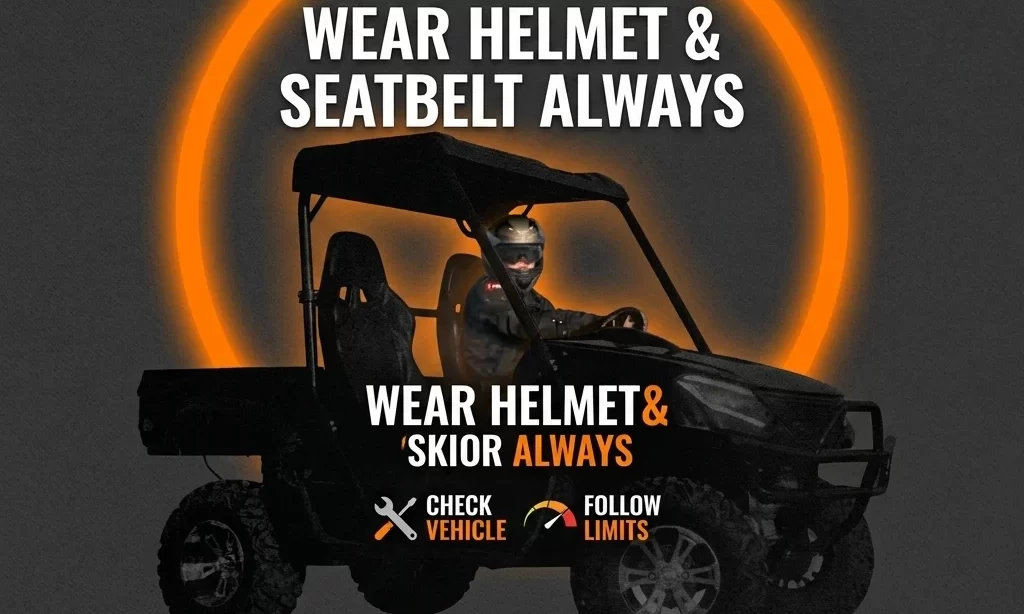
Each UTV has a manufacturer’s set of load, towing, climbing, wading and other performance parameters, these parameters are based on the body structure, suspension, braking system comprehensive calculations of the safety red line. Using the vehicle beyond its design limits will directly damage the stability of the vehicle body, significantly increasing the probability of rollover and overload damage to mechanical parts, and is one of the core causes of major accidents involving UTVs.
UTV body center of gravity is high, different from ordinary off-road vehicles, load imbalance, overload towing, forced climbing steep slopes, will change the distribution of the center of gravity of the vehicle. Especially when loading heavy loads and carrying multiple passengers, the center of gravity shifts up or off, and it is very easy to rollover when turning and walking up side slopes. Relevant data show that overloading, illegal towing, and exceeding the limit of climbing the slope, occupies a large proportion of UTV rollover accident triggers. If you want to use the car safely, you must familiarize yourself with the vehicle manual, keep in mind the following four core limit parameters, and strictly abide by them.
Every UTV has a rated gross vehicle weight, which includes the total weight of the driver, passengers, and accompanying cargo, and ranges from 500 to 1500 pounds for the most popular models. First, the number of passengers should be strictly adhered to. The vehicle can only carry a few passengers if it has a few factory seats, and it is never permitted to carry passengers in the cargo hold, footwells, or have passengers sitting on the driver’s lap.
Secondly, standardize the loading of goods, the weight of goods can not exceed the rated load, while following the “even distribution, low placement” principle. Heavy goods as far as possible placed in the middle of the cargo bucket, close to the chassis position, do not unilateral stacking, to avoid the center of gravity shift. Highly stacked cargo will raise the center of gravity of the whole vehicle, and the risk increases dramatically when turning and bumping. All cargo must be fixed firmly with straps to prevent it from slipping off while driving.
UTVs with a towing function have a clear maximum towing weight and towing pin load limit, and the towing capacity of conventional models is between 1,000 and 2,500 pounds. When towing a trailer, farm machinery, or equipment, the total weight should never be exceeded.
When towing, vehicle braking distances become longer, steering agility is reduced, and maneuvering becomes significantly more difficult. Drivers should slow down in advance, enlarge the turning radius appropriately, and avoid sharp braking and turning. At the same time, regularly check the towing device, connecting ropes/trailer hooks to make sure that there is no deformation or cracks to prevent the connection from breaking during towing, which may cause accidents.
The manufacturer will indicate the maximum uphill, downhill and sidehill angles according to the model design, and the climbing limit will be further reduced when fully loaded. When driving on slopes, try to drive straight uphill and straight downhill, and avoid traveling diagonally across steep slopes (side-slope driving), which is a high-risk operation of UTV driving.
When driving uphill, use low-speed gears, keep the gas pedal steady, and do not turn off the engine or stop in the middle of the journey; when driving downhill, use the engine to control the speed of the vehicle, tap the brakes to control the speed, and do not hold the brakes for a long period of time. If the slope is steeper than the vehicle limit, do not force to climb, and timely selection of detour routes. In addition, but also keep in mind the vehicle ground clearance, the maximum wading depth, the depth of water beyond the standard do not forcibly wade, to avoid engine water, short circuit.
Many car enthusiasts will privately modify the suspension, tires, raise the body, increase the load accessories, this type of modification is easy to break the original body balance, change the center of gravity and driving parameters. Non-professional modification will directly lead to a decline in vehicle performance, while manufacturers have the right to refuse warranty on privately modified vehicles.
If you need to modify, be sure to choose the original compliant parts, operated by professionals, after modification to re-evaluate the vehicle load, climbing, driving limits, adjusting driving habits. Daily use, but also according to the vehicle wear and tear, aging, properly reduce the load and driving intensity.
Anti-roll bar (ROPS) + safety belts, is the UTV encountered rollover, collision, to protect the lives of drivers and passengers of the two core configurations, the two must be paired with the use of, in order to play the maximum protective effect. Industry data show that more than two-thirds of UTV accidents are rollover accidents, and more than 80% of rollover fatal cases, drivers and passengers are not wearing seat belts.
Some drivers have the wrong perception that the vehicle speed is slow, the road condition is gentle, wearing a seat belt binds the body, and can not jump out of the car in time to escape in case of danger. But the reality is just the opposite: UTV rollover speed, heavy body, jumping is very easy to be crushed by the body, impact. The role of the seat belt is to fix the driver and passenger in the safety cabin, with the roll cage formed by the safety cage, to avoid personnel being thrown out, extrusion, which is the safest way of protection.
Statistics show that speeding is one of the main causes of UTV loss of control, rollover and collision. Some rollover accidents seem to occur at low speeds (within 20 mph), but speeding will directly increase the probability of accidents and injury levels. There is no uniform standard for safe speed under different road conditions, loads and environments, but the core principle is that the more complicated the road conditions, the poorer the visibility, and the heavier the load, the slower the speed should be.
Combined with different scenarios, we share targeted speed control and driving skills:
Conventional flat road surface: In areas with good road conditions, such as fields and flat forest paths, do not step on the gas pedal to drive at extreme speeds. The road surface seems to be flat, but may hide dark pits, gravel, keep driving in low speed, reserve enough space to react.
Turning road: Slow down before turning, steer smoothly after entering the corner, and absolutely prohibit high-speed sharp turns; UTVs have a high center of gravity, and high-speed turns will generate strong centrifugal force, which will instantly cause a rollover. Don’t brake, accelerate or decelerate during the turning process, and keep the speed stable.
Complicated bumpy road surface: potholes, gravel, bumpy dirt road, must significantly reduce the speed of the vehicle, low speed and uniform speed through. High-speed bumps will not only make the vehicle out of control, but also aggravate the wear and tear of parts, and drivers and passengers are also prone to injury due to violent bumps.
Loaded, towing driving: when the vehicle is fully loaded with goods and towing a trailer, the braking distance will increase significantly and the steering sensitivity will decrease. Drive at a low speed, anticipate the road conditions in advance, and stay away from steep slopes and sharp curves.
Special weather and low visibility scenarios: rainy days, slippery roads, mud, tires, reduced grip; fog, night, dense forests, obstructed vision, we must reduce the speed to a minimum, while turning on the lights, frequent use of the horn to warn the surrounding.
In addition, the driving process to eliminate racing, speed, stunt driving and other dangerous behavior. Don’t suddenly accelerate, brake sharply, change lanes drastically, all the operations to do calmly and consistently. Safety is always more important than speed, smooth driving in order to enjoy the cross-country fun for a long time.
The advantage of UTV is to adapt to a variety of complex terrain, but the road grip, resistance and risk points of different terrains are very different. Blindly applying the same driving style, it is easy to get stuck, skidding, rollover. Want to safely cross the field terrain, must be targeted to master the mud, sand, rocky road, water, snow and other scenes of driving skills, while combining the previous speed, load, climbing rules comprehensive operation.
Mud puddles, wet and soft dirt road grip is poor, the wheels are very easy to slip and get stuck. When traveling, use low-speed gears, maintain a stable speed, do not frequently add or subtract the throttle to avoid wheel spinning deeper and deeper into the trap. Plan your route in advance and choose a track with shallow soil and a solid roadbed.
Try to drive along the rut of the previous car, do not open a new route. If the wheel slips, gently close the throttle and make small adjustments to the direction, do not jerk the direction. Reduce the tire pressure beforehand to improve the grounding area and floating ability of the tires.
Deserts and river sandy beaches have soft soil, and vehicles are prone to sinking. Keep the gas pedal steady throughout the journey to maintain the inertia of the vehicle, and do not stop or idle in the middle of the journey. When turning, slow down the speed of the vehicle, steer gently, and prohibit turning sharply to prevent the body from overturning.
Tire pressure can be adjusted moderately low to enhance the passage of tires in the sand. If you feel the vehicle sinking, immediately small forward or backward, out of the soft area, do not step on the gas pedal in place to struggle.
Mountain roads covered with gravel and large rocks are bumpy and the chassis is easy to bump. Get out of the car in advance to observe the route and pick a path with gentle rock gaps. Drive slowly and at low speed, align the wheels with the rock gaps to avoid sharp stones scratching the tires.
Keep your hands on the steering wheel and your body steady, don’t sway with the bumps. Avoid towering rocky outcrops to prevent bottoming out and damaging the chassis and fuel tank. When encountering continuous steep slopes and rocky roads, switch to low-speed four-wheel drive mode and steady throttle to climb at a constant speed.
Before wading, you must check the water depth and road conditions under the water, and confirm that the water depth is lower than the maximum wading depth of the vehicle, and that there are no big pits or rapids under the water before passing.
Choose a low-speed gear, drive smoothly into the water, drive at a constant speed throughout the whole journey, do not stop, accelerate, and make sharp turns. When the current is fast, try to pass perpendicular to the direction of the current. After wading in the water, gently apply the brakes and drive for a period of time to evaporate the water of the brake disc and restore the braking performance. If the depth of water exceeds the standard and the current is rapid, directly choose to go around.
Tire grip on snowy and icy roads is extremely poor, doubling the risk of skidding. Reduce tire pressure, drive at low speeds, and avoid sharp braking and steering. Brake in the way of point brake, do not step on the dead. Climbing slopes, choose gentle slopes, pass in a straight line, and avoid driving on side slopes.
Try to choose familiar routes for daily riding. When exploring an unfamiliar area for the first time, slow down, observe carefully, and get off the bike to explore if you are not sure of the road conditions. Follow the principle of “no risk if you can go around”, and don’t challenge terrains that are beyond your own skills and vehicle’s capacity.
UTV supports multiple passengers, and many people will form teams to cross-country and bring their families to experience it, but the driver is directly responsible for the safety of all passengers. Passengers riding inappropriately, jostling, overcrowding, will change the center of gravity of the vehicle, interfere with the driver’s operation, and then cause accidents. Combined with safety norms and accident cases, passenger management needs to implement the whole process requirements.
Firmly comply with the original number of seats in the vehicle, and never overcrowding. Cargo buckets, footrests, roofs and other locations are strictly prohibited to carry people, such areas do not have seat belts, protective structures, bumps, rollover personnel will be thrown out directly. Each passenger must be seated in a regular seat and wear a seat belt independently.
Passengers sit upright throughout the vehicle, with their backs pressed against the seats, their feet stepping smoothly on the footrest area, and their hands gripping the handrails inside the vehicle. It is strictly prohibited to extend the head, arms and legs out of the vehicle to prevent them from being cut by branches and rocks.
Do not touch the steering wheel, brake, gas pedal and other control parts to avoid interfering with the driver. When the vehicle is not completely stopped, passengers should not get up and jump out of the car.
Minors must be accompanied by an adult guardian when traveling on the UTV. Judge the suitability of children according to the requirements of the vehicle, do not ride the UTV if they are short, unable to sit steadily, or unable to land on the ground, and do not hold children in your arms, as this is an extremely dangerous behavior.
After carrying passengers, the overall weight of the vehicle increases and the center of gravity changes. The driver should take the initiative to reduce the speed of the vehicle, turn, brake and climb the slope more gently, and reserve a longer braking distance. Try to choose routes with smooth road conditions, avoiding steep slopes, sharp curves, complex mud puddles and other high-risk terrain.
Before leaving the car, the driver must do a simple safety talk to passengers, informing the rules of the car, emergency posture, so that all personnel to reach a consensus on safety.
UTV activities are mostly concentrated in remote mountainous areas, wilderness, field construction sites, such areas of weak cell phone signals, rescue personnel to arrive at the time-consuming. Vehicle breakdowns, injuries, stuck in a car, extreme weather and other emergencies, if there is no emergency equipment and disposal capacity, small problems will evolve into life-threatening danger. Prepare emergency supplies in advance, master the basic emergency skills, is the field UTV traveling the necessary homework.
All UTV trips, no matter short-distance, long-distance, should carry emergency equipment, according to the “medical rescue, vehicle extrication, communication for help, basic survival” four major categories:
Medical first aid kit: contains band-aids, gauze, bandages, tourniquets, disinfectant supplies, bruise ointment, emergency medicines. Used to deal with cuts, bumps, scratches and other minor injuries, when encountering serious injuries, you can temporarily stop the bleeding, fix the injured and wait for rescue.、
Vehicle extrication and maintenance tools: tow rope, steel plate skid plate, engineering shovel, portable inflatable pump, simple maintenance tools, spare tires. Respond to the trapped car, flat tire, small mechanical failure, to realize the scene of self-help. At the same time, it is equipped with a fire extinguisher to cope with the fire of electric circuit and oil circuit.
Communication and distress equipment: remote areas without signal, cell phones can not be used normally, need to be equipped with walkie-talkies, satellite locator, emergency signal lights, whistles. Before the trip will be traveling route, round-trip time to inform the staff left behind, once lost, to facilitate the rescue personnel to locate.
Survival protection materials: according to the length of the trip and the environment, carry drinking water, emergency food, warm clothing, rain gear. The temperature difference between day and night in the wild is big, and when you are suddenly stranded, you can resist hunger, low temperature, rain, and prevent temperature loss and dehydration.
Team travel do not leave the team alone, keep the vehicle spacing, look out for each other. Novice players try to follow the experienced veteran players team, do not go deep into the uninhabited wilderness alone. Before each trip to check whether the emergency equipment is intact, whether the supplies are sufficient, after the use of timely replenishment, replacement of expired items.
Combined with all the above safety rules, we sort out the most common safety mistakes made by players and operators. These mistakes may seem small, but they are the triggers of most accidents. Check yourself against them and correct your bad habits in time in order to build a complete safety system:
Perfunctory protective equipment: short distances, low speeds without helmets, goggles, wearing damaged equipment, summer for the sake of coolness without long sleeves, is the most common bad habits.
Omit the vehicle inspection: think the vehicle is not a problem, skip the tires, brakes, fluids, seat belts check, with hidden dangers on the road.
Ignoring vehicle limits: overloading people and cargo, illegal towing, climbing steep slopes over the limit, and arbitrarily modifying vehicles to break the original balance.
Wearing safety belts is not standardized: too much trouble not to fasten the safety belt, or belt strangulation abdomen, shoulder belt card armpit, lose the protective effect.
Speeding + radical driving: blind pursuit of speed, high-speed turns, sharp braking, hard acceleration, show off in complex terrain.
Terrain operation errors: long walk side slopes, mud puddles, sandy wheel spinning, wading through the water rashly, triggered by car traps, rollover.
Trespassing in prohibited areas: deviating from the designated trails, intruding into protected areas, private territories, unknown wilderness, and falling into the double risks of safety and law.
Lax passenger management: overcrowding, carrying people in cargo compartments, and passengers sticking their limbs out of the vehicle or playing around inside the vehicle.
Drink driving, drug driving, fatigue driving: driving after drinking on a fluke, taking drugs, forcibly maneuvering the vehicle in a state of fatigue.
Lack of emergency equipment: short-distance travel without a first aid kit, extrication tools, communication equipment, unexpected situations can not help themselves.
Improper operation of electric vehicles: indiscriminate use of chargers, slamming on the accelerator pedal, charging in the open air in rainy days, not warning pedestrians.
Every misunderstanding corresponds to a real accident case, UTV is not a toy, whether it is recreational off-road or production operation, we should abandon the fluke mentality, and implement the safety rules into every start, every section of driving.
Vehicle stuck in the car: do not step on the gasoline in place to avoid the wheels sinking deeper and deeper. Use the engineer shovel to clean up the soil and gravel around the wheels, laying anti-skid plate and stones, and dragging each other out of the trap with the help of the tow rope. Single person trapped car priority to reduce the weight of the car load.
Vehicle rollover: When the vehicle overturns, the seat belt will fix the people in the car, do not panic and struggle. Confirm that the vehicle is stable, no longer rolling, observe the surrounding environment, confirm that there is no secondary risk, and then slowly unbuckle the seat belt to evacuate. If you are squeezed by the vehicle, do not move forcibly, and send out a signal for help at the first time.
Injuries: Use the first aid kit to deal with minor injuries on the spot; in the event of fractures, hemorrhage, head impact and other serious injuries, do not move the injured to prevent secondary injuries, immediately set up warning signs, send a distress signal and wait for professional rescue.
Vehicle fire: When the oil circuit and electric circuit catch fire, immediately turn off the fire and disconnect the electricity, and use the vehicle fire extinguisher to extinguish the fire by aiming at the root of the fire source. If the fire spreads quickly, evacuate to a safe area at the first time, stay away from the vehicle and call for help.
UTVs are both entertaining and practical, but if you want to enjoy the convenience and fun of UTVs for a long time with peace of mind, safety is always the first prerequisite. From wearing equipment and checking the vehicle before going out, to controlling speed, dealing with terrain and managing passengers during driving; from abiding by regional rules and refusing to drink and drive, to preparing for emergencies in the wilderness and special protection for electric vehicles, each of these rules has been summarized through accidents and experience. Please keep this complete set of UTV safety guidelines in mind, ride in a civilized manner, operate in a standardized manner, guard your own life and the lives of others, and make every UTV trip a safe start and a smooth return trip.


-150x150.png)