ATV (All-Terrain Vehicle) is a lightweight off-road vehicle that is suitable for use on dirt, sand, mountain roads, snow, etc. It is also known as a four-wheeled beach vehicle. It is a lightweight off-road vehicle, suitable for mud, sand, mountains, snow and other complex unpaved roads.
Originally used for recreational off-roading, ATVs are now widely used for small farms, ranch inspections and outdoor operations.
Lightweight Design – Compact, lightweight and highly maneuverable, suitable for narrow terrain and complex routes.
Off-Road Tires – Equipped with deep-pattern, low-pressure off-road tires for excellent grip on mud, sand and rocky surfaces.
4WD Capability – Most models support 2WD/4WD switching and differential lock to enhance hill climbing and extrication capability.
Engine Options – Fuel-powered models from 50cc to over 1,000cc are available, as well as the increasingly popular electric ATV version.
Motorcycle-Style Riding Position – With a straddle seat and handlebar steering, riders can flexibly adjust their center of gravity to handle complex terrain.
Long-Travel Suspension – Effectively absorbs bumps and shocks to enhance off-road comfort.
Accessory Compatibility – Can be retrofitted with a winch, trailer hitch, cargo rack, snow shovel and other accessories.
Excellent Terrain Adaptability – Suitable for mud, sand, mountains, snow and forest trails.
A UTV (Utility Task Vehicle), also known as a Side-by-Side (SxS), is an off-road vehicle designed for multi-passenger, heavy-duty transportation and work applications.
Compared with ATVs, UTVs have a larger load capacity, a more comfortable cabin, and a car-like driving experience, so they are widely used in farms, ranches, scenic spots, construction sites, and park management scenarios.
Multi-Passenger Seating – Typically offers 2 to 6 seats with seat belts and a more comfortable ride.
Automotive Controls – Designed to drive like a car with steering wheel, gas and brake pedals.
Heavy-Duty Chassis – Stronger frame with significantly better load and towing capacity than ATVs.
Large Off-Road Tires & 4WD – Equipped with wide off-road tires, 4WD and differential locks for heavy-duty off-roading.
Multiple Power Options – Available in gasoline, diesel and electric versions, of which electric UTVs are becoming more and more popular due to low noise and low maintenance costs.
Cargo Bed & Towing Capability – Cargo bed and towing hitch come standard to transport tools, equipment and supplies.
Enhanced Safety – Higher safety than ATVs with roll bars (ROPS), seat belts and doors.
Customizable Accessories – Optional windshield, roof, doors, heater system, winch and more.
Work Use: Farm, Ranch, Construction, Landscape Maintenance, Material Transportation
Recreation: Off-road adventure, camping, hunting, family outings
Specialized Tasks: Patrol, Search and Rescue, Firefighting, Factory Commuting
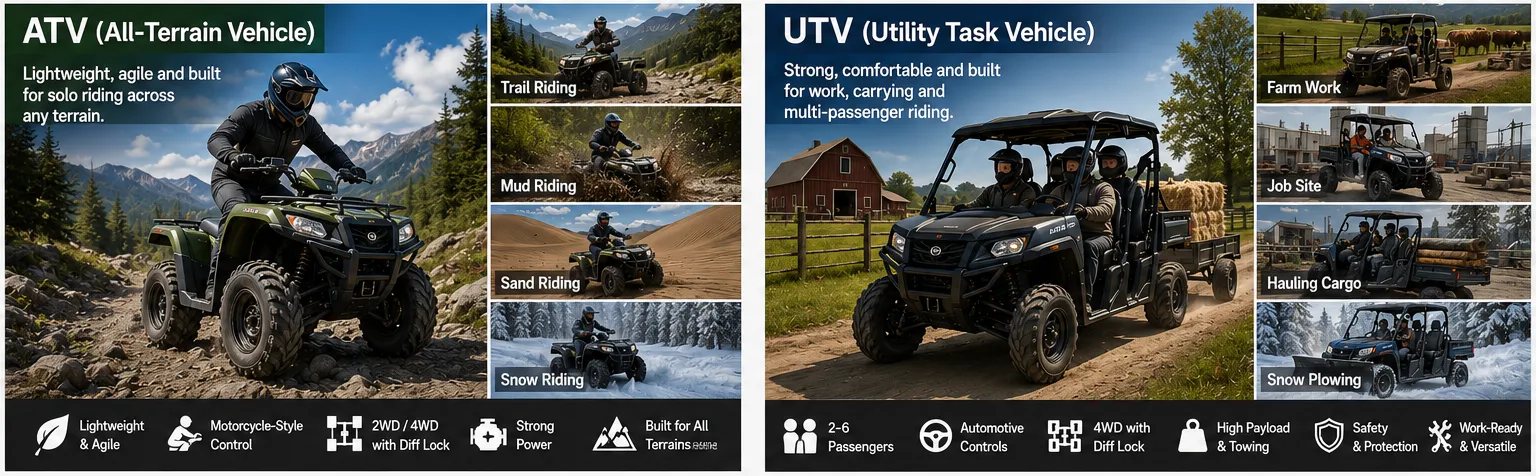
In order to facilitate purchasers, off-road players to quickly benchmark the differences between the two models, the following from the 11 core dimensions to do a visual side-by-side comparison, accurate clarification of the selection gap.
| Comparison parameters | ATV all-terrain vehicle | UTV multifunctional off-road vehicles
|
| Seat structure | Motorcycle-style cross-country seat, mainly single, a small number of 2person models | side-by-side cockpit bucket seats, support for 2-6 people to ride comfortably |
| Control Method | Handlebar steering + thumb throttle | Steering wheel + foot-operated throttle and brake (automotive-style controls) |
| Vehicle Dimensions and Weight | Compact and lightweight; curb weight of 500–1,200 lbs | Large and heavy; curb weight of 1,000–3,000+ lbs |
| Passenger Capacity | Standard single-seat; passenger comfort is extremely poor | Multi-seat cabin compliant with regulations; seatbelt protection for all occupants |
| Cargo Carrying Capacity | External rack only; limited cargo space | Integrated cargo bed; ample storage space for heavy loads |
| Towing and Hauling Performance | Moderate load capacity; rated at 500–1,500 lbs | Heavy-duty towing; rated at 1,000–3,500+ lbs |
| Chassis Stability | Standard suspension; higher center of gravity; increased risk of rollover | Extended suspension + low center of gravity; greater stability on slopes |
| Vehicle Maneuverability | Small turning radius; navigates narrow roads and dense forests with ease | Wide body; restricted movement on narrow forest trails |
| Factory Safety Features | Basic protection; lacks roll cage and standard seatbelts | Standard roll cage, seatbelts, and enclosed protective doors |
| Vehicle Purchase& Ownership Costs | Low entry price; lower overall costs for purchase and maintenance | Extensive features; higher costs for vehicle purchase and insurance |
| Primary Use Cases | Solo off-roading, navigating narrow paths, light agricultural work, budget-conscious purchasing | Heavy-duty operations, carrying multiple passengers, long-distance driving, commercial use and maintenance |
ATV core advantages
First, the vehicle’s mobility and flexibility is full, and the body width is smaller, which is suitable for deep forests, goat trails, and rocky and narrow extreme off-road terrain.
Secondly, the transportation and storage difficulty is low, the body is small and can be directly placed in the pickup truck cargo box, no need to customize a large trailer, logistics transfer, warehouse storage is more trouble-free.
Thirdly, the cost-effectiveness of the whole vehicle is outstanding, new car purchase, car insurance, daily oil filter maintenance costs are low, fit for novice, individual players small purchase budget.
Fourth, the riding control is more interesting, the motorcycle cross-riding structure linkage is strong, racing, dune cross-country, mountain climbing sports experience is better.
Fifth, the terrain penetration ability is strong, can reach the UTV can not drive into the remote wilderness points, suitable for single person field exploration, niche hunting trips.
ATV obvious shortcomings
First of all, the safety protection is weak, no original anti-roll bar, closed cockpit, high center of gravity, steep slopes and sharp curves are very easy to roll over hidden danger.
Secondly, the ability to carry people and cargo is insufficient to meet the needs of team travel, bulk material transfer, commercial operations greatly reduced practicality.
At the same time, the comfort of long-distance riding is poor, the body has no windproof and rainproof structure, and the rider controls the center of gravity independently, which makes it easy to get tired after a long time of riding.
UTV core advantages
Firstly, the safety protection system is perfect, with the original ROPS anti-roll structure, snap-on seat belt and protective doors covering the whole vehicle, so that the safety and security of the riders and passengers are fully guaranteed.
The second heavy-duty multifunctional attribute is full, with self-unloading bucket, excellent towing and loading performance, which is suitable for batch transfer of farm materials and engineering tools.
The third multi-people comfortable cockpit design, with adjustable professional cross-country suspension, long-distance cross-country, all-day factory operations to effectively alleviate driving fatigue.
The fourth modification and expansion space is sufficient, can be retrofitted with a roof, warm air, spray equipment, equipment, a key to switch the leisure, equipment dual mode.
The fifth new energy adaptability is high, the mass production of electric UTV process is mature, suitable for global environmental parks, cultural and tourism scenic area compliance landing.
UTV obvious shortcomings
Vehicle purchase, insurance, annual maintenance costs are higher than ATVs, more parts and components of the whole machine, failure maintenance costs, parts replacement costs are higher.
Wide wheelbase, bulky body, large turning radius, narrow roads in dense forests, rugged niche mountain roads can not pass, terrain adaptation limitations.
The space occupied by the whole vehicle transportation and storage is large, and special heavy-duty trailers are needed for transfer, which increases the cost of transportation and storage for individual players’ own use.
In 2026, the global off-road vehicle environmental control upgrades, fuel off-road vehicle models are subject to increased restrictions, electric ATV, electric UTV has become the industry’s mainstream shopping trend.
The two new energy models abandon the fuel engine, equipped with high-capacity lithium modules, fit the environmental protection policy of overseas ranches, scenic spots and parks, and have clear differentiation advantages.
Electric ATV body is small, battery capacity is small, energy consumption is lower, idling, traveling almost zero noise, suitable for single person close forest inspection.
Electric UTV is equipped with large-capacity power battery packs, longer range, no power decay under heavy load conditions, and the operating noise is lower than 50dB.
It will not disturb the wild animals and will not produce noise pollution in the factory, which is perfectly suitable for hunting bases, eco-farms and cultural tourism parks to use on a regular basis.
Electric ATV focuses on lightweight power output, and only supports single rider + lightweight small materials placement, no heavy-duty, towing operations.
Commercial-grade electric UTV optimizes the torque output of the motor, and the power output is smooth when fully loaded with cargo hopper and hauling agricultural equipment, and the performance is stable when climbing slopes and getting out of trouble in the mud.
There is no need for fuel refueling, and plugging in is enough to replenish the energy. It can be installed at ranches, construction sites, and parks with fixed charging piles, and the operation and maintenance process is extremely simple.
Electric ATV is suitable for: individual off-road players, small-scale retail farms, limited budgets, and single-person short-distance field inspection purchasing groups.
Electric UTV is suitable for: large-scale ranch, cultural and tourism scenic spots, fire prevention and security, engineering team, family multi-person cross-country, and bulk commercial purchasing customers.
Comprehensive 2026 foreign trade sales data, the commercial procurement of electric UTV order growth rate far exceeds that of electric ATV, becoming a new energy off-road models.
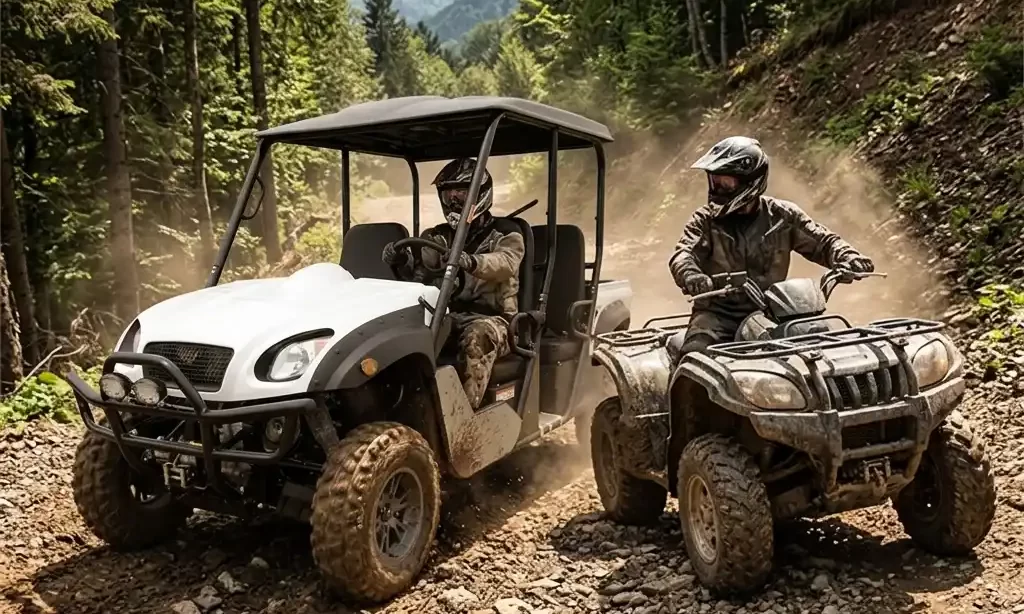
If you are a solo off-road enthusiast who favors mountain racing, sand dune cross-country and other sporty rides, ATVs are preferred.
If you run a small family farm, only need to complete fence inspection, simple field inspection and light farm work, have a limited budget and want to reduce the cost of purchasing a vehicle, ATV is suitable for you.
Daily travel through dense forests, narrow mountain roads, vehicle space is limited, the pursuit of body maneuverability, ATV is the optimal solution.
Off-road vehicle novice players, personal use, low-frequency recreational riding, no need to carry people and cargo, prioritize the cost-effective ATV.
Family companion outdoor camping, hunting, long-distance cross-country travel, need to carry more than one occupant, carry outdoor equipment, directly choose UTV.
Large farms and large-scale ranches need to transfer feed, agricultural materials, towing farming equipment, heavy-duty operations just need to recognize the electric UTV.
Sightseeing in scenic spots, security patrols in parks, firefighting duty in forests, and operation and maintenance in construction sites are suitable for commercial jobs.
Emphasizing driving safety, riding protection in rainy and sandy weather, and all-day long operation comfort, commercial procurement prioritizes the layout of electric UTV products.
This section organizes the high-frequency search Q&A of Google overseas users, accurately matches the long-tail keywords, improves the search engine ranking of the article, and answers the public’s core purchasing doubts.
Q1: Does UTV belong to the category of ATV?
The answer is no. The official industry standard divides the two independently. ATV is a straddle-type all-terrain vehicle, and UTV is a side-by-side multi-function task vehicle, with completely different structure, safety and compliance standards, which should not be mixed up.
Q2: Which one is safer, UTV or ATV?
UTVs lead in safety performance across the board. The original factory is equipped with anti-roll bar, seat belt, closed cockpit, and lower center of gravity of the chassis; ATV has no protection structure, and the risk of rollover is higher when driving on slopes and sharp turns.
Q3: Is it worthwhile to purchase electric UTVs in bulk for commercial use?
It is worth purchasing. Electric UTVs are free of oil change, have zero exhaust emissions, have a range that meets the requirements of a single day’s work, and the long-term maintenance cost is much lower than that of fuel models, which is in line with the global policy of environmentally friendly vehicle use.
Q4: Can the two models be legally driven on the road?
The original models are off-road off-road vehicles; UTVs with lights, mirrors and turn signals can be put on the road for the record in many countries and regions, while ATVs basically can’t be qualified for the road.
Q5:Which one has a longer service life under the same working condition, ATV or UTV?
The frame and motor structure of UTV are more durable under work conditions; the life span of both is equal under leisure use conditions, and the life span of the electric version is better than that of fuel off-road vehicles.
Comprehensive comparison of the whole article summarizes that: ATVs are preferred for low-cost, single-person off-road sports, and narrow-road access; UTVs are preferred for commercial loading, multi-person travel, safety and comfort, and long-term operation and maintenance.
Combined with the overseas procurement trend in 2026, environmental protection policies, and commercial payback cycle, electric UTVs have become the preferred model for family users, corporate procurement, and farmers.
Compared with imported high-priced Polaris and Bombardier UTVs, domestic foreign trade-grade electric UTVs are more cost-effective and support customization of cockpit, cargo hopper, and tooling attachments, and are suitable for global export certification standards.
Our whole series of electric UTVs are equipped with reinforced load-bearing frame, long-lasting lithium modules, 4WD off-road chassis, taking into account the dual needs of leisure off-road and agriculture, animal husbandry, scenic spots, one-stop to meet the needs of bulk foreign trade purchases and individual purchases.
Compared with the same price electric ATV, the self-developed electronic control system is more stable in power, stronger in load, and full of protection configuration, which is the best choice for cost-effective off-road purchase in 2026.
Review UTV vs ATV: Know the difference between the two best off-road vehicles Core content, the two top off-road vehicles positioning is very different.
ATV focuses on lightweight, high mobility, high cost-effective, personal leisure services, light field operations; UTV focuses on heavy-duty, safety, multi-person cabin, new energy adaptation, empowering the commercial all-area working conditions.
There is no need to blindly follow the trend of vehicle purchasing, combining their own number of travelers, operating load, driving terrain, annual budget, environmental protection needs of the vehicle selection can be.
If you are mainly engaged in commercial operation and maintenance, family travel, and long-term cost reduction, you should give priority to high-performance electric UTVs to realize the three-in-one comfort, practicality and economy.


-150x150.png)