The vast majority of UTV owners give priority attention to shock absorbers, power, and appearance kits when modifying and maintaining their vehicles, but often overlook the most central accessory – tires. As a matter of fact, tires are the only parts of the UTV that come into contact with the ground, and they directly determine the vehicle’s grip, driving stability, driving comfort, off-road passability, and even the service life of the entire vehicle.
This article will start from scratch, comprehensively dismantle all the core knowledge of UTV tires, combined with different terrain, different vehicle scenarios to give accurate selection plan, while pointing out the tire upgrade misunderstanding and replacement timing, to help every UTV owner to choose the right tires in one step, taking into account off-road performance, vehicle safety and vehicle service life.
Many vehicle owners think that tires are just a substitute accessory, as long as they can roll, it is enough, this idea is the biggest misunderstanding of off-road vehicles. Properly matched UTV tires can comprehensively improve vehicle performance in five dimensions: handling, safety, cost, range, and scene adaptation, and choosing the wrong tires can lead to multiple hidden dangers.
Tires with different tread patterns correspond to completely different ground grip effects. Matching the tire pattern to the terrain can effectively improve vehicle acceleration, braking performance, and at the same time improve the stability of the body when driving on side slopes. On the contrary, if you use mud tires to drive on hard paved roads, there will be body bouncing, longer braking distance, steering fluttering; if you use all-terrain tires to drive on deep mud, the tire tread will easily be filled with mud, and the tire will completely lose grip, resulting in the vehicle getting stuck.
Simply put: tire tread determines the grip, and the grip directly determines whether you can stabilize the vehicle, avoiding dangerous situations such as side-slip, tail-flip, and loss of control in the off-road process.
The off-road surface is full of gravel, roots and sharp stones, and tires with weak sidewalls and insufficient ply are very prone to scratches, bulges and flat tires. UTV tires with appropriate ply and reinforced sidewalls can withstand the impact of sharp and hard objects on the road and reduce the probability of tire blowout during high-speed off-road and heavy-duty driving.
At the same time, matching the specifications of the tires can ensure that the original body ground clearance and center of gravity height, to avoid over-sized tires lead to a higher center of gravity, the risk of rollover on side slopes, from the hardware level to ensure the safety of the entire vehicle off-road.
Tires are afraid of mismatching terrain: off-road tires run on paved roads for a long time, and the tread pattern will wear out quickly; road-oriented tires frequently traverse rocky and gravelly roads, and the sidewalls are very easy to break. Although the purchase price of high-quality UTV tires is higher upfront, the use of terrain-matched tires can significantly extend the service life of the tires, reduce the cost of repeated tire replacement, while avoiding additional expenses for field rescue and vehicle maintenance due to tire failures, which is much more cost-effective than low-cost mismatched tires in the long run.
This is the exclusive focus of electric UTV purchase, but also fuel UTV owners do not need to focus on the core points. Electric UTVs rely on motor drive, motor output torque directly on the tires, high rolling resistance, tread too large tires, will continue to consume more power, directly shorten the vehicle range.
Adapted radial tires can effectively reduce rolling resistance, which not only improves the range performance of electric UTVs, but also reduces the operating loads of motors, drive shafts, and differentials, avoiding the problems of overheating and increased loss of motors in long-term high-load work, and protecting the entire vehicle’s three electric systems.
The UTV itself has a wide range of uses: daily forest recreational traversing, farm heavy-duty work, wetland mud adventure, desert dune play, mountain hunting, professional cross-country competitions, and different scenarios have different requirements for tire strength, tread pattern, and loading capacity. Choosing tires according to needs can not only meet extreme off-road needs, but also ensure the practicality of daily commuting and heavy-duty operations without frequent tire replacement.
Before choosing UTV tires, you must read the three core parameters: tire structure, ply specifications, and size markings, as well as separating the basic terminology and reading all the parameters on the sidewall of the tire, in order to avoid buying a product that is not compatible with your vehicle.
Currently on the market all UTV tires are divided into radial (Radial) and bias-ply (Bias-Ply) two kinds of tires, the two internal cords arranged in different ways, performance, applicable scenarios are very different, the specific differences are as follows:
Comparison of radial tires (Radial) bias-ply tires (Bias-Ply)
Internal cord structure cord perpendicular to the bead layout, tread with stabilizing steel belt cord cross diagonal layout, the overall structure of one stronger rigidity
Driving comfort soft sidewalls, good shock absorption, more comfortable for long-distance traveling too hard sidewalls, obvious vibration on bumpy road, poor comfort
Heat dissipation and abrasion resistance excellent heat dissipation, high speed driving is not easy to heat, tread more wear-resistant high speed driving heat accumulation serious, tread wear faster
Sidewall impact resistance sidewall is soft, extreme rocky road surface is more likely to be scratched sidewall rigidity pull full, anti-puncture, anti-extrusion ability is very strong
The best application scenarios daily all-terrain traversing, high-speed driving, electric UTV general-purpose rock climbing, deep mud off-road, heavy-duty engineering operations
Suggestions: 90% of general players, electric UTVs give priority to radial tires; only players who often play extreme rock traversing, heavy mud off-road, need to get bias tires.
Tire ply represents the overall strength and load capacity of the tire, not the actual number of ply of the cord. The higher the ply, the stronger the puncture resistance and load capacity of the tire, and at the same time, the higher the dead weight and the lower the comfort level:
– 4-ply tires: light weight, comfort is the best, only suitable for the original light recreational walk, can not cope with gravel, rocky roads, easy to puncture the tire, not recommended for off-road players.
– 6-ply tires: gold balanced models, taking into account the strength, weight, comfort, suitable for the vast majority of casual cross-country, daily crossing scene, is the most common UTV tire specifications on the market.
– 8-ply and above tires: heavy-duty heavy-duty tires, sidewall comprehensively strengthened, puncture-resistant pull full, suitable for height modification of UTVs, high-horsepower models, farms, heavy-duty pulling goods, the disadvantage is that the self-weight is large, will slightly increase power consumption and fuel consumption.
UTV universal size format: 27 × 11R14, each number meaning at a glance:
– 27: tire overall outside diameter (inches), the larger the value of the higher ground clearance
– 11: tire tread width (inches), the larger the width of the soft ground flotation is better
– R: for radial tires, no R / – for bias tires
– 14: Adaptable wheel diameter (inches)
Directional pattern: single direction rotating pattern, stronger mud draining performance, can not be switched back and forth; non-directional pattern: can be switched at will tire position, more uniform wear, daily maintenance is more convenient. Tire sidewall, tire lip, rubber formula will directly affect the tire anti-aging and anti-tearing ability.
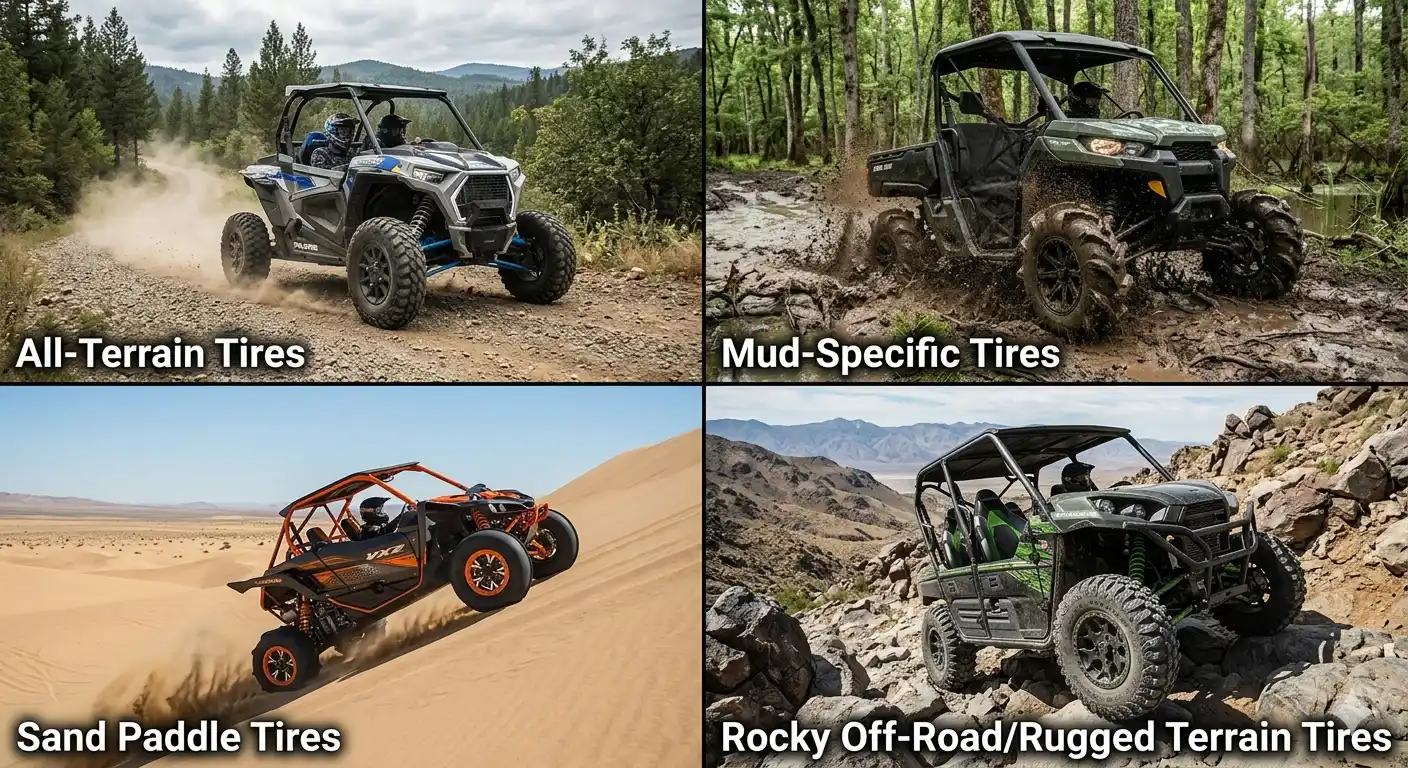
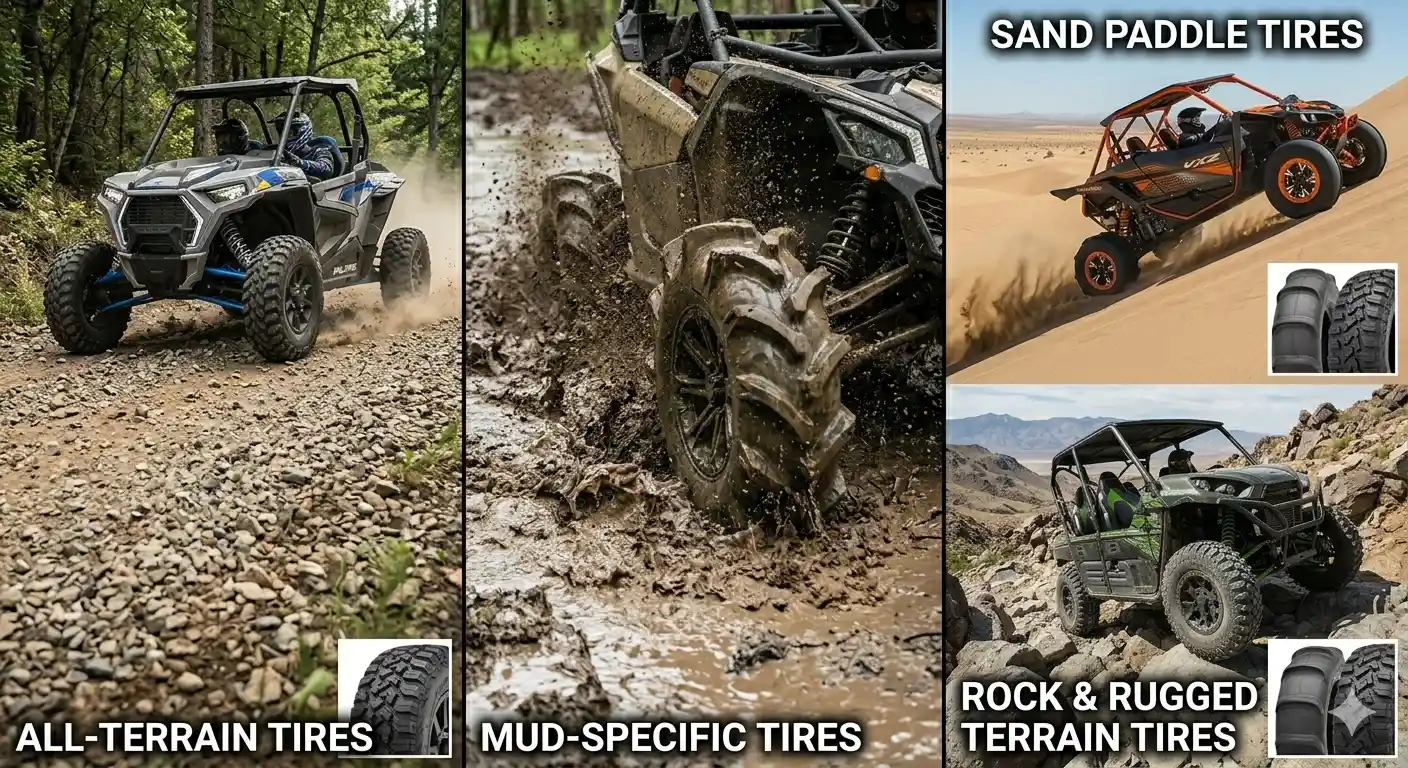
UTV tires are divided into five categories according to the tread pattern and terrain, there is no all-around tire, only the most suitable for their own road conditions, the following all-around dismantling of the suitability of each type of tire scenarios:
The tire with the highest sales volume and the widest range of adaptable people on the market, with moderate height and balanced spacing of the tread blocks, taking into account multiple scenarios of hard roads, gravel roads, dirt roads and shallow mud.
– Advantages: versatility, low noise, comfortable ride, wear-resistant tread, no need to replace tires frequently.
– Disadvantages: Extreme deep mud, sandy terrain performance is average, unable to reach the extreme performance of professional off-road tires.
– Suitable for: daily recreational traversing, hunting in the mountains and forests, light work on farms, and most electric UTV owners.
– Popular models: Magis Bighorn, STI Black Diamond, Kenda series all-terrain tires.
The tread blocks are more than 25mm deep and the tread spacing is very large, which can automatically shake out the mud during driving, avoiding tread blockage and loss of grip, specially designed for swamps, sticky land, and deep puddles.
– Advantage: Muddy road grip ceiling, no fear of deep mud stuck in the car
– Weaknesses: severe bouncing on hard surfaces, extremely noisy, very fast tread wear, electric UTVs increase power consumption significantly.
– Suitable for: wetland adventure, swamp off-road, southern rainy and muddy road players.
Differentiated front and rear wheel patterns: oversized paddle pattern on the rear wheel provides driving power, while the glossy rib pattern on the front wheel reduces driving resistance, and focuses on the floating sand effect to prevent the vehicle from getting stuck in the fine sand.
– Advantage: fine sandy road without sinking, dune driving with plenty of power
– Weaknesses: Cannot be used on rocks, dirt roads, or mud, very poor versatility.
– Suitable for: Desert off-road and beach lovers.
The sidewalls are reinforced, the tread pattern is compact and hard, and the carcass has a thicker rubber formula that is resistant to scratches and crushing, and the sidewalls have a strong grip when climbing a rock wall at low speeds.
– Advantage: anti-puncture performance pull full, rock wall, rock pile driving stability is very strong
– Weaknesses: easily clogged in soft mud, poor comfort at high speeds.
– Suitable for: professional rock climbers, extreme off-road hardcore gamers.
Smoother tread pattern reduces wind resistance and heat buildup at high speeds, focusing on high speed stability and giving up extreme off-road capabilities.
– Advantage: High-speed cornering stability, fast heat dissipation, better top speed performance.
– Weaknesses: lack of grip on complex off-road surfaces, lowest versatility.
– Suitable for: UTV racing, desert high speed cruising players.
Recommended Tires: All Terrain Radials|Recommended Tire Pressure: 10-18PSI
Conventional forest traversing road conditions are very complex, the road surface is full of gravel of different sizes, raised roots, potholes of different depths and hard compacted dirt road, the whole process of continuous bumps and vibrations, and sharp gravel is very easy to scratch the tread and sidewalls, the tire’s filtering ability, abrasion resistance and resistance to puncture ability has a double requirement.
Many players blindly installed deep groove cross-country tires with large tread pattern, seemingly stronger cross-country performance, but it is counterproductive: large blocks of tread in the flat hard surface will produce a significant bounce resonance, the body bumps greatly intensified, long-distance traversal is very easy to produce driving fatigue, and at the same time, wide blocks of tires and the ground contact area is not uniform, the tread of the local wear and tear speed, but also produces a continuous harsh driving noise. The all-terrain radial tire adopts a moderately sparse and balanced tread design, which can not only catch the gravel road with the help of moderate blocks to prevent slipping when cornering and climbing, but also rely on soft sidewalls to filter the fine bumps on the road, taking into account the comfort of daily riding and long-term wear-resistant performance, which is perfectly suited to the needs of the vast majority of forest traversing, and there is no need to blindly pursue the extreme large-tread cross-country tires.
Recommended Tire: Directional Tread Mud Tire|Recommended Tire Pressure: 6-12PSI
When driving on sticky and heavy mud, wet and soft swampy surfaces, do not keep the standard hard surface tire pressure. It is necessary to lower the tire pressure to let the tire body fully stretch, expand the ground contact area between the tire and the mud, evenly distribute the weight of the whole vehicle, effectively improve the tire’s flotation ability in the soft mud, and prevent the tire from sinking directly into the bottom of the mud.
At the same time, the low-pressure state of the sidewall fit better, so that the mud tires wide deep grain fully bite the soft ground, further strengthening the grip, from the root to avoid the vehicle skidding, wheel spinning, the whole car into the mud can not get out of the problem. Remember not to lower the tire pressure too much, otherwise it will increase the risk of tire side crushing and air leakage.
Recommended Tires: Special paddle sand tires|Recommended Tire Pressure: 8-12PSI
Sandy road texture is soft and loose, fine sand mobility is very strong, high tire pressure tire tread is too hard, grounding area is narrow, the tire will directly penetrate the surface of the floating sand, quickly sink into the depth of the sand layer, it is very easy to appear wheel spinning planing sand, the vehicle is completely trapped in the situation. Therefore, dunes, beach driving is strictly prohibited to maintain the conventional hard surface high tire pressure, need to moderate deflation to reduce tire pressure, so that the tire tread is fully spread out, greatly expanding the contact area of the tire and the sand, uniformly share the weight of the vehicle, relying on a larger grounding area to achieve the effect of floating floating sand, to avoid tires sinking into the fine sand. At the same time, the low-pressure tread can better fit the undulating dune slopes, with the exclusive paddle pattern of the sand tires to firmly grasp the loose sand, steadily improving the vehicle’s climbing ability and overall throughput, and easily coping with continuous dune crossing.
Recommended Tire: 8-ply Rock Tire|Recommended Tire Pressure: 6-10PSI
The rocky piles and rocky road surfaces are full of sharp-edged hard stones, raised rocks and rugged drop-offs, and the road surface support points are scattered and hard, the tire carcass is too hard to fit the uneven rock surfaces under the high tire pressure condition, which will lead to the problems of local overhanging and faulty grip, and at the same time, it is very easy to damage the wheel hubs and tires by hard impacts. Therefore, we need to lower the tire pressure to let the tire side fully flexible deformation, closely fit the irregular rocky slope and angular gap, all-round enhance lateral grip and friction, to ensure the stability of the body when climbing at low speeds without skidding. At the same time, the pressure relief tires can act as a natural buffer layer, absorbing the hard impact of the rock, effectively isolating the hard objects directly hit the wheel hub, to avoid wheel deformation and cracking, but also avoid tire pressure is too low, to prevent off-road process of tire side off the rim, crushing the tire wall structure.
Most of the daily cross-country will not be fixed single road conditions, many travel routes will be linked gravel forest roads, shallow mud pits, soft dirt roads and a small number of hard surfaces, road switching frequently and irregularly, and it is time-consuming and labor-intensive to replace the special tires alone. This kind of mixed and variable road conditions, preferred all-terrain tires with strong versatility, without the need to prepare multiple sets of tires back and forth dismounting.
Tire pressure can be adjusted flexibly and dynamically according to the real-time road surface during driving: lowering the tire pressure to enhance the flotation and grip when driving on soft mud and dirt roads, and raising the tire pressure when driving on hard gravel roads and compacted road surfaces to reduce the deformation of the tire body and the abnormal wear of the tire tread. Relying on the flexible tire pressure fine-tuning, a set of all-terrain tires can comfortably cope with the whole process of changing road conditions, taking into account the ability to pass, driving comfort and tire durability, which is the most worry-free and practical choice for the majority of ordinary off-road players.
Vehicle scene recommended tire type recommended tier recommended structure core purchasing focus
Daily leisure forest traversing all-terrain AT tires 6 tiers radial comfort, low power consumption, low noise
Mud off-road adventure professional mud tires 6-8 ply bias/heavy radial self-cleaning tread pattern, deep tread pattern
Farm Heavy Duty Reinforced All-Terrain Tires 8+ ply radials load capacity, sidewall strength
Rock Extreme Climbing Rock Off-Road Tire 8-Ply Slanted Puncture Resistant, Rigid Sidewalls
Mountain Silent Hunting Low Noise All-Terrain Tires 6-ply radials for low driving noise and no disturbance to prey.
Many vehicle owners blindly increase tire size in order to improve off-road face value and ground clearance, not knowing that tire size changes will affect the performance of the entire vehicle in all aspects, especially electric UTVs, the impact is far greater than fuel models:
Every 1-inch increase in tire OD, ground clearance increases by 0.5 inches, which greatly improves the passability and makes it easier to cross tree roots, rocks, and potholes, and the whole vehicle has a stronger off-road aura.
– Slower acceleration: larger tire circumference increases the load on the motor, and the starting explosive power decreases significantly.
– Shrinkage of range: rolling resistance is greatly increased, electric UTV range is directly reduced by 10-20%.
– Increased transmission loss: half shafts, differentials, and motors are continuously overloaded, and transmission parts are easily damaged by long-term use.
– Increased center of gravity: increased risk of rollover when driving on side slopes, heavy steering.
It is recommended that the maximum upgrade of the original vehicle should not be more than 2 inches; more than 3 inches must be matched with a lift kit, clutch kit, and speed ratio adjustment, or it will seriously damage the whole vehicle power system.
Big tread tires have higher face value, but the comfort of daily driving is extremely poor, power consumption and fuel consumption soar, ordinary players do not need to blindly on the big tread off-road tires
Arbitrary replacement of non-standard tires, wheel rubbing fenders, speedometer inaccuracy, abnormal wear and tear of the transmission system problems
Choose 8-ply hard tires for light mobility, and the comfort level plummets; choose 4-ply thin tires for heavy off-road use, and frequent punctures and blowouts occur.
Miscellaneous low-priced tires with poor rubber formula, anti-aging, tear-resistant ability is insufficient, driving in the field there is a great security risks
Front and rear tire tread, structure inconsistency, vehicle driving deflection, damage to the four-wheel drive transmission system
Fixed tire pressure throughout the year, will not adjust the tire pressure according to the road surface, significantly shortening the service life of tires.
– Severe tread wear: the corners of the tire blocks are flattened, the grip drops drastically, and there is obvious slippage in climbing and braking.
– Rubber aging and cracking: the side of the tire appeared fine cracks, rubber hard white, belonging to the rubber aging, high temperature off-road very easy to blow the tire
– Persistent slow air: no obvious puncture point, but need to make up air frequently, indicating that the sidewalls have invisible damage.
– Tire bulging, deep cuts: tire side bulging belongs to the internal cord fracture, is a high-risk hidden danger, must be replaced immediately.
– Abnormal shaking: the vehicle body continues to shake at a constant speed, the steering wheel shaking, represents the internal structure of the tire is damaged.
Additional maintenance recommendations: UTV tires are recommended for mandatory replacement in 4-6 years, even if the tread is intact, the aging of rubber will also pose a safety risk; usually long term parking is recommended to be stored in the shade, to avoid direct sunlight to accelerate the aging.
Priority radial tires, lower rolling resistance can effectively save power to improve range, the motor running load is smaller, more comfortable for daily driving, only heavy off-road scenarios need bias tires.
There is no 100% all-round tire, all-terrain AT tire is the optimal compromise solution, taking into account most of the road conditions; if you often switch to extreme road conditions, it is recommended to prepare two sets of tires to be replaced as needed.
No modification is needed for small increase (1-2 inches); more than 2 inches, the speed ratio and clutch must be adjusted; otherwise, the power decreases significantly, and the transmission system will be easily damaged.
Mileage reference: 1500-5000km; Time reference: 4-6 years, subject to the aging state of rubber and the degree of tread wear.
It is not recommended, not only the noise is harsh and bouncing, it will also wear out the tire tread quickly and increase the power consumption of electric UTV significantly.
When choosing UTV tires, the core principle is always: give priority to matching the main driving terrain, then determine the tire structure, ply and size, don’t blindly upgrade to large-size and large-pattern tires for the sake of value.
For the vast majority of ordinary players and electric UTV owners, 6-ply radial all-terrain tires are the standard answer for cost-effectiveness and practicality; only for extreme off-road scenarios, and then select mud, rock, sand special tires as needed. Choosing the right tires can not only guarantee off-road safety and enhance the driving experience, but also protect the power and drivetrain of the whole vehicle and extend the service life of the whole vehicle.


-150x150.png)