With the advantages of zero fuel consumption, low noise and low failure rate, electric UTV is widely used in farm operations, outdoor engineering, off-road leisure and other scenarios, gradually replacing traditional fuel UTV. Most car buyers only pay attention to the selling price of bare cars, and there is a widespread misunderstanding that “the purchase price of electric UTV is high and the later maintenance is more expensive”. They ignore the long-term maintenance, operation and maintenance and energy consumption costs, which can easily lead to out-of-control car budget. In fact, the overall maintenance cost of electric UTV is 35%-70% lower than that of fuel oil, and the cost-performance advantage of long-term vehicles is outstanding.
This paper combines brand official data, industry measured cases and standardized maintenance specifications to disassemble the annual and long-term maintenance costs of electric UTV in an all-round way.
The Core Reason For The Significant Reduction In Maintenance Costs Of Electric UTV
The high maintenance cost of fuel UTV stems from the complex mechanical structure of the internal combustion engine, which contains hundreds of moving parts and requires high-frequency regular maintenance, consumable replacement and system maintenance. The electric UTV adopts a motor-driven architecture, abandoning the traditional internal combustion engine, fuel supply, ignition, exhaust and other complete systems, reducing more than 80% of conventional maintenance projects from the root, which is also the core reason for the precipitous decline in maintenance costs.
Specifically, the electric UTV completely eliminates the necessary high-frequency maintenance items for fuel UTV, and completely eliminates related consumables and labor costs:
Of course, electric UTV is not non-zero maintenance, and some mechanical loss parts are exactly the same as fuel models, and still need regular maintenance, mainly including: tires, brake systems, suspension systems, differentials, transmission oil, anti-rust cleaning of the vehicle chassis, etc. At the same time, the maintenance center of gravity of electric UTV has shifted significantly, no longer focusing on the engine, but focusing on battery health monitoring, circuit connector protection, vehicle software upgrade, motor and battery cooling system maintenance. The frequency of such maintenance projects is extremely low, the cost of consumables is low, and there is almost no high cost.
It is worth mentioning 1 the energy recovery braking (regenerative braking) system equipped with electric UTV can greatly reduce the frequency of use of mechanical brakes, effectively extend the service life of brake pads and brake discs, and further reduce the brake system compared with fuel UTV. The maintenance and replacement cost of the system has formed an additional cost advantage.
Electric/Fuel UTV Annual & Ten-Year Maintenance Cost Accurate Comparison
All the cost data in this article are from the Landmaster, Polaris official ten-year vehicle analysis report, North American UTV industry operation and maintenance white paper, combined with different use scenarios, maintenance methods (DIY/store professional maintenance) comprehensive value, the data is true for reference, can accurately reflect the real car cost of ordinary users.
| Cost Category | Electric UTV | Fuel UTV | Cost Variance and Explanation |
| Annual Routine Maintenance Cost | $100-400 (mainstream range $150-200) | More than $300-$800 | Electric models are 35%-70% lower, including only tires, brakes, oil and testing costs. |
| Total cost of ten years of conventional maintenance | $2000-$4500 ($4045 Landmaster measured) | $8000-$9000 (measured mean $8800) | Ten years of direct savings of $4000-5000, no engine consumables overhead |
| Energy Consumption Operating Costs | Extremely low, a single full charge 0.5-2 US dollars, and the cost per mile is about 0.09 US dollars | Much higher than the electric model, fuel unit price, fuel consumption costs are rising year by year. | Ten years of energy consumption can save more than 5000-6000 US dollars, which is the core saving item. |
| Battery replacement costs | 3500-15000 US dollars, service life 5-10 years, most brands are guaranteed for 5-8 years | There is no need to replace the high-voltage battery, only the 12V starting battery needs to be replaced. | The only large potential overhead for electric models, which can be completely circumvented during the warranty period. |
It is clear from the table data that even if potential battery replacement costs are included, the long-term comprehensive cost of electric UTVs is still much lower than that of fuel models. Landmaster official measured data show that users can save about 4755 US dollars in maintenance costs after using electric UTV for ten years. Polaris Polaris also said publicly that the routine maintenance cost of its electric UTV is 70% lower than that of fuel vehicles of the same grade, and the data is extremely reliable.
Details of Maintenance Items Required for Electric UTV
Many car owners mistakenly believe that electric UTV does not need maintenance, long-term zero detection, zero maintenance, and eventually lead to minor failures into major problems, but increase maintenance costs. In fact, the maintenance core of electric UTV is “regular inspection, light maintenance, key protection of batteries and circuits”. All maintenance items are just needed, low frequency and low cost.
Conventional rigid maintenance items are mainly divided into 5 categories: first, basic vehicle condition inspection, including tire pressure, tire wear, brake pad thickness, brake oil state, suspension tightness, whole vehicle lighting, chassis integrity inspection; Second, battery system maintenance, including charging habit control, battery appearance inspection, terminal cleaning, battery health monitoring; Third, oil replacement and maintenance, regular replacement of differential gear and gearbox gear oil, ensure the smooth operation of the transmission system; Fourth, circuit system protection, check the status of lines, connectors and fuses, and clean up dust and rust. Fifth, scene-based cleaning and maintenance. After mud, sand and water wading operations, clean the chassis, battery compartment and heat dissipation channel in time to avoid corrosion and blockage.
At the same time, it needs to be made clear that the core high-voltage components such as high-voltage circuits, motor controllers and battery packs of electric UTV are prohibited from being disassembled and overhauled by car owners. Complex faults must be handled by brand authorized technicians, which can not only ensure the safety of the car, but also avoid the failure of the warranty caused by unauthorized maintenance. For owners with hands-on ability, basic inspection, cleaning and simple replacement of consumables can be completed by themselves, which can further reduce maintenance costs.
Life Cycle Cost Summary: High Down Payment For Long-Term Ultra-High Cost Performance.
Electric UTV generally has a purchase premium, compared to the same configuration of fuel UTV, the new car price will be higher by a portion, but this part of the difference can be passed. Ultra-low maintenance costs + extreme low energy costs quickly offset. According to industry estimates, the regular frequency of the use of electric UTV,3-7 years can be returned to the cost, high-frequency commercial, farm operation scenarios, the return cycle will be further shortened.
Even if the battery pack needs to be replaced after 5-10 years of use, the electric UTV still saves a lot of money than the fuel model. And with the iteration of battery technology, the stability and life of lithium batteries have been greatly improved. The batteries of most mainstream models can be used stably for 8-10 years, basically covering most of the service life of the vehicle. Most car owners do not need to replace the batteries at their own expense during the life cycle of the vehicle.
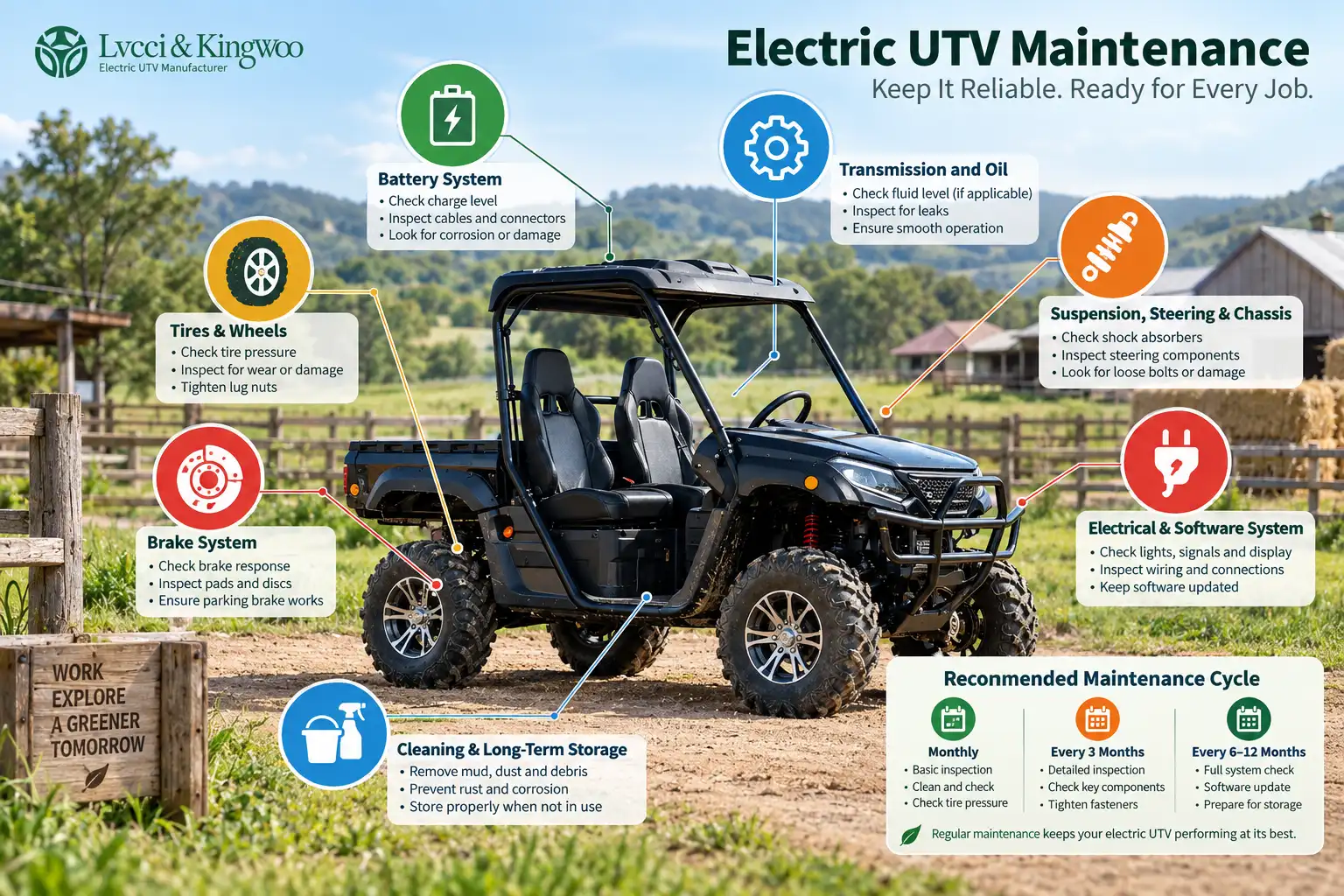
In order to effectively control the maintenance cost of electric UTV and prolong the service life of the whole vehicle, it is only necessary to master the standardized maintenance specifications of the core components, maintain on demand, and eliminate excessive maintenance and lack of maintenance. The following streamlined dismantling of the seven core maintenance modules and general maintenance cycle of electric UTV, suitable for home leisure, farm operations, commercial heavy-duty and other full-scene use needs.
Battery System Maintenance
The battery is the most costly core component of the electric UTV, which directly determines the service life and long-term operation and maintenance costs of the vehicle. Mainstream Polaris, Landmaster electric UTV are equipped with long-term lithium battery, daily maintenance-free, just follow the scientific habits can greatly delay the decay.
It is recommended to keep the power in the range of 20%-80% for daily charging to avoid deep power loss, long-term full-power static and high-temperature charging. After high-intensity operation, the battery and motor need to be cooled and recharged, and the original charger must be used to prevent unstable voltage and current from damaging the BMS battery management system.
Daily vehicles can check the battery status through the dashboard, visually check the battery shell and connection terminals every month, clean and remove rust in time and do insulation protection; at the same time, regularly maintain the 12V low-voltage auxiliary battery to ensure the normal operation of the entire vehicle’s electrical appliances. In case of sudden drop in battery life, abnormal charging or system alarm, it shall be immediately sent to an authorized store for maintenance to avoid permanent damage to the battery. Standard maintenance of lithium battery life of up to 8-10 years, the basic coverage of the vehicle life cycle.
Tire And Wheel Maintenance
Tires are the most important conventional wear and tear parts of electric UTV. Complex outdoor terrain will accelerate wear. Standardized maintenance can effectively reduce replacement costs. It is necessary to check and calibrate the tire pressure on a regular basis, and adjust it flexibly according to the load and road conditions, so as to eliminate the problems of tire pressure that is too high and puncture, and the tire wall is too low.
Regularly check the tire pattern and sidewall status. The pattern thickness is less than 3mm and needs to be replaced in time. At the same time, the four wheels are replaced in time to ensure uniform wear and prolong service life. Due to the characteristics of battery weight and instantaneous torque, the tire wear of electric UTV is slightly higher than that of fuel vehicles in off-road scenarios, and the loss can be offset by smooth driving. The service life of tires for light use can reach 2,000-5,000 miles, while that for heavy off-road is only 1,000-2,500 miles, and the rubber parts need to be replaced as a whole in 4-6 years to avoid aging and cracking.
Maintenance Of Brake System
Relying on regenerative braking technology, the brake loss of electric UTV is much lower than that of fuel models, which is one of the core cost advantages. When the vehicle is coasting or going downhill, the motor recovers energy, which greatly replaces the work of mechanical brakes, effectively extending the life of brake pads and brake discs.
Regular maintenance needs to check the wear state of brake accessories and pipeline sealing every month, and replace the brake oil every 1-2 years to prevent the deterioration of the oil from affecting the braking effect. The use frequency of electric UTV brake is low, and it is easy to rust the disk surface and jam the accessories. It is necessary to regularly remove the rust with light brake. Under the same use intensity, the service life of electric UTV brake pads is 1.5-2 times that of fuel models, and the total cost of ten-year brake maintenance is only half of that of fuel models.
Transmission System and Oil Maintenance
Electric UTV eliminates high-frequency maintenance components such as engines, CVT belts, and clutches, and only retains transmission structures such as gearbox and differentials, which greatly reduces maintenance frequency and cost. Conventional light use requires replacement of gear oil every 50-100 hours or once a year, and the maintenance cycle for muddy, wading and heavy-duty heavy scenes is halved to prevent oil ingress failure and aggravate component wear.
It is necessary to check the gear oil level on a daily basis, check the state of the half shaft and CV dust cover every month, and replace it in time after damage to avoid sand and gravel from wearing precision accessories. At the same time, grease is regularly added to the chassis hinge points and steering joints, so that low-cost DIY maintenance can greatly reduce the probability of later failure maintenance, and the overall transmission maintenance cost is reduced by more than 60% compared with fuel UTV.
Suspension, Steering And Chassis Maintenance
The electric and fuel UTV chassis, suspension, and steering structure are the same. As the core load-bearing structure of the all-terrain, long-term bumps are prone to looseness, leakage, and wear. Check the shock absorber, control arm, ball head, bushing and other vulnerable parts every 25-50 hours to check the hidden dangers of abnormal noise, oil leakage and looseness.
After off-road and muddy operations, the chassis must be thoroughly cleaned to remove sediment and debris to prevent corrosion of the chassis and blockage of the heat dissipation channel. Calibrate the four-wheel positioning and steering accuracy every 50-100 hours, and tighten the body screws regularly; for heavy vehicles, in-depth maintenance of the suspension system and replacement of aging accessories every 200 hours to ensure stable vehicle handling.
Electrical and Software System Maintenance
The electrical system is the exclusive core architecture of electric UTV. Low-voltage accessories can be maintained independently. Core components such as high-voltage batteries, motors and electric controls are strictly prohibited from being disassembled without permission to avoid potential safety hazards and warranty failure.
Check the dashboard fault prompt every day, check the function of the electrical accessories of the whole car every week, clean the line connector, fuse box and low-voltage battery terminal every month, and do a good job of insulation and rust prevention. Regularly clean up the dust in the motor and battery heat dissipation duct to ensure smooth heat dissipation; New models can regularly upgrade official firmware to stores to optimize energy consumption and fault monitoring performance. All high-voltage system failures, in-depth maintenance and upgrades must be operated by professional technicians, and non-standard parts are prohibited from being modified without permission.
Cleaning And Long-Term Storage Maintenance
Standardized cleaning and storage can effectively avoid hidden loss of electric UTV and protect precision electrical components. Daily cleaning with low-pressure clean water with neutral detergent, prohibit high-pressure water gun directly into the battery, high-voltage connectors, motors and other precision parts, after cleaning thoroughly dry water, to prevent short-circuit corrosion.
For long-term parking (over 15 days), 50%-60% moderate power shall be maintained, the low-voltage battery shall be disconnected, and the vehicle shall be stored in a dry and ventilated indoor environment with suitable temperature and humidity to avoid exposure to the sun and severe cold erosion. During the idle period, short-distance start driving every month to activate the battery cell to avoid static attenuation and component aging.
Standardized Maintenance Cycle
In order to facilitate car owners to standardize maintenance and control costs, organize and streamline general maintenance cycles, and halve all cycles for heavy use scenarios:
Years And 10 Years Of Regular Maintenance Base Cost
Combined with store charges, DIY maintenance and brand official data, the annual maintenance cost of electric UTV with moderate use (annual average of 1000-2000 miles) is US $100-400, while the mainstream expenditure of ordinary car owners is only US $150-250, which is about 1/3 of that of fuel UTV. The total cost of 10-year routine maintenance is only 2,000-4,500 US dollars, which can save more than 4000 US dollars compared with 8,000-9,000 US dollars of fuel UTV. The combined energy consumption cost can save more than 10000 US dollars in 10 years, with outstanding long-term cost advantages.
Core Components Breakdown Maintenance Costs
The maintenance cost of electric UTV is concentrated on a few conventional wearing parts, and the long-term cost of each component for ten years is clear and controllable:
Many users struggle with the core of model selection, is unable to clearly distinguish between the two models of long-term maintenance differences. This section visually demonstrates the maintenance advantages of electric UTV through all-round dimensional comparison, helping users make accurate decisions.
| Contrast dimension | Electric UTV | Fuel UTV | Advantage party |
| Engine related maintenance | No engine maintenance project | Need high-frequency replacement of oil, filter element, spark plug, debugging valve, carburetor | Electric UTV |
| Transmission system maintenance | Only need to change the gear oil, no CVT belt, clutch maintenance | Belt, clutch high frequency wear, need frequent inspection and replacement | Electric UTV |
| Brake wear speed | Regenerative braking to reduce the burden, extremely low wear and long life | Fully mechanical braking, fast wear and high replacement frequency | Electric UTV |
| Maintenance frequency | Long cycle, less annual maintenance times | Time-consuming and labor-intensive maintenance | Electric UTV |
| Annual maintenance costs | $100-400 | More than $300-$800 | Electric UTV |
| Ten-year maintenance costs | $2000-$4500 | $8000-9000 | Electric UTV |
| Core Long-Term Risks | Battery pack aging replacement (worry-free within the warranty period) | Engine and gearbox overhaul, frequent failure | Each has its own advantages and disadvantages, and the electric risk is lower. |
Overall, the core advantage of electric UTV is save 80% of high-frequency, cumbersome and high-cost engine maintenance projects, maintenance is more worry-free, lower cost, less failure rate; The only short board is the long-term potential cost of battery replacement, but relying on long-term warranty and scientific maintenance, the vast majority of car owners can avoid it perfectly. Although there is no battery cost for fuel UTV, the cumulative cost of replacement, maintenance and troubleshooting of consumables at high frequency all year round is extremely high, and the complexity of using vehicles is far higher than that of electric vehicles.
Most car owners worry about the high cost of maintenance of electric UTV batteries, but in fact there are cognitive misunderstandings. The daily maintenance cost of electric UTV batteries is extremely low, no high input of consumables is required, and only the usage habits need to be standardized. The only potential large expenditure is battery replacement many years later, and relying on long-term quality assurance and scientific maintenance, the overall cost is completely controllable.
Daily Battery Maintenance: The Average Annual Cost Is Very Low
Daily maintenance of electric UTV batteries can be completed by the owner, almost no additional costs. Charging electricity is the only fixed expenditure, a single charge only 0.5-2 dollars, long-term costs can be ignored. Basic operations such as battery cleaning, terminal rust prevention, and status inspection can be completed with only simple tools, and the average annual cost of consumables is less than US $50. The BMS system carried by the vehicle can monitor the battery status autonomously, without frequent inspection in the store, and only requires routine medical examination every year. The single inspection cost is 50-150 US dollars, and the overall average annual maintenance cost can be controlled within 100 US dollars.
Battery Life, Replacement Costs And Warranty Policies
The cycle life of lithium batteries equipped with mainstream electric UTV can reach 3000-3500 times. Under conventional household and mild commercial scenarios, the service life can reach 8-10 years, basically covering the service life of the whole vehicle. The slight capacity attenuation in the later period does not affect normal use. Polaris, Landmaster and other brands provide a 5-year basic battery warranty, some of which can be extended to 5-8 years. During the warranty period, non-human damage and significant capacity attenuation can be maintained or replaced free of charge. Battery replacement cost stratification is clear, conventional model battery pack 3500-5000 US dollars, high-end large-capacity version 8000-15000 US dollars, belongs to the 1 of a decade of low-frequency overhead, the average annual cost of sharing is very low.
Key Factors Affecting Battery Life
Battery attenuation is mainly determined by usage habits and storage environment. Long-term high temperature, deep power loss, full power standing, use of non-original charger and storage in harsh environment will accelerate battery core aging. Daily maintenance of 20%-80% of the power range, re-charging after cooling, standardized storage, smooth driving, can control the battery annual decay rate within 1.5, to maximize the battery life.
The maintenance cost of electric UTV is greatly affected by the intensity of use, road conditions, climate and car habits, and the annual cost gap between different scenarios is significant. Accurately matching the scene-based maintenance rhythm can effectively avoid the problem of insufficient or excessive maintenance and accurately control the cost of the car.
Light Recreational Use (Within 1000 Miles Per Year)
Suitable for light load scenarios such as light off-road and courtyard care, with extremely low vehicle condition loss. The annual maintenance cost is 100-250 US dollars, the accessories wear slowly, the battery life can reach more than 10 years, and there is almost no large maintenance expenditure. It is the lowest cost car model.
Moderate Farm/Daily Operational Use (1000-3000 Miles Per Year)
As a mainstream vehicle scene, it covers farm transportation, conventional off-road, and occasional heavy-duty muddy operations. The annual maintenance cost is 200-350 US dollars. Regular oil replacement, chassis cleaning and inspection of wearing parts are required. The battery life is stable at 7-9 years. The cost is controllable and the comprehensive cost performance is the best.
Heavy Commercial/Extreme Terrain Use (More Than 3000 Miles Per Year)
High-frequency heavy load, site operation, muddy sand and gravel wading cross-country will aggravate the loss of the whole vehicle, and the maintenance cost will rise to more than US $300-600. It is necessary to shorten the maintenance cycle by half and delay the loss of components and batteries. Even if the cost increases, it can still save more than 40% of the maintenance cost compared with the fuel UTV under the same working condition.
Climate And Hidden Loss Of Car Use Habits
High and low temperature extreme environment will accelerate the battery, line aging, low temperature frequent charging loss is higher. Compared with driving mileage and road conditions, irregular charging and discharging habits are the core reason for battery attenuation and long-term cost increase. Standardized car use is the most cost-effective way to reduce costs.
The maintenance threshold of electric UTV is far lower than that of fuel oil. Most basic maintenance can be operated by itself to save labor costs. However, high-voltage core components have safety and quality assurance risks and need to be handled by professional stores. Reasonable combination of DIY and professional maintenance, can take into account the safety of the car, quality assurance rights and maintenance costs.
Independent DIY Conservation Projects
Conventional low-voltage and low-risk maintenance projects can be completed by themselves, covering 80% of the annual maintenance content, which can effectively save labor costs, including body chassis cleaning, tire pressure adjustment, tire rotation, basic brake pad replacement, 12V battery maintenance, body hinge Point lubrication, light and fuse inspection, routine vehicle condition inspection, etc. The average annual cost of pure DIY maintenance can be controlled at 100-300 US dollars, which is extremely cost-effective.
Maintenance Items That Must Be Operated In Stores
High-voltage circuits and precision core components are strictly prohibited from DIY operation, which not only causes electric shock and fire hazards, but also causes warranty failure. It includes the inspection and maintenance of high-voltage battery packs, motors, controllers, and high-voltage lines, system fault diagnosis, firmware upgrades, battery capacity detection and replacement, four-wheel positioning and transmission system overhaul, etc., which can be operated by professionals to avoid major failure losses.
Cost Comparison of Three Maintenance Modes
Pure DIY maintenance costs 100-300 US dollars per year, which is the most economical. DIY + store mixed maintenance averages 200-450 US dollars per year, taking into account money saving, safety and quality assurance, which is the best choice. The average annual maintenance of the whole store is 300-600 US dollars, which is worry-free but costly. It is suitable for commercial high-frequency vehicles or users without independent maintenance conditions.
Combined with ten years of vehicle data and industry operation and maintenance experience, seven cost-effective and cost-saving skills are sorted out. They are zero-cost and easy to operate, which can effectively reduce annual maintenance costs, prolong the service life of vehicles and avoid large maintenance costs.
Summary
According to the official measured data and industry vehicle cases, the maintenance advantages of electric UTV are very obvious. The overall maintenance cost is 35%-70% lower than that of fuel UTV. The conventional annual maintenance cost is only US $100-400. A single decade of conventional maintenance can save more than US $4000. The long-term comprehensive vehicle income is far higher than that of fuel UTV.
The battery is the only large potential maintenance cost for electric UTV, but mainstream brands provide a 5-8 year long-term original warranty. With scientific charging and discharging and storage maintenance habits, the battery service life can reach 8-10 years, basically covering the service cycle of the whole vehicle, and most car owners do not need to replace it at their own expense. At the same time, conventional wear-and-tear parts such as tires, brakes and chassis can be further reduced by standardizing the use of vehicles, regular maintenance and independent DIY maintenance. On the whole, although there is a certain purchase premium for electric UTV, the long-term ultra-low maintenance and energy consumption costs can fully offset the difference.
FAQ


-150x150.png)